October 1, 2026
Heat Pump Services: Installation, Repair, Maintenance and Costs
What heat pump installation, repair and maintenance actually involve, which winter behavior is normal and which is a fault, when to use emergency heat, and what each heat pump service costs in New Jersey.
What Are Heat Pump Services?
Heat pump services are the installation, repair and maintenance of heat pumps — the all-electric systems that heat a home in winter and cool it in summer by moving heat rather than burning fuel. In practice the term covers four kinds of visit: sizing and installing a new system, diagnosing and repairing a fault, seasonal maintenance, and conversion work such as adding a heat pump to an existing gas furnace.
Heat pumps need a slightly different kind of service from a furnace or a stand-alone air conditioner. The same outdoor unit runs all year, it reverses direction twice a day in some weather, and it has to defrost itself in winter. A technician who treats it like a summer-only air conditioner will miss the parts that fail most often. This guide explains what proper heat pump service involves, which problems are normal and which are not, and what each type of service costs in New Jersey.
How a Heat Pump Works (and Why It Changes the Service)
A heat pump is an air conditioner that can run in reverse. In summer it pulls heat out of the house and releases it outdoors. In winter a reversing valve switches the flow of refrigerant so the outdoor coil absorbs heat from the outside air — there is usable heat in air well below freezing — and the indoor coil releases it into the house.
Because it moves heat rather than generating it, a heat pump can deliver two to four units of heat for every unit of electricity it uses. That is the source of its efficiency, and it is also why installation and service quality matter so much: refrigerant charge and airflow that are slightly wrong cost a heat pump far more in winter than the same error costs an air conditioner in summer.
Three components are unique to heat pumps and get specific attention on every service visit:
- The reversing valve, which switches between heating and cooling. When it sticks, the system heats in summer or cools in winter.
- The defrost control, which periodically melts frost off the outdoor coil in winter. When it fails, the coil ices over and heating output collapses.
- Auxiliary heat — usually electric heat strips in the air handler, or a gas furnace in a dual-fuel system — which supplements the heat pump in very cold weather and during defrost.
Types of Heat Pump Services
| Service | When you need it | What it covers |
|---|---|---|
| Installation | Replacing an old system, converting from oil or propane, adding cooling | Load calculation, equipment selection, permit, installation and commissioning |
| Repair | No heat, no cooling, ice that will not clear, noise, high bills | Diagnosis with instruments, repair, and a check that the system is back in specification |
| Maintenance | Twice a year — before heating season and before cooling season | Cleaning, electrical testing, refrigerant and airflow readings, defrost test |
| Conversion and add-on | Keeping a gas furnace but adding a heat pump (dual fuel), or adding ductless zones | Controls set-up, balance-point programming, electrical capacity check |
Heat Pump Installation Services
A correct heat pump installation starts with a room-by-room load calculation (ACCA Manual J), not the size of the old unit. Sizing matters more for a heat pump than for a furnace: an oversized heat pump short-cycles and dehumidifies poorly in summer, while an undersized one leans on expensive auxiliary heat every cold night.
The main options for a New Jersey home are:
- Ducted air-source heat pump with an indoor air handler — the straight replacement for a furnace and central air conditioner in a home with good ductwork.
- Dual fuel — a heat pump paired with a gas furnace. The heat pump carries most of the year; the furnace takes over below a programmed outdoor temperature. Popular in homes that already have gas.
- Ductless mini-split — one outdoor unit serving one or more wall, floor or ceiling units. The natural choice for homes heated by baseboard or radiators, additions and finished attics. See ductless mini-splits.
- Cold-climate models — variable-speed heat pumps that keep producing useful heat at 5°F and below. ENERGY STAR's cold-climate criteria require a meaningful efficiency at 5°F, which is a good filter when comparing quotes.
New systems now use lower-global-warming refrigerants such as R-454B and R-32. These are classed A2L (mildly flammable), so equipment includes leak sensors and is installed as a matched indoor and outdoor set. Installation day, commissioning and permits are covered in detail in our HVAC installation service guide; for the equipment itself, see heat pump installation and repair.
Heat Pump Repair: Common Problems and What They Mean
Some heat pump behavior that worries homeowners is completely normal. Some of it is a fault that gets more expensive the longer it runs. Here is how to tell the difference.
Normal behavior — no service call needed
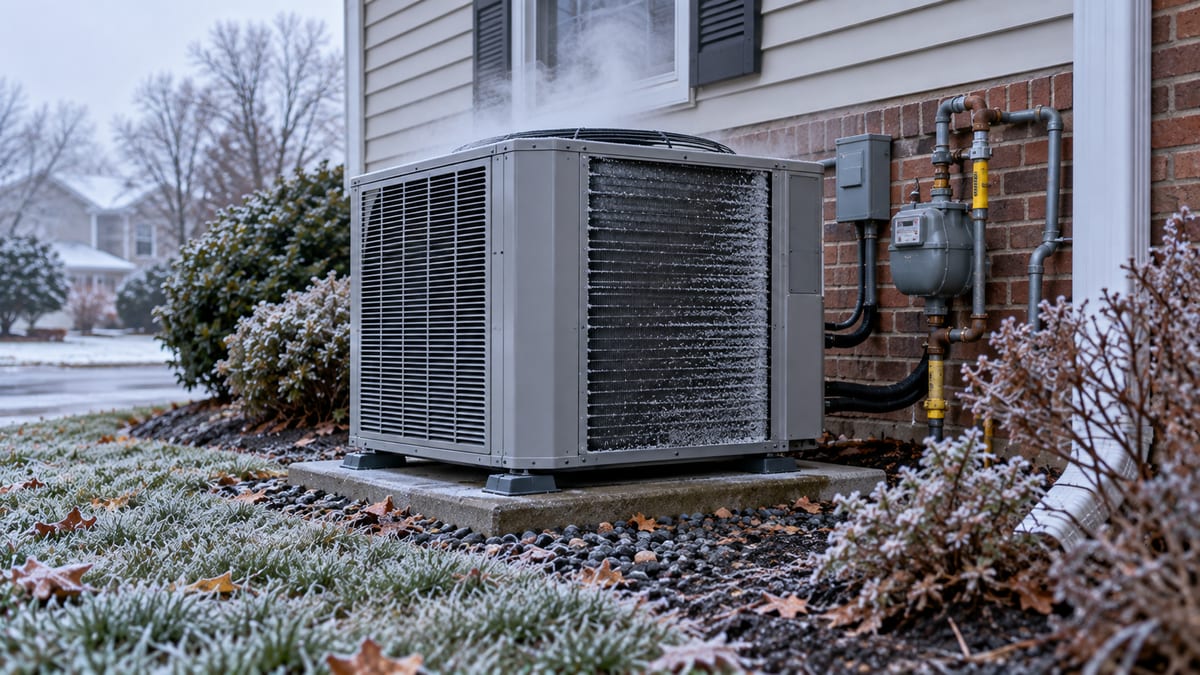
- Steam rising from the outdoor unit in winter. That is the defrost cycle melting frost off the coil. It usually lasts a few minutes.
- A whoosh or click when the system changes mode. That is the reversing valve shifting.
- Air from the vents that feels lukewarm. Heat pumps deliver air at roughly 90–100°F, cooler than a gas furnace's 120°F or more. It feels less hot against your hand but still heats the house — it simply runs longer to do it.
- A light coating of frost on the outdoor coil that clears every hour or so.
Faults — book a repair
- The outdoor unit is encased in ice and the ice does not clear. Likely causes are a failed defrost control or sensor, low refrigerant, a stopped outdoor fan, or water dripping onto the unit from a gutter.
- Cold air in heating mode for long periods — a stuck reversing valve, a refrigerant leak, or a failed compressor.
- "Aux heat" or "emergency heat" showing constantly in mild weather. The heat pump is not keeping up and expensive backup heat is doing the work. Electric bills rise sharply.
- Short cycling — starting and stopping every few minutes — from oversizing, a refrigerant problem or a thermostat fault.
- Grinding, rattling or a loud buzz from the outdoor unit, often a failing fan motor, contactor or capacitor.
- A sudden jump in the electric bill with no change in weather or use.
Before calling, it is worth checking three things yourself: that the filter is clean, that the thermostat is set to heat or cool (not emergency heat), and that the breakers for both the indoor and outdoor units are on. If a breaker has tripped, reset it once; if it trips again, leave it off and call. Our HVAC repair guide covers what a homeowner should and should not attempt.
Emergency heat: what that setting is for
"Emergency heat" on a heat pump thermostat locks out the heat pump and runs only the backup heat. It exists for when the outdoor unit has failed. Running it by choice is expensive — electric heat strips cost roughly two to three times as much per unit of heat as the heat pump itself. If you have switched to emergency heat because the house will not warm up, that is the moment to book a repair rather than a workaround. If the house is losing heat in freezing weather, our emergency HVAC service guide covers what to do first.
Heat Pump Maintenance: What a Proper Tune-Up Includes
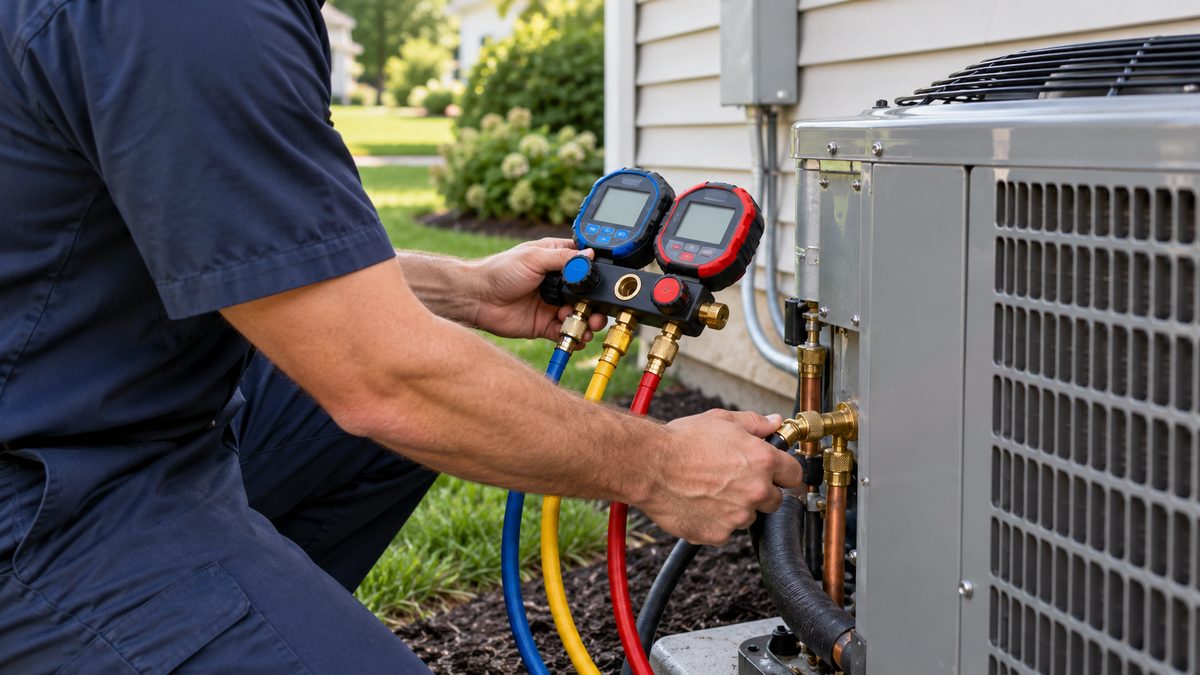
Heat pumps should be serviced twice a year — once in autumn before the heating season and once in spring before the cooling season — because, unlike a furnace or an air conditioner, the same equipment works through both. A proper visit records measurements, not just observations:
- Electrical — capacitor values against their rating, contactor condition, tightness of connections, voltage and amp draw on the compressor and fan motors.
- Refrigerant — charge verified by superheat or subcooling, and a check for oil stains that signal leaks.
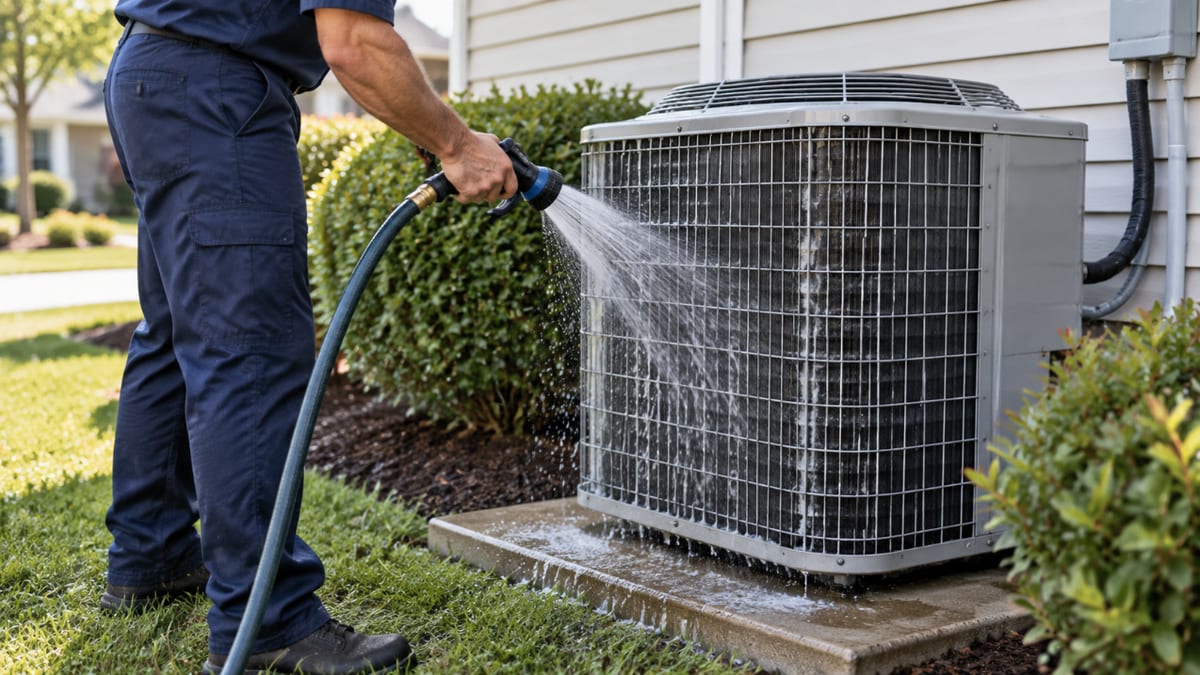
- Outdoor coil — cleaned and straightened; debris, leaves and grass cleared from around the base.
- Indoor coil, blower and filter — airflow and static pressure checked, filter replaced or inspected.
- Defrost test (autumn visit) — the cycle forced and confirmed to start and terminate correctly.
- Reversing valve — confirmed to shift cleanly in both directions.
- Auxiliary heat — heat strips or furnace backup tested and their staging confirmed.
- Condensate drain — cleared and the safety switch tested.
- Thermostat — settings for auxiliary heat lockout and, on dual fuel, the switchover temperature.
- A written record of readings, so next season's numbers can be compared.
Between visits, the homeowner's part is simple: change or clean filters every one to three months, keep 18–24 inches clear around the outdoor unit, and after a snowfall clear snow away from the sides and top. Outdoor units should sit on a raised pad or wall brackets so melting defrost water and snow drain away instead of refreezing around the coil. For how this fits into a full maintenance plan, see HVAC maintenance.
Heat Pumps in New Jersey Winters
The most common question we hear is whether a heat pump can actually heat a New Jersey home. The answer depends on the equipment. Older single-speed heat pumps lost much of their output in the 20s and relied heavily on backup heat. Modern cold-climate, variable-speed heat pumps are a different class of machine: they keep producing usable heat well below freezing, which covers almost all of a typical central New Jersey winter.
Three practical points help in cold weather:
- Do not use deep setbacks. Turning the thermostat down 8 degrees overnight and back up in the morning often triggers auxiliary heat during recovery, wiping out the savings. Small setbacks of 2–3 degrees, or none, usually cost less.
- Expect longer, steadier run times. A variable-speed heat pump running for hours at low speed is working as designed.
- Set the auxiliary heat lockout correctly. On a dual-fuel system, the outdoor temperature at which the furnace takes over is a setting your installer should choose using your electricity and gas rates — not left at the factory default.
Heat Pump Service Costs in New Jersey
Most heat pump repairs in New Jersey cost between $150 and $1,500, maintenance visits typically run $100–$200, and a new ducted heat pump costs about $5,000–$12,000 installed. These are orientation ranges consistent with our other cost guides; an exact price depends on the diagnosis or site survey.
| Service | Typical NJ range | Notes |
|---|---|---|
| Diagnostic / service call | $89–$150 | Often credited toward the repair |
| Maintenance visit (per season) | $100–$200 | Often included in a maintenance plan |
| Capacitor replacement | $150–$400 | The most common single failure |
| Contactor replacement | $150–$350 | Pitted contacts cause no-start or non-stop running |
| Defrost control board or sensor | $300–$700 | Fixes outdoor units that ice over |
| Refrigerant leak repair and recharge | $300–$1,500+ | Depends on leak location and refrigerant type |
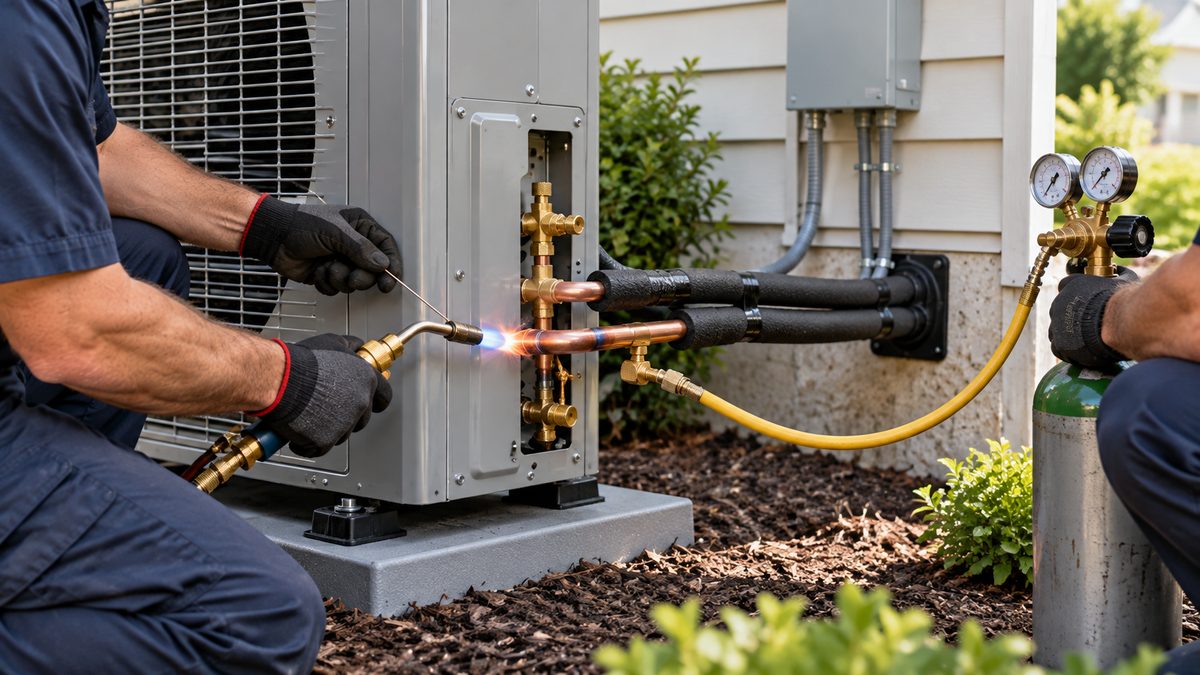
| Reversing valve replacement | $1,000–$2,500 | Labor-heavy: refrigerant recovery, brazing, evacuation |
| Compressor replacement | $1,200–$2,800+ | On older units, usually the point to compare with replacement |
| Ductless mini-split (single zone), installed | $3,500–$6,000 | Multi-zone systems cost more |
| Ducted heat pump, installed | $5,000–$12,000 | Cold-climate and variable-speed models at the upper end |
Repair or replace?
Heat pumps typically last 12–17 years. If yours is past about 10 years and needs a compressor or reversing valve — or still runs on R-22, which is no longer produced — replacement usually deserves a quote alongside the repair. A useful rule of thumb: multiply the repair cost by the age of the system in years; above about $5,000, replacement is usually the better use of money.
Rebates and incentives
Heat pumps remain the equipment most likely to qualify for incentives in New Jersey, through the NJ Clean Energy Program, utility efficiency programs and manufacturer promotions. The federal Section 25C tax credit for home HVAC equipment ended for equipment installed after December 31, 2025, so treat any older article quoting it with care. We help customers identify what currently applies — see current offers.
How to Choose a Heat Pump Service Company
- Do they work on heat pumps regularly? Ask how many they service each winter. Defrost and reversing-valve diagnosis is specific experience.
- Will they do a load calculation before quoting a new system, and check your ductwork?
- Are they licensed and insured in New Jersey, with EPA Section 608 certified technicians for refrigerant work?
- Do they record readings and give you a copy after maintenance?
- Is the price flat and written before work starts?
- Can they check your electrical capacity? Converting from gas or oil to a heat pump adds electrical load, and the panel should be checked as part of the quote. Our guide to electrical wiring services explains what that check involves.
Book Heat Pump Service With Guardian Air
Whether your heat pump is icing over, running on backup heat, due for its seasonal tune-up or ready to be replaced, Guardian Air's licensed technicians will diagnose it with instruments, explain what they find in plain language and give you a written price before any work starts.
Call (848) 276-6300 or book a visit. You can also read about heat pump installation and repair, ductless mini-splits, and our broader guide to HVAC service.