October 8, 2026
Ductless Mini Split Installation Cost in NJ (2026)
A ductless mini split installation in central NJ typically costs $3,500–$7,500 for one zone and $9,000–$22,000 for multi-zone. What drives the price, cold-climate models, installation day step by step, rebates and maintenance.
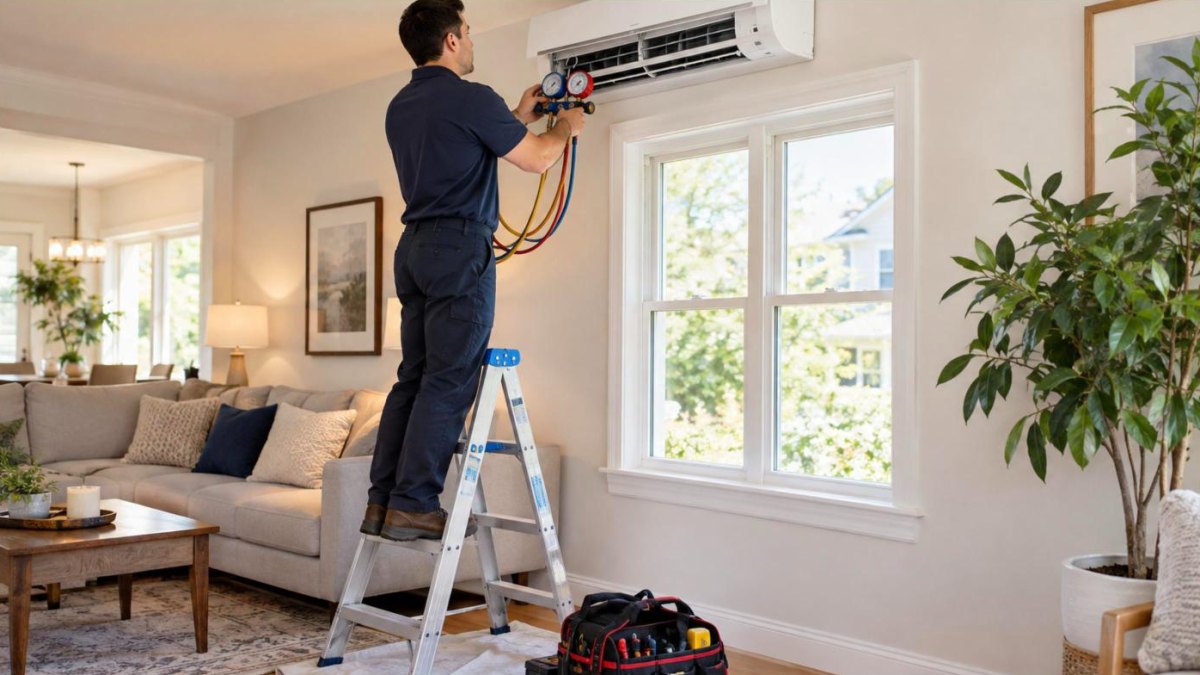
In central New Jersey, a ductless mini split installation typically costs about $3,500 to $7,500 for a single zone and $9,000 to $22,000 for a multi-zone system with two to five indoor heads. A standard 9,000–12,000 BTU wall unit in a simple location sits at the low end. Larger or cold-climate models, long line-set runs, ceiling cassettes and new electrical circuits push the price up. These are typical 2026 estimates, not quotes; the only reliable number for your home is an itemized estimate after someone has looked at the walls, the panel and where the outdoor unit will sit.
Written by the Guardian Air HVAC & plumbing team · Reviewed for accuracy October 2026
This guide explains what you are actually paying for, how per-zone pricing works, which cold-climate models make sense for New Jersey winters, how installation day goes step by step, and where a mini split is the wrong choice. If you already know you want one, our ductless mini split installation service page covers the indoor unit styles we install and how to book a free written estimate.
Ductless Mini Split Installation Cost at a Glance
Mini split pricing is easiest to understand per zone. A "zone" is one indoor unit (a head) serving one room or open area, with its own thermostat. A single-zone system pairs one outdoor unit with one head. A multi-zone system runs two to five heads off one larger outdoor unit.
| Configuration | Typical 2026 installed price in central NJ |
|---|---|
| Single-zone, one wall head (9,000–12,000 BTU), simple install | $3,500–$6,000 |
| Single-zone, larger or cold-climate model (15,000–24,000 BTU) | $5,500–$7,500 |
| Multi-zone, 2 heads | $9,000–$12,500 |
| Multi-zone, 3 heads | $11,500–$16,000 |
| Multi-zone, 4–5 heads | $15,000–$22,000 |
Rough per-zone arithmetic follows from that table: the first zone carries the outdoor unit, the electrical circuit and the permit, so it is the expensive one. Each additional head on a multi-zone system usually adds somewhere around $2,500 to $4,500, depending on the head style and how far its line set has to travel. That is also why two or three separate single-zone systems can price close to one multi-zone system, a choice we come back to below.
These ranges are consistent with the ductless section of our broader heat pump cost guide, which also prices ducted and dual-fuel systems if you are comparing options for the whole house.
What Drives the Cost of a Mini Split Installation
When two quotes for "the same mini split" differ by a few thousand dollars, the difference is almost always in the items below rather than in the brand. A good estimate lists each one, even when it comes to zero on your job.
Capacity (BTU) and number of zones
Equipment cost rises with capacity and with the number of heads. A 9,000 BTU head for a bedroom costs less than an 18,000 BTU head for an open living area, and a five-port outdoor unit costs much more than a single-zone condenser. Efficiency tier matters too: a higher SEER2 (cooling) and HSPF2 (heating) rating usually means a variable-speed inverter compressor with a wider operating range, and a higher price.
Line-set length and routing
The line set is the pair of insulated copper refrigerant lines, plus the communication/power cable and condensate drain, that connects each head to the outdoor unit. It is the single biggest labor variable. On a ranch house where the head sits on an exterior wall and the condenser is right outside, the run can be a few feet straight through the wall. On a two-story colonial, getting lines to a second-floor bedroom neatly usually means running them down the outside wall in a paintable line-hide cover, or through closets and attic space. Every manufacturer lists a minimum and maximum line length and a maximum height difference; longer runs can also need extra refrigerant added on site.
Indoor unit style: wall, ceiling cassette or ducted air handler
- High-wall heads are the most common and least expensive. They mount on a bracket high on a wall and need roughly a three-inch hole behind them.
- Ceiling cassettes sit flush in the ceiling and throw air in several directions. They look tidier in finished rooms but need joist space above, framing, and more labor to hang and drain.
- Floor consoles sit low on a wall, which suits knee walls in Cape Cod upstairs rooms and spaces under windows.
- Concealed (slim) ducted air handlers hide in an attic, soffit or closet and feed short duct runs to one or several rooms. They cost the most per zone but leave only grilles visible.
Electrical circuit and panel capacity
Almost every outdoor unit needs a dedicated 240V circuit and a service disconnect within sight of the unit. On a typical job that is a few hundred to around $1,200 in electrical work. The bigger question is whether the panel has room. Plenty of homes in older Middlesex and Monmouth neighborhoods still have 100-amp service with every slot used; adding a large multi-zone condenser to that panel may need a subpanel or a service upgrade, which can run $2,500 to $5,000 and involves your utility. We check the panel on the first visit so this never appears as a surprise on installation day.
Condensate drainage
Every indoor head produces water when it cools, and the outdoor unit sheds meltwater during winter defrost. Where the head is on an exterior wall, the drain usually runs by gravity out with the line set. Interior walls, basements and ceiling cassettes often need a small condensate pump, typically $75 to $450 installed, plus a safe place to discharge the water.
Mounting pad or wall bracket
The outdoor unit sits on a pad, a raised stand or a wall bracket, usually $150 to $700. In our area we favor raised stands or brackets: they keep the coil above drifting snow, stop defrost water from freezing into an ice block under the unit, and, in shore towns, lift it above minor flooding.
Permits and inspection
A new mini split in New Jersey is construction work under the Uniform Construction Code, administered by your town's construction office. Expect a mechanical and an electrical permit on most jobs, typically $100 to $600 combined depending on the municipality. The NJ Division of Codes and Standards publishes the rules and permit forms. A contractor who offers to skip the permit is offering you an uninspected 240V installation.
Cold-Climate Mini Split Heat Pumps for New Jersey Winters
Every ductless mini split sold today is a heat pump: it cools in summer and heats in winter by reversing the refrigerant flow. What differs is how well it heats when it is cold outside. Standard models lose capacity quickly as the temperature falls, while cold-climate models are designed to keep delivering most of their rated heat well below freezing.
For ENERGY STAR's cold-climate designation, a ductless unit must reach at least 8.5 HSPF2, a coefficient of performance of at least 1.75 at 5°F, and at least 70% of its rated heating capacity at 5°F. The NEEP cold-climate air-source heat pump list, maintained with AHRI, lets you look up a specific model's capacity and efficiency at 5°F and 17°F, which is the data we use when sizing a system for heat.
Central New Jersey's winter design temperature sits in the low-to-mid teens Fahrenheit, with occasional colder nights. In practice that means:
- If the mini split is supplemental, for example cooling a hot upstairs and taking the edge off shoulder-season mornings while a boiler or furnace carries the winter, a standard high-efficiency model is usually enough.
- If the mini split will be the main heat for an addition, a converted garage or a house coming off oil or electric baseboard, we specify a cold-climate model and size it to the room's heat loss at design temperature, not to its summer cooling load. Expect cold-climate equipment to add to the price, which is why those systems sit in the upper rows of the table above.
Heating performance is also where outdoor placement matters. A head that heats well on paper still struggles if its condenser is buried in a snowdrift or tucked where defrost water can't drain. If you are weighing a mini split against keeping or replacing fossil-fuel heat, our heat pump vs furnace comparison runs the NJ operating-cost math, and our heat pump installation page covers ducted options.
Sizing Basics: How Many BTUs per Room?
Mini split heads commonly come in 6,000, 9,000, 12,000, 15,000, 18,000 and 24,000 BTU sizes. Rules of thumb based on square footage give a starting point, but they ignore the things that actually set the load: window area and orientation, insulation, ceiling height, air leakage and whether the room is over an unheated garage or under a hot attic.
On a site visit we measure each room and look at exactly those factors, ideally running an ACCA Manual J load calculation. Two errors are common in the homes we see:
- Oversizing. A head that is too big for a small bedroom reaches the set point fast and cycles, which removes less humidity in July and makes the room feel clammy. Inverter units modulate down, but only so far.
- Sizing for cooling when heating is the real job. In New Jersey, a room's heat loss on a January night is often larger than its heat gain in August. If the unit is meant to heat, size it for that.
Multi-zone systems add another wrinkle. The outdoor unit has a minimum output, and when only one small head is calling, it may not be able to turn down far enough. For whole-home heating we often recommend several single-zone systems, or a ducted cold-climate system, rather than one large multi-zone condenser for that reason. Separate systems also mean one failure does not take every room offline.
Choosing the Mini Split Installation Location
Where each piece goes affects comfort, noise, maintenance and cost. On a walk-through we check:
- Indoor head position. High on a wall where air can travel the length of the room, not blowing directly on a bed or a desk, and not above a TV or bookshelf that blocks airflow. ENERGY STAR's guidance on ductless systems also stresses considering heat rise and airflow patterns.
- What is inside the wall. Studs, wiring, plumbing vents and, in older homes, plaster and lath that cracks if drilled carelessly.
- Outdoor unit clearance. Clear airflow away from shrubs and fences, room to service it, and not right beside a bedroom window or a neighbor's patio, since even quiet condensers make some noise.
- Drainage. Where defrost water will go in winter, so it does not freeze on a walkway or a driveway.
- Snow and water. In shore towns we check flood exposure; everywhere we raise the unit above typical snow depth.
Installation Day, Step by Step
A single-zone install is usually finished in one day. Multi-zone jobs with several heads or interior line-set routing typically take one to three days. Here is how a properly done install goes:
- Protect and lay out. Drop cloths down, furniture moved, and the exact head and condenser locations marked and confirmed with you before any drilling.
- Mount the indoor bracket and drill the wall. The mounting plate is leveled and anchored to framing, then a roughly three-inch hole is cored through the wall with a slight downward slope to the outside so condensate drains by gravity.
- Set the outdoor unit. The pad, stand or wall bracket goes in level, with the unit isolated so vibration does not carry into the house.
- Run the line set. Copper lines, communication cable and drain are routed from head to condenser, with gentle bends rather than kinks, insulation intact on both lines, and exterior runs covered with line-hide where you want a finished look.
- Make the flare connections. Each copper end is cut square, deburred and flared with a proper flaring tool, then tightened to the manufacturer's torque value with a torque wrench. Flare joints that are guessed at, rather than torqued, are one of the most common sources of slow leaks we find on mini splits installed by others.
- Pressure test with nitrogen. The line set and indoor coil are pressurized with dry nitrogen and held to confirm there are no leaks before any refrigerant is released into them.
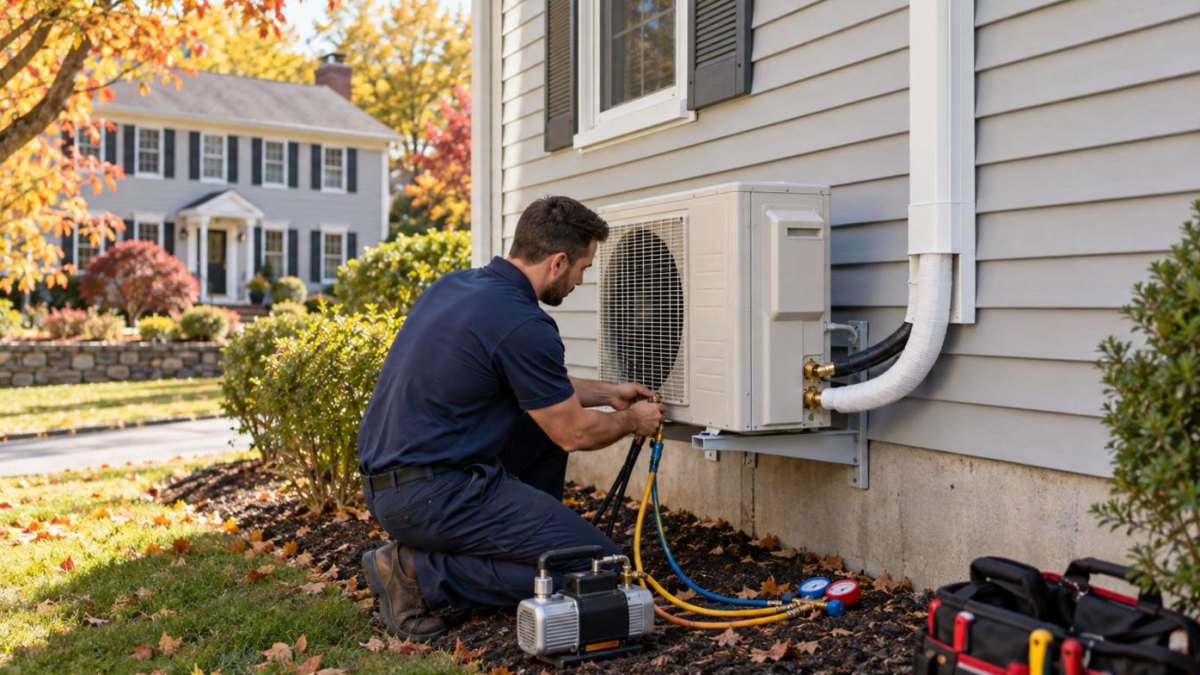
- Evacuate with a vacuum pump. A vacuum pump pulls the system down, measured with a micron gauge, to remove air and moisture. We then isolate the pump and watch that the vacuum holds; a reading that creeps back up points to a leak or remaining moisture. Skipping this step leaves moisture that can damage the compressor over time.
- Release and adjust the charge. The service valves are opened to release the factory charge held in the outdoor unit. If the line set is longer than the length that charge covers, refrigerant is added by weight per the manual.
- Electrical and controls. The dedicated circuit and disconnect are connected, the communication wiring terminated, and the remote or wall controller set up.
- Commission and walk through. We run the system in cooling and heating, check temperatures and drainage, confirm the condensate pump (if any) trips its safety switch, then show you how to use the modes and clean the filters. The inspection is scheduled with the town afterward.
DIY Mini Split Kits: An Honest Warning
"DIY" mini split kits with pre-charged, quick-connect line sets are sold online for much less than an installed system. We understand the appeal, and some homeowners do get them running. Before you buy one, weigh these points:
- Warranty. Many manufacturers limit or void the warranty on standard units unless a licensed contractor installs them, and even DIY-branded kits often have registration and installation conditions. Read the warranty terms before purchase, not after a compressor fails.
- Refrigerant rules. Under Section 608 of the Clean Air Act, the EPA prohibits intentionally venting refrigerants and their substitutes, and work that opens a refrigerant circuit is for certified technicians. Quick-connect kits are designed to avoid opening the circuit, but trimming a line, fixing a leak or adding charge for a longer run puts you outside what you can legally do yourself.
- Licensing and permits. In New Jersey, HVAC installation for hire requires a licensed HVACR contractor, and the electrical circuit is work your construction office will want permitted and inspected. Check with your town before assuming a homeowner exemption covers the job.
- Electrical risk. A 240V circuit wired wrong is a fire risk, and it is the part of a DIY install most likely to be done poorly.
- Newer refrigerants. Many current mini splits use A2L refrigerants such as R-32, which are mildly flammable and come with specific installation requirements.
If you do go the DIY route, at minimum have a licensed electrician run and permit the circuit. If the cost of a full professional install is the obstacle, ask about our current HVAC offers and financing before deciding.
Rebates for Ductless Mini Splits in NJ
The federal heat pump tax credit (Section 25C) ended for equipment placed in service after December 31, 2025, so a mini split installed in 2026 does not qualify. Incentives in New Jersey now run mainly through the utilities, which the state's New Jersey Clean Energy Program site points to.
As one example, JCP&L's HVAC rebate program, which covers most of Monmouth and Ocean counties, listed a $750 rebate for qualifying ENERGY STAR ductless mini splits when we checked in October 2026, with minimums of 17.1 SEER2, 11.7 EER2 and 7.8 HSPF2. PSE&G and other utilities run their own programs. Amounts and requirements can change during a program cycle, so confirm the current terms with your utility before you sign, and make sure the exact indoor and outdoor model combination on your quote meets them.
Ductless Mini Split vs Central AC
The most common question we get on site is whether a mini split or a central system makes more sense. The answer usually depends on whether the house already has usable ductwork.
| Factor | Ductless mini split | Central AC (ducted) |
|---|---|---|
| Best fit | Homes without ducts, additions, finished attics, garages, single hot rooms | Homes with existing, well-sized ductwork |
| Typical installed cost | $3,500–$7,500 per single zone; $9,000–$22,000 multi-zone | See our AC replacement cost guide |
| Duct losses | None; air is delivered in the room | Can be significant when ducts run through hot attics |
| Heating | Yes, every mini split is a heat pump | No, unless the outdoor unit is a heat pump |
| Zoning | Each head has its own control | One thermostat unless zoning dampers are added |
| Appearance | Visible head in each room (cassettes and ducted heads less so) | Only grilles visible |
| Upkeep | Filter and coil cleaning in every head | One filter; coil and condenser service |
| Installation disruption | Small wall openings, usually one day per zone | Minimal on a replacement; major if ducts must be added |
If your ducts are in good shape, a central system or a ducted heat pump is usually the better whole-house value; our AC installation team can quote both. If you have no ducts, or one area that the central system never keeps comfortable, ductless is often the cheaper and better-performing fix.
Ductless Mini Split Maintenance
Mini splits are low-maintenance, not no-maintenance. Neglected heads are one of the most common service calls we see, usually for weak airflow, odors or water dripping down the wall.
- Every few weeks in heavy use: rinse the washable filters in each head and let them dry before reinstalling.
- Seasonally: keep leaves, grass clippings and snow clear of the outdoor unit, and make sure defrost water can drain away.
- Once a year (professional): clean the indoor coil and blower wheel, flush and test the condensate drain and any pump, check the outdoor coil, verify electrical connections and confirm the system is heating and cooling to spec.
The blower wheel deserves a special mention. In a humid New Jersey summer, a dirty wheel can grow mold and slime that a filter rinse never reaches, which is why a professional cleaning matters even when the filters look clean. Our HVAC maintenance guide covers what a full service visit should include.
How We Price a Mini Split Job
We would rather you understand our quote than be surprised by it. A Guardian Air estimate for a ductless system is written, itemized and fixed before work starts, and it shows:
- The exact indoor and outdoor model numbers, with their SEER2 and HSPF2 ratings, so you can check rebate eligibility yourself.
- Each head's size and location, and how each line set will be routed and covered.
- Electrical work, including whether your panel can carry the new load.
- Condensate pumps, pads or brackets, and any patching or line-hide.
- Permits and inspection.
What raises a quote is usually access rather than equipment: second- and third-floor heads, long or interior line-set runs, plaster walls, a full panel, or a condenser location that needs a wall bracket. What lowers it is a back-to-back install on an exterior wall with the panel nearby. If a competing quote is far lower, compare it line by line; missing permits, an untorqued flare connection or a skipped vacuum test are not visible on installation day, but they show up later.
When a Mini Split Is Not the Right Answer
- You have good ductwork and want the whole house conditioned evenly. A ducted system usually costs less per square foot and keeps equipment out of sight.
- The house has many small, closed-off rooms. Heating or cooling each one well can take more heads than the budget supports.
- You need significant fresh-air ventilation or whole-house filtration. Mini split heads recirculate room air; they don't replace ventilation.
- The panel can't take the load and a service upgrade isn't worth it for the space you are conditioning.
- Appearance is a deal-breaker and the budget doesn't stretch to ceiling cassettes or concealed ducted heads.
In those cases we will say so, and quote the alternative instead.
Mini Split Installers in Old Bridge, Freehold and Across Central NJ
We install single-zone and multi-zone ductless systems throughout Monmouth, Middlesex and Ocean counties. Mini splits are especially popular in the split-levels and older homes around Old Bridge, where many houses were built with baseboard or hot-water heat and no ducts, and in the colonials and farmhouses around Freehold, where a cooled-down upstairs bedroom is the most common request. When you are comparing mini split installers, ask each one how they size the system, whether they pressure test and pull a vacuum with a micron gauge, whether the permit is included, and what the written warranty covers.
Sources
- ENERGY STAR: Ductless heating and cooling
- ENERGY STAR: Air-source heat pump key product criteria (cold climate)
- NEEP: Cold Climate Air Source Heat Pump List
- U.S. EPA: Section 608 of the Clean Air Act
- NJ Department of Community Affairs: Division of Codes and Standards
- JCP&L: Residential HVAC rebates
- New Jersey Clean Energy Program
- U.S. Department of Energy: Heat pumps
About Guardian Air
Guardian Air is a licensed New Jersey HVAC and plumbing contractor serving Monmouth, Middlesex and Ocean counties. We install, repair and maintain ductless mini splits, heat pumps, central air, furnaces and water heaters, with written, itemized estimates. Learn more about our team, or contact us or call (848) 276-6300 to schedule a free mini split estimate.