October 9, 2026
Tankless vs Tank Water Heater: Costs, Pros & Cons for NJ Homes
Tankless vs tank water heater for New Jersey homes: real installed and running costs, how to size tankless for cold winter water, gas line, venting and panel realities, descaling, and the cases where a storage tank is still the smarter buy.
By Noor Kamal, Technology Manager · Published · Updated
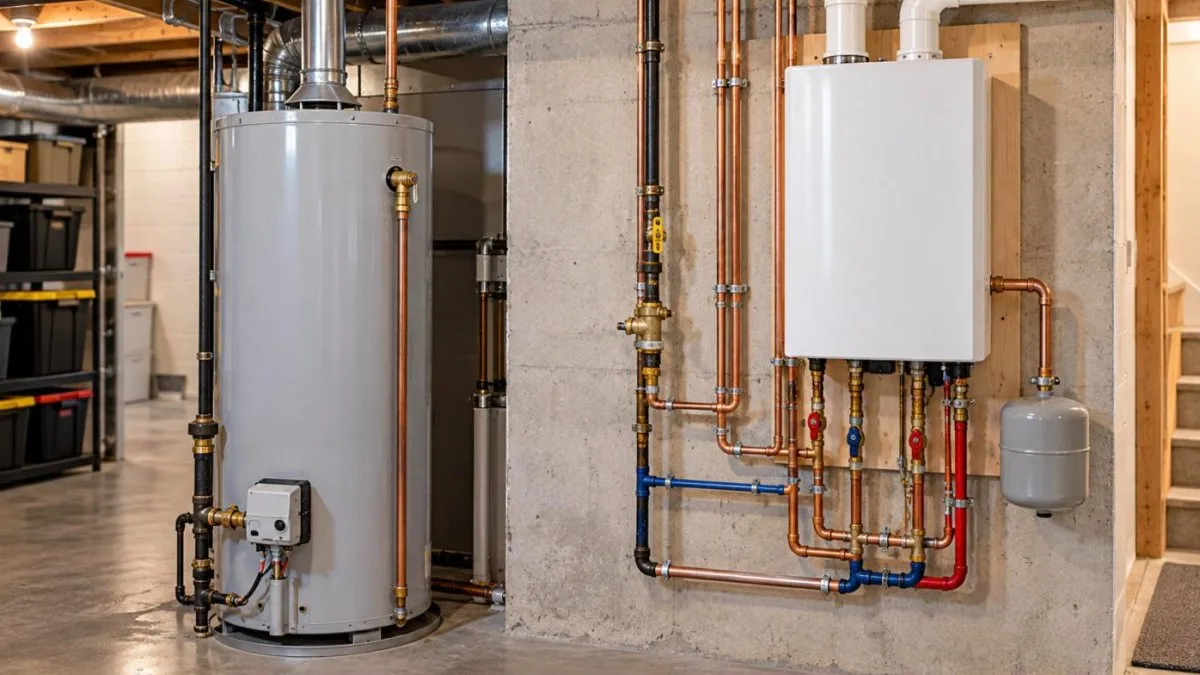
Tankless vs tank water heater, in one paragraph: a standard gas tank costs about $1,900 to $3,500 installed in central New Jersey, lasts roughly 8 to 12 years and runs about $280 a year on gas. Converting to a condensing gas tankless unit typically costs $3,500 to $6,500, can last 20 years or more with annual descaling, and runs about $180 a year. Tankless wins on endless hot water, space and lifespan. A tank wins on upfront cost, simplicity and tolerance of neglect.
Written by the Guardian Air HVAC & plumbing team · Reviewed for accuracy October 2026
Which one is right depends less on the brochure and more on your house: the size of your gas line, where the vent can go, how much amperage your panel has, how hard your water is, and how your family actually uses hot water. This guide walks through how each type works, what each really costs to install and run in New Jersey, how we size a tankless unit for a January morning, and the cases where we tell people to stick with a tank. For a full breakdown of every water heater type's price, see our water heater replacement cost guide.
How a Storage Tank Water Heater Works
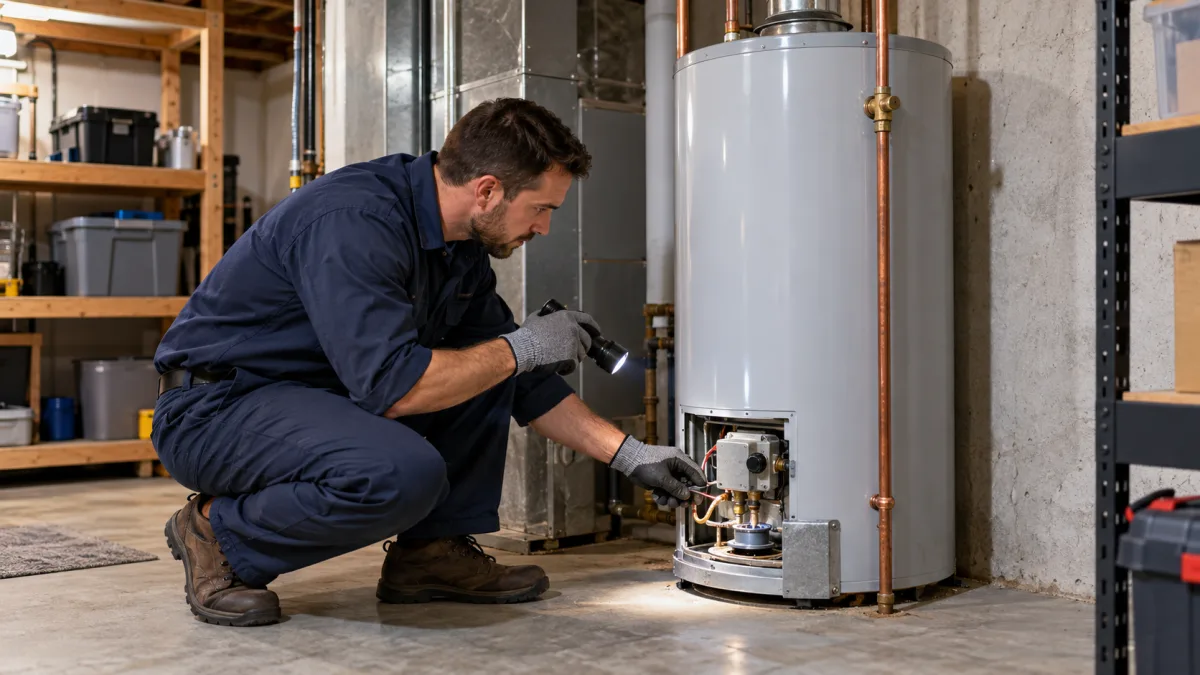
A storage tank water heater keeps 40 to 80 gallons of water hot around the clock. Cold water enters near the bottom, a gas burner or electric elements heat it, and hot water leaves from the top. The burner fires whenever the tank cools below its setpoint, including overnight. Reheating water that is just sitting there is called standby loss, and it is the main reason a tank uses more energy than a tankless unit for the same hot water delivered.
The tank's strengths are simplicity and surge capacity: several taps can open at once because the hot water is already made. Its limit is the first-hour rating on the EnergyGuide label. Once that volume is used, recovery takes time and the last shower goes lukewarm. Most homes we work in across Monmouth, Middlesex and Ocean counties have a 40- or 50-gallon atmospheric gas tank in the basement venting into a chimney or B-vent; electric tanks are common in shore homes and anywhere without gas.
How a Tankless (Instant) Water Heater Works
A tankless water heater, also sold as an instant or on-demand water heater, stores no hot water. When you open a hot tap, a flow sensor fires a modulating gas burner or switches on electric elements, and water is heated as it passes through a compact heat exchanger. The Department of Energy's Building America measure guideline on transitioning to tankless notes a 1–3 second delay before the burner lights and a minimum flow, typically 0.4 to 0.9 gallons per minute, before it fires at all.
That design gives you endless hot water and no standby loss, but it swaps a volume ceiling for a flow ceiling: a tankless unit runs short when too many fixtures open at once, especially in winter. A trickle at the sink may not trigger the burner, and quick on-off-on use can send a brief slug of cold water, which the DOE guideline calls the "cold water sandwich." If an existing heater has stopped delivering hot water altogether, our no hot water troubleshooting guide covers what to check first.
Condensing gas units add a second stainless heat exchanger that captures exhaust heat, reach the highest ratings and vent through plastic pipe. Non-condensing units cost less, run less efficiently and need stainless venting. Almost every conversion we quote is condensing.
Tankless vs Tank Water Heater: Side-by-Side Comparison
| Gas storage tank (40–50 gal) | Condensing gas tankless | Electric tankless (whole house) | |
|---|---|---|---|
| Typical installed price, central NJ (2026 estimate) | $1,900–$3,500 (atmospheric) | $3,500–$6,500 as a conversion | $2,000–$4,500+, before any service upgrade |
| Typical UEF | ~0.60–0.70 | 0.95 and up (ENERGY STAR minimum) | ~0.98–1.00 |
| Approx. NJ running cost per year* | ~$280 | ~$183 | ~$800 |
| Typical lifespan | 8–12 years | 20+ years with descaling | Long element life; scale still matters |
| Hot water limit | Runs out after first-hour volume | Never runs out, but flow is capped | Low winter flow; often one shower at a time |
| Venting | Chimney or B-vent (atmospheric) | PVC/CPVC or polypropylene to wall or roof | None |
| Gas or electric supply | Usually a 1/2-inch gas branch | Typically a new 3/4-inch line or larger | Roughly 110–150 A at 240 V for whole-house units |
| Annual maintenance | Flush sediment; check anode every few years | Descale heat exchanger; clean inlet filter | Descale; check connections |
| Floor space | About a 2-foot circle plus clearance | Wall-hung, suitcase-sized | Wall-hung, smaller still |
| How it usually fails | Tank rusts through and leaks | Stops heating; error code | Stops heating |
*Running costs use the same assumptions as our replacement cost guide: 55 gallons a day heated from 58°F to 125°F, New Jersey's 2026 residential electricity price of about 23.98¢ per kWh from the EIA Electric Power Monthly, and about $1.55 per therm for natural gas based on EIA's New Jersey residential gas prices from July 2025 to June 2026. They are estimates; your rates and habits will differ.
Tankless Water Heater Cost vs Tank: Upfront Prices
The unit is the smaller part of a tankless water heater installation cost. In a house that has always had a tank, a conversion usually adds a larger gas line, new PVC venting through a wall or roof, a condensate drain (often with a neutralizer so the mildly acidic water doesn't eat cast-iron pipe), isolation valves for descaling, a 120V outlet, and the permit.
That is why our typical range for a condensing gas tankless conversion is $3,500 to $6,500, against $1,900 to $3,500 for a like-for-like atmospheric gas tank and $1,800 to $3,000 for an electric tank. Replacing an existing tankless unit, where the gas line and vent are already right, usually costs well below the conversion price. Electric tankless looks cheap at $2,000 to $4,500+, but that assumes your panel can carry it.
How we price, and what affects your quote
We don't quote a tankless conversion over the phone, because the variables that swing the price are on site: the gas run from the meter and how much finished ceiling is in the way, the total connected gas load (furnace, range, dryer, generator), whether a sidewall vent meets clearances or we must go through the roof, where condensate can drain, whether your water hardness calls for a softener or scale filter, and whether removing the tank leaves the furnace alone in an oversized chimney. Every quote lists those lines separately, even the ones that come to zero. Current promotions are on our offers page.
Operating Cost and UEF: What Each One Costs to Run
Water heater efficiency is rated as a Uniform Energy Factor (UEF), the DOE test-procedure number on every EnergyGuide label. ENERGY STAR explains that a higher UEF means a more efficient water heater. To earn the label, a gas tankless unit must meet the ENERGY STAR key product criteria: a UEF of at least 0.95, at least 2.8 gallons per minute over a 67°F rise, and a warranty of at least 6 years on the heat exchanger and 5 on parts.
| Water heater | UEF used | Energy per year | Approx. cost per year (NJ) |
|---|---|---|---|
| Electric tank | 0.92 | ~3,570 kWh | ~$857 |
| Electric tankless | 0.98 | ~3,350 kWh | ~$803 |
| Gas tank, atmospheric | 0.62 | ~181 therms | ~$280 |
| Gas tankless, non-condensing | 0.82 | ~137 therms | ~$212 |
| Gas tankless, condensing | 0.95 | ~118 therms | ~$183 |
| Heat pump water heater | 3.0 | ~1,100 kWh | ~$263 |
The method: about 11.2 million BTU of heat delivered per year, divided by UEF, times the fuel price. Going from a gas tank to condensing gas tankless saves roughly $100 a year at this load. Electric tankless barely beats an electric tank, about $54 a year here; the DOE guideline puts the best case at about 12%, because an electric tank already turns nearly all its electricity into heat. The big electric win is a heat pump water heater.
What about over the full life of the heater?
On the price gap alone, payback looks long: $2,500 extra saving $100 a year is 25 years. Lifespan changes that. Over 20 years a tank owner typically buys two tanks; a well-maintained tankless owner buys one. At the midpoints of our ranges in today's dollars, that's about $5,400 in tanks plus $5,600 in gas, against about $5,000 for the conversion plus $3,700 in gas: tankless ahead by roughly $2,300 before maintenance. Pay a plumber to descale every year and most of that gap disappears; do the flush yourself and it largely survives. Honestly framed, gas tankless is a comfort and space choice that roughly pays for itself over a full life, not a money-maker.
Sizing a Tankless Water Heater for New Jersey Winters
This is where most disappointing tankless installs go wrong. A tank is sized in gallons; a tankless unit is sized by flow rate in gallons per minute (GPM) at your coldest temperature rise. The DOE guideline's method: find the coldest incoming water temperature, set the output temperature, add up the fixtures likely to run at once, and pick a unit whose flow table covers that GPM at that rise.
Winter inlet temperature and rise
Incoming water is coldest in late winter, and reservoir and river supplies cool off more than deep wells. On winter calls in central New Jersey we commonly find water entering in the 40s or low 50s °F, against the 60s in summer. With 45°F water and a 120°F setpoint the unit must add 75°F; in August it may only need 55°F. That is why a tankless heater that felt endless in summer can struggle in February. If your utility doesn't publish a minimum supply temperature, a thermometer on the cold tap after a minute's run in February tells you.
Peak demand and matching the unit
A shower doesn't use only hot water. At 105°F at the head, with 45°F cold and 120°F hot, about 80% of the flow is hot, so a 2.0 GPM showerhead draws about 1.6 GPM from the heater. Two showers at once need roughly 3.2–4.0 GPM; add a dishwasher or warm-wash laundry and you're near 4.5–5.5 GPM. A large soaking tub filling at 4 GPM or more is the biggest sizing trap we see.
Output is roughly BTU per hour ÷ (500 × temperature rise). A common 199,000 BTU gas unit at 95% efficiency delivers about 189,000 BTU, or about 5.0 GPM at a 75°F rise: two showers and a dishwasher. A 27 kW electric unit delivers about 92,000 BTU, or roughly 2.5 GPM: one shower in January. Homes with three or more full baths or a big tub may need two linked units.
Gas Line Sizing and Venting for a Gas Tankless Water Heater
A 40- or 50-gallon gas tank burns roughly 35,000 to 40,000 BTU per hour. A whole-house tankless unit is commonly rated near 199,000. The DOE guideline is blunt that the fuel requirement "may necessitate a larger gas line" and that in most cases the in-house line serving the unit "will need to be ¾ in. diameter." On an install we add up the connected load of every gas appliance, size the pipe from the fuel gas code tables for that load and run length (long runs in older ranch homes often need 1-inch pipe for part of the trunk), check whether the meter can carry the new total, and test pressure with everything firing at once. A unit starved at full fire throws error codes and delivers lukewarm water on the busiest morning of the week.
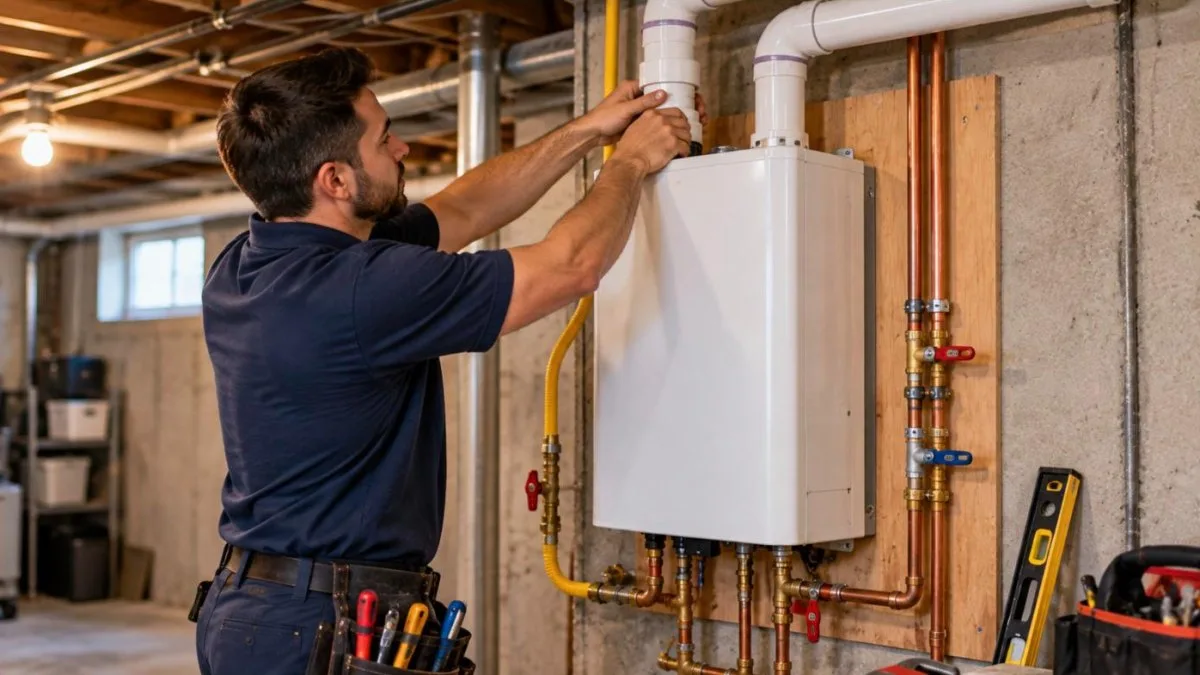
Venting. A condensing unit's exhaust is cool enough to run in PVC, CPVC or polypropylene, whichever the manufacturer lists, and it never goes into the old masonry chimney. Most installs use two pipes (exhaust and outdoor combustion air) or a concentric kit that runs both through one wall or roof penetration. The termination must meet manufacturer and code clearances from windows, doors, air intakes, the gas meter and regulator, and grade, and we keep it above the expected snow line so a drift can't shut the unit down in a storm. Non-condensing units need Category III stainless vent, one reason we rarely recommend them for conversions.
Condensate and the old chimney. The mildly acidic condensate needs a path to a floor drain, laundry tub or pump, usually through a neutralizer. And if the tank shared a chimney with an atmospheric furnace or boiler, removing it changes how that appliance drafts; our water heater cost guide explains this orphaned-chimney problem.
Electric Tankless Water Heaters: The Amperage Reality
Electric tankless water heaters need no vent, no gas and no condensate drain, which makes them look simple. The catch is power. The DOE guideline notes that most electric tankless units run on 208 or 240 volts and draw 50 to 200 amps depending on size, often on multiple dedicated circuits. A 27 kW unit draws about 112 amps at 240 volts; a 36 kW unit, about 150 amps.
Many older central Jersey homes still have 100-amp service, and newer 150- or 200-amp panels are often already committed to central air, an electric range, a dryer and an EV charger. Adding that much water heating usually means a load calculation, a service upgrade and coordination with JCP&L or PSE&G. The DOE guideline warns a whole-house electric unit "may be cost prohibitive" in cold regions. Where electric tankless shines is point-of-use: a small unit under a sink in a far-off bathroom or basement bar. For whole-house electric water heating, a heat pump water heater is usually the better tool.
The Third Option: Heat Pump (Hybrid) Water Heaters
If you have an electric tank and no gas, the real comparison is tank vs heat pump water heater: a storage tank with a small heat pump on top that pulls heat from the surrounding air. The federal Energy Management Program's purchasing guidance estimates an ENERGY STAR model costs about $97 a year to run nationally versus $340 for a standard electric tank; at New Jersey prices our table shows about $263 versus $857. ENERGY STAR says they need a space between 40°F and 90°F year-round with roughly 1,000 cubic feet of air, which a typical unfinished New Jersey basement provides. Our typical installed range is $3,200 to $5,500 before rebates, and JCP&L's appliance rebate program lists $750 for an ENERGY STAR certified unit. For space heating with the same technology, see our heat pump cost guide.
Lifespan and Tankless Water Heater Maintenance
The DOE guideline puts tankless lifespan at up to 20 years, against 10 to 15 for tanks. Locally, the tanks we replace usually reached 8 to 12 years; well-maintained tankless units routinely pass 20. The word doing the work there is maintained.
Why scale matters more in a tankless unit
Hard water deposits calcium and magnesium scale when heated. In a tank it mostly settles at the bottom. In a tankless unit, the guideline explains, scale builds inside narrow heat-exchanger passages, restricting flow, cutting efficiency and shortening the unit's life. Manufacturers may require a softener once hardness exceeds about 8 to 14 grains per gallon (136 to 239 ppm), and recommended flushing intervals range from twice a year to every three years.
Hardness varies widely across Monmouth, Middlesex and Ocean counties, between towns and between public systems and private wells, so we don't guess. Your supplier's annual Consumer Confidence Report lists it, and well owners can test. That number decides whether a scale-reduction cartridge or softener belongs on the quote.
What a descaling visit involves
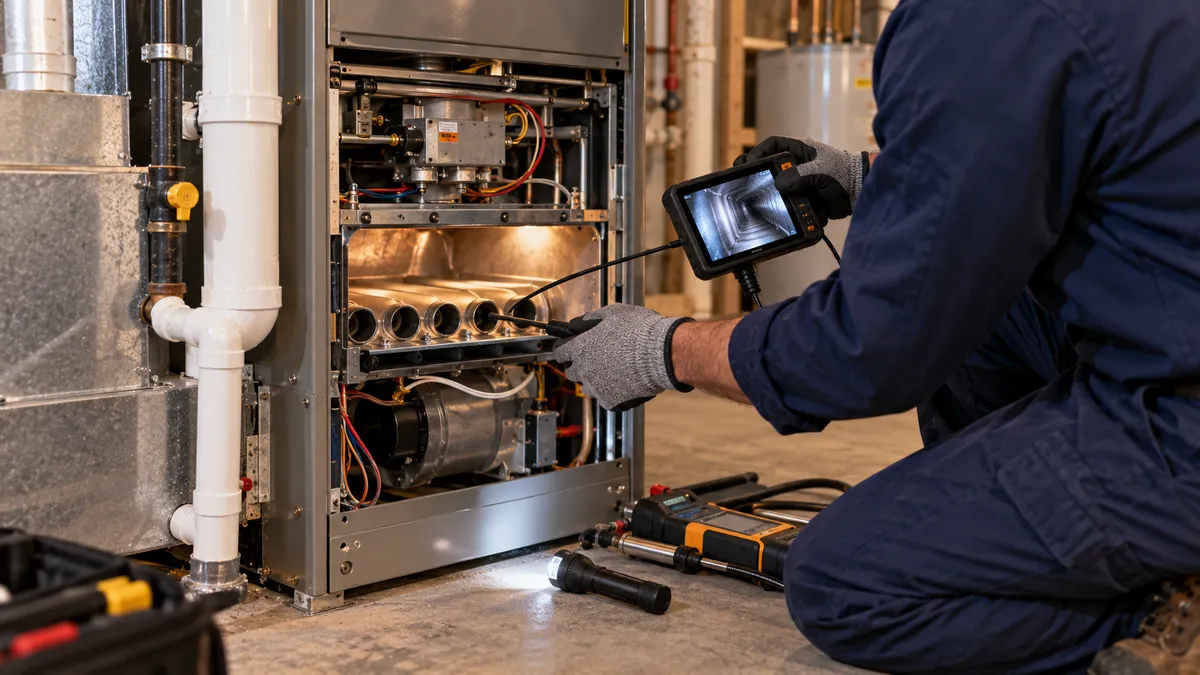
We shut off gas or power, close the isolation valves, and circulate a descaling solution (food-grade vinegar or a manufacturer-approved descaler) through the heat exchanger with a small pump for the time the manual specifies. Then we flush with clean water, clean the inlet screen, check the condensate trap and neutralizer, and fire the unit to confirm outlet temperature and no error codes. Many manufacturers tie warranty coverage to maintenance on the manual's schedule, so keep the receipts. A tank wants only a sediment flush and an anode check every few years, and tolerates neglect far better, though it pays for that with a shorter life.
When a Tank Is the Better Choice
We install plenty of tankless units, and we talk people out of plenty more. A storage tank water heater is usually the better buy when:
- One or two people live in the house and a 40- or 50-gallon tank already keeps up.
- The gas line would have to cross long stretches of finished ceiling, or no wall or roof location meets vent clearances.
- The water is very hard and nobody wants a softener or annual descaling.
- You plan to sell within a few years.
- The heater has failed and you need hot water today; a like-for-like tank can often go in the same day.
- The house is all-electric on 100-amp service.
Tankless earns its price when you genuinely run out of hot water, want the floor space back, have back-to-back showers every morning, or have the heater above finished space where a tank leak would be expensive. See our water heater repair and replacement page for the tank side of the decision.
Limitations of This Comparison
Prices here are typical 2026 ranges from our central New Jersey jobs, not quotes. Running costs use one standard load and statewide average prices, ignoring fixed delivery charges. Lifespans are typical, not guaranteed. Rebates change: NJNG's SAVEGREEN water heating program listed up to $750 for the highest-efficiency gas units, with equipment purchased and installed by June 30, 2027 and proof of permit required, when we checked in October 2026. The federal 25C tax credit is no longer available: the IRS confirms it does not apply to property placed in service after December 31, 2025. Confirm current amounts with each program before you buy.
Whichever you choose, replacing a water heater in New Jersey requires a permit. A like-capacity replacement counts as minor work under N.J.A.C. 5:23-2.17A, and a tankless conversion with new gas piping and venting is work for a licensed plumber.
Tankless vs Tank Decision Checklist
Answer these honestly and the choice usually makes itself:
- Do you run out of hot water now? If never, a same-size tank is probably fine.
- What is your peak demand? Count what runs at once on your busiest morning.
- Gas or electric? Gas favours tankless; all-electric favours a heat pump water heater.
- How far is the gas meter, and can a vent reach an outside wall or the roof?
- How hard is your water, and will someone descale the unit every year?
- How long will you stay? Tankless favours owners staying 10 years or more.
- Is the floor space worth money to you?
About Guardian Air
Guardian Air is a licensed New Jersey HVAC and plumbing contractor serving Monmouth, Middlesex and Ocean counties. We install and service tank, tankless and heat pump water heaters in homes from Freehold and Howell to Toms River and Old Bridge. Every estimate is written and itemized, includes the permit, and covers the option you might not have asked about, including "just replace the tank." Learn more about our team, read about tankless water heater installation in NJ, or call (848) 276-6300 (Mon–Fri 8–6, Sat 8–4) and request your free estimate.
Sources
- U.S. Department of Energy, Building America: Measure Guideline: Transitioning to a Tankless Water Heater
- ENERGY STAR: Water Heater Key Product Criteria
- ENERGY STAR: What Is Uniform Energy Factor?
- ENERGY STAR: Heat Pump Water Heaters
- U.S. DOE Federal Energy Management Program: Purchasing Energy-Efficient Residential Water Heaters
- U.S. Energy Information Administration: Average Price of Electricity by State and New Jersey Residential Natural Gas Price
- U.S. EPA: Consumer Confidence Reports
- NJNG SAVEGREEN: Water Heating Incentives; JCP&L: Appliance Rebates
- IRS: FAQs on the modification of Section 25C