October 24, 2026
Cracked Heat Exchanger: Signs, Dangers & Cost (2026)
A cracked heat exchanger can leak carbon monoxide, but only an inspection confirms one. Learn the signs, how technicians prove it, how to spot a bad diagnosis, what warranties cover and 2026 NJ costs.
By Noor Kamal, Technology Manager · Published · Updated
A cracked heat exchanger is a split, hole or rust-through in the sealed metal chamber that keeps a gas furnace's flames and exhaust separate from the air it blows through your house. It can let carbon monoxide into your home, so a furnace with a confirmed crack should be shut off until the heat exchanger or the furnace is replaced. Only a technician's inspection can confirm one, and you are entitled to see the evidence.
Written by the Guardian Air HVAC team · Reviewed for accuracy October 2026
Few diagnoses land as hard as "cracked heat exchanger." It usually comes with a shut-off furnace, a tag on the gas valve and a replacement quote, sometimes in January. It's also one of the most argued-about findings in the trade: a real safety defect, and a finding that has been used to sell furnaces that didn't need replacing. This is our attempt at the honest version: what the heat exchanger does, what cracks it, the signs, how dangerous it is, how a good technician proves it, how to protect yourself from a bad diagnosis, how warranties work, and what it costs in Monmouth, Middlesex and Ocean counties in 2026.
What Is a Furnace Heat Exchanger?
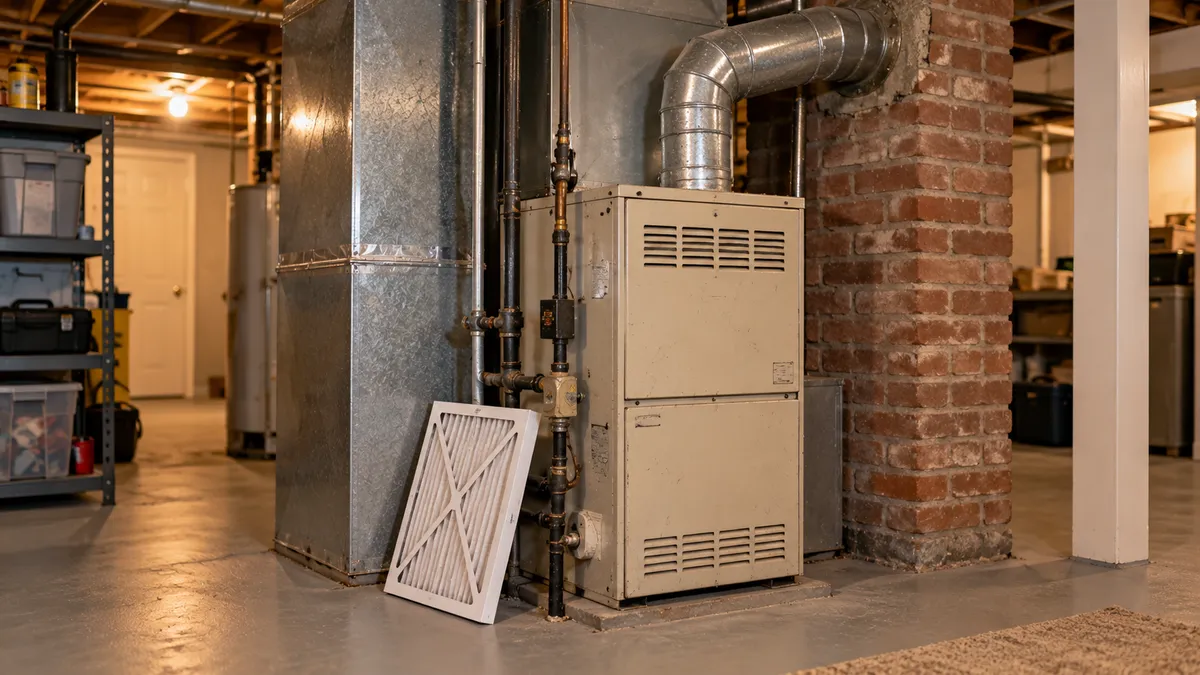
A gas furnace burns natural gas or propane inside a set of sealed metal chambers or tubes: the heat exchanger. The flame and exhaust stay inside. The blower pushes house air across the outside of that hot metal, and the warmed air travels through your ducts. The exhaust never touches the air you breathe; a small fan called the draft inducer pulls it out through the flue or PVC vent.
That wall of metal is the only thing between combustion gases, which can include carbon monoxide (CO), and the air circulating through your house. That's why a breach matters more than almost any other furnace fault, and why the heat exchanger carries the longest warranty on the furnace.
Primary and secondary heat exchangers
A standard 80% efficiency furnace, still common in older central New Jersey homes, has one heat exchanger, usually steel "clamshell" sections or bent steel tubes. Its exhaust leaves hot enough to go up a metal flue into a chimney.
A 90%-plus condensing furnace adds a secondary heat exchanger, a coil of finned stainless or coated tubing after the primary. It pulls so much extra heat from the exhaust that water vapor condenses into slightly acidic liquid that drains through a trap. The two fail differently: a primary usually cracks from heat stress or rusts through, while a secondary usually corrodes and leaks. Our guide to a furnace leaking water covers secondary heat exchanger leaks.
Why a crack doesn't always leak exhaust
On almost every modern furnace, the inducer pulls exhaust through the heat exchanger, so the inside runs at slightly lower pressure than the house air passing over it. As HVAC School's Bryan Orr explains in his guide to heat exchanger crack diagnosis, a small crack often pulls house air into the heat exchanger rather than pushing exhaust out. That's the root of the nuance below. It doesn't make a crack safe: pressures change when the blower starts, when the vent is partly blocked, and as the crack grows.
What Causes a Cracked Heat Exchanger?
Heat exchangers are built to expand and contract thousands of times a winter. Cracks come from things that make that cycle harsher, or from corrosion that thins the metal. Lennox's consumer guide to a cracked heat exchanger lists the same main causes we see in the field.
Overheating from restricted airflow
When too little air moves across the heat exchanger, the metal runs hot. A clogged filter, closed registers, an undersized return, a dirty blower wheel or a matted AC coil all restrict airflow. The high-limit switch shuts the burners off, the furnace cools and relights, and each cycle stresses the same seams. As Lennox puts it, "Poor airflow causes your furnace to overheat." It's the most preventable cause, and it starts with the filter.
Oversizing and short cycling
An oversized furnace satisfies the thermostat in a few minutes, shuts off and starts again. Lennox notes that incorrect sizing or poor duct design can accelerate wear on the exchanger, because more starts mean more expansion-contraction cycles. Our guide to furnace short cycling explains how to tell oversizing from an airflow or flame sensor problem.
Age and metal fatigue
Most gas furnaces last about 15 to 20 years, as our guide to how long furnaces last explains, and the heat exchanger is the part that most often ends a furnace's life. A crack on a 22-year-old furnace is usually wear, not a defect.
Corrosion from chemicals, condensation and water
- Chemical fumes in the combustion air. A furnace that takes combustion air from the basement burns whatever is in it. A. O. Smith's bulletin on combustion air contaminants lists water softener salts, laundry bleaches, detergents, adhesives, paints, paint strippers, waxes and plastics as sources of chlorine and fluorine compounds that, when burned, "form acids that corrode the heat exchanger and vent system." Lennox's warranty excludes damage from a corrosive atmosphere, naming chlorine and fluorine.
- Condensation inside a non-condensing furnace. An 80% furnace running on very cold return air or very short cycles can condense flue gas inside the primary heat exchanger and rust it from within. Lennox's warranty excludes operation with continuous return air below 60°F.
- Water from above. A clogged or rusted AC coil pan sitting on the furnace can drip onto the heat exchanger every summer.
- Acidic condensate. A secondary heat exchanger lives in it; a blocked trap lets it sit where it shouldn't.
Defects and over-firing
Occasionally a heat exchanger fails young from a bad seam, or because gas pressure was set too high or the wrong orifices were installed. HVAC School recommends checking for low airflow, incorrect orifice size or over-firing whenever a newer furnace cracks. If the cause isn't fixed, the new heat exchanger fails the same way.
Signs of a Cracked Heat Exchanger
None of these cracked heat exchanger symptoms proves a crack on its own, and several have more common causes. Treat them as reasons to get the furnace inspected, and a CO alarm as a reason to get out first.
- Carbon monoxide alarm. The most important sign. Lennox lists CO alarms or readings above 30 ppm as a possible indicator. A water heater, gas range, blocked chimney or car can also be the source.
- Soot around the burners, on the burner door or at supply registers, a sign of incomplete combustion.
- Flame that changes when the blower starts. If the flames dance, lift or roll out the moment the blower comes on, air may be crossing into the combustion side through a breach.
- Yellow or orange flames. New Jersey Natural Gas says gas equipment should have a clear, blue flame and that yellow or orange may indicate a problem.
- Rollout switch trips. This switch shuts the furnace down when flame escapes the burner area. A crack, blocked heat exchanger or blocked vent can cause it. Don't keep resetting it.
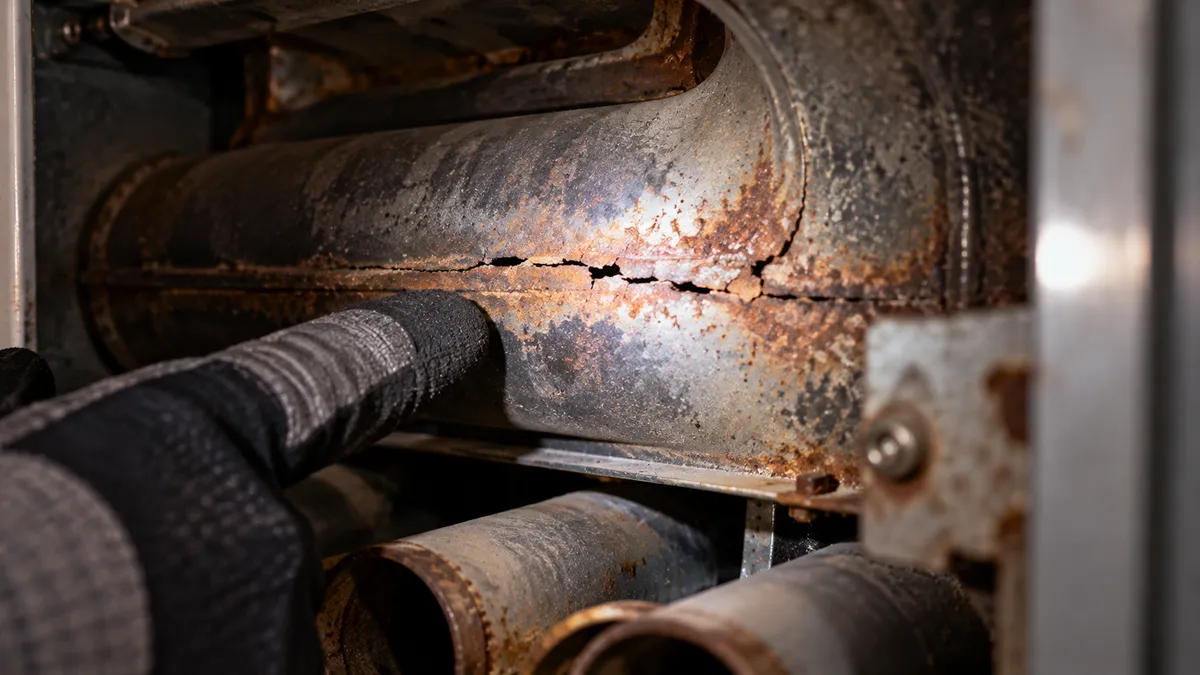
- Visible cracks, holes or heavy rust, or rust scale falling onto the burners.
- Unusual odors. Lennox lists "a burning, metallic, or chemical odor." CO itself has no smell.
- Headaches or flu-like symptoms at home. The CPSC describes early CO poisoning as like the flu without the fever: headache, fatigue, shortness of breath, nausea and dizziness, especially if several people feel it or it eases when you leave.
Our post on the 5 signs your furnace needs repair covers the more common faults that can look like heat exchanger trouble but aren't.
Burning Smell From the Furnace: Dust Burn-Off or a Real Problem?
"My furnace smells like burning" is a common call on the first cold day of fall, and usually it's harmless. Dust settles on the heat exchanger and burners over the summer and burns off the first time the furnace fires. Trane's guide to a heater that smells like it's burning suggests letting it run about 10 minutes; if the smell fades, you're likely fine. A brand-new furnace can also smell like burning plastic for its first few hours.
A burning smell from the furnace is worth a call when:
- It lasts. Trane says a smell that persists over an hour suggests a bigger issue.
- It smells electrical. That can be a failing motor, wiring or control board. Turn the furnace off.
- It's sharp or chemical every time the burners run, especially with soot, a yellow flame or headaches. That points to combustion problems.
- It smells like rotten eggs. That's natural gas. Leave and call your gas utility and 911 from outside.
Is a Cracked Heat Exchanger Dangerous?
Yes, and it helps to understand why. The danger is carbon monoxide. The EPA lists leaking furnaces among the sources of CO in homes. A breach creates a possible path from the combustion side to the air side. If the burner is also producing CO, because the crack disturbs the flame, the vent is partly blocked or the burners are dirty, the blower can distribute it through the whole house.
The honest nuance: not every crack leaks measurable CO into the home. With the heat exchanger under negative pressure and a clean burner, a CO test at the registers can read zero on a furnace with a real crack. HVAC School notes that combustion testing "won't necessarily tell you if you have an exchanger leak."
That isn't a reason to keep running it. Cracks grow, and the pressure balance shifts with a clogged filter or a partly blocked vent. Flame disturbance can cause rollout, and Lennox notes that in extreme cases a damaged heat exchanger can lead to overheating or fire. HVAC School's conclusion is that "if there are any cracks in an exchanger, it needs to be replaced," and Lennox says that because the heat exchanger is sealed, "repairs are rarely recommended."
What a "red tag" means
When a technician confirms a hazardous condition like a crack, standard practice is to shut the furnace off, close its gas valve and attach a warning tag, often called a red tag, saying it is unsafe to operate. Gas utility technicians do the same when they answer a CO call and find an unsafe appliance. In our area that's New Jersey Natural Gas, PSE&G or Elizabethtown Gas, depending on your address. Procedures vary and the utilities don't publish a single red-tag policy, so ask the technician to write down what was found and what must be done before the furnace can run again. Don't remove the tag or relight the furnace yourself.
What the codes and standards say
Gas furnaces are certified to the CSA/ANSI Z21.47 standard for gas-fired central furnaces, and New Jersey installations follow the state's Uniform Construction Code fuel gas subcode and the manufacturer's instructions. Some websites claim a specific code "requires" a cracked furnace to be condemned; we'd rather not overstate it. The practical rule is that a breached heat exchanger isn't operating as certified, manufacturers call for replacing it, and no responsible technician leaves one running. For home sales, New Jersey's inspector rules (N.J.A.C. 13:40-15.16) cover only the visible and accessible portions of the heat exchanger, which is why inspectors often refer it to an HVAC technician.
How Technicians Diagnose a Cracked Heat Exchanger
There's no single perfect test. Heat exchangers are mostly hidden, cracks can be hairline, and some open only when the metal is hot. A good diagnosis uses more than one method.
| Method | What it shows | Limitations |
|---|---|---|
| Visual inspection with flashlight and mirror | Cracks, holes and rust on visible surfaces | Most of the heat exchanger can't be seen without disassembly; hairline cracks are easy to miss |
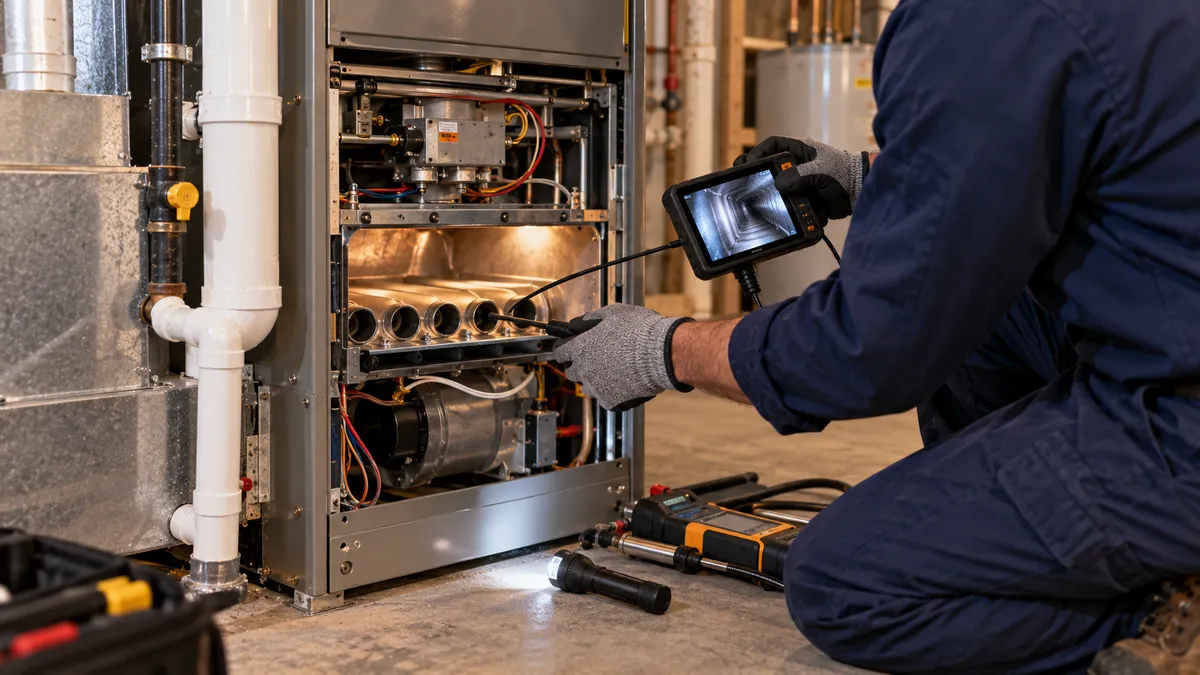
| Inspection camera (borescope) | Inside of clamshells or tubes, with photos or video | Sees only what it can reach; seams, shadows and scale can look like cracks |
| Flame behavior test | Whether flames move or roll out when the blower starts | Shows air is getting in somewhere, not where |
| Combustion analysis | CO, oxygen and draft in the flue; changes when the blower starts | Doesn't reliably prove or rule out a crack, but finds unsafe CO either way |
| CO testing in supply air and living space | Whether CO is reaching the house | A crack may leak little at the moment of testing; cooking or a car can raise readings |
| Pressure, smoke or tracer tests | Whether air or a tracer crosses between the two sides | Depends on sealing the heat exchanger well; can be ambiguous |
Lennox says a technician confirms a crack through "diagnostic testing, such as combustion analysis or visual inspection." In practice, the strongest evidence is a clear photo or video of the crack. Next is a combination: a disturbed flame, abnormal readings and visible damage. A single reading, or "I can just tell," is weak.
The "Cracked Heat Exchanger Scam" Question
Search this topic and you'll find stories of homeowners told about cracks that weren't there. Misdiagnosis happens, sometimes from honest error, sometimes from sales pressure. Real cracks are also common in old furnaces, and the technician who tags one is often doing exactly the right thing. Here's how to tell a well-documented finding from a weak one.
- Ask for photos or video of the damage on your furnace, and look at the camera screen yourself.
- Ask for written readings: combustion analysis, CO at the registers and flue, and flame behavior.
- Ask about the warranty. The report should list the model, serial number and age, and whether the heat exchanger may still be covered.
- Ask what caused it, especially on a younger furnace.
Red flags: no photos or readings, a "crack" found during a cheap tune-up special on a young furnace with no mention of warranty, a same-day-only discount, or a furnace left running after a crack was "found." A real crack gets the furnace shut off.
A second opinion is reasonable, and no honest contractor should mind. Keep the first company's photos and readings, keep the furnace off, and ask another licensed contractor to inspect the same area with a camera and run their own combustion test. Our furnace replacement cost guide lists other questions to ask before signing for a new furnace.
Can You Repair a Cracked Heat Exchanger? Repair vs. Replace
Welding, patching or sealing a cracked heat exchanger is not an accepted repair. The metal around a crack is fatigued or thin, a patch can fail as soon as it heats up, and no manufacturer we know of approves it. Lennox says "replacement of the exchanger is the safest and most cost-effective solution," and that depending on age and other damage it may be necessary to replace the entire furnace. So the real choice is between replacing the heat exchanger with a new factory part, often most of a day's work, or replacing the furnace.
Heat exchanger warranty: what is and isn't covered
- Carrier lists a 20-year heat exchanger parts limited warranty on its Comfort 80 furnace in an owner-occupied home.
- Lennox's Basic Limited Warranty covers heat exchangers for 20 years on its listed 80% models, and for a limited lifetime for the original owner (20 years for later owners) on listed high-efficiency models.
- Trane's warranty explainer lists 20 years on furnace heat exchangers under both base and registered warranties.
- Goodman advertises a lifetime heat exchanger limited warranty on its gas furnaces, tied to online registration within 60 days where the law allows.
The fine print matters:
- Labor is usually not included. Trane says labor isn't covered under either warranty, and Lennox's warranty leaves the owner paying labor, trip, diagnostic and shipping costs.
- Registration and maintenance matter. Unregistered units often get shorter coverage, and Lennox states that failure to maintain the equipment voids its warranty.
- Claims have deadlines. Lennox requires claims within 45 days of the failure.
- Exclusions apply. Corrosive atmospheres, improper installation and misuse are commonly excluded, and some lifetime terms cover only the original owner.
Here's how we walk customers through the decision. Under about 10 years old and under warranty, replacing the heat exchanger usually makes sense. Between 10 and 15 years, get both prices, because labor can approach a large fraction of a new furnace while other parts age. Out of warranty or over about 15 years, replacement almost always wins. Parts can also be backordered for weeks in midwinter, so ask about lead times.
What Our Technicians Find
These observations come from our own service calls across Monmouth, Middlesex and Ocean counties, not a national study.
Most cracks are on furnaces that have earned them
The cracked heat exchangers we document are mostly on older 80% furnaces, 18 to 25 years in service, often with years of skipped maintenance: rust-through at the bottom of a clamshell or a stress crack at a bend. A crack on a five-year-old furnace is rare in our experience, and when we see one we look hard at the cause before replacing anything.
Airflow is the usual cause on younger furnaces
When a younger furnace cracks, we usually find restricted airflow: an undersized return, a high-MERV filter jammed into the wrong slot, closed registers, or a dusty AC coil. We measure temperature rise and static pressure and compare them with the nameplate. If they're out of range, a new heat exchanger alone just resets the clock.
Laundry rooms and AC coils take a toll
Furnaces sharing a room with the washer, bleach, a water softener or pool chemicals show more rust than furnaces in a clean utility room. We also find heat exchangers rusted from the outside where a leaking AC coil pan has dripped onto the furnace for years.
We show you, every time
If we call a cracked heat exchanger, we show you the camera image or the damage, leave the readings, and tell you whether the warranty may cover the part. If something concerns us but we can't confirm a crack, we say so. And if you want a second opinion on another company's finding, we'll tell you honestly if we don't see what they saw.
What to Do Right Now If You Suspect a Cracked Heat Exchanger
If a CO alarm is sounding, or anyone has headache, dizziness, nausea or confusion that might be CO:
- Get everyone, including pets, outside immediately. Don't look for the source. The CPSC says to call 911 or the fire department and not re-enter until responders say it's safe.
- Get medical attention for anyone with symptoms, as Elizabethtown Gas also advises.
- Call your gas utility. New Jersey Natural Gas advises calling 911 first from a safe place, then NJ Poison Control at 800-222-1222 and NJNG at 800-221-0051. PSE&G's gas emergency line is 1-800-880-7734; Elizabethtown Gas's is 1-800-492-4009.
- Don't restart the furnace until it has been inspected and cleared.
If there's no alarm and no symptoms but you've seen soot, a flame that moves when the blower starts, rust or a tripped rollout switch: turn the furnace off at the thermostat and the service switch, open a few windows if anything smells off, confirm your CO alarms work, and call a licensed HVAC contractor. Never use a gas range or oven to heat the house. Have the model and serial number (on the label inside the furnace door) and any warranty paperwork ready.
CO alarms in a New Jersey home
New Jersey's fire code (N.J.A.C. 5:70-4.19) requires CO alarms in the immediate vicinity of the sleeping areas in one- and two-family homes with a fuel-burning appliance or an attached garage. They may be battery-operated, hard-wired or plug-in, and must be listed to UL 2034. The CPSC recommends alarms on every level and outside sleeping areas, but not directly above fuel-burning appliances or in kitchens. NJNG recommends replacing detectors every five to seven years. In our view a basement with a gas furnace deserves an alarm too, placed away from the furnace.
Cracked Heat Exchanger Cost in Central NJ (2026 Estimates)
These ranges come from our own jobs in Monmouth, Middlesex and Ocean counties and match our other cost guides. Heat exchanger replacement varies widely by model: on some furnaces it's a few hours, on others the furnace comes almost completely apart. For other repairs, see our furnace repair cost guide.
| Service | Typical cost | Notes |
|---|---|---|
| Diagnostic / service call | $89–$150 | Includes CO and flame checks; often credited toward the repair |
| Furnace tune-up with heat exchanger inspection | $100–$200 | Visual inspection plus combustion and CO safety check |
| Camera inspection and combustion analysis (second opinion) | $150–$350 | Photos or video and written readings left with you |
| Heat exchanger replacement, part under warranty | $900–$2,500 | You pay labor, shipping, and refrigerant handling if the AC coil must be moved |
| Heat exchanger replacement, out of warranty | $2,000–$4,500+ | Part plus labor; on older furnaces this usually points to replacement |
| Secondary heat exchanger (condensing furnace) | $1,500–$3,000+ | Often covered by parts warranty |
| New gas furnace, installed | $3,800–$10,000 | See our furnace replacement cost guide |
| CO alarm supplied and installed | $75–$250 per alarm | Battery or plug-in at the low end; hard-wired, interconnected at the high end |
If the heat exchanger labor quote is more than about a third of a new furnace's price and the furnace is past about 12 years old, ask for both options in writing.
How to Prevent a Cracked Heat Exchanger
- Change the filter on schedule, and use the size and type the furnace was set up for.
- Keep registers and returns open. Closing vents raises duct pressure and heat exchanger temperature.
- Get an annual furnace tune-up. The CPSC and EPA both recommend annual professional inspection of heating systems. A proper tune-up includes a heat exchanger inspection, combustion and CO check, temperature rise and safety controls. Our guide to what HVAC maintenance includes and costs explains what to expect, and many manufacturers require proof of maintenance for warranty claims.
- Size it right. When replacing a furnace, ask for a Manual J load calculation.
- Fix airflow problems. Ask your technician to measure static pressure and temperature rise.
- Keep chemicals away from a furnace that draws combustion air from the room.
- Keep the AC coil drain clear so water stays off the furnace below.
- Register a new furnace on time and keep invoices and service records.
About Guardian Air
Guardian Air is a licensed New Jersey HVAC and plumbing contractor serving Monmouth, Middlesex and Ocean counties. Our technicians inspect, repair and replace gas furnaces from every major brand, in homes from Freehold and Middletown to Edison and Toms River. When we find a heat exchanger problem, you get photos, readings and a written quote before any work starts, plus an honest answer on whether the warranty covers it. See our heating services, furnace tune-up and furnace replacement pages, learn more about our team, or call (848) 276-6300 (Mon–Fri 8–6, Sat 8–4) and book an inspection or second opinion.
Sources
- U.S. Consumer Product Safety Commission: Carbon Monoxide Fact Sheet
- U.S. Environmental Protection Agency: Carbon Monoxide's Impact on Indoor Air Quality
- New Jersey Natural Gas: Carbon Monoxide Safety
- Elizabethtown Gas: Committed to Safety
- N.J.A.C. 5:70-4.19: Carbon monoxide alarm requirements
- N.J.A.C. 13:40-15.16: Home Inspection Standards of Practice
- Lennox: What to Do If Your Furnace Has a Cracked Heat Exchanger
- Lennox: Lennox Equipment Basic Limited Warranty (W900001-01)
- Carrier: Comfort 80 Gas Furnace (58SC0) warranty terms
- Trane: Trane Warranties Explained
- Goodman: Gas Furnace product page and warranty terms
- HVAC School (Bryan Orr): Heat Exchanger Crack Diagnosis
- A. O. Smith: Technical Bulletin 66: Combustion Air Contaminants
- Trane: Why Your Heater Smells Like It's Burning
- ANSI: CSA/ANSI Z21.47-26 / CSA 2.3-2026: Gas-Fired Central Furnaces