June 20, 2026
Why Annual AC Maintenance Pays for Itself
A tune-up returns its cost through four separate channels — energy, avoided repairs, equipment lifespan and warranty protection. Here is the mechanism behind each, what a real maintenance visit includes, and the cases where we would tell you to skip it.
By Noor Kamal, Technology Manager · Published · Updated
"Does an AC tune-up actually do anything, or is it just a way to sell me a service plan?"
It is a fair question, asked often, and it deserves a real answer rather than a sales pitch. So this article does something most maintenance articles avoid: it puts numbers against the claim, explains the mechanism behind each one, and is honest about the cases where an annual tune-up is not the best use of your money.
The short version is that maintenance pays for itself through four separate channels — energy, repair avoidance, equipment lifespan, and warranty protection — and the fourth one alone is frequently worth more than the visit costs. But the reasoning matters more than the conclusion, so let us go through it properly.
What Actually Happens to an Air Conditioner Between Summers
An air conditioner does not wear out the way a car does, through mileage. It degrades through accumulation, and understanding that explains why annual attention works.
Your outdoor condenser spends nine months of the year sitting in the weather. Its job is to reject heat from the refrigerant into outdoor air, which requires unobstructed airflow across a coil made of thin aluminium fins. Over a season, that coil collects pollen, grass clippings, dryer lint, cottonwood seed and road dust. Each layer insulates the coil slightly. An insulated coil rejects less heat. To achieve the same cooling, the system must run longer and at higher pressure.
Indoors, the evaporator coil and blower collect their own film — dust that passes the filter, plus the moisture that condenses on the coil by design. That combination is exactly what mould likes. Meanwhile the condensate drain line, which carries away the water your system pulls from the air, slowly accumulates biological growth until it restricts or blocks entirely.
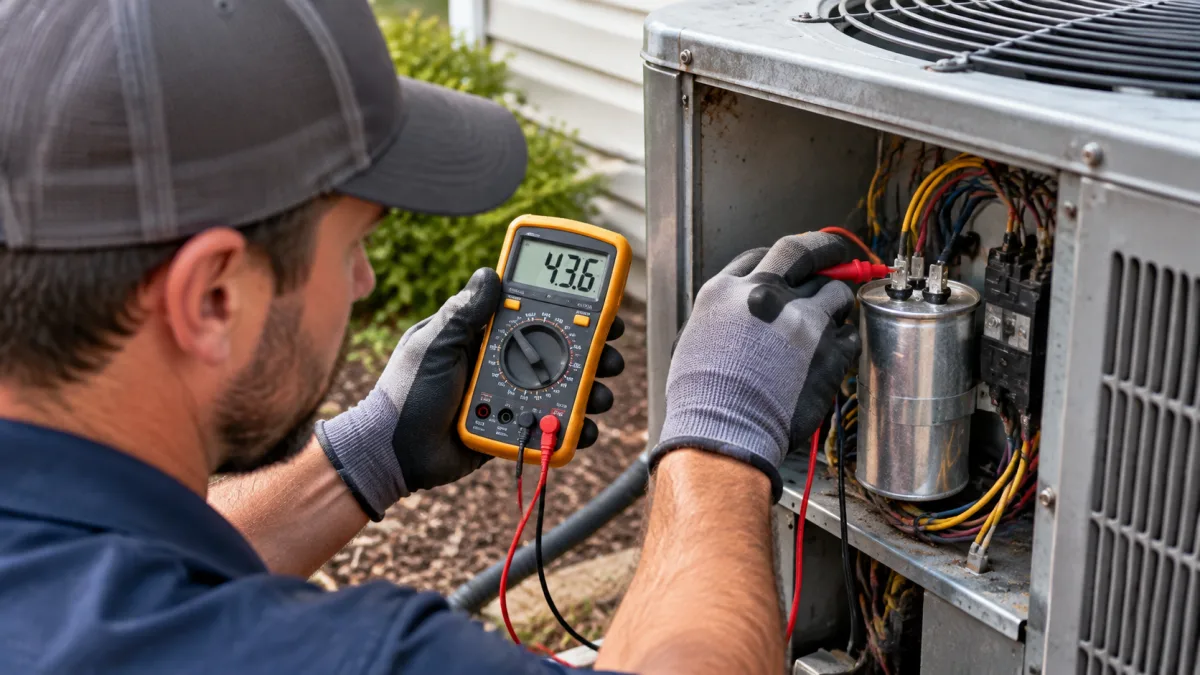
Electrically, capacitors degrade from the day they are installed. A capacitor is a small cylinder that provides the starting torque for your compressor and fan motors, and its capacitance — measured in microfarads — drifts downward with heat and age. A capacitor at 80 percent of rating still works, but it makes the compressor work harder every single start.
Refrigerant, meanwhile, is a sealed system. It should never need "topping up." If your charge is low, you have a leak, and a technician who simply adds refrigerant each year without finding it is selling you the same gas repeatedly while your system runs inefficiently between visits.
Channel One: Energy
The efficiency figure most often quoted in the trade is that an air conditioner loses roughly 5 percent of its efficiency per year without maintenance. Whether the exact number is 4 or 6 matters less than the direction and the compounding: a system three years past its last service is meaningfully less efficient than it was, and the gap widens.
Industry sources commonly put the recoverable savings from regular maintenance at 10 to 15 percent of cooling costs. The mechanism is not mysterious — it is the sum of the specific losses described above:
- A dirty condenser coil raises head pressure, and the compressor draws more current to overcome it.
- A restricted filter or dirty evaporator reduces airflow, lengthening run times for the same cooling effect.
- A weak capacitor increases starting current on every cycle.
- Low refrigerant charge reduces capacity disproportionately — a system 10 percent undercharged loses considerably more than 10 percent of its cooling output.
- Loose electrical connections create resistance, which becomes heat, which is energy you paid for and did not use.
How much that is worth in dollars depends entirely on your home, your system and how you run it, which is why we are not going to invent a figure. What we would suggest instead is a measurement you can make yourself: pull your July and August electricity bills for the last three years and compare kilowatt-hours, not dollars. Rates change; consumption tells you about your equipment. A steady climb in summer kWh with no change in household habits is your system losing efficiency in real time.
Channel Two: The Repairs That Do Not Happen
This is the channel homeowners underrate, because avoided problems are invisible.
The failures that generate the most urgent summer calls are, in our experience, overwhelmingly foreseeable. A capacitor that tests low in May is a five-minute part swap on a scheduled visit. The same capacitor failing in a July heatwave means a house at 85 degrees, a compressor that has been straining, and whatever the wait for an appointment happens to be when every contractor in three counties is booked. Our AC repair cost guide shows what those common failures typically cost to fix.
The same applies to condensate drains. A blocked drain is trivial to clear during maintenance. Left alone, it either trips a safety float switch and shuts your system down, or — on systems without one, or where the switch has failed — overflows into whatever is beneath the air handler. We have seen that mean a ceiling, insulation and drywall.
Contactors are a third example. The contactor is an electrical switch that engages the outdoor unit, and its contacts pit and erode with each cycle. Caught during maintenance, it is an inexpensive part. Left until the contacts weld shut, it can mean a condenser that runs continuously, or one that will not start at all.
None of these are exotic. They are the ordinary wear items of a mechanical system, and the entire argument for annual service is that you would rather meet them on a Tuesday in May than a Saturday in July.
Channel Three: Equipment Lifespan
A central air conditioner in New Jersey should give you 12 to 15 years. Well maintained, some run longer. Neglected, many do not reach 10.
The component that determines this is the compressor, which is both the heart of the system and by far its most expensive part — expensive enough that on an older unit, compressor failure usually means replacing the whole system rather than the compressor alone.
Compressors fail from heat and from strain. Every condition that maintenance corrects — dirty coils, low charge, weak capacitors, restricted airflow — makes the compressor run hotter and work harder. Maintenance is, functionally, compressor life extension.
There is a coastal footnote for anyone in Point Pleasant, Long Branch, Barnegat or the bayfront parts of Middletown: salt air corrodes condenser coils and electrical contacts noticeably faster than inland conditions. Rinsing the outdoor coil and treating connections matters more near the water, and honest expectations for equipment life should be adjusted accordingly.
Channel Four: Warranty — The One That Pays for Everything Else
This is the channel most homeowners do not discover until it costs them.
Major manufacturers typically provide a 10-year parts warranty on residential equipment. What is much less widely known is that these warranties generally require the system to have received annual professional maintenance — and require you to be able to document it. Read your warranty certificate; the language is usually explicit.
The consequence is straightforward. If your compressor fails in year seven and you cannot produce maintenance records, a claim that should have been covered may be denied. The part alone on a modern system is a substantial sum. Set against that risk, the cost of an annual visit reads less like a service purchase and more like keeping an insurance policy in force.
Whoever performs your maintenance, keep the invoices. A folder or a scanned PDF is enough. If you ever need to file a claim, that documentation is what the manufacturer will ask for.
What a Real Tune-Up Includes
Not all "tune-ups" are equal, and the price difference between a thorough visit and a cursory one usually reflects what is actually performed. A legitimate cooling maintenance visit should cover:
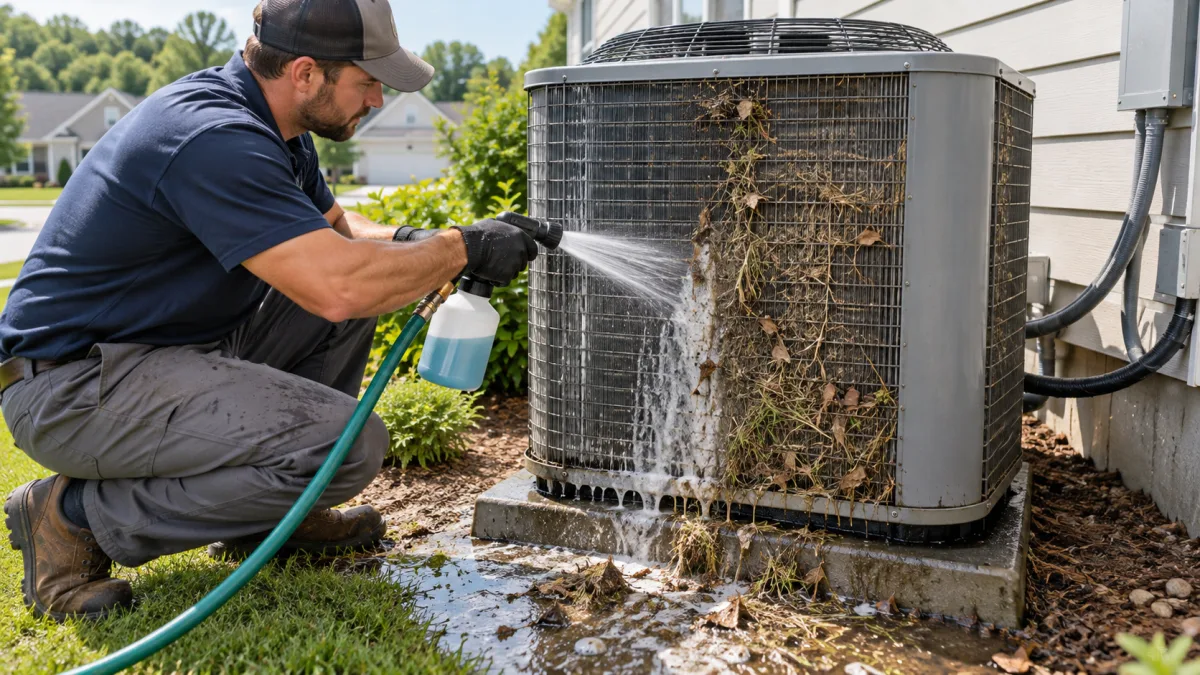
- Cleaning the outdoor condenser coil and clearing debris from around the unit
- Inspecting and cleaning the indoor evaporator coil where accessible
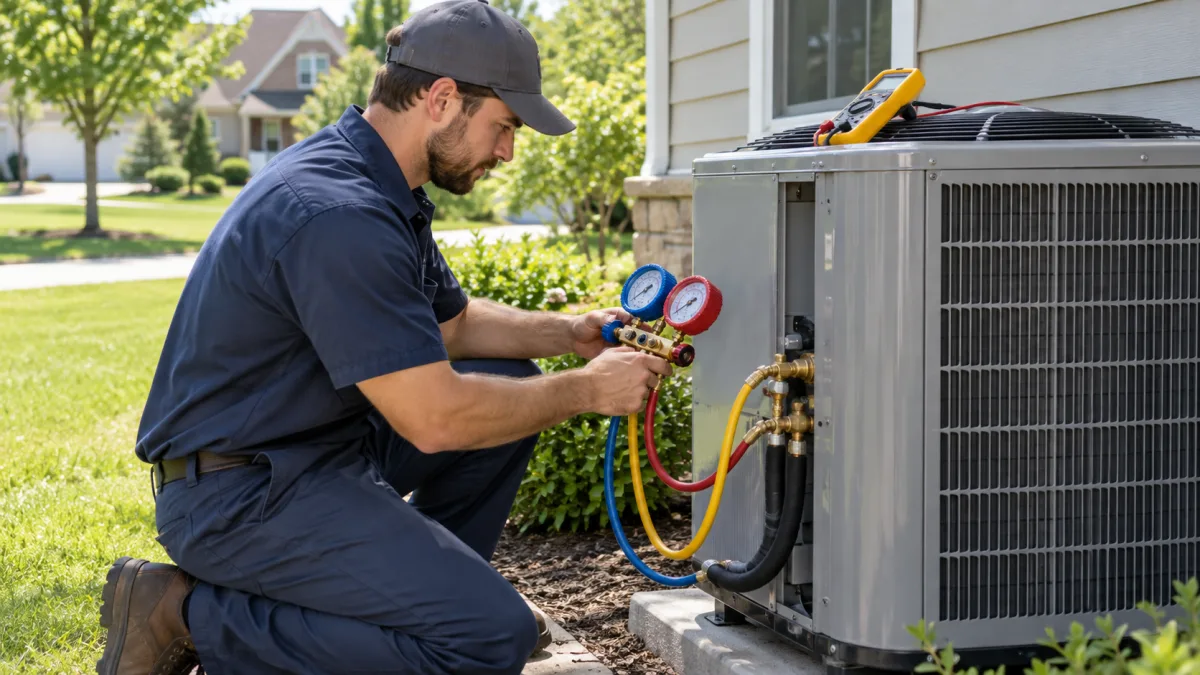
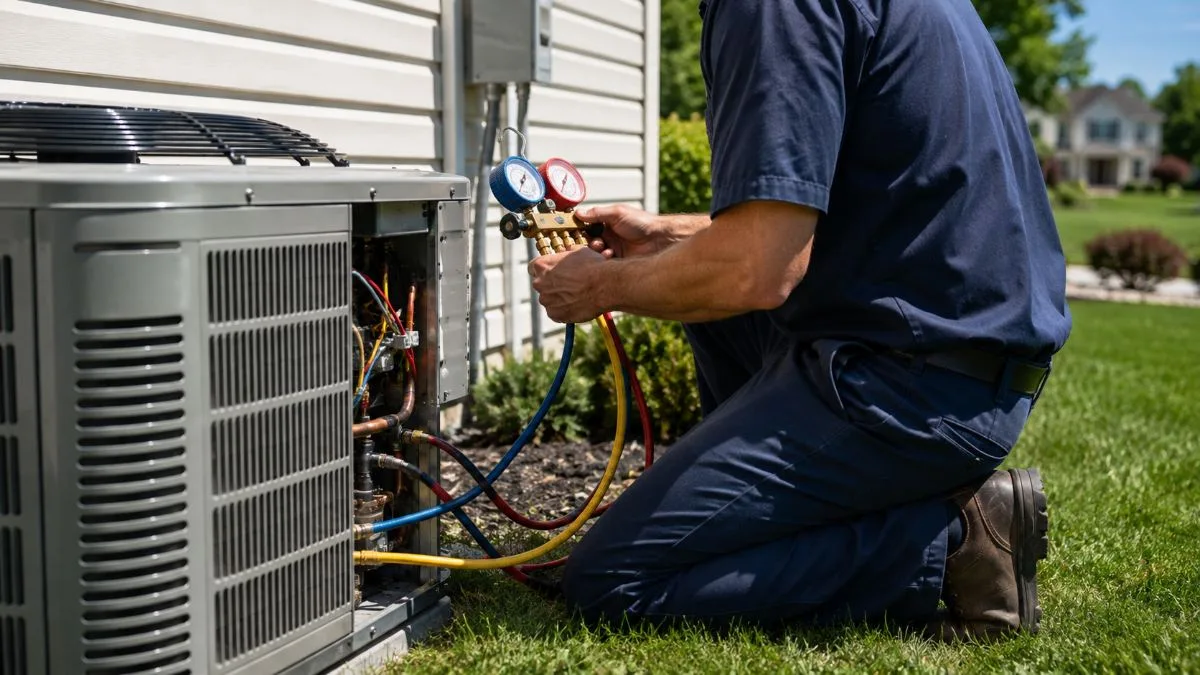
- Checking refrigerant pressures against manufacturer specification — and investigating, not merely topping up, any shortfall
- Testing capacitors against their rated microfarad value
- Inspecting the contactor for pitting and wear
- Clearing and treating the condensate drain line, and testing the float switch
- Tightening electrical connections and measuring amp draw on the compressor and fan motors
- Checking and replacing the air filter
- Verifying thermostat calibration and cycle behaviour
- Measuring the temperature differential across the coil — typically 16 to 22 degrees on a correctly performing system
- Inspecting the blower wheel and motor
That last item — temperature split — is worth knowing about as a homeowner. It is a quick, direct measure of whether the system is actually performing, and a technician who measures it is telling you something checkable rather than asserting that everything looks fine.
If a visit consists of glancing at the unit and changing the filter, you did not receive maintenance. You received a filter change.
When Maintenance Is Not Worth It
We said we would be honest about this, so here are the cases where we would not push it.
If your system is 15+ years old and already failing regularly, maintenance is not going to rescue it. That money is better set aside toward replacement, and our AC replacement cost guide shows what to budget. We would rather tell you that than sell you a tune-up on equipment we expect to fail anyway.
If your system is one or two years old and still under a builder or installer service agreement, check what you already have before paying for anything additional. Duplicate coverage is common.
If you are selling the house within the year, a full maintenance programme is harder to justify — though a documented recent service does help at inspection, and a system that fails during the sale process is a genuinely bad problem to have.
If a contractor recommends adding refrigerant every single year, that is not maintenance. That is an unrepaired leak being managed as an annuity. Ask for a leak search.
Plan or Pay-As-You-Go?
Maintenance plans typically bundle scheduled visits with some combination of repair discounts, waived diagnostic fees and priority scheduling. Whether a plan beats booking visits individually is arithmetic, and the arithmetic depends on the specific plan.
The questions worth asking before signing anything:
- How many visits are included, and does that cover both heating and cooling?
- What exactly is performed at each visit — ask for the checklist in writing?
- What is the repair discount, and does it apply to parts, labour, or both?
- Is the diagnostic fee waived for plan members?
- Does the plan carry over if you sell the house?
- Is there an auto-renewal, and how do you cancel?
Compare the total plan cost against what two individual visits would cost you, then weigh the discounts against how many repairs you realistically expect. For a system under about eight years old in good condition, individual visits often make sense. For older equipment, or for a household that values priority scheduling in peak season, plans usually come out ahead.
What You Should Do Yourself Between Visits
Professional maintenance is annual. These are monthly or seasonal, they cost nothing, and they materially affect how your system performs:
- Change the filter — every 90 days for a one-inch pleated filter, 60 with pets. This is the single highest-impact thing a homeowner controls.
- Keep two feet clear around the outdoor unit. Shrubs, fence panels and stacked items all restrict the airflow the coil depends on.
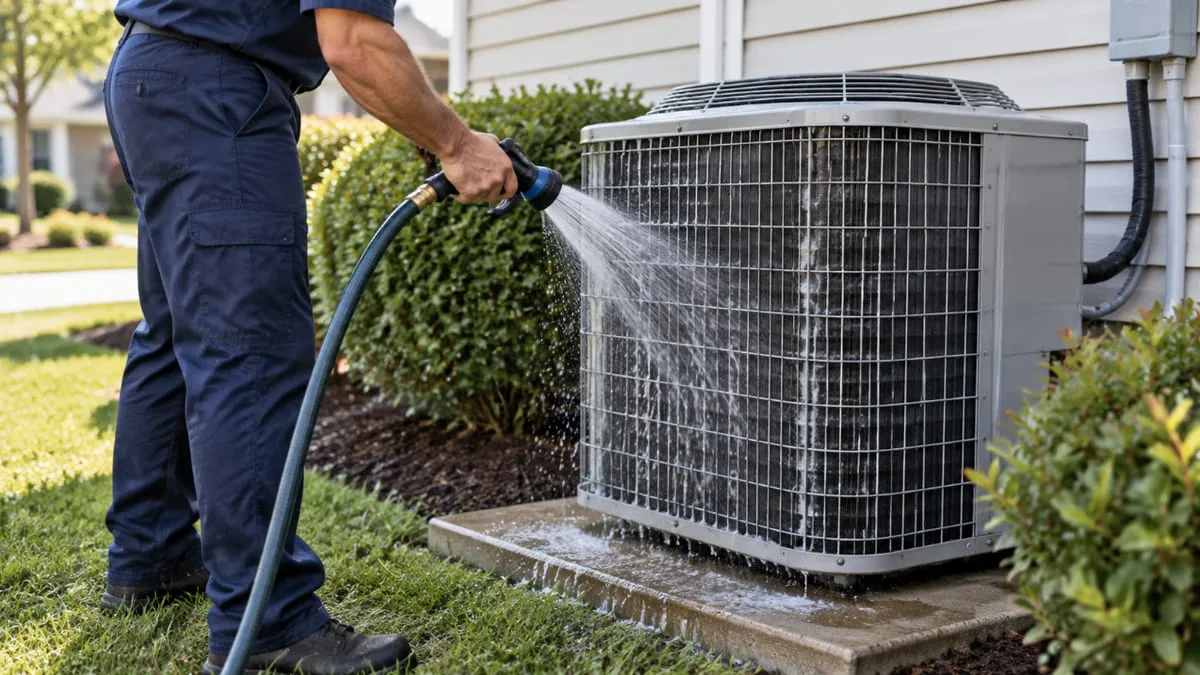
- Rinse the outdoor coil gently with a garden hose — never a pressure washer, which bends the fins and makes things worse.
- Keep registers open and unobstructed. Closing vents in unused rooms raises static pressure and strains the blower; it does not save money.
- Watch the condensate drain for standing water or overflow near the indoor unit.
- Listen. New grinding, screeching or repeated clicking at start-up is worth a call before it becomes a failure. If the system runs but the house stays warm, our guide to an AC not cooling covers the checks you can do yourself first.
Timing: Book in Spring
Schedule cooling maintenance in spring, before the first heatwave. Two reasons, both practical.
The first is availability. Once temperatures climb, every contractor in Monmouth, Middlesex and Ocean counties is running emergency calls, and scheduled maintenance is the first thing that gets pushed.
The second is that a problem found in April is a scheduled repair with time to source parts and consider your options. The same problem found in July is an emergency, with whatever that implies for both urgency and choice.
The equivalent logic applies to heating in the autumn — which is why most households end up on a two-visit rhythm, spring and fall. Our HVAC maintenance guide covers what both visits include and cost.
Heat Pumps Change the Calculation
If your home is heated and cooled by a heat pump rather than a separate furnace and air conditioner, everything above still applies — but the stakes are higher, because the equipment runs year-round instead of for one season.
A heat pump is an air conditioner that can run in reverse, extracting heat from outdoor air and moving it indoors during winter. That means roughly double the annual run hours of a cooling-only system, and wear accumulates accordingly. It also adds components a standard air conditioner does not have: a reversing valve that switches between heating and cooling modes, and a defrost control that periodically clears frost from the outdoor coil in cold weather.
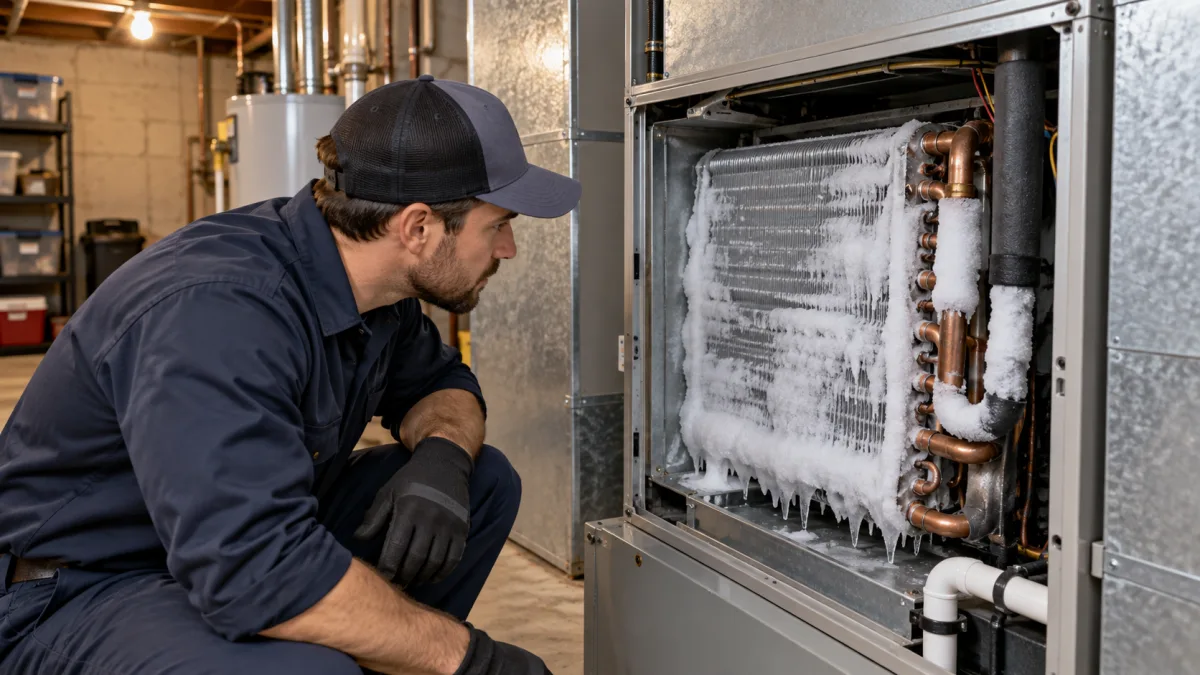
Both are failure points worth inspecting. A reversing valve that sticks leaves you with cooling when you asked for heat, or the reverse. A defrost control that malfunctions allows the outdoor coil to ice over, at which point the system loses capacity precisely when the weather is worst.
For these systems we would recommend two visits a year rather than one — spring and autumn — which is the same rhythm most households end up on anyway once heating is included. Our heat pump service guide details what each of those visits should cover.
What If It Has Been Years?
A fair number of the systems we see have not been touched since installation. If that describes yours, the honest answer is that a single visit will not fully restore it, but it will tell you where you stand — and that is worth knowing before you spend anything else.
Expect the first visit on a long-neglected system to take longer and to surface more than a routine one would. Coils that have accumulated several seasons of debris need genuine cleaning rather than a rinse. Capacitors that have drifted well out of specification need replacing. A condensate line with years of growth may need clearing rather than treating. None of that is upselling; it is the backlog.
What it buys you is a decision made on evidence. Either the system is fundamentally sound and worth maintaining from here, or it is far enough gone that you should be planning replacement on your own timetable rather than reacting to a failure in August.
Booking a Tune-Up
Guardian Air is a family-owned, licensed and insured HVAC contractor serving Monmouth, Middlesex and Ocean counties — Freehold, Howell, Aberdeen, Middletown, Red Bank, Long Branch, Old Bridge, Edison, Woodbridge, Toms River, Brick, Jackson, Lakewood and surrounding towns.
Our cooling maintenance follows the checklist above, and you get a written report of what was measured — pressures, capacitor readings, temperature split — rather than a verbal assurance that things look fine. If we find something, you get a flat-rate quote before any work begins. If your system is past the point where maintenance is a sensible investment, we will say so.
Call (848) 276-6300 or book online. You can also read about AC tune-ups, AC installation and replacement, or typical AC repair costs in New Jersey.