September 24, 2026
Furnace Replacement Cost in 2026: What a New Furnace Really Costs in New Jersey
A new gas furnace typically costs $3,800–$10,000 installed in 2026. We break the cost into its real parts (equipment, venting, condensate, ducts, permits), explain NJ rebates and the end of the tax credit, and show how to compare quotes.

The typical furnace replacement cost in 2026 is about $3,800 to $10,000 installed for a gas furnace, with national averages clustered around $4,800. A basic 80% AFUE furnace swapped into the same spot sits at the low end. A 95–98% AFUE condensing furnace that needs new PVC venting, a condensate drain and a chimney liner for the water heater lands in the upper half, and a modulating unit with duct changes can pass $10,000.
The range is wide because "a new furnace" is really eight or nine separate pieces of work, and each quote bundles them differently. This guide breaks the cost into those pieces, explains what changes the price in New Jersey, and shows how to compare two estimates line by line.
How Much Does a New Furnace Cost in 2026?
The large national cost surveys broadly agree. Where they differ, it is mostly because they measure different things: some quote every fuel type together, some only gas, and some include the extras that high-efficiency installs need.
| Source (2026) | What it measures | Range | Average |
|---|---|---|---|
| Fixr | Furnace replacement, all fuels | $2,800–$7,500 (most homeowners) | $4,800 |
| Fixr | Natural gas furnace, installed | $3,800–$10,000 | — |
| This Old House | New furnace, all fuels, installed | $1,600–$10,000 | $4,799 |
| This Old House | Gas furnace, installed | $3,800–$10,000 | — |
| HomeGuide | Gas furnace replacement, installed | $3,800–$12,000 | — |
Putting those together: for a gas furnace, which is what nearly every home we work on in Monmouth, Middlesex and Ocean counties has, $3,800 is a realistic floor and $10,000–$12,000 is the realistic ceiling for a residential system. The ~$4,800 averages include cheaper electric furnaces, so a gas replacement with a condensing furnace usually costs more than that headline number.
What Goes Into the Cost of Furnace Replacement?
A good furnace replacement estimate lists every line below, even when some come to zero.
The furnace itself: 80% vs 95–98% AFUE
AFUE (annual fuel utilization efficiency) is the share of the gas you buy that ends up as heat in the house. An 80% furnace sends about a fifth of that energy out the flue. A 96% furnace captures most of it by condensing water vapor out of the exhaust in a second heat exchanger. Condensing is what raises the efficiency, and it is also what drives most of the extra installation work.
Tier pricing from HVACProjectCost's August 2026 benchmark (equipment, labor and permit for a same-location swap) shows how the price steps up:
| AFUE tier | Typical burner / blower | Installed cost |
|---|---|---|
| 80% | Single-stage, PSC blower, metal flue | $2,800–$4,600 |
| 90–92% | Single-stage, basic ECM blower, PVC vent | $3,900–$6,000 |
| 95–96% | Two-stage, ECM blower | $4,600–$7,800 |
| 97–98.5% | Modulating, variable-speed ECM blower | $6,300–$10,500 |
Manufacturer and survey figures line up with this. Bryant, a major furnace manufacturer, says high-efficiency furnaces typically cost $1,000–$2,500 more up front than standard-efficiency models. HomeGuide prices 80–89% AFUE gas furnaces at $3,800–$6,200 installed and 90–95% units at $5,200–$8,800.
Single-stage, two-stage or modulating?
A single-stage furnace has one firing rate: full output or off. A two-stage furnace runs most of the winter on a low fire (around 65% of capacity) and only switches to high fire on the coldest days. A modulating furnace adjusts its output continuously, down to roughly 40% on many models. That means longer, gentler run cycles, steadier temperatures between floors, and quieter operation.
Today's Homeowner prices single-stage furnaces at $2,500–$4,000 installed and two-stage at $3,500–$6,500. Modulating furnaces sit in the premium tier above. For a typical New Jersey colonial or split-level, two-stage is usually the best value. Uneven temperatures between floors are more often a duct problem than a furnace problem, and a modulating furnace can't fix ducts.
Labor
Fixr puts furnace installation labor at $300–$1,800 nationally, or 10–40% of the total, with most replacements taking 4 to 10 hours. That assumes a like-for-like swap. Labor goes up for a crawlspace or closet install, an 80%-to-condensing conversion, or a rebuilt plenum and return.
Venting: the biggest hidden cost in older homes
An 80% furnace vents hot exhaust up a metal flue and usually into a masonry chimney, often shared with a gas water heater. A condensing furnace produces cool, wet, slightly acidic exhaust, so it needs sealed PVC or polypropylene venting run out through a sidewall or the roof. It can't use the old chimney.
That leads to a problem homeowners are rarely warned about: the orphaned water heater. Once the furnace leaves the chimney, the water heater vents alone into a flue sized for two appliances. That flue doesn't warm up enough to draft well, so exhaust can cool, condense, spill back into the basement and damage the masonry. The fix is usually a properly sized stainless liner for the water heater alone, or converting the water heater to a direct-vent or power-vent model. This is why two quotes for "the same furnace" can differ by $1,000 or more: one contractor included the liner and the other didn't mention it.
Condensate drain or pump
A condensing furnace produces water every time it runs, and it has to go somewhere. If there's a floor drain or laundry standpipe nearby, a gravity drain is cheap. If not, you need a condensate pump. Many installers also add a neutralizer cartridge so the acidic condensate doesn't damage cast-iron drain lines. A pump needs an outlet and should have a safety switch that shuts the furnace down if it fails, or it can flood a finished basement.
Ductwork, plenum and transitions
New furnaces rarely have the same footprint as the unit coming out. At a minimum, expect new sheet-metal transitions on the supply plenum and return drop. If the existing ducts are undersized, leaky or collapsed, the scope gets bigger. Fixr puts duct repairs at $5–$45 per linear foot and full ductwork replacement at $1,400–$6,000. A new blower on a restrictive return will be noisy and underperform; our guide to a furnace blowing cold air covers the airflow side in more detail.
Gas line, electrical and thermostat
A furnace in the same location usually reconnects to the existing gas branch with a new shutoff and sediment trap. Relocating it or upsizing the pipe for a larger unit is extra; Fixr lists fuel lines at $9–$27 per linear foot. The furnace also needs a proper service switch and dedicated circuit, plus an outlet if a condensate pump is added. A new thermostat is optional unless you're moving to two-stage or modulating equipment, which needs a control that can call for the lower stages.
Permit, inspection and disposal
Fixr puts permits at $50–$1,500 nationally and old-furnace removal at $50–$330. In New Jersey the permit fee is set by your municipality's construction office, so ask the contractor what they've included for your town rather than relying on a national average. The New Jersey permit process is covered in its own section below.
The A/C coil sitting on top of the furnace
If you have central air, the evaporator coil sits on the furnace's supply outlet, and replacing the furnace puts that coil in the way. There are three possibilities, and a good quote says which one applies:
- Reuse the existing coil. Cheapest when the coil is sound and the A/C is fairly young. It still has to be re-sealed and re-transitioned to the new cabinet.
- Replace the coil only. Any new coil has to match the refrigerant and capacity of the outdoor unit you're keeping.
- Replace the full system. Often sensible when the A/C is as old as the furnace.
The refrigerant transition complicates this in 2026. New split-system air conditioners now use A2L refrigerants such as R-454B and R-32 instead of R-410A. Under an EPA final rule effective July 27, 2026, R-410A equipment manufactured or imported before January 1, 2025 can still be installed until existing supplies run out. The practical consequences:
- If you keep an R-410A condenser, any replacement coil must be an R-410A coil, and remaining inventory is shrinking.
- If you go to A2L, the coil and condenser must both be A2L. A2L coils carry a refrigerant leak sensor, and under UL 60335-2-40 the system must start the indoor blower to disperse refrigerant if a leak is detected. The furnace has to accept that signal through an A2L-ready control board or a mitigation kit. Ask whether the furnace in your quote is A2L-compatible even if you're keeping the A/C for now.

Typical add-on costs at a glance
| Item | When you need it | Typical cost | Source |
|---|---|---|---|
| PVC venting system | Any 80% → condensing conversion | $250–$800 | HVACProjectCost |
| Condensate gravity drain | Floor drain nearby | $75–$250 | HVACProjectCost |
| Condensate pump | No gravity drain available | $150–$450 | HVACProjectCost |
| Chimney liner | Orphaned gas water heater | $900–$2,500 | HVACProjectCost / HomeGuide |
| Duct repairs | Leaky or damaged runs | $5–$45 per linear ft | Fixr |
| Full duct replacement | Failed or badly undersized system | $1,400–$6,000 | Fixr |
| Gas line work | Relocation or upsizing | $9–$27 per linear ft | Fixr |
| Permit | Always (fee varies by town) | $50–$1,500 | Fixr |
| Old furnace removal | Always | $50–$330 | Fixr |
HVACProjectCost puts a typical 80%-to-condensing conversion at $325–$1,250 in total, rising to nearly $3,900 in the worst case, which is when a chimney liner is needed on top of everything else.
Furnace Replacement Cost in New Jersey
Permits and inspection under the NJ Uniform Construction Code
Replacing a furnace in New Jersey requires a permit. Under N.J.A.C. 5:23-2.17A, replacing an existing warm-air furnace with a new appliance of like capacity counts as "minor work." The contractor notifies the construction office before starting, files the application within five business days, and the office inspects within three business days of the request. Work can start before the permit issues, which is why a furnace can be replaced the day after it fails. Under the state's HVACR licensing law, a licensed Master HVACR contractor has to seal the permit application.
It matters for your wallet too: NJNG requires proof of permit with its rebate application.
Your gas utility decides your rebate
New Jersey Natural Gas serves Monmouth and Ocean counties and parts of Middlesex; PSE&G serves much of the rest of Middlesex. Both run high-efficiency furnace incentives, and the rules are specific:
- NJNG SAVEGREEN: The program requires a natural gas furnace rated at least 95% AFUE, and it must replace an existing non-condensing furnace or boiler. New construction doesn't qualify. Equipment must be purchased and installed by June 30, 2027. Applications are due within 120 days of purchase and need a photo of the old equipment, a paid receipt and proof of permit. Eligible customers can also finance up to $25,000 at 0% APR on their bill, net of rebates.
- PSE&G HVAC Instant Rebates: Also requires a 95% AFUE furnace replacing a non-condensing unit, and works through participating contractors, with an on-bill repayment option of up to $25,000 interest-free.
Rebate amounts change and depend on funding, so confirm the current figure with your utility or contractor before you sign. Electric-side incentives through JCP&L and PSE&G are mainly for heat pumps, which is one reason some homeowners compare a furnace with a heat pump or hybrid system. Our heat pump vs furnace guide goes through that decision.
Labor and housing stock
Much of Monmouth and Ocean county housing went up between the 1960s and 1990s, typically with the furnace and water heater sharing a masonry chimney, which is exactly where conversion costs appear. Homes near the water also tend to show corrosion on flue connectors and gas fittings. Add local labor rates, which national averages blend away, and a New Jersey furnace installation usually lands in the middle to upper part of the national ranges rather than at the bottom.
Should You Buy an 80% or a 95% Furnace in New Jersey?
In New Jersey's heating climate the answer is usually 95% or better, but an 80% furnace is still a legal and sometimes sensible choice.
The federal rule. The Department of Energy finalized a standard in 2023 requiring non-weatherized gas furnaces manufactured from December 18, 2028 to reach at least 95% AFUE, which would end production of new 80% furnaces. The rule is now in doubt. The D.C. Circuit upheld it in November 2025, but in June 2026 the Supreme Court vacated that decision and sent the case back for reconsideration in light of the federal government's changed position. DOE has also asked for comment on a petition to push compliance to at least January 1, 2030. For now the rule stands with its 2028 date, and installing an 80% furnace today remains legal.
ENERGY STAR. To earn the label in the northern U.S., which includes New Jersey, a gas furnace must be rated 97% AFUE or higher with 2.0% or less air leakage.
When an 80% can make sense: when conversion costs are unusually high, when you plan to sell soon, or in a lightly heated space. Otherwise a condensing furnace wins in a climate that needs heat from October to April, and it qualifies for utility rebates that an 80% furnace doesn't.
What Size Furnace Do You Need?
Many quotes are sized by rule of thumb: so many BTUs per square foot, or simply "same as the old one." Both methods tend to oversize. The old furnace was often oversized to begin with, and the house has since gained insulation and better windows.
The industry standard is an ACCA Manual J load calculation. It's a room-by-room heat-loss estimate based on your walls, windows, insulation, air leakage and local design temperature. An oversized furnace short-cycles: it satisfies the thermostat quickly, shuts off before far rooms catch up, and adds on-off stress to the heat exchanger and ignition parts. It also costs more to buy, so ask every bidder how they sized the furnace.
Is It Worth Repairing an Old Furnace Instead?
Sometimes. Gas furnaces typically last 15 to 20 years with regular HVAC maintenance. A single failed part on a ten-year-old furnace is almost always worth repairing. Check what that repair should cost in our furnace repair cost guide.
The trade's shortcut is the $5,000 rule: multiply the furnace's age in years by the repair quote. If the result is over about $5,000, replacement usually makes more financial sense. A $450 repair on a 7-year-old furnace scores 3,150, so repair it. The same repair on a 16-year-old furnace scores 7,200, so start pricing replacements. The rule has real limits:
- It ignores warranty. A covered part on a young furnace is labor-only.
- It ignores efficiency. Moving from a 70% furnace to a 96% one cuts fuel use a lot every winter, which pushes toward replacement sooner.
- It ignores repair frequency. Three $300 calls in two winters is a pattern, not three separate events.
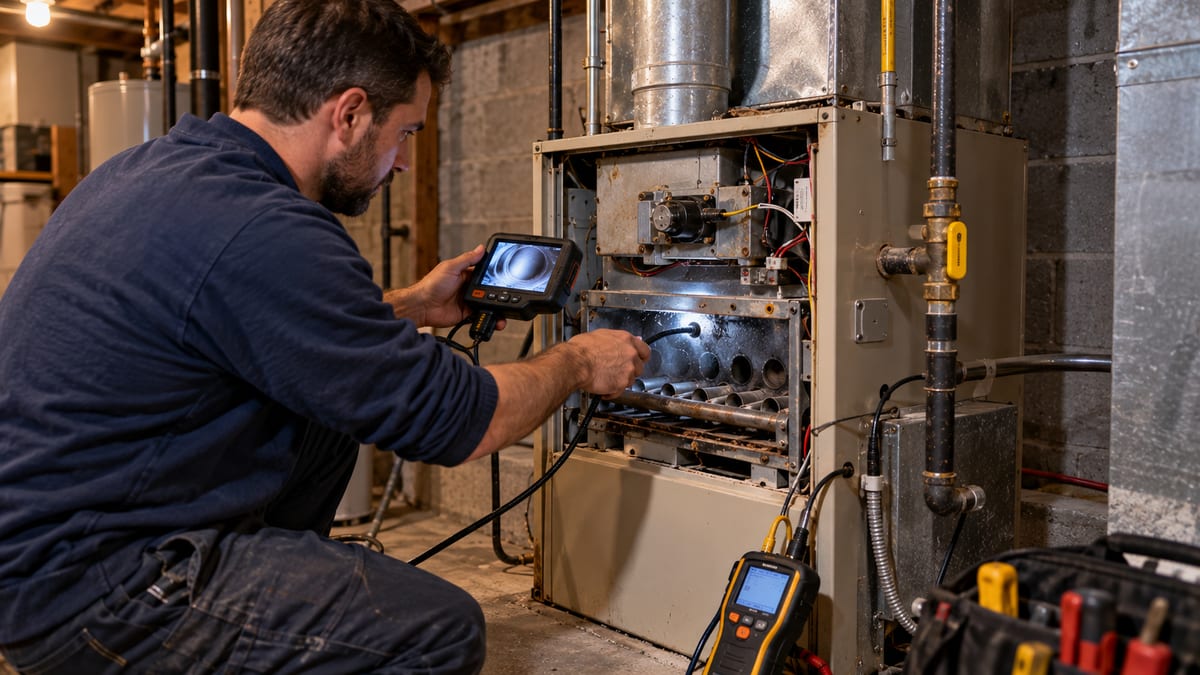
One finding overrides the arithmetic: a cracked heat exchanger on a furnace out of warranty. It can let combustion gases, including carbon monoxide, into the air that circulates through your home, and it's normally a replace-now situation. Make sure the technician shows you the crack, with a camera image or combustion readings. Our 5 signs your furnace needs repair and HVAC repair guide cover the symptoms that lead up to that decision.
How to Compare Furnace Replacement Quotes Line by Line
Get at least two written estimates and put them side by side. A lower price often just means less work is included. For each quote, check:
- Exact model numbers for the furnace and, if included, the coil and condenser, not just a brand and "96%." Look them up in the AHRI directory to confirm the rated efficiency and that the components are a matched system.
- Capacity and how it was chosen. The input BTU rating, and whether a Manual J was done.
- Venting scope. PVC route and termination location, and what happens to the water heater: liner, re-vent, or nothing (nothing is a warning sign).
- Condensate plan. Gravity drain or pump, neutralizer, pump safety switch.
- Duct and plenum work. New transitions, return modifications, sealing.
- Coil plan. Reuse, replace or full system, with refrigerant type stated, and whether the furnace is A2L-compatible.
- Gas, electrical and thermostat work included.
- Permit included and pulled by the contractor, with inspection attended.
- Removal and disposal of the old equipment.
- Warranty terms. Parts, heat exchanger and labor, and whether registration is required.
- Rebate handling. Who files the utility paperwork and whether the price shown is before or after rebates.
Red Flags in a Furnace Bid
- A price given without anyone measuring the house, ducts or venting.
- "Same size as the old one" as the only sizing method.
- A condensing furnace quote that doesn't mention the water heater venting at all.
- No permit, or a suggestion to skip it.
- Pressure to sign today to get a "special" that expires tonight.
- A cracked heat exchanger diagnosis with no photo, camera footage or readings to back it up.
- A promised 30% federal tax credit on a 2026 installation (see below).
Rebates, Tax Credits and Financing in 2026
The federal 25C tax credit is gone. The Energy Efficient Home Improvement Credit used to cover 30% of a qualifying furnace, up to $600. The One Big Beautiful Bill Act, signed July 4, 2025, ended it. The IRS confirms that the credit is not allowed for any property placed in service after December 31, 2025. A furnace installed in 2025 can still be claimed on a 2025 return. A 2026 installation gets nothing federally, so don't include it in your budget.
Utility rebates are the main incentive now. In central Jersey that means the NJNG and PSE&G programs described above: 95% AFUE minimum, replacing a non-condensing unit, permit required, and a June 30, 2027 installation deadline on the NJNG side. Current offers are on our offers page.
0% on-bill financing of up to $25,000 through NJNG and PSE&G is often a better deal than dealer financing. Compare the total repaid, not the monthly payment.
How to Lower Your Furnace Replacement Cost
- Replace before it fails. Replacing an aging furnace on your schedule in early fall leaves time to compare quotes; a January emergency doesn't.
- Size it properly. A correctly sized furnace often costs less than the oversized unit it replaces.
- Claim every rebate. Line up the permit, photos and paperwork with your utility's requirements.
- Maintain the new one. Annual service is often a warranty condition. If you're new to the equipment, our explainer on what HVAC is and how the parts work together is a good primer.


