September 24, 2026
Heat Pump vs Furnace: Which Is Cheaper to Run in New Jersey?
How a heat pump and a gas furnace compare in New Jersey: efficiency (COP vs AFUE), what each costs to run at 2026 NJ rates with the math shown, how dual-fuel systems work, and which rebates are still available.

Heat Pump vs Furnace: The Short Answer
A heat pump moves heat from outdoor air into your home and also cools it in summer; a furnace burns gas (or uses electric resistance) to make heat and only heats. At current New Jersey prices, a gas furnace is still cheaper to run per unit of heat than even an efficient heat pump, but a heat pump beats oil, propane and electric-resistance heat by a wide margin. For many central Jersey homes the best answer is both: a dual-fuel system.
Below we show the numbers behind that answer so you can check them against your own bills, and explain when we would recommend each system. If the equipment vocabulary is new to you, start with our guide to what HVAC means and how each system type works.
What Is the Difference Between a Heat Pump and a Furnace?
A furnace makes heat. A heat pump moves it.
How a furnace makes heat
A gas furnace burns natural gas or propane inside a sealed heat exchanger. The blower pushes house air across the outside of the exchanger, and the combustion gases go out the flue. Outdoor temperature doesn't affect the process, so a furnace puts out the same heat at 5°F as it does at 45°F. That consistency is its main strength.
An electric furnace does the same job with resistance coils instead of a burner. Each kilowatt-hour of electricity becomes one kilowatt-hour of heat. In New Jersey that makes it the most expensive way to heat a house, as the cost table below shows.
How a heat pump moves heat
A heat pump is an air conditioner that can run in reverse. In winter a reversing valve switches the direction of refrigerant flow, so the outdoor coil becomes the cold side. Refrigerant colder than the outdoor air absorbs heat from it, even at 30°F. The compressor then raises the refrigerant's pressure and temperature so it can release that heat through the indoor coil.
The electricity runs the compressor and fans; it doesn't make the heat. That is why a heat pump can deliver two, three or more units of heat per unit of electricity. ENERGY STAR says certified air-source heat pumps can deliver up to three times more heat energy to a home than the electrical energy they consume.
Is a Heat Pump More Efficient Than a Gas Furnace?
Measured by energy in versus heat out, yes, by a wide margin. Measured in dollars, not necessarily. The two are rated on different scales, so you have to convert before you compare.
AFUE: how furnaces are rated
AFUE (Annual Fuel Utilization Efficiency) is the percentage of the fuel's energy that becomes heat in your house over a season. The federal minimum for non-weatherized gas furnaces has been 80% since 2015. Condensing furnaces use a second heat exchanger to recover heat from the water vapor in the exhaust, reaching the mid-to-high 90s. ENERGY STAR requires 97% AFUE or higher for gas furnaces in the northern U.S., which includes New Jersey. A 2023 DOE rule raising the minimum to 95% from December 2028 is back in court after a 2026 Supreme Court order, so don't plan around that date yet. No furnace can exceed 100%.
COP and HSPF2: how heat pumps are rated
COP (Coefficient of Performance) is heat delivered divided by electricity used, at a single outdoor temperature. A COP of 3 means three units of heat per unit of electricity, or 300% in AFUE terms. HSPF2 is the seasonal rating on the EnergyGuide label, in BTUs delivered per watt-hour used. Divide it by 3.412 to get an approximate seasonal COP. A ducted heat pump at HSPF2 8.1, the ENERGY STAR cold-climate minimum, works out to a seasonal COP of about 2.4.
Why a heat pump's efficiency falls as it gets colder
The wider the temperature gap between outdoors and indoors, the harder the compressor has to work to move each BTU. As the weather drops, two things happen together:
- COP falls, because each BTU takes more electricity to move.
- Capacity falls, because colder, less dense refrigerant vapor carries less heat per compressor stroke. Meanwhile the house is losing heat faster than at any other time.
Cold-climate heat pumps offset both with variable-speed (inverter) compressors that can run faster than their nominal rating. ENERGY STAR's cold-climate designation requires a COP of at least 1.75 at 5°F and at least 70% of rated heating capacity at 5°F compared with 47°F. The NEEP cold-climate air-source heat pump list publishes tested 5°F capacity and COP for each model. It is the most useful document to have open when you compare quotes.
Balance point, auxiliary heat and emergency heat
A house loses more heat as it gets colder outside, while a heat pump's capacity falls. The temperature where the two lines cross is the thermal balance point. Below it, something has to make up the difference. In an all-electric system that is auxiliary heat: resistance strips in the air handler, with a COP of 1. When the thermostat shows "AUX," part of your heat is coming at electric-furnace prices. Emergency heat is the same strips switched on manually with the compressor locked out. Use it when the outdoor unit has failed, not on cold nights.
Defrost cycles: the steam is normal
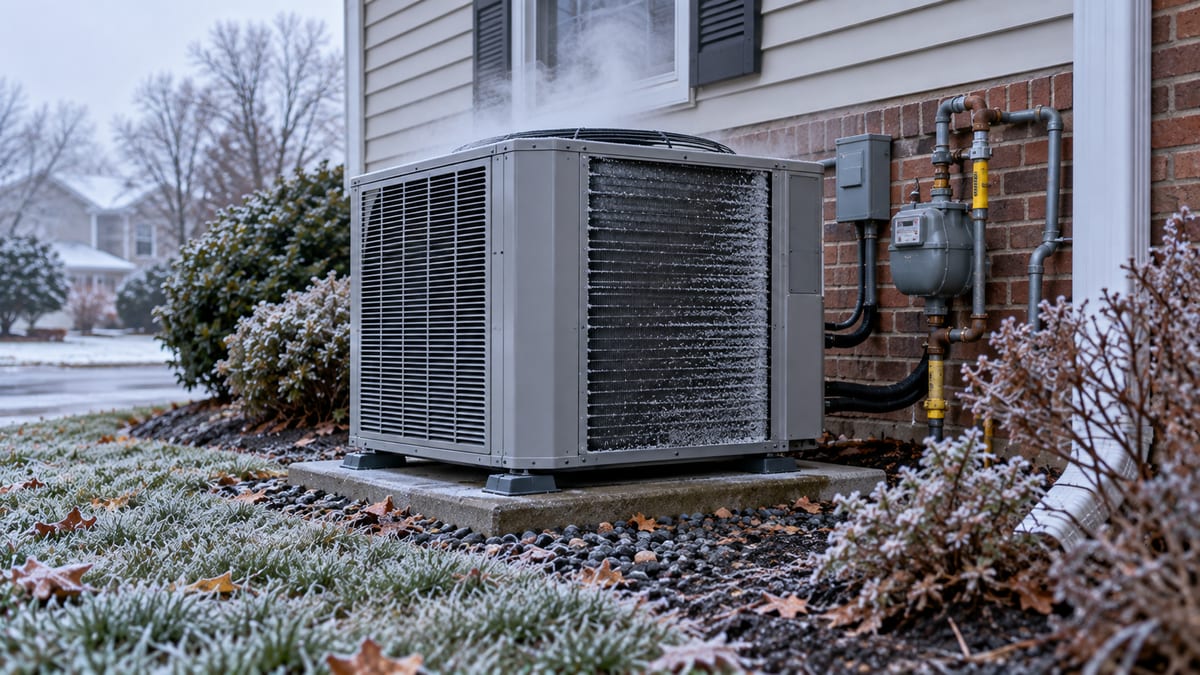
Below freezing in damp weather, frost builds on the outdoor coil. When the control board detects it, it briefly switches the system into cooling mode so hot refrigerant melts the ice. The outdoor fan stops, steam rises off the unit, and the strips usually come on to temper the supply air. This lasts a few minutes. A unit that stays encased in ice needs a service call.
What Is Cheaper to Run: a Heat Pump or a Gas Furnace?
In New Jersey, at current rates, a gas furnace is. Here is the arithmetic.
The formula
Compare cost per million BTU (MMBtu) of heat delivered into the house, not cost per unit of fuel:
- Gas: price per Mcf ÷ 1.036 MMBtu per Mcf ÷ AFUE
- Electricity: price per kWh × 293.1 kWh per MMBtu ÷ COP
The conversion factors are the U.S. Energy Information Administration's: 1,036 BTU per cubic foot of natural gas and 3,412 BTU per kWh.
The New Jersey inputs
- Natural gas: $14.21 per thousand cubic feet, the 2025 New Jersey residential average. Winter 2026 was close to that: $14.22 in January and $13.91 in February, per EIA's New Jersey residential natural gas prices. That comes to $13.72 per MMBtu of fuel.
- Electricity: 23.65¢ per kWh, the New Jersey residential average for January through June 2026, up from 21.06¢ a year earlier, per EIA's Electric Power Monthly. That comes to $69.31 per MMBtu at a COP of 1.
- Oil and propane: EIA's weekly survey had New Jersey heating oil at $4.47 a gallon and propane at $3.71 in late February 2026. Oil then rose to about $5.84 by the end of March.
The result
| Heating system | Efficiency assumed | Cost per MMBtu delivered | Example season (60 MMBtu) |
|---|---|---|---|
| Gas furnace, condensing | 96% AFUE | $14.29 | $857 |
| Gas furnace, standard | 80% AFUE | $17.15 | $1,029 |
| Heat pump, high efficiency | Seasonal COP 3.0 | $23.10 | $1,386 |
| Heat pump, cold-climate minimum | Seasonal COP 2.4 (HSPF2 8.1) | $29.25 | $1,755 |
| Oil boiler or furnace | 85% | $38.29 | $2,297 |
| Propane furnace | 95% AFUE | $42.73 | $2,564 |
| Electric furnace or aux strips | COP 1.0 | $69.31 | $4,159 |
The 60 MMBtu season is an illustration, not a typical-home figure. Your load depends on the house's size, insulation, air leakage and thermostat settings. The totals scale up or down, but the ranking stays the same.
What the numbers mean
The key figure is the break-even COP, the efficiency a heat pump would need to match gas: $69.31 ÷ $14.29 = about 4.9 against a 96% furnace, and $69.31 ÷ $17.15 = about 4.0 against an 80% furnace. No air-source heat pump we would install sustains a seasonal COP near 4.9 through a New Jersey winter. Per unit of energy, electricity here costs about five times as much as gas, and a heat pump's efficiency doesn't close that gap.
Four things cut the other way:
- Against oil, propane and electric resistance, the heat pump wins clearly, even at the cold-climate minimum.
- Fixed charges. A home that drops gas service entirely stops paying the monthly gas customer charge.
- Rates move. New Jersey's electric supply price resets every June through the Basic Generation Service auction. The NJ Board of Public Utilities certified the 2026 results in February, with prices up slightly on higher wholesale and PJM capacity costs. A heat pump is a bet on where the gas-to-electric price ratio goes over its service life, not over one winter.
- Solar. Winter kilowatt-hours from panels you already own cost you less than the utility tariff.
Heat Pump vs Electric Furnace
This one isn't close. The Department of Energy says today's heat pump can reduce electricity use for heating by approximately 65% compared with electric-resistance heat such as electric furnaces and baseboard. In the table, that is $69 per delivered MMBtu against $23 to $29. If your home has electric heat, a heat pump is the recommendation we make with the most confidence.
Heat Pump vs Furnace and AC
In practice, most central Jersey homes have a furnace and a central air conditioner on the same ducts. A heat pump sits on the same pad as the AC, uses the same line set and indoor coil, and cools just as well. It adds a reversing valve and defrost controls. So when a 15-year-old condenser fails in July, the real choice is between replacing the AC with another AC or with a heat pump that also heats. That choice usually leads to dual fuel. For the cooling side, see our air conditioning services.
Dual-Fuel Heat Pumps: Heat Pump and Gas Furnace Combo
A dual-fuel or hybrid system pairs an outdoor heat pump with an indoor gas furnace. The heat pump cools in summer and heats in mild weather. Below a set outdoor temperature, the switchover point, the controls shut it off and run the furnace instead. The two never run at once, because heat from the furnace would push the heat pump's refrigerant pressures too high.

Where to set the switchover
An economic switchover is set where the heat pump's COP drops to break-even. At 2026 New Jersey rates that would bring the furnace on early and often. A capacity switchover is set at the thermal balance point, so gas takes over before the resistance strips ever run. Many owners choose somewhere in between: the heat pump handles spring and fall with steady, even heat, and gas handles the cold snaps. It is a thermostat setting, and we can change it in minutes if rates shift.
Why dual fuel fits central New Jersey
The ENERGY STAR county design-temperature guide, built from ASHRAE and ACCA Manual J data, lists 99% heating design temperatures of 13°F for Monmouth County and 10°F for Middlesex and Ocean counties. Outdoor temperatures are above those figures for all but about 1% of the hours in a typical year. A cold-climate heat pump can carry most of the winter here, and the furnace covers the few very cold nights, when a heat pump is at its least efficient. Dual fuel also carries the largest local rebate right now.
Heat Pump Rebates in New Jersey (2026)
The federal tax credit is gone
Much of the advice online still cites a 30% federal credit of up to $2,000 for heat pumps. That credit, Section 25C, was ended early by Public Law 119-21. According to the IRS guidance on the change, it is not allowed for property placed in service after December 31, 2025. The same applies to furnaces. A heat pump or furnace installed in 2026 gets no federal tax credit. If a quote still counts one, ask for it to be removed.
Utility programs
New Jersey's efficiency rebates now run through the utilities under programs the Board of Public Utilities approves and oversees. The current cycle runs from January 1, 2025 to June 30, 2027 and gives heat pumps priority. What you can get depends on your electric and gas utilities:
- New Jersey Natural Gas (SAVEGREEN): NJNG, the gas utility for most of Monmouth and Ocean counties, offers a hybrid heat rebate of up to $2,000 for a single-zone home or $4,000 for a two-zone home. It applies when a gas furnace or boiler is paired with an air-source heat pump and an integrated thermostat. The two-zone tier requires SEER2 ≥ 15.2, EER2 ≥ 10, HSPF2 ≥ 8.1 and COP ≥ 1.75 at 5°F. Equipment must be purchased and installed by June 30, 2027, and 0% on-bill repayment of up to $25,000 is available.
- JCP&L: rebates on ENERGY STAR certified air-source and ductless heat pumps installed by a contractor, plus no-cost on-bill repayment financing.
- PSE&G: an HVAC instant-rebate program for qualifying heat pumps, applied at purchase through participating contractors.
Rebate amounts change during the program cycle, so we confirm the current figures for your utilities when we quote and list the rebate as a separate line. Our current offers page shows anything we are running on top of them.
Heat Pump vs Furnace: Side-by-Side Comparison
| Gas furnace | Air-source heat pump | Dual fuel (both) | |
|---|---|---|---|
| How it heats | Burns gas in a heat exchanger | Moves heat from outdoor air | Heat pump in mild weather, gas in the cold |
| Provides cooling | No, needs a separate AC | Yes | Yes |
| Efficiency rating | AFUE, 80% to high 90s | HSPF2 / COP, usually 2 to 3+ seasonal | Both |
| Output in deep cold | Full rated output | Capacity and COP fall; may need aux strips | Full output from the furnace |
| Cost per MMBtu delivered (NJ, 2026) | $14 to $17 | $23 to $29 (strips: $69) | Depends on switchover setting |
| Air at the registers | Hot, shorter cycles | Warm, longer and steadier cycles | Varies with outdoor temperature |
| Combustion and CO | Flue, CO alarms and annual inspection needed | None on site | Yes, from the furnace |
| Outdoor unit runtime | AC runs in summer only | Runs all year | Rests in the coldest weather |
| 2026 NJ incentives | Limited; no federal credit | Utility rebates, 0% financing | NJNG hybrid rebate up to $2,000 / $4,000 |
Heat Pump vs Furnace Cost to Install
We won't quote a statewide number, because the difference between two houses is usually bigger than the difference between the two technologies. What drives the price:
- What is already there. Replacing a furnace with a furnace, or an AC with a heat pump, reuses the ducts, venting, gas line and wiring. Converting from oil, or adding ducts, is a much bigger job.
- Electrical capacity. Heat pump backup strips add significant load to the electrical panel, and older 100-amp services sometimes need work. Dual fuel mostly avoids this, because the furnace is the backup.
- Cold-climate equipment. Variable-speed outdoor units cost more, and they are the ones that qualify for the larger rebates.
For a line-by-line breakdown of a furnace quote, see our guide to furnace replacement cost. If your current furnace might just need a repair, check our furnace repair cost guide and the five signs your furnace needs repair first.
Sizing: Why Manual J Matters More for Heat Pumps
An oversized furnace wastes some fuel but still works. A heat pump sized wrong causes problems you notice. Start with an ACCA Manual J load calculation: a room-by-room calculation of heat loss and heat gain based on the house's actual walls, windows, insulation and air leakage, run at the design temperatures above. Rules of thumb like tons per square foot are not a substitute.
A heat pump also has to meet both the heating and cooling loads with one outdoor unit, and in New Jersey the heating load is usually larger. A single-stage unit sized for heat is oversized for summer, which means short cycles and poor dehumidification. One sized for cooling falls short on the coldest nights. Variable-speed equipment handles both by running slowly most of the time, which is why we specify it. Dual fuel avoids the problem, because the furnace covers the cold end.
Heat pumps also need more airflow than furnaces, so undersized or leaky ducts that were fine with a furnace can leave a heat pump feeling weak. Air that is warm rather than hot is normal for a heat pump. It is different from a furnace that actually blows cold, which we cover in why your furnace is blowing cold air.
Maintenance Differences
A heat pump's compressor runs in both heating and cooling seasons, so it accumulates hours faster than a cooling-only AC. Clean coils, correct refrigerant charge, a clear condensate drain and working defrost controls matter more as a result. Service it in spring and fall. A gas furnace needs its own safety checks: heat exchanger, flue draft, combustion and carbon monoxide. Our HVAC maintenance guide covers both, and our HVAC repair guide explains which failures are emergencies.
New heat pumps now use lower-global-warming-potential A2L refrigerants such as R-454B and R-32 instead of R-410A. If you are only replacing the outdoor unit, check that the indoor coil and line set are compatible.
Which Should You Choose?
Here is what we recommend to homeowners from Red Bank and Freehold to Edison, Woodbridge, Old Bridge, Toms River, Brick and Howell.
- Gas furnace with a standard AC: you have gas, your AC is fairly new, and only the furnace is failing. Replacing a working AC to get a heat pump rarely pays back at today's rates.
- Dual fuel: you have gas, and the AC (or both units) is near the end of its life. This is the most common situation we see, and dual fuel is usually our first recommendation. You get cooling, efficient heat in mild weather, full-output gas heat in the cold, two independent heat sources, and NJNG's hybrid rebate if you qualify.
- All-electric heat pump: you heat with oil, propane, an electric furnace or baseboard; you have no gas service or want to drop it; or you have solar. Choose a cold-climate model from the NEEP list, sized with Manual J, so the strips stay a backup.
- Neither, yet: if rooms are drafty or uneven, fix the air sealing, insulation and ducts first, which also shrinks the system you will eventually need. If the furnace just needs a part, repair it and decide when the AC fails. If the house has no ducts, look at ductless mini-split heat pumps.
For a recommendation based on your own house, rates and utilities, we will run the load calculation and price both options side by side. See our heating services and heat pump installation pages, check our Monmouth, Middlesex and Ocean County service area, or contact us to book a visit.


