October 8, 2026
Commercial HVAC Service: Repair, Response Times, Agreements and Replacement
What commercial HVAC service covers beyond maintenance: repair and response times, what a service agreement should put in writing, when to replace a rooftop unit, refrigerant and ventilation compliance, and how to choose a provider.
By Noor Kamal, Technology Manager · Published · Updated
What Is Commercial HVAC Service?
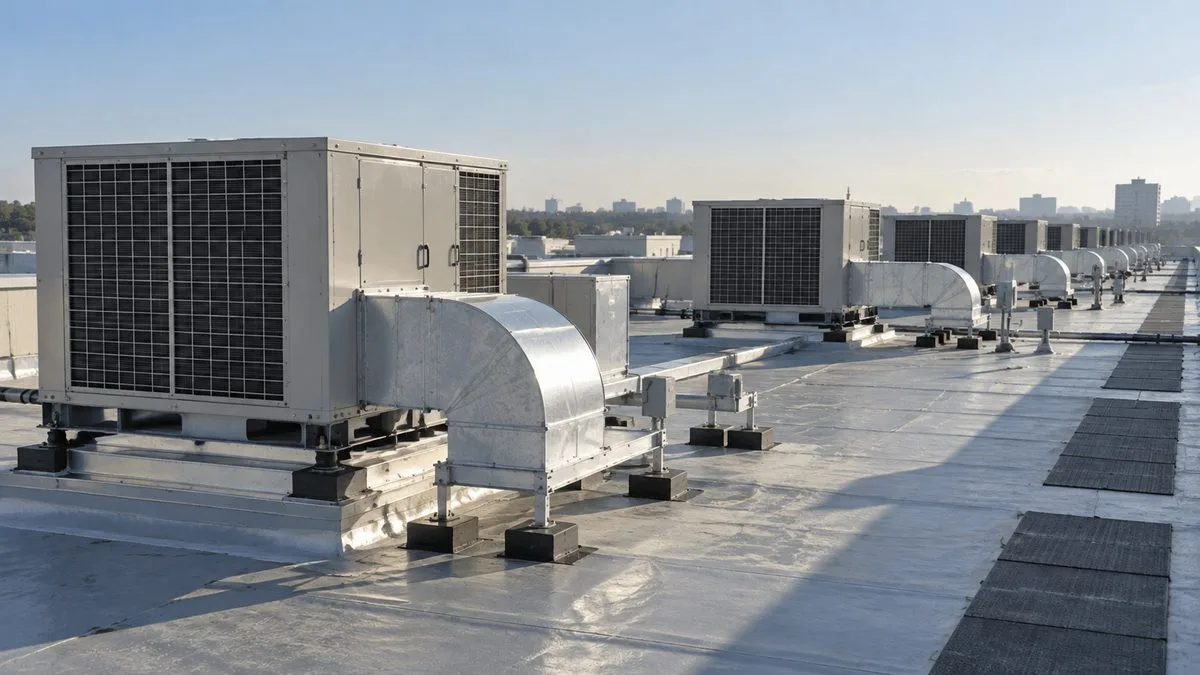
Commercial HVAC service is the repair, maintenance, replacement and emergency response for the heating, cooling and ventilation equipment in a business property — rooftop units, split systems, VRF, chillers, boilers, make-up air units and the controls that run them. Done well, it is an ongoing relationship with a contractor who knows your equipment, rather than a string of one-off calls to whoever can come today.
That relationship is the whole point. A commercial building's HVAC problems are rarely solved by one visit: the unit that failed last July is usually one of several the same age on the same roof, the ventilation setting that is wrong on one floor is usually wrong on the next, and the repair that is cheapest today is not always the cheapest across the next three years. This guide explains what commercial HVAC service covers, how response and service agreements work, when to repair and when to replace, what compliance looks like, and how to choose a provider who can actually service what is on your roof.
If you are specifically comparing maintenance programmes — task lists by interval, frequency by equipment class and contract pricing — our guide to commercial HVAC maintenance services covers that in depth. This article covers everything around it.
How Commercial HVAC Service Differs from Residential
The refrigeration cycle is the same in a restaurant as in a house. What changes is the equipment, the hours and the consequences:
| Residential | Commercial | |
|---|---|---|
| Typical equipment | Furnace + split AC, heat pump, boiler | Packaged rooftop units, split DX, VRF, chillers, boilers, make-up air |
| Run hours | A few hours a day, seasonally | 12–24 hours a day, often year-round |
| Power | Single-phase 240V | Usually three-phase 208V or 460V |
| Ventilation | Largely natural infiltration | Outside-air rates set by code for the occupancy |
| Controls | A thermostat | Programmable controllers or a building automation system |
| Access | Basement, attic, side yard | Roof, often needing ladders, hatches, fall protection or a lift |
| Cost of failure | Discomfort | Lost trading hours, spoiled stock, cancelled appointments |
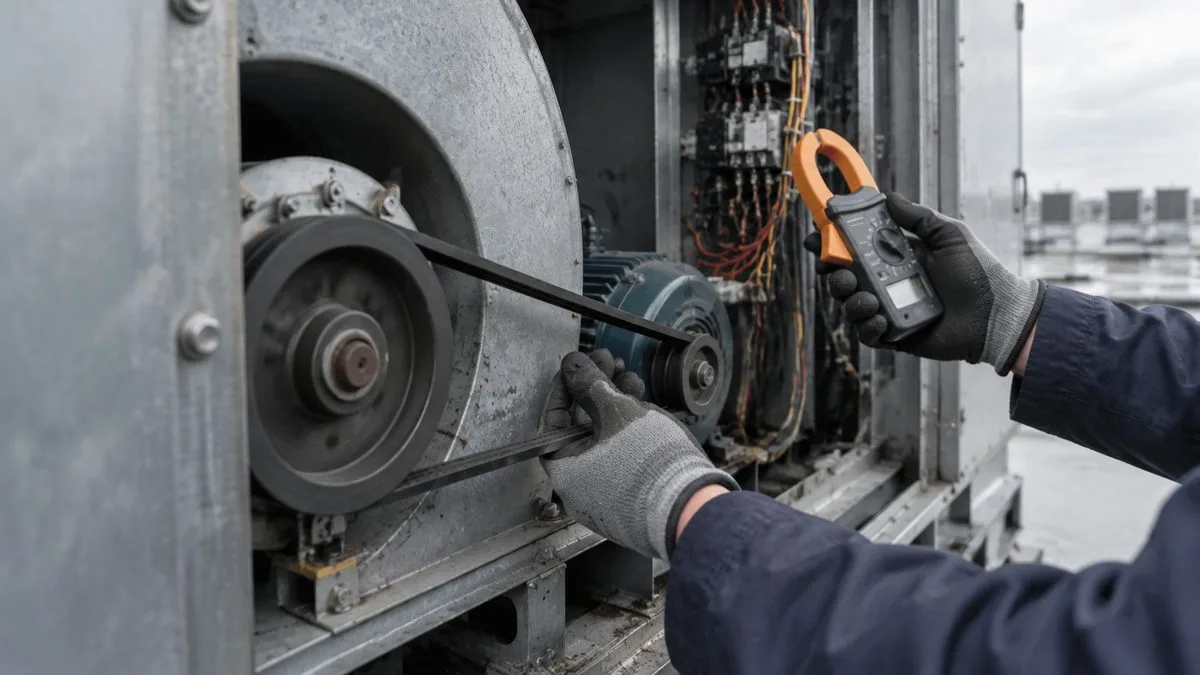
Three-phase power, economizers, belt-driven blowers, variable-frequency drives and building automation are routine commercial work and rare in homes. A technician who is excellent on residential systems may not be the right person for a 25-ton rooftop unit, and a good company will match the technician to the equipment.
What Commercial HVAC Services Include
A full-service commercial HVAC provider should cover five areas. Many firms are strong in two or three; it is worth asking about all five before you commit.
Repair and troubleshooting
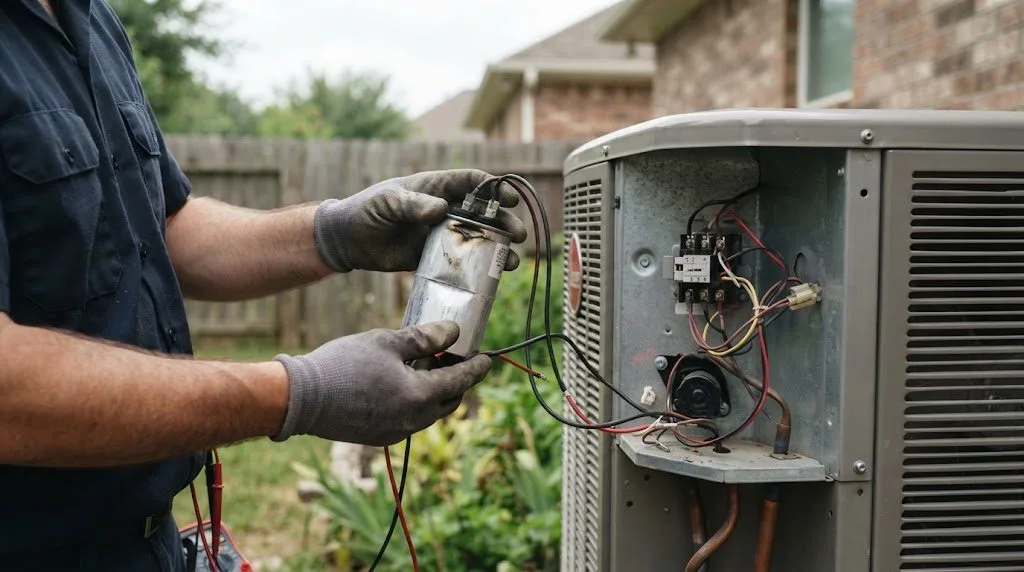
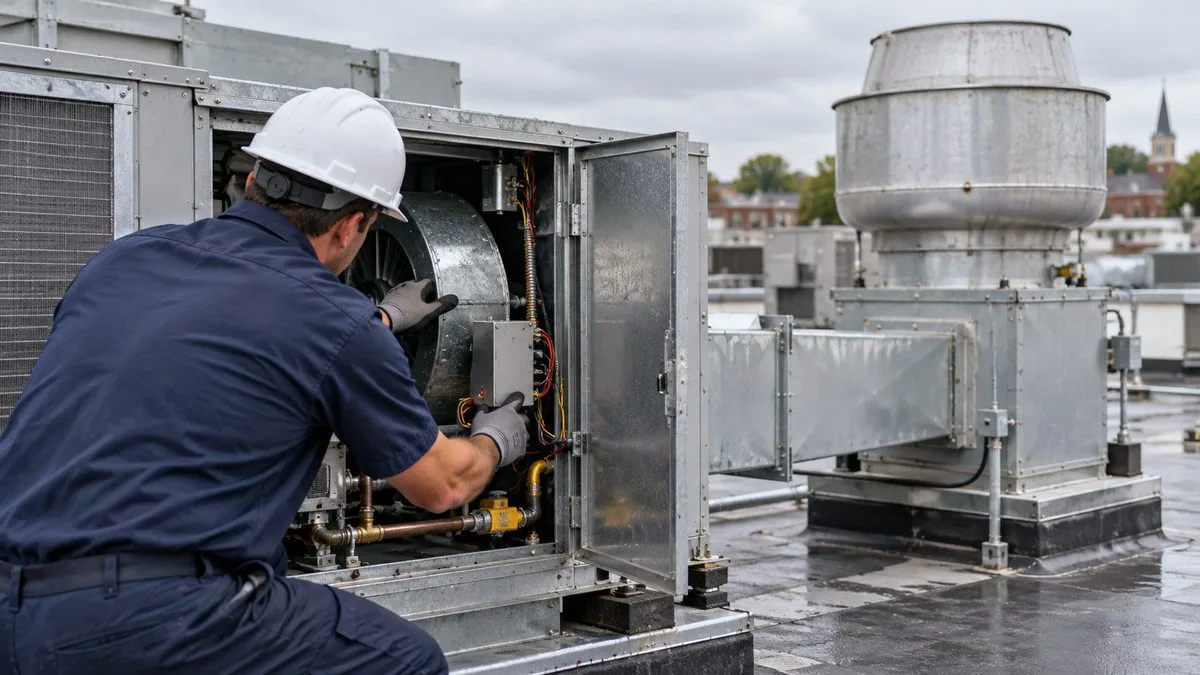
Diagnosing faults on three-phase equipment, economizers, variable-frequency drives, gas heat sections and controls, then repairing them with the correct parts. The skill that matters most is diagnosis: on commercial equipment a wrong guess is expensive, because parts are larger and access costs more. See commercial HVAC repair.
Preventive maintenance
Scheduled servicing organised by interval — monthly filters, quarterly belts, coils and electrical, seasonal refrigerant and combustion checks — ideally against ASHRAE Standard 180. It is covered in full in our commercial maintenance guide, and offered as maintenance contracts.
Replacement and installation
Replacing rooftop units, condensing units and air handlers at end of life, plus new installations for tenant fit-outs and change of use. This is where load calculation, curb adaptation, crane logistics, permits and commissioning all matter — covered below.
Emergency response
Priority dispatch when equipment fails, ahead of routine work on the schedule. The value of an established service relationship shows here: a contractor who already has your equipment list, access arrangements and history arrives knowing what they are walking into. Our emergency HVAC service guide covers what to do before the technician arrives.
Controls, ventilation and indoor air quality
Scheduling, setpoints, economizer settings and outside-air rates. A surprising share of commercial comfort complaints and high energy bills trace back to controls rather than failed equipment — units running overnight in an empty building, economizers stuck closed, or ventilation set for an occupancy the space no longer has. Filtration upgrades and indoor air quality work sit here too.
Response Times and Service Agreements
The most important commercial HVAC service question is not the hourly rate — it is how fast someone arrives when a unit fails in the middle of trading, and what that is written down as. Without a service agreement, a commercial customer joins the same queue as everyone else. With one, response is prioritised and the terms are agreed in advance.
A useful service agreement defines, in writing:
- Response time by severity — for example, total loss of cooling or heat in an occupied space versus a single noisy unit.
- What counts as an emergency, so there is no argument about it at 9 p.m.
- After-hours terms — whether evening and weekend labour is included, discounted or billed at a premium.
- Labour rates and parts markup for work outside the covered scope.
- The equipment covered, listed unit by unit with make, model, serial number and location.
- Reporting — what you receive after each visit and each repair.
- Access arrangements — keys, roof hatches, alarm codes, site contacts and any hours when work cannot take place.
For multi-site operators, insist on consistency: the same task list, the same report format and a single point of contact across every property. That consistency is what makes it possible to compare sites and plan replacement budgets across a portfolio.
Commercial HVAC Service by Business Type
Different properties stress equipment in different ways, and a good service plan reflects that.
Restaurants and food service
Kitchen exhaust removes large volumes of air, and make-up air units have to replace it or the building goes negative — doors that are hard to open, pilot lights that struggle, and hot kitchens. Grease loads filters and coils quickly, so service is more frequent, and walk-in coolers and freezers often share the roof and the service call. A failed rooftop unit over a dining room in July costs a service.
Medical and dental offices
Ventilation rates, filtration and humidity carry more weight here, and some spaces have specific pressure relationships. Service must be scheduled around patient hours, and documentation matters for accreditation and inspection.
Retail
Long trading hours, high door traffic and large glazed frontages put steady load on rooftop units. Controls and scheduling offer the biggest easy energy savings, because retail equipment is often left running long after close.
Offices and multi-tenant buildings
Comfort complaints are the everyday currency — too hot by the windows, too cold in the conference room. Zoning, controls and balancing matter as much as the equipment, and responsibility for HVAC between landlord and tenant should be clear in the lease.
Warehouses and light industrial
Unit heaters, large rooftop units and make-up air dominate. Temperature-sensitive stock turns an HVAC failure into an inventory problem, which changes how urgent every call is.
Repair or Replace a Commercial HVAC Unit?
Replace a commercial HVAC unit when its annual cost to keep — repairs, energy and downtime risk — exceeds the annualised cost of a new one across its service life. That sounds obvious, but it produces different answers from the residential rules of thumb, which ignore downtime, depreciation, lease term and the efficiency gap across long commercial run hours. We explain why the popular $5,000 rule misleads commercial buyers in our commercial maintenance guide.
Signals that replacement belongs on the capital plan:
- Age. Packaged rooftop units typically last 15–20 years; split systems similar; chillers and boilers often 20–30 years with good care. Units past that range are on borrowed time.
- Refrigerant. Equipment still running R-22 cannot be economically recharged, since the refrigerant is no longer produced. Any significant leak on an R-22 unit is a replacement conversation.
- Repeat failures. Two major repairs on the same unit in a year, or a compressor failure on an older unit.
- A fleet of the same age. When several units went in together, the first failure predicts the rest. Planning a phased replacement is almost always cheaper than replacing them one at a time as emergencies.
- Change of use. A space converted from storage to offices, or from retail to restaurant, may need a different capacity or ventilation rate than the original equipment provides.
What a rooftop unit replacement involves
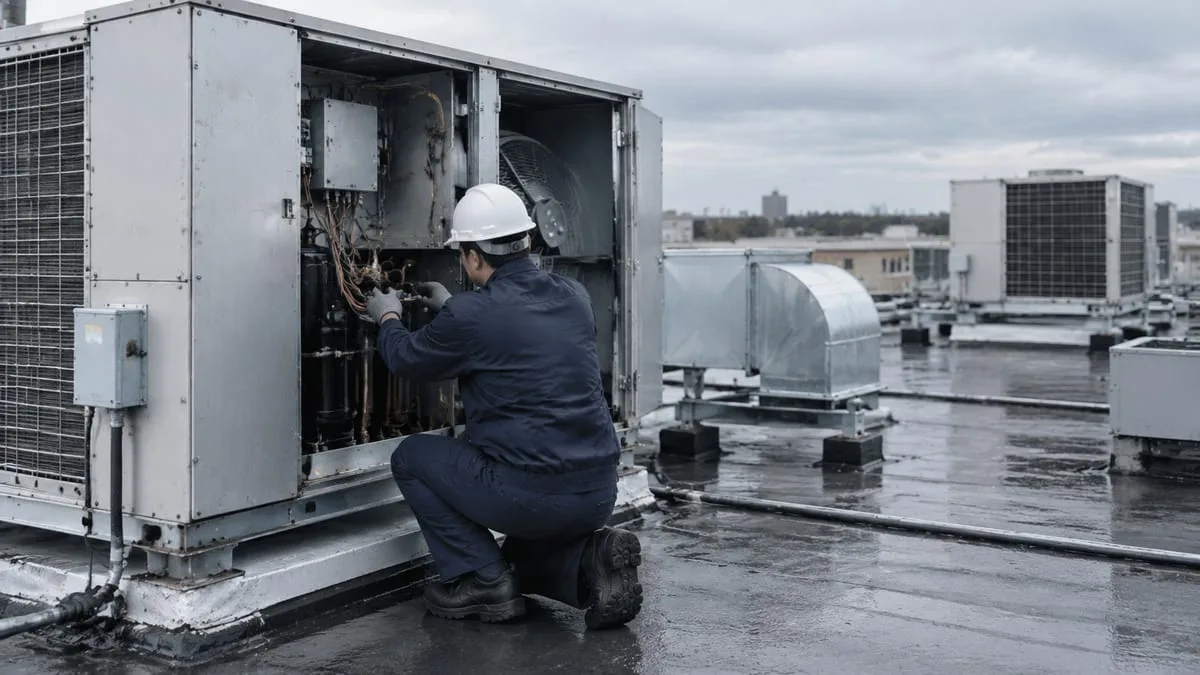
Replacing a rooftop unit is a logistics project as much as a mechanical one. A typical job includes a site survey and load check; confirming whether the new unit fits the existing curb or needs a curb adapter; a mechanical permit from the local construction official; scheduling a crane and sometimes a street closure; disconnecting and recovering refrigerant from the old unit; lifting out the old unit and setting the new one; reconnecting gas, power, condensate and controls; and commissioning — verifying airflow, charge, economizer operation, heat section and control sequences before handover. Most single-unit swaps are completed in a day once the crane is on site, often early in the morning to keep disruption away from trading hours.
Compliance: Refrigerant, Ventilation and Permits
Commercial HVAC service carries obligations that residential work mostly does not:
- Refrigerant handling. Anyone who opens a refrigerant circuit must hold EPA Section 608 certification. Under federal rules, owners of comfort-cooling equipment holding 50 pounds or more of refrigerant must repair leaks once the annual leak rate exceeds 10%, and keep records. Your contractor should track this for you.
- The refrigerant transition. New equipment has moved to lower-global-warming refrigerants such as R-454B and R-32, which are classed as mildly flammable (A2L) and bring their own installation and service requirements. Ask any contractor how they handle A2L equipment.
- Ventilation. Outside-air rates in occupied commercial spaces are set by the building code, which references ASHRAE Standard 62.1. Economizers and outside-air dampers must actually deliver them.
- Permits and licensing. Equipment replacement generally requires a permit under New Jersey's Uniform Construction Code, and the contractor must hold a New Jersey Master HVACR licence.
- Records. Dated service records support warranty claims, insurance, health inspections and lease negotiations. A contractor who produces them is doing part of your compliance work for you.
What Does Commercial HVAC Service Cost?
Commercial HVAC service is priced as a service call plus labour and parts for repairs, per unit or per square foot for maintenance agreements, and as a project quote for replacement. Commercial labour rates run higher than residential because the work needs more specialised skills, more equipment and more time on access and safety.
- Repair calls are typically billed as a trip or diagnostic charge plus hourly labour and parts, with premiums for after-hours work unless your agreement says otherwise.
- Maintenance agreements commonly benchmark at around $0.15–$0.30 per square foot per year, but serious proposals are built per unit — see our commercial maintenance pricing breakdown.
- Rooftop unit replacement is quoted as a project and commonly runs well into five figures per unit depending on tonnage, heat type, curb adaptation, crane access and controls.
The number that matters most is not on any invoice: it is the cost of an hour of downtime. For most businesses, that figure is what justifies a service agreement with guaranteed response.
How to Choose a Commercial HVAC Service Company
Search results for "commercial HVAC service near me" mix residential firms, national chains and genuine commercial specialists. These questions separate them quickly:
- What commercial equipment do you service every week? Rooftop units, VRF, chillers and boilers are different skill sets. Ask which they handle routinely, not occasionally.
- Will you survey before you quote? A firm that prices your building without seeing the roof is guessing.
- What is your written response time? Ask for it by severity, and what happens after hours.
- Can I see a sample service report? Per-unit readings and a condition summary are what you want.
- Are you licensed and insured for roof work? A New Jersey Master HVACR licence, plus liability and workers' compensation cover.
- How do you handle A2L refrigerants and Section 608 leak records? The answer tells you whether they are current.
- Who is my point of contact? One named person who knows your sites beats a call centre.
Talk to Guardian Air About Commercial HVAC Service
The best starting point for any commercial property is a survey: a technician on the roof recording every unit's age, condition, refrigerant and access, so that repair, maintenance and replacement decisions are based on your actual equipment.
Guardian Air is licensed and insured across Monmouth, Middlesex and Ocean counties. Explore commercial HVAC, maintenance contracts and commercial repair; for buildings where plumbing sits under the same roof, commercial plumbing is handled by the same team. Get in touch to book a survey.