September 22, 2026
What Is HVAC? Meaning, Systems, and Maintenance Explained
HVAC stands for heating, ventilation, and air conditioning. What the letters mean, how each system type works, what HVAC maintenance really involves, what technicians earn, and how to choose a contractor in New Jersey.
By Noor Kamal, Technology Manager · Published · Updated
What Is HVAC?
HVAC stands for heating, ventilation, and air conditioning. It is the system that heats your home in January, cools it in July, and moves air through it every day in between — usually as one connected set of equipment sharing the same ductwork, the same thermostat, and the same blower.
That one-sentence answer covers most of what people are looking for when they search the term. But "what is HVAC" is really four questions wearing a trench coat: what the letters mean, what the equipment actually does, what it costs to run and look after, and who you call when it stops. This guide answers all four, in that order, without the filler.
What Does HVAC Stand For?
HVAC is an acronym for Heating, Ventilation, and Air Conditioning. You will sometimes see HVACR, where the R adds Refrigeration — that variant is used mainly in commercial and industrial settings where coolers and freezers are part of the same trade.
The term is pronounced either as individual letters ("H-V-A-C") or as "aitch-vak." Both are normal. In the trade, the equipment itself is often just called "the system," and a technician who works on it is an HVAC tech.
Worth clearing up early, because it causes real confusion when people request service: HVAC is not a single appliance. It is a category. A furnace is HVAC. A central air conditioner is HVAC. So is a heat pump, a ductless mini-split, a rooftop unit, and the thermostat on your wall. When someone says "my HVAC is broken," the useful follow-up question is always which part.
What Is an HVAC System?
An HVAC system is the combination of equipment that controls three things about the air in a building: its temperature, its humidity, and its freshness. Strip away the branding and the model numbers and almost every residential system is doing the same four jobs.
Heating
Something has to add heat. In most New Jersey homes that is a gas furnace burning natural gas to warm air, or a boiler heating water for radiators and baseboard. Increasingly it is a heat pump, which does not create heat at all — it moves existing heat from outdoor air into your house, which is why it can be far more efficient than combustion. Furnace efficiency is measured in AFUE (the percentage of fuel that becomes usable heat); heat pump heating efficiency is measured in HSPF.
Ventilation
This is the letter everyone forgets, and it is the one that quietly determines how the house feels. Ventilation covers the movement of air — the blower, the supply and return ducts, the filter, and any dedicated fresh-air equipment. Modern homes are built tight for energy efficiency, which is excellent for bills and less excellent for air. Without deliberate ventilation, moisture, cooking fumes, and carbon dioxide accumulate. An ERV or HRV brings in outdoor air while recovering most of the energy from the air it exhausts, and it is the part of a system people most often discover they are missing when they start looking into indoor air quality.
Air Conditioning
Air conditioning removes heat and moisture rather than producing cold. Refrigerant circulates between an indoor evaporator coil and an outdoor condenser. Inside, it absorbs heat from your household air and evaporates; outside, it is compressed, gets hot, and dumps that heat into the outdoor air. The dehumidifying side effect matters more than most people realize — a properly running AC pulls gallons of water out of a humid house, which is a large part of why the same 74°F feels comfortable in one home and clammy in another. Cooling efficiency is rated in SEER2.
The controls that tie it together
The thermostat is the visible piece, but the system also depends on limit switches, pressure switches, a condensate drain, and a control board that sequences everything safely. A surprising share of "my system is dead" calls trace back to one cheap control component rather than the expensive box it is attached to — which is covered in more depth in our guide to HVAC repair.
The Main Types of HVAC System
Knowing which type you have makes every future conversation — with us or anyone else — faster and cheaper.
Split systems
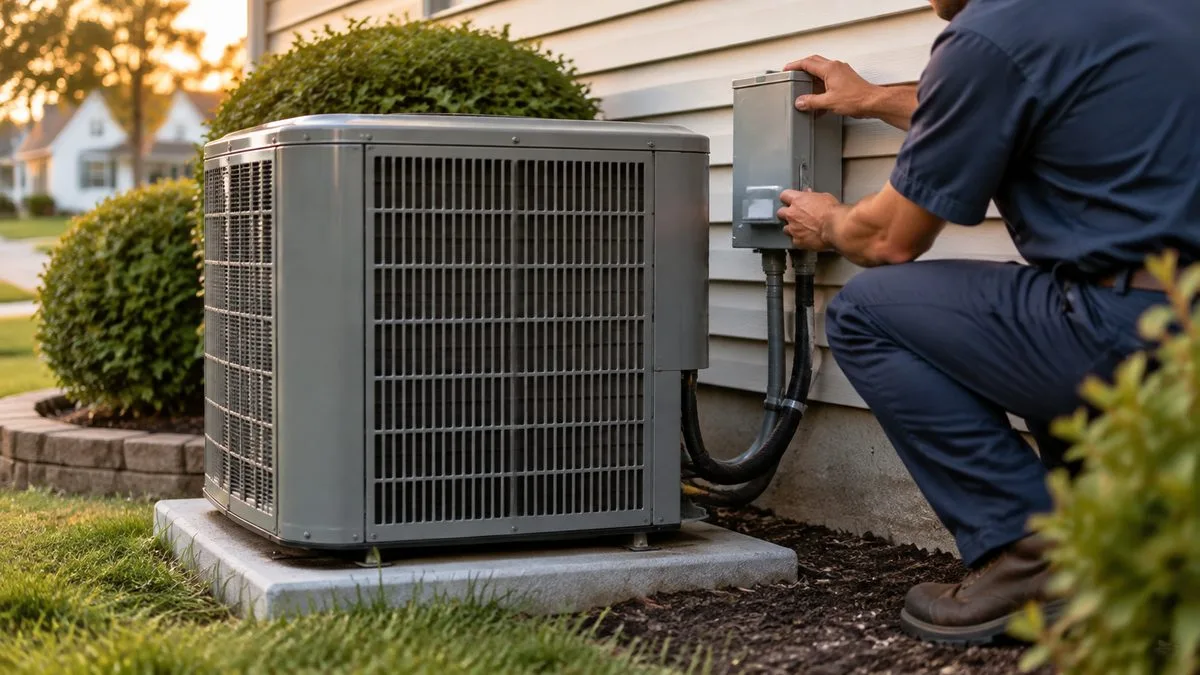
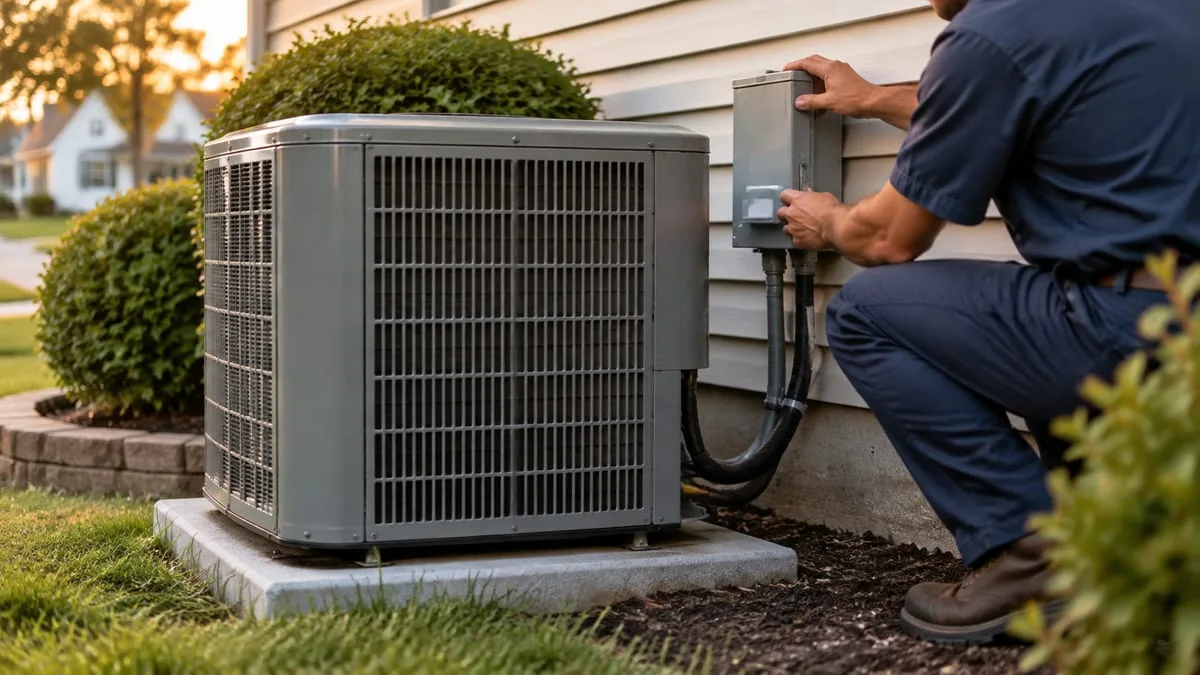
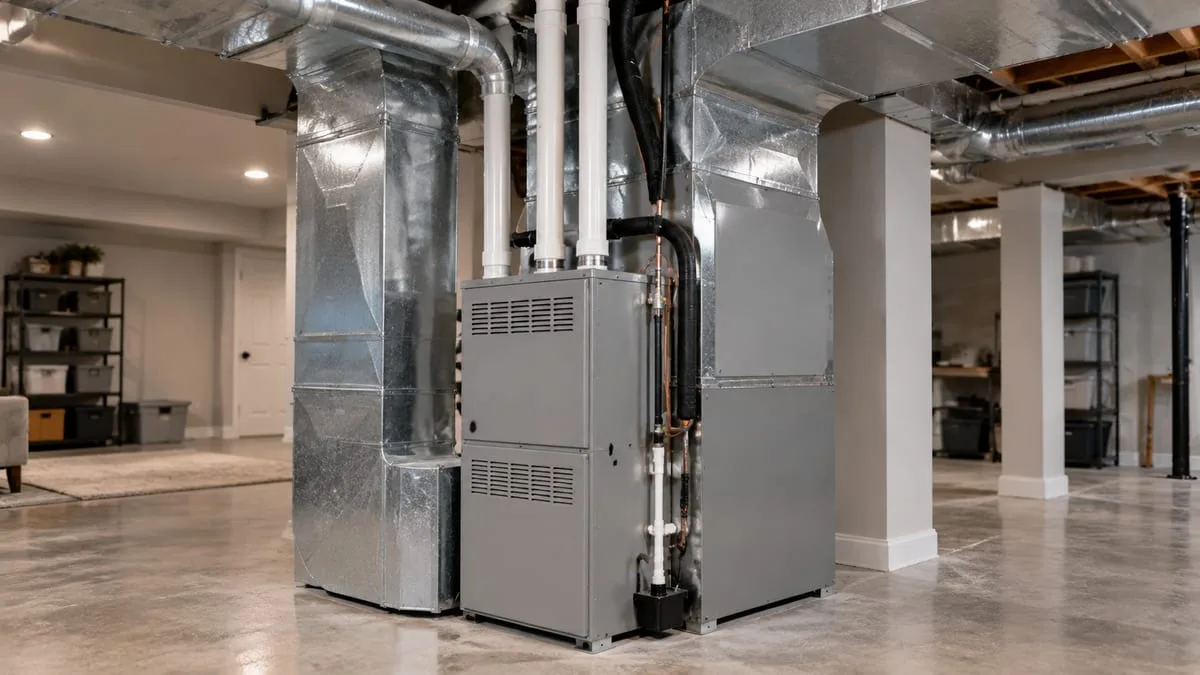
The most common residential setup in this region. A furnace and evaporator coil live indoors (basement, attic, or closet), the condenser sits outside on a pad, and ducts distribute air. "Split" refers to the indoor and outdoor halves. If you have a metal box in the basement and a humming unit beside the house, this is you.
Heat pumps
Mechanically an air conditioner that can run backwards. In summer it moves heat out; in winter it reverses and moves heat in. Modern cold-climate models hold useful capacity well below freezing, which was not true of units sold twenty years ago. Many New Jersey installations are dual-fuel: the heat pump handles mild weather efficiently and a gas furnace takes over in deep cold. Available New Jersey heat pump rebates and incentives can take a meaningful bite out of the upfront cost.
Ductless mini-splits
An outdoor unit connected by refrigerant lines to one or more wall-mounted indoor heads, with no ductwork at all. These are the standard answer for additions, converted attics, garages, sunrooms, and older homes that never had ducts. Each head is its own zone, so you are not paying to condition rooms nobody is in. See ductless mini-split service for how these differ in practice.
Boilers and hydronic heat
Common in older housing stock across the state. Water is heated and circulated to radiators, baseboard, or in-floor tubing. Boilers heat without moving air, which many people find more comfortable and less drying — but it also means a boiler-heated house has no ducts, so cooling has to come from mini-splits or a separate system. Boiler repair is a distinct skill set from forced-air work.
Packaged and rooftop units
Everything — compressor, coils, blower, heat — in a single cabinet, usually on a roof or a slab. Standard for retail spaces, offices, restaurants, and light industrial buildings, and the reason commercial HVAC is treated as its own discipline rather than residential work at a larger scale.
How Long Does an HVAC System Last?
Useful planning numbers, assuming the equipment has been looked after (we go deeper on how long furnaces last in a separate guide):
| Equipment | Typical service life |
|---|---|
| Gas furnace | 15–20 years |
| Central air conditioner | 12–17 years |
| Heat pump | 12–16 years |
| Ductless mini-split | 15–20 years |
| Boiler | 20–30 years |
Two things move equipment toward the bottom of those ranges faster than anything else: incorrect sizing at installation, and neglected maintenance. The first is unfixable after the fact. The second is entirely within your control, which brings us to the part of this article that actually saves people money.
What HVAC Maintenance Actually Involves
HVAC maintenance is scheduled, preventive work performed on equipment that is still running fine. That framing matters, because it is exactly why people skip it — nothing appears to be wrong. But the failures that strand you on the coldest night of the year are almost never sudden. They are the visible end of a slow drift that was measurable months earlier. If yours has already stopped, our guide to what to do in an HVAC emergency covers the first hour.
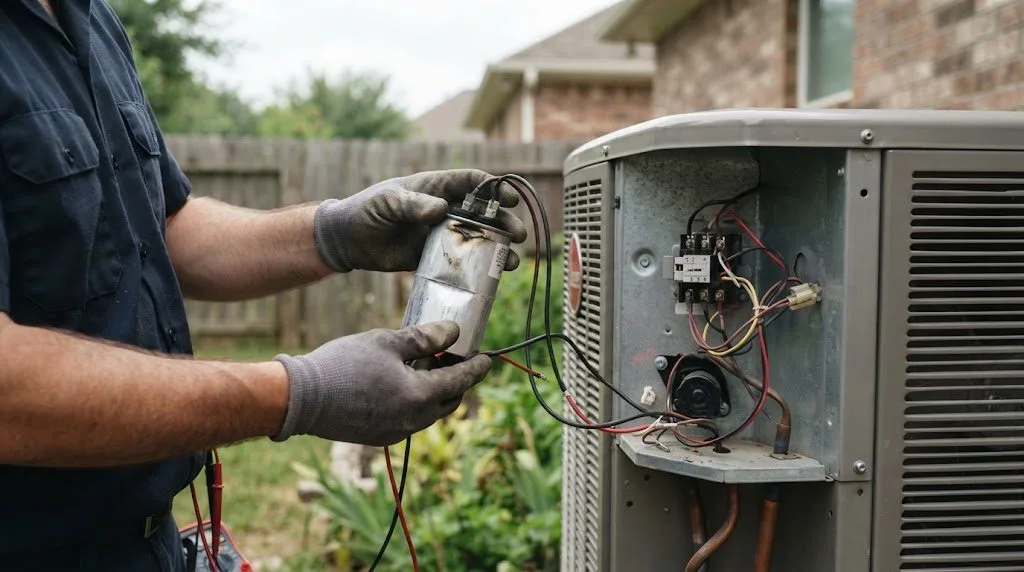
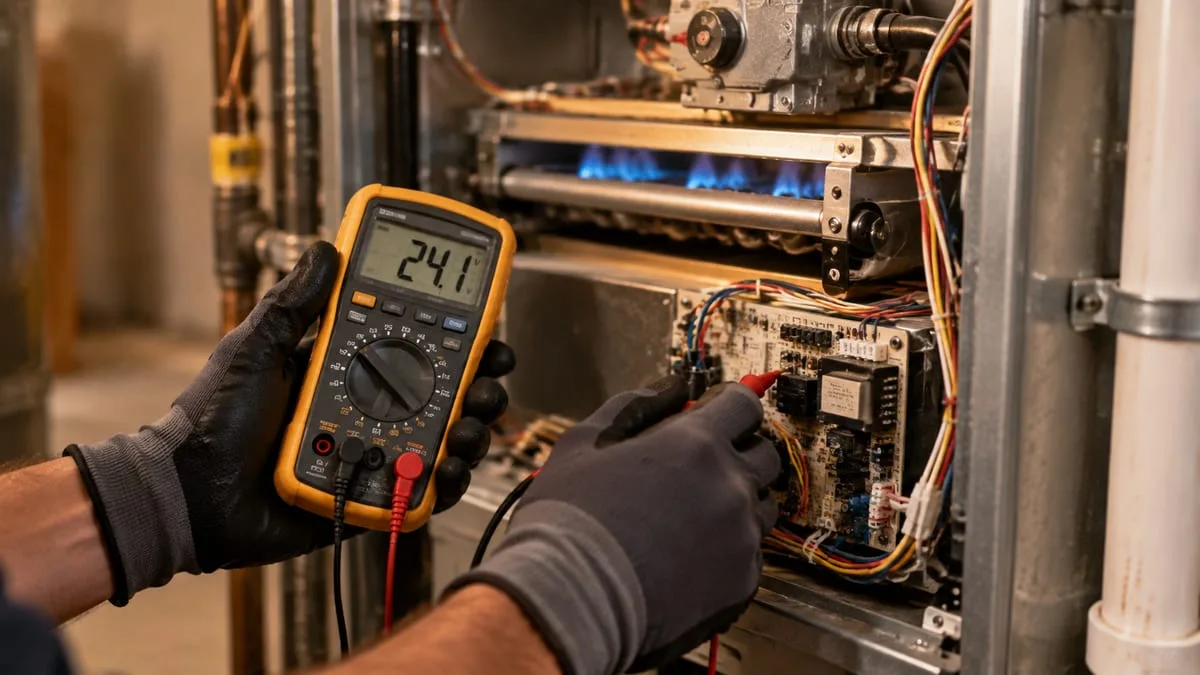
A capacitor does not fail without warning; its capacitance falls out of tolerance gradually and can be read with a meter. A condenser coil does not block overnight; it loads up with cottonwood and dust over two or three summers while the compressor works progressively harder against rising head pressure. Proper HVAC system maintenance is, more than anything, measurement — catching those drifts while they are still adjustments rather than replacements.
What a professional maintenance visit covers
A real AC tune-up or furnace tune-up is a checklist with instruments, not a visual once-over:
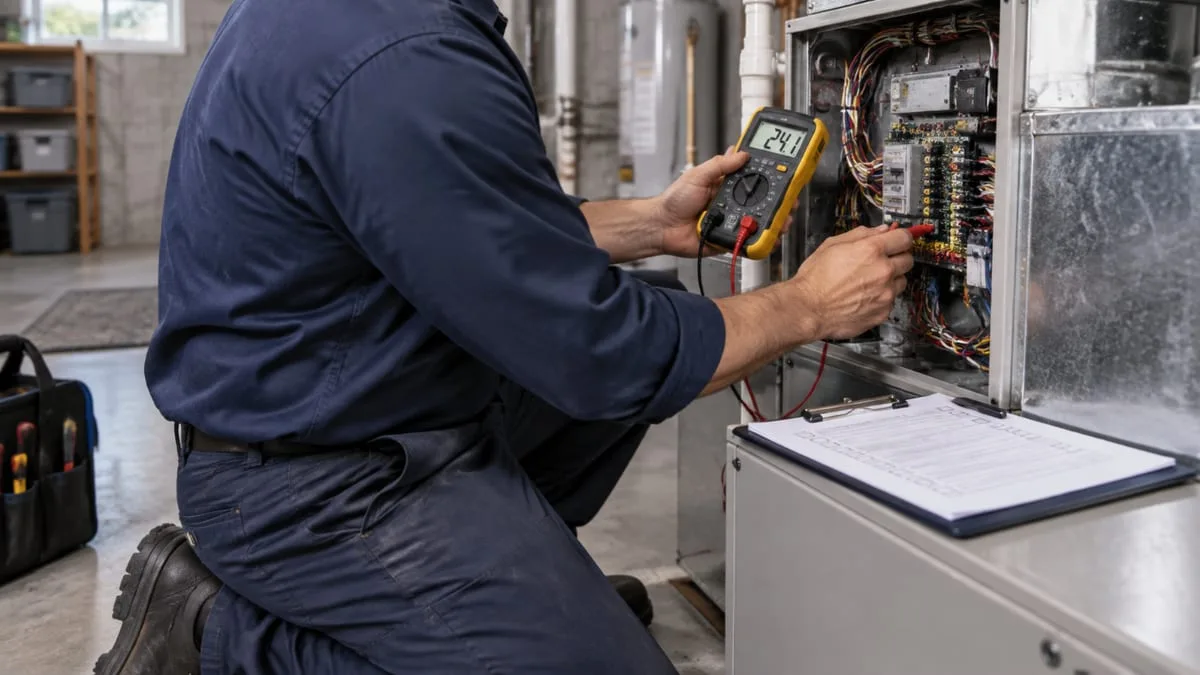
- Electrical — capacitor microfarad readings against rated tolerance, contactor pitting, amp draw on the compressor and blower motor, tightening of connections that have loosened through thermal cycling.
- Refrigerant side — suction and head pressures, superheat and subcooling, temperature split across the evaporator. These numbers reveal an undercharge or a restriction long before you notice weak cooling.
- Airflow — filter condition, blower wheel cleanliness, and static pressure across the system. High static pressure is the single most under-diagnosed problem in residential HVAC and it shortens the life of everything downstream of it.
- Combustion safety (heating) — heat exchanger inspection, flame sensor cleaning, ignition sequence, draft, and a carbon monoxide check at the flue. This is the portion of a maintenance visit that is genuinely about safety rather than efficiency.
- Condensate — clearing the drain line and trap, and confirming the safety float works. A blocked drain is the most common cause of water damage from an air conditioner.
How often should it be done?
The working rule is twice a year for a system that both heats and cools: cooling serviced in spring, heating serviced in autumn. A heat pump genuinely earns two visits because it runs year-round — roughly double the annual hours of a cooling-only condenser. If you have a furnace and separate AC and you are only going to do one visit, do the heating one; combustion safety is not an efficiency question.
What you should do between visits
The highest-value maintenance task in your home takes ninety seconds and needs no tools. Change the filter. A 1-inch pleated filter needs checking monthly and changing every one to three months; 4- or 5-inch media filters typically run six to twelve months. A loaded filter starves the blower, drops airflow, freezes evaporator coils in summer and overheats heat exchangers in winter. Chasing higher MERV ratings than your system was designed for causes the same problem — for most homes MERV 8 to 11 is the sensible band, and going higher is a conversation to have with a technician who can measure your static pressure first.
Beyond the filter: keep two feet of clearance around the outdoor unit, rinse the condenser fins gently with a hose each spring with the power off, keep supply and return vents unblocked by furniture, and pour a cup of warm water down the condensate drain occasionally in cooling season.
Commercial HVAC Maintenance Is a Different Job
Commercial HVAC maintenance shares the physics with residential work and almost nothing else. The equipment is usually packaged rooftop units rather than split systems, runs far longer duty cycles, and serves a building where a failure stops trading rather than making a family uncomfortable.
The practical differences: filter changes run quarterly or monthly instead of seasonally because commercial filter racks load much faster; belt-driven blowers need tension and alignment checks that residential ECM motors do not; economizers and their dampers need verification every season and are among the most commonly broken components on any rooftop; and outside-air requirements are often a code obligation rather than a comfort preference.
Most commercial buildings are better served by a scheduled agreement than by calling when something breaks — planned visits, documented readings, and priority response. That is the reasoning behind commercial maintenance contracts, and for a restaurant or medical office the documentation alone frequently justifies the arrangement at inspection time.
How Much Do HVAC Techs Make?
This question comes up constantly alongside the others — sometimes from homeowners working out where their invoice goes, more often from people considering the trade. The authoritative source is the U.S. Bureau of Labor Statistics, which tracks the occupation as "heating, air conditioning, and refrigeration mechanics and installers."
As of the May 2025 BLS figures, the median annual wage was $61,010, or $29.33 per hour. Median means half the workforce earned more and half earned less — a more honest centre than an average, which gets dragged upward by the top of the range.
Pay varies meaningfully by the industry a technician works in:
| Industry | Median annual wage (May 2025) |
|---|---|
| Wholesale trade | $71,190 |
| Retail trade | $62,830 |
| Educational services | $62,520 |
| HVAC contractors | $60,030 |
New Jersey technicians generally earn above the national figure, reflecting both the cost of living and a licensing regime that restricts the supply of qualified people. State wage data puts the New Jersey mean near $77,580, though published state figures vary by source and by whether they report a mean or a median — treat it as "comfortably above the national number" rather than a precise target.
The outlook is unusually strong. BLS projects 11 percent employment growth from 2025 to 2035 — much faster than the average across all occupations — with about 40,600 openings per year against roughly 440,900 existing jobs. The drivers are straightforward: an ageing installed base of equipment, tightening efficiency standards, the shift toward heat pumps, and a retiring generation of technicians that the trade has not replaced. Entry typically requires a postsecondary non-degree award or an apprenticeship rather than a four-year degree, and in New Jersey, work of any scale requires a licensed contractor.
If that interests you as a career rather than as trivia, we list openings on our careers page.
What HVAC Service Costs a Homeowner
Rough ranges for New Jersey, with the caveat that any honest contractor quotes after seeing the system rather than over the phone. Our HVAC service guide breaks down what each type of visit includes, and HVAC installation service covers replacement in depth.
- Maintenance visit — typically $100–$200 per system, less on a plan that bundles both seasons.
- Diagnostic fee — commonly $80–$150, frequently credited toward the repair.
- Common repairs — a capacitor or contactor is usually a few hundred dollars; a blower motor or control board runs higher. Our AC repair cost guide and furnace repair cost guide break these down line by line.
- System replacement — most full replacements land between $6,000 and $14,000 depending on equipment type, efficiency tier, and whether ductwork needs modification.
The repair-versus-replace decision has a reasonable rule of thumb behind it: multiply the repair quote by the equipment's age in years, and if the result exceeds about $5,000, replacement usually wins on arithmetic. It is a starting point for a conversation, not a verdict.
Choosing an HVAC Company
Searching for HVAC maintenance near me returns a lot of names, and the differences between them are not visible from the listings. A few checks separate them quickly.
Verify the licence and insurance. New Jersey requires HVAC contractors to hold a state licence. Ask for the number and confirm it. Ask for a certificate of insurance naming both liability and workers' compensation — if a technician is hurt in your home and the company carries no comp coverage, that exposure can land on your homeowner's policy.
Ask what the maintenance visit actually includes. "We'll check everything over" is not an answer. A company that performs real HVAC maintenance service can tell you which readings they take and will leave you a copy of them. If nobody can describe the checklist, there probably isn't one.
Insist on flat-rate pricing in writing before work begins. Hourly pricing on an unknown fault means you are carrying the risk of a slow diagnosis.
Be wary of pressure. A cracked heat exchanger or a failed compressor is a genuinely serious finding — and a technician who has found one should be able to show you the evidence and let you get a second opinion without resistance. Urgency that arrives before evidence is a sales technique.
Talk to Guardian Air
Whether you have just discovered what the letters stand for or you are comparing maintenance plans, the useful next step is the same: have someone measure your system rather than guess at it. Guardian Air is licensed and insured across Monmouth, Middlesex, and Ocean counties, and we quote flat rates in writing before any work starts.
Browse heating, cooling, indoor air quality, and commercial HVAC services (or the full list of what we do), check our current offers, or get in touch to book a visit.