October 12, 2026
Heat Pump Not Heating? Causes, Fixes & Repair Costs
Heat pump not heating or blowing lukewarm air? Learn what's normal (defrost, aux heat, 90–100°F air), the safe checks you can do yourself, what a technician looks for, and 2026 central NJ repair costs from Guardian Air's HVAC team.
By Noor Kamal, Technology Manager · Published · Updated
A heat pump not heating is most often a thermostat problem (wrong mode, or set up as a conventional system), a clogged filter, an outdoor coil buried in snow or solid ice, a tripped breaker or condensate float switch, or a failed capacitor or contactor. Some "no heat" complaints are normal: heat pump air runs around 90–100°F, which feels lukewarm, and defrost briefly blows cool air. If the checks below don't fix it, low refrigerant, a stuck reversing valve or a failed defrost control needs a licensed technician.
Written by the Guardian Air HVAC team · Reviewed for accuracy October 2026
When someone calls to say "my heat pump is not heating," the first job is separating a broken system from one doing what heat pumps do. This guide follows the order our technicians use across Monmouth, Middlesex and Ocean counties: what is normal, what you can safely check, what we check with gauges and meters, and what repairs cost. For gas equipment, see our guide to a furnace blowing cold air.
Is Your Heat Pump Actually Broken? What Normal Looks Like
The air feels lukewarm
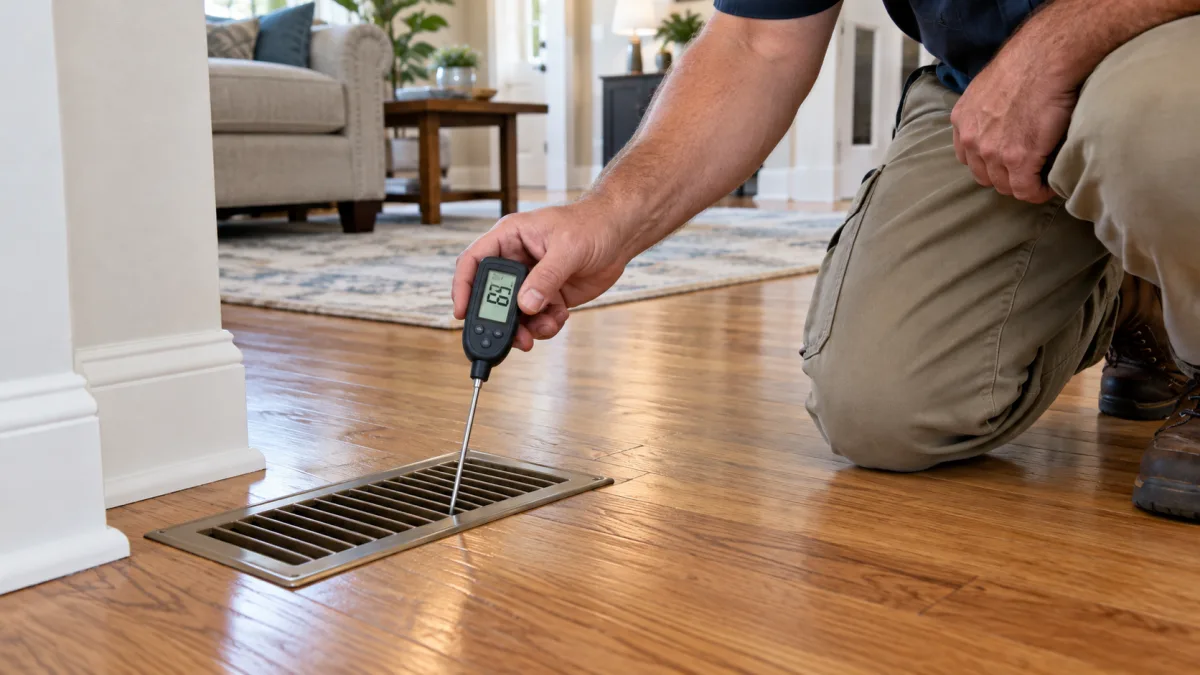
A heat pump moves heat in from outdoors rather than burning fuel, so its air is cooler than a furnace's. Energy Vanguard puts heat pump supply air typically between 90°F and 110°F, while furnaces commonly deliver 120–140°F. Your skin is in the low 90s, so heat pump air can feel cool on your hand while heating the house fine. The test is whether the house reaches and holds the setpoint.
Long run times in cold weather
Heat pumps, especially variable-speed models, are built to run long, steady cycles, and on a 20°F night may run almost nonstop. That is normal. A heat pump that cannot reach setpoint on a 40°F day is not.
Defrost: steam, a stopped fan and brief cool air
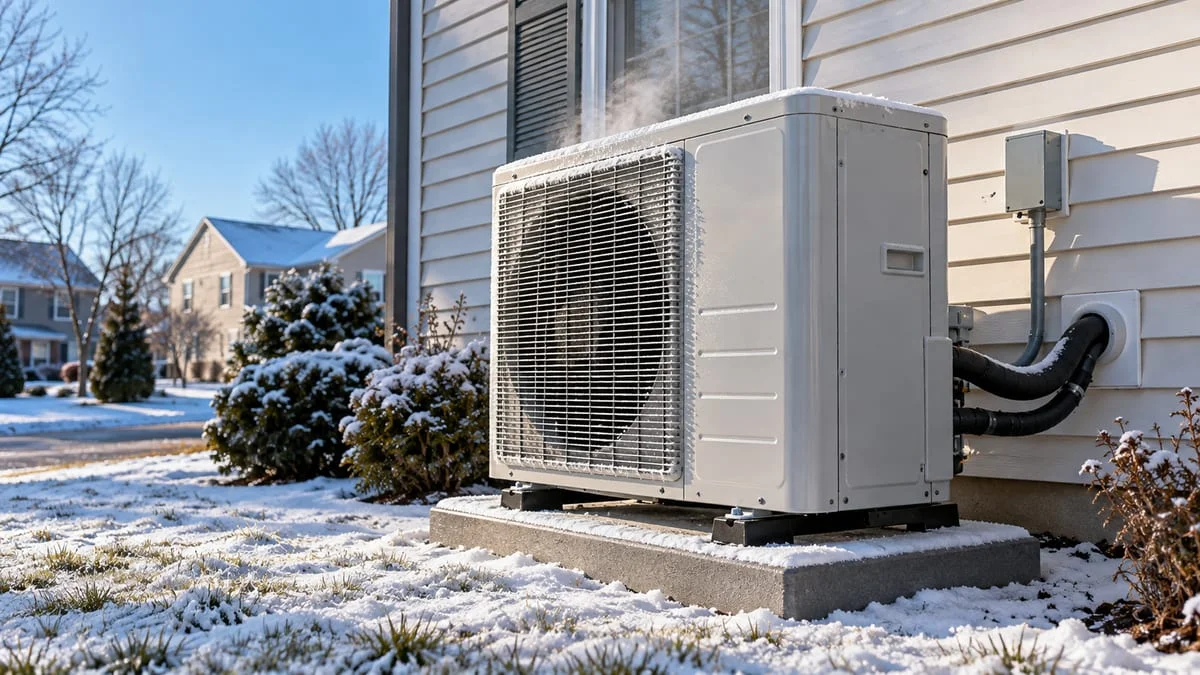
In cold, damp weather, frost builds on the outdoor coil, and the system briefly reverses into cooling to melt it. The outdoor fan stops, you may hear a whoosh, and steam rises off the unit. Lennox says defrost usually lasts 5 to 15 minutes. Many systems run backup heat during defrost; if yours does not, a few minutes of cool air is expected. If you are searching "heat pump not blowing cold air" in January because it briefly is blowing cool air, defrost is almost always why.
Balance point and auxiliary heat
As it gets colder, a house loses heat faster while a heat pump's output drops. Where the two cross is the balance point; below it, backup heat fills the gap and the thermostat shows "AUX." That is electric resistance strips, or a furnace on a dual-fuel system. AUX on the coldest nights is normal. AUX on a 45°F afternoon is a symptom. Our heat pump vs furnace comparison explains balance points in detail.
Why Is My Heat Pump Not Heating? Symptom and Cause Table
| Symptom | Likely cause | What you can safely check | When to call |
|---|---|---|---|
| Air feels lukewarm, house holds setpoint | Normal operation | Nothing | No need |
| Cool air for minutes, steam outside | Defrost cycle | Wait 15 minutes | If it never ends or repeats constantly |
| Cold air whenever heat is called | Thermostat setup, O/B setting, reversing valve | Mode and system type | If settings are correct |
| Heat pump not blowing air at all | Breaker, float switch, blower motor | Breakers, filter, drain pan | If a breaker re-trips or the pan is full |
| Outdoor unit not turning on | Emergency heat selected, disconnect, capacitor, contactor | Thermostat mode, disconnect, breaker | If it hums but won't start |
| Outdoor coil a solid block of ice | Defrost control, low refrigerant, fan motor | Clear snow, check for dripping gutters | If ice remains after a few hours |
| Heat pump not heating enough, AUX always on | Low charge, dirty coil, airflow | Filter, registers | Call: needs gauges |
| Falls behind only below about 15°F | Undersized or non-cold-climate unit | Confirm AUX comes on | For a sizing review |
Heat Pump Will Not Heat: Safe Homeowner Checks in Order
None of these needs tools, sealed panels opened or wiring touched. The simple fixes are usually found in the first five.
- Thermostat mode. HEAT, not COOL, AUTO or OFF, with the setpoint a few degrees above room temperature and fresh batteries.
- "Em Heat" on the display. Emergency heat locks out the outdoor unit. If it was left on, the outdoor unit won't run and your bill climbs. Switch back to HEAT.
- Air filter. A clogged filter chokes airflow and can trip a safety limit. If light doesn't pass through it, replace it.
- Registers and returns. Open closed vents and clear furniture or rugs off return grilles.
- Breakers. There are usually two: outdoor unit and air handler/heat strips. Reset a tripped one once; if it trips again, leave it off and call.
- Outdoor disconnect. In the gray box by the outdoor unit, confirm the pull-out block or lever is in and on. Touch nothing else inside.
- Snow and clearance. Brush snow off the unit by hand or with a soft broom, keep a foot or two clear around it, and watch for gutters dripping onto it.
- Condensate drain. Look at the air handler's drain pan and any condensate pump. A float switch shuts the system off when water backs up, a common reason a heat pump heater is not working at all.
- Possible defrost. Steam outside or a stopped outdoor fan? Give it 15 minutes.
- Error codes. Photograph any code or blinking LED before resetting anything, so the technician sees the original fault.
Normal frost vs a solid block of ice
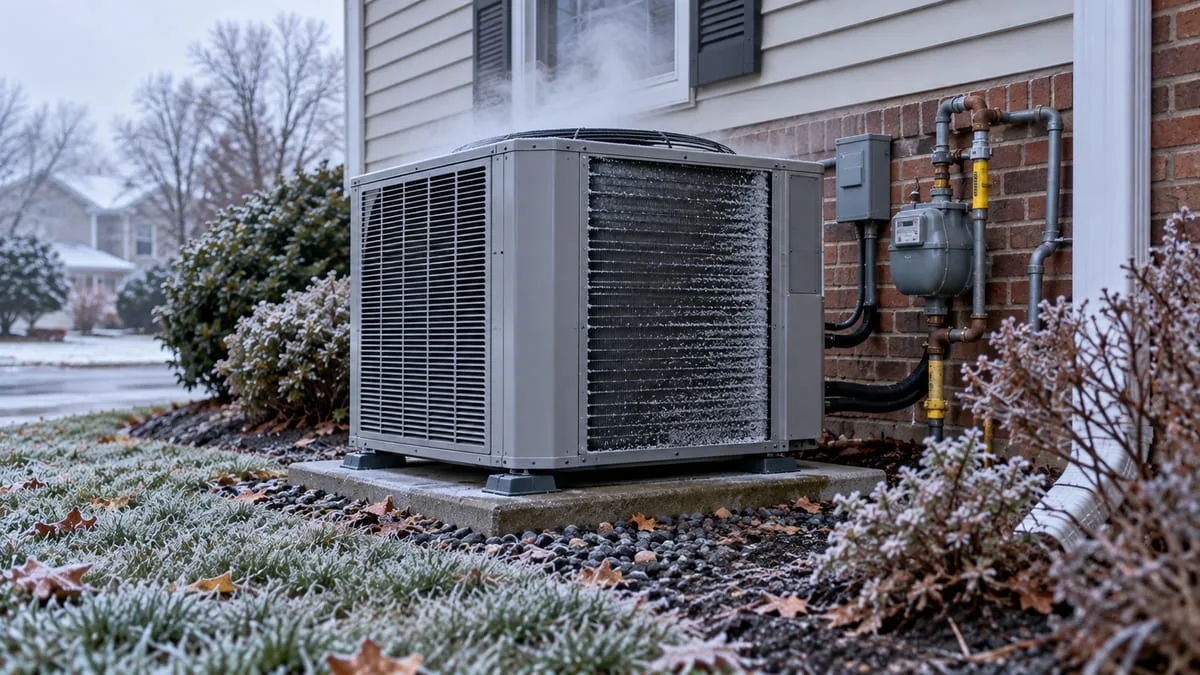
Thin white frost on a cold, wet morning is normal; defrost clears it. Thick clear ice encasing the coil or freezing the fan is not. Do not chip ice with a screwdriver or scraper: the fins and tubing are thin, and one puncture turns a defrost repair into a refrigerant leak. Hot water is a poor idea too, because the runoff refreezes at the base. Switch to emergency heat, clear snow by hand, and call.
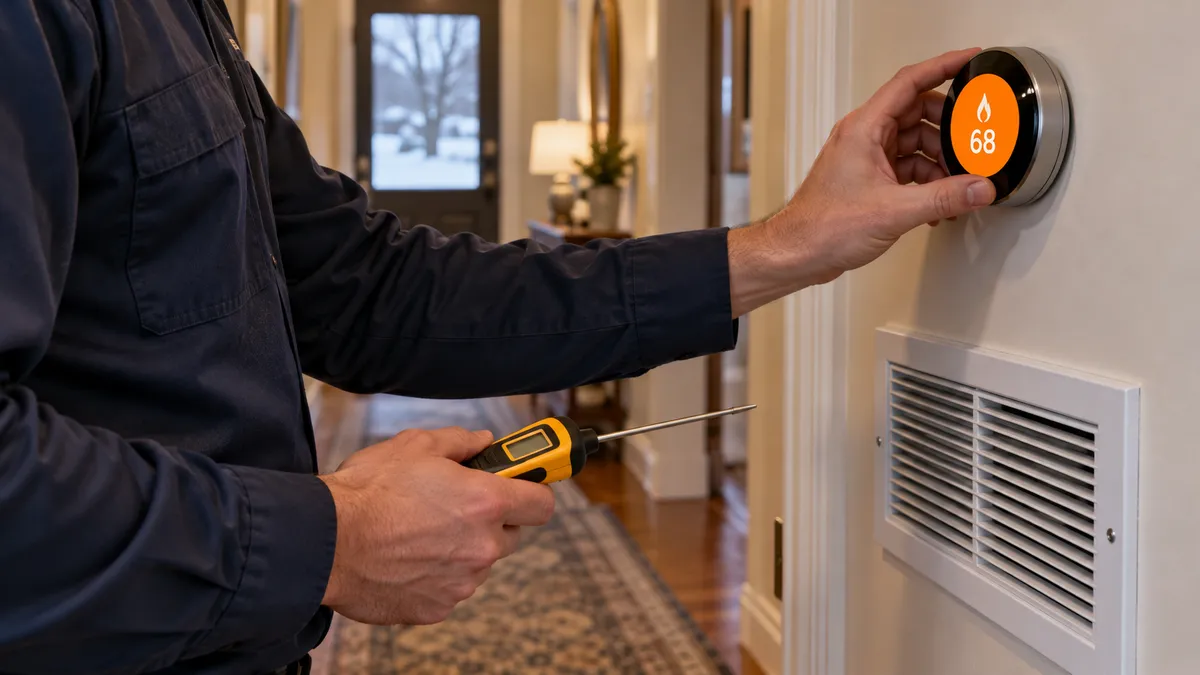
Thermostat Problems Behind a Heat Pump Heat Not Working
In the first cold week of the season, a good share of heat pump no heat calls trace to the thermostat, not the equipment.
Wrong system type. The thermostat must be configured as a heat pump, not a conventional gas/electric system. A self-installed smart thermostat set to conventional may never run the outdoor unit in heat.
The O/B setting. The reversing valve is driven by a wire labeled O or B. Most brands energize it in cooling (O); some, notably Rheem and Ruud, in heating (B). Set backwards, the system cools when you ask for heat. A heat pump that has blown cold air since the day a new thermostat went in almost always has this reversed.
Backup heat wiring. If the auxiliary wire wasn't connected during a swap, backup heat never comes on and the house falls behind on cold nights. Photograph the wiring for the technician.
Heat Pump Running But Not Heating: What a Technician Checks
Past the simple checks, the remaining causes need meters, gauges and a license.
What we most often find
On service calls across Monmouth and Ocean counties we most often find, roughly in this order: a failed capacitor or pitted contactor in the outdoor unit, a misconfigured thermostat, a low refrigerant charge from a slow leak, a defrost control or sensor that has stopped clearing the coil, and a float switch tripped by a clogged condensate line. Shore homes add salt-air corrosion of coils and electrical contacts. Reversing valve and compressor failures are less common but sit at the expensive end.
Capacitor and contactor
The capacitor helps the compressor and outdoor fan start; when it weakens, the unit hums or clicks and the thermostat falls back on AUX. The contactor is the relay that switches the outdoor unit on, and pitted contacts cause no-start. These are the usual reasons the outdoor unit of a heat pump is not turning on when it has power.
Low refrigerant
Refrigerant is not used up, so a low charge means a leak. It shows up as a heat pump not heating enough, long run times, constant AUX and heavy icing. We confirm with gauges, find and repair the leak, then charge to the manufacturer's specification. Topping off without fixing the leak means buying the same refrigerant again next winter.
Stuck reversing valve
If the reversing valve sticks in cooling, the heat pump runs but no heat comes out for the whole cycle, not just during defrost. We rule out the thermostat and the valve's solenoid coil first, because both cost far less than the valve, which requires refrigerant recovery, brazing and evacuation.
Defrost control, outdoor fan and blower
When the defrost board or coil sensor fails, frost becomes a block of ice and output collapses; a failed outdoor fan motor does the same. If the heat pump is not blowing air at all, suspect the indoor blower motor, its capacitor or the float switch. Dirty indoor coils and blower wheels, which a filter change doesn't reach, weaken airflow.
Sizing and cold-climate capability
ENERGY STAR's county design-temperature guide lists 99% heating design temperatures of 13°F for Monmouth and 10°F for Middlesex and Ocean counties. A standard single-stage heat pump loses much of its capacity near those numbers. If yours keeps up at 30°F but a heat pump not heating to set temperature below 15°F is your pattern, and backup heat works, the unit may be undersized or not cold-climate rated. ENERGY STAR's cold-climate criteria require at least 70% of rated capacity and a COP of at least 1.75 at 5°F, and the NEEP cold-climate list publishes tested performance by model. That is a sizing conversation; our heat pump cost guide covers cold-climate equipment.
Ductless Mini Split Not Heating
Indoor heads use a "hot start" that holds the fan off for a few minutes until the coil warms, so a head that seems dead right after switching on may just be waiting. Confirm the remote says HEAT, not AUTO, DRY or FAN. Rinse the washable filters; on heads that run all winter, clogged filters are the most common cause of weak heat. Most heads show defrost with an indicator light and faults with a blink pattern or display code; note it for the technician, since codes vary by brand. Keep the outdoor unit raised above snow. Our ductless mini split cost guide covers upkeep.
When to Use Emergency Heat (and Why It Is Expensive)
Emergency heat shuts off the compressor and heats with resistance strips or, on dual fuel, the furnace. Use it when the outdoor unit has failed, is iced solid, or is grinding or banging, so the house stays warm until help arrives. Don't use it as a boost. Resistance heat turns one unit of electricity into one unit of heat, while a heat pump in mild weather delivers two to three times that, so a week on emergency heat shows clearly on a JCP&L or Atlantic City Electric bill.
Heat Pump Repair Costs in Central NJ (2026 Estimates)
These estimates come from our own jobs and match our heat pump services guide. Your price depends on the diagnosis, equipment, refrigerant and access.
| Repair | Typical cost | Notes |
|---|---|---|
| Diagnostic / service call | $89–$150 | Often credited toward the repair; thermostat setup fixes usually handled here |
| Capacitor replacement | $150–$400 | Most common single failure |
| Contactor replacement | $150–$350 | No-start or non-stop outdoor unit |
| Defrost control board or sensor | $300–$700 | Fixes outdoor units that ice over |
| Refrigerant leak repair and recharge | $300–$1,500+ | Depends on leak location and refrigerant |
| Reversing valve replacement | $1,000–$2,500 | Labor-heavy brazing job |
| Compressor replacement | $1,200–$2,800+ | On older units, compare with replacement |
A rule of thumb from our HVAC repair guide: multiply the repair cost by the system's age in years. Above about $5,000, get a replacement quote too, and check our NJ HVAC rebates guide before you buy.
Limitations and Safety Notes
- No refrigerant work. Under EPA Section 608, opening a refrigerant circuit and buying most refrigerants requires certification. Store-bought "recharge" cans and venting are illegal and can ruin a compressor.
- No electrical panels. Resetting a breaker is fine. Removing panel covers or the outdoor unit's service panel exposes 240-volt wiring, and capacitors hold a charge after power is off.
- No bypassed safety switches. A float or pressure switch that keeps tripping is reporting a real problem.
- This guide can't diagnose your system. Controls, codes and defrost logic differ by brand; check your manual or call.
If the house is losing heat fast, someone vulnerable lives there, or pipes may freeze, treat it as urgent; see our emergency HVAC service guide.
About Guardian Air
Guardian Air is a licensed New Jersey HVAC and plumbing contractor serving Monmouth, Middlesex and Ocean counties. Our EPA 608-certified technicians diagnose and repair ducted heat pumps and ductless mini splits from every major brand, in homes from Freehold and Edison to Toms River and Brick, with a diagnosis and written quote before any work starts. Learn more about our team, see our heat pump repair and installation service and service areas, or call (848) 276-6300 (Mon–Fri 8–6, Sat 8–4) and book a service visit.
Sources
- U.S. Department of Energy, Energy Saver: Heat Pump Systems and Air-Source Heat Pumps
- ENERGY STAR: Air-Source Heat Pumps and Key Product Criteria (cold climate)
- ENERGY STAR: Ductless Heating & Cooling
- NEEP: Cold Climate Air Source Heat Pump List
- U.S. EPA: Section 608 of the Clean Air Act: Stationary Refrigeration and Air Conditioning
- Energy Vanguard: Is Heat Pump Supply Air Too Cold for Heating?
- Lennox: Heat Pump Defrost Cycle