October 29, 2026
Water Heater Leaking? Causes, What to Do Now & Repair Cost
Where the water is coming from tells you almost everything. How to find a water heater leak, what to do in the first ten minutes, when a leak is dangerous, repair vs. replace, and 2026 central NJ costs.
By Noor Kamal, Technology Manager · Published
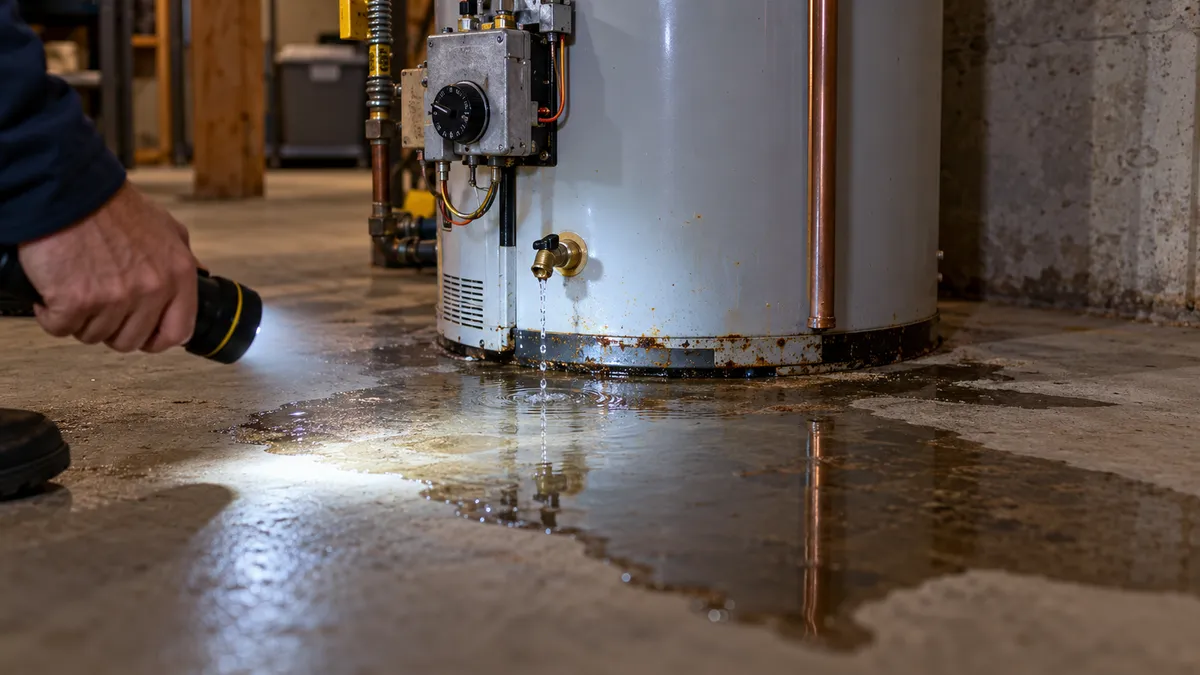
A water heater leaking from the bottom of the tank usually means the steel tank has rusted through, and that can't be repaired: the heater needs replacing. Many leaks are smaller and fixable, though. Water at the top usually comes from a loose inlet or outlet fitting; water from the side or from the pipe running down to the floor is the temperature and pressure (T&P) relief valve; a drip at the faucet near the base is the drain valve; and some "leaks" are just condensation. Whatever the source, turn off the power or gas, close the cold-water valve on top of the heater, and find where the water is actually coming from before deciding what to do.
Written by the Guardian Air plumbing team · Reviewed for accuracy October 2026
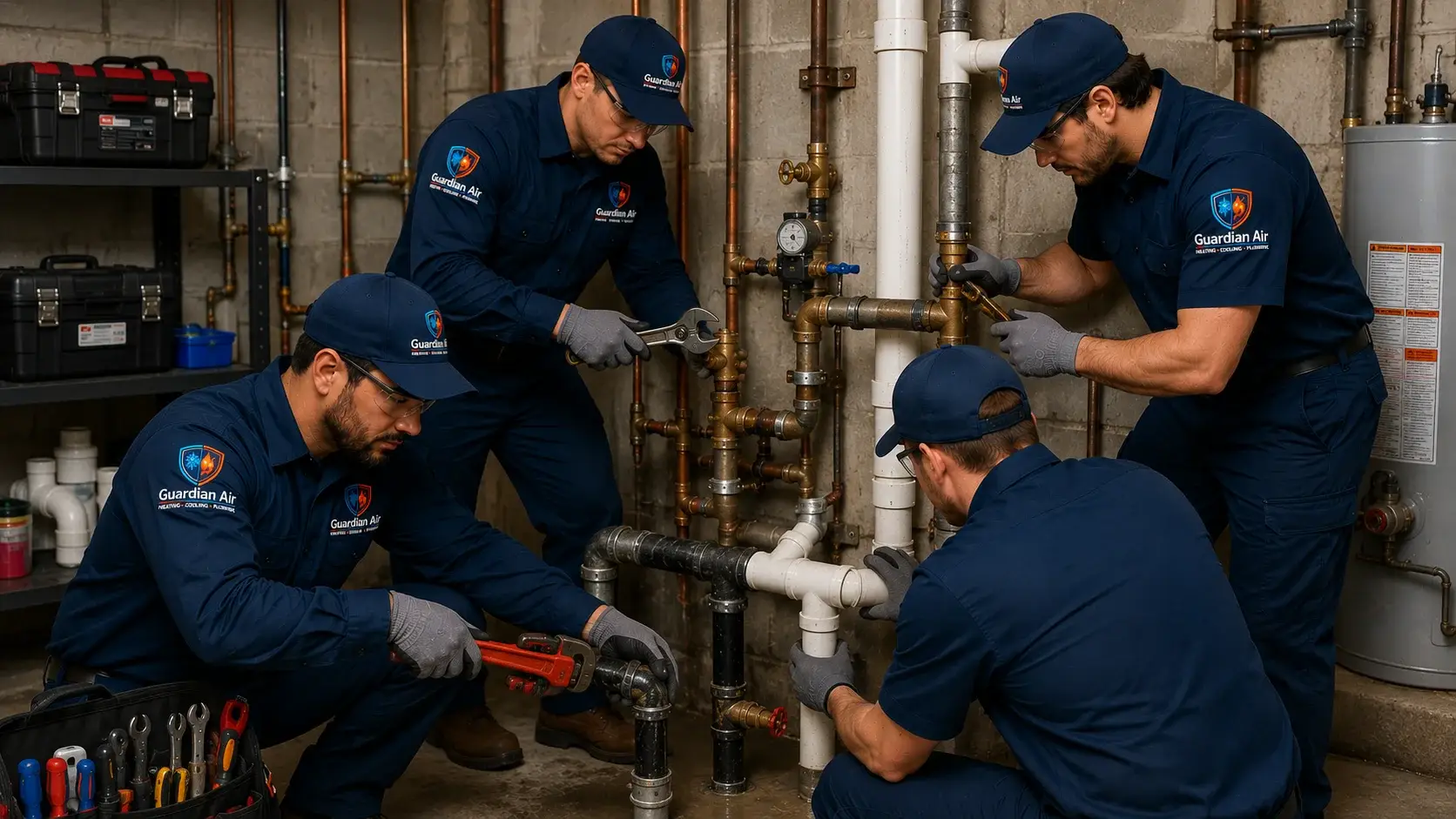
A puddle next to the water heater is one of the most common calls our plumbers take in Monmouth, Middlesex and Ocean counties. Sometimes it's a five-minute fix. Sometimes it's a 50-gallon tank on the edge of letting go in a finished basement. The difference is almost always where the water is coming from, and that is something you can work out yourself in a few minutes with a flashlight and a dry paper towel. This guide explains why water heaters leak, how dangerous a leak really is, exactly what to do right now, how to tell a leak from the bottom apart from one at the top, the T&P valve or the drain valve, what to do about a tankless water heater leaking, when to repair or replace, and what each fix costs in central New Jersey in 2026.
Why Is My Water Heater Leaking? The Short List
A tank water heater is a steel cylinder lined with glass, wrapped in insulation and an outer metal jacket, with a few pipes and valves screwed into it. Water can only escape from a handful of places, and each one points to a different cause:
- Inlet and outlet fittings on top. The cold-water inlet and hot-water outlet connections, their flexible connectors and the short steel nipples screwed into the tank. Loose joints, corroded nipples and worn connectors are common and repairable.
- The T&P relief valve. The brass valve near the top or on the side, with a pipe running down toward the floor. It is designed to release water when the tank gets too hot or the pressure gets too high, so water here is either a failed valve or a valve doing its job.
- The drain valve. The small faucet near the bottom. Plastic drain valves on builder-grade heaters crack, and any drain valve can drip after someone flushes the tank and sediment keeps it from sealing.
- Condensation. Cold incoming water can make the tank sweat, and a gas burner can drip condensation onto itself after sitting idle. It looks like a leak but isn't one.
- The tank itself. Once the sacrificial anode rod is used up, the water starts to corrode the steel. Sediment at the bottom speeds that up. Eventually a pinhole opens, usually low on the tank, and water seeps out under the jacket. This is the one that can't be fixed.
- Something nearby. A sweating cold-water pipe overhead, a furnace or air conditioner condensate line, a washing machine hose or a backed-up floor drain. We regularly arrive for a "water heater leaking" call and find the heater is dry.
A.O. Smith, one of the largest tank manufacturers, sums up the pattern the same way we do on site: top leaks usually come from pipe fittings and connections, side leaks often come from the T&P relief valve, and water at the base is often the first sign of a serious problem.
Is a Leaking Water Heater Dangerous?
Usually it's a water damage problem first and a safety problem second, but there are real hazards to know about before you start poking around:
- Scalding. The water in the tank and coming out of the T&P discharge pipe can be very hot. The U.S. Consumer Product Safety Commission's tap water scald alert notes that most adults suffer third-degree burns after two seconds in 150°F water, six seconds at 140°F and thirty seconds at 130°F. Never put your hand under the discharge pipe or open the drain valve on a hot tank without gloves and a hose.
- A T&P valve that keeps discharging hot water or steam. That valve is the safety device that stops a tank from overheating. If it is blowing off repeatedly, the heater may be running too hot. Turn the heater off and get it checked. Never cap, plug or remove the discharge pipe to stop the drip.
- Electricity and water. An electric water heater is on a 240-volt circuit. If water is near the heater's wiring, an outlet or the electrical panel, don't stand in it to reach anything. Turn off the breaker only if you can reach the panel from a dry floor.
- Gas, flue and carbon monoxide. Water dripping onto a gas burner can put out the pilot or the flame and rust the burner and flue baffle. A rusted-out flue or a burner area that was soaked can lead to poor combustion. If you smell gas, leave the house and call your gas utility from outside. If a carbon monoxide alarm sounds, get everyone out and call 911. The CPSC lists early CO symptoms as headache, fatigue, shortness of breath, nausea and dizziness. New Jersey requires a CO alarm near the sleeping areas in homes with a fuel-burning appliance under N.J.A.C. 5:70-4.19.
- Sudden tank failure. A seep from the bottom of an old tank can turn into a split with no warning. On a finished basement floor or in a closet over living space, that means drywall, flooring and carpet, and then mold.
Gas emergency lines in our area: New Jersey Natural Gas 800-GAS-LEAK (800-427-5325), PSE&G 1-800-880-7734, Elizabethtown Gas 1-800-492-4009.
What to Do Right Now When Your Water Heater Is Leaking
If water is coming out faster than a drip, do the first three steps before anything else. If it's a slow drip, you have time to work through all of them calmly.
- Turn off the heat source. On a gas heater, turn the gas control knob to "off" (or "vacation" or "pilot" if you plan to relight it soon). On an electric heater, switch off its double-pole breaker at the panel. Heating a tank that may be draining down can burn out an electric element or overheat a gas unit.
- Close the cold-water supply valve. It's on the cold-water pipe going into the top of the heater, usually marked or found on the right side. Turn a round handle clockwise until it stops, or turn a lever a quarter turn so it sits crossways to the pipe. This stops the tank from refilling as it leaks. Old gate valves sometimes won't close fully; if that happens, shut the main water valve for the house instead.
- Protect the area. Move boxes, rugs and anything stored near the heater. Make sure the floor drain is clear. Put down towels or a wet-vac. If the heater sits on a finished floor or in a closet, keep water away from walls and carpet.
- Find the source. Dry the tank, the fittings and the floor with towels. Then wipe each spot with a dry paper towel, starting at the top: the cold and hot connections, the T&P valve and its pipe, the drain valve, the burner access cover (gas) or element covers (electric), and the bottom seam. Wait 15 to 30 minutes and look again. Water runs down, so the highest wet spot is your leak.
- Take photos of the leak, the label on the heater (it shows the model, serial number and often the build date) and any water damage. They help your plumber quote accurately and help with an insurance claim if it comes to that.
- Drain the tank only if the tank itself is leaking. If the leak is from the tank body or bottom and it's getting worse, you can drain it once the power or gas has been off for a few hours and the water has cooled. Connect a garden hose to the drain valve, run it to a floor drain or outside below the level of the valve, open a hot faucet upstairs to let air in, and open the drain valve. If the drain valve is the plastic type and is already leaking, leave it for the plumber.
- Call a plumber. Tell them where the water is coming from, how old the heater is and whether it's gas or electric. That's enough for most plumbers to know whether to bring parts or a new heater.
Once the cold water is off and the heat source is off, a leaking water heater is no longer an emergency. You'll be without hot water, but the damage stops growing.
Water Heater Leak Diagnosis: Where It's Leaking and What It Means
Use this table once you've found the highest wet spot. Costs are central New Jersey 2026 ranges from our own jobs, including parts and labor, and our service call is credited toward the repair.
| Where it's leaking | Likely cause | Usual fix | DIY or pro | Typical cost |
|---|---|---|---|---|
| Top: cold inlet or hot outlet connection | Loose joint, worn flexible connector, corroded nipple | Tighten, replace connector or nipple | Snug a compression nut gently yourself; corroded nipples are pro work | $150–$350 |
| Top: around the anode rod port or flue (gas) | Leaking anode fitting; on gas units, often condensation in the flue | Reseal or replace anode; check venting | Pro | $200–$400 |
| Side: T&P valve or discharge pipe | Thermal expansion in a closed system, excessive temperature, or a worn valve | Lower temperature, add expansion tank, or replace valve | Lowering temperature is DIY; valve and expansion tank are pro | Valve $175–$350; expansion tank $250–$500 |
| Bottom: drain valve | Valve not closing, cracked plastic, sediment on the seat | Cap it with a hose cap; replace the valve | Hose cap is DIY; replacement needs the tank drained | $150–$300 |
| Bottom: element cover (electric) | Leaking element gasket | Replace gasket or element | Pro | $200–$400 |
| Bottom: burner area (gas), only when cold or first firing | Condensation dripping onto the burner | Usually none; check temperature setting and venting if constant | Watch it | $0, or a service call $89–$150 |
| Bottom: tank seam or under the jacket | Tank rusted through | Replace the water heater | Pro, with a permit | $1,800–$3,500 for a standard 40–50 gal tank |
| Tank sweating all over, no single source | Condensation from cold incoming water or a humid basement | None; dehumidify; watch over a few days | DIY | $0 |
| Tankless unit | Fittings, relief valve, condensate line, or heat exchanger | Repair fitting, valve or condensate line; descale; heat exchanger under warranty or replace | Pro | $150–$450 for most repairs; replacement $3,500–$6,500 as a conversion |
Water Heater Leaking From the Bottom
"Water heater leaking from the bottom" is the version of this problem people search for most, and it's the one that causes the most worry. A puddle at the base doesn't automatically mean the tank is finished. Work through these four possibilities in order.
1. Water running down from higher up
A leaking connection on top or a dripping T&P valve can run down the side of the tank, under the jacket or along the discharge pipe, and collect at the base. Before you condemn the tank, dry everything and check the top with a paper towel. In our experience, a good share of the "bottom leaks" we're called to actually start at the top.
2. The drain valve
Look at the faucet near the bottom of the tank. If water is dripping from its spout, the valve isn't sealing. Try turning the handle closed a little more (clockwise) by hand. If it still drips, screw a brass garden hose cap with a rubber washer onto the outlet; that is a perfectly good stopgap. A.O. Smith's advice is that a drain valve that won't close properly is best replaced, which means draining the tank first. If water is coming from where the valve threads into the tank, or the plastic body is cracked, leave it for a plumber.
3. Condensation
When a lot of cold water enters the tank at once (after showers, laundry or a refill), the outside of the tank and the gas flue can cool enough for moisture to condense. A.O. Smith describes this as normal on electric heaters and usually gone once the water heats up, and says moisture on gas heaters when cold water enters or the burner fires after sitting idle is typically temporary. A gas heater that drips onto the burner and hisses for a few minutes after a big draw is often just condensing. Signs it's condensation, not a leak: the water appears after heavy hot-water use or in humid summer weather, dries up within an hour or two, and the floor stays dry overnight. If the puddle is still there in the morning after a night with no hot water use, it's a leak.
4. The tank has rusted through
If the water is seeping from the bottom seam, from under the jacket, from behind the burner access cover on a gas unit with no other source, or you can see rust streaks and white mineral crust at the base, the inner tank has failed. A.O. Smith is plain about it: corrosion of the tank can't be repaired, and a cracked tank typically means replacing the water heater. There is no patch, sealant or epoxy that holds on a pressurized tank. We've seen the results of people trying. Shut it down, drain it if it's getting worse, and plan the replacement. Our water heater replacement cost guide breaks down the price of each option.
What to do if your water heater is leaking from the bottom, in one line: turn off the gas or power, close the cold valve, dry it off and check the top, the T&P pipe and the drain valve first. If the water is coming from the tank itself, it's a replacement.
Water Heater Leaking From the Top
Leaks at the top are usually the good news. The tank is fine; something screwed into it isn't.
Inlet and outlet fittings
The cold inlet and hot outlet usually connect through short steel nipples (often "dielectric" nipples with a plastic lining) and then flexible stainless or copper connectors, or hard-piped copper. Expansion and contraction every time the heater runs can loosen joints over time. Corrosion where copper meets steel can eat the nipple threads. If a compression nut on a flex connector is weeping, a gentle snug with a wrench can stop it; A.O. Smith warns against overtightening, which can crack fittings and make things worse. Green or white crust, rust on the nipple or water appearing from the threads in the tank is a job for a plumber, because the old nipple has to come out of the tank without damaging the threads.
Anode rod port
The anode rod screws into a port on top of the tank, sometimes under a plastic cap. A leak there is less common, but we see it on older tanks and after an anode has been changed without fresh thread sealant.
Flue condensation on gas heaters
On a gas heater, water dripping from the top around the draft hood is sometimes condensation inside the flue, especially in a cold basement on a heater that's oversized or vented into a cold masonry chimney. It is worth a look by a plumber, because constant condensation in the flue points to a venting problem, and a rusting flue or draft hood is not something you want on a gas appliance.
Water Heater Leaking From the T&P Valve or Discharge Pipe
The temperature and pressure relief valve is the most important safety part on the heater. It opens if the water gets too hot or the pressure gets too high, so the tank can't fail violently. Its discharge pipe carries that water down toward the floor. Water dripping from the end of that pipe has three likely explanations.
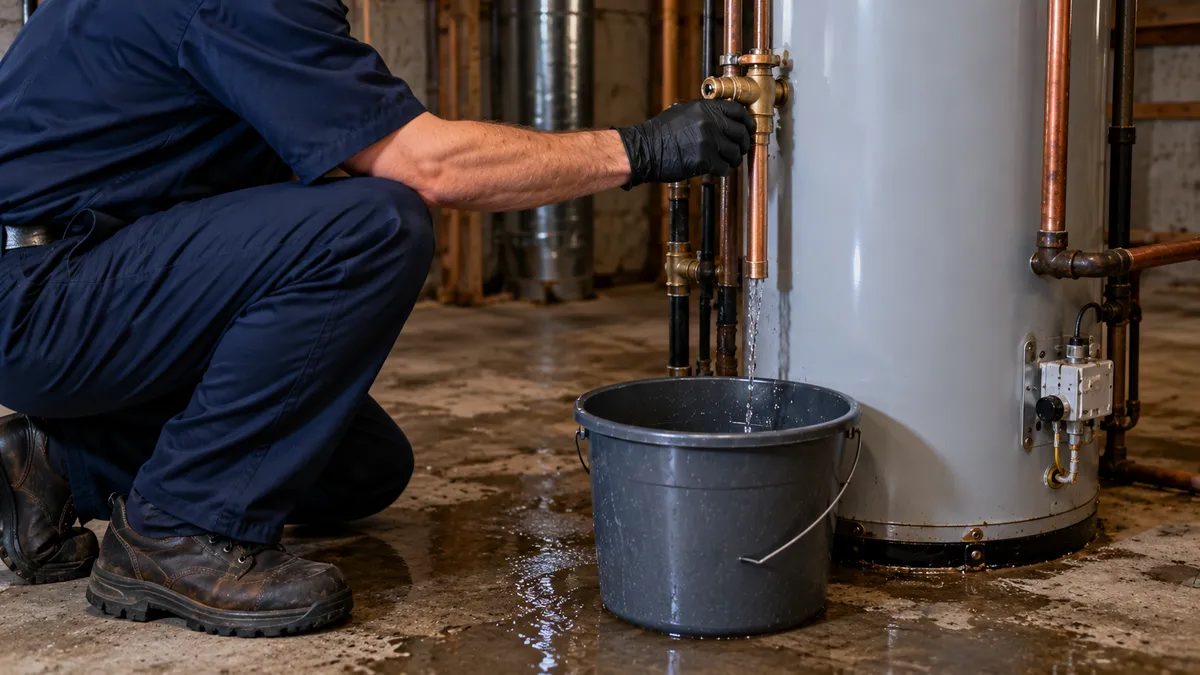
Thermal expansion in a closed system
This is the most common cause we find in central New Jersey. Water expands as it heats. In older homes that extra volume pushed back into the street main. Most homes now have a check valve, backflow preventer or pressure-reducing valve at the meter, which makes the plumbing a "closed system." Every time the heater runs, pressure in the house climbs until the relief valve weeps a little. The telltale pattern: a small amount of water from the discharge pipe after each heating cycle, often overnight or after showers, with nothing in between. A.O. Smith's recommended long-term fix is a properly sized and charged expansion tank on the cold supply. Swapping the relief valve without fixing the expansion just means the new valve drips too.
The water is too hot
A thermostat set very high, or a failed gas control or electric thermostat that won't shut off, can push the tank toward the valve's temperature setting. A.O. Smith notes that if high pressure is making the valve leak, turning down the thermostat can stop it. We set most heaters at or near 120°F, which the CPSC recommends for scald protection. If the valve discharges a lot of hot water or steam, turn the heater off and call a plumber. Don't try to stop the flow.
A worn or dirty valve
Relief valves get mineral deposits on the seat, especially in hard-water towns, and stop sealing fully, often after someone tests them by lifting the lever. If temperature and pressure check out and the valve still drips steadily, it gets replaced. That means partly draining the tank. On an older tank, we sometimes advise against it, because disturbing a corroded valve can expose a weak tank.
What the discharge pipe should look like
Every T&P valve needs a full-size discharge pipe. The model plumbing codes, as summarized in the International Code Council's CodeNotes on water heater safety, require that it have no valves or tees, not be trapped, have no threads at the end so it can't be capped, end no more than six inches above the floor, a drain pan or a floor drain, and discharge where people in the house can see it. New Jersey uses the National Standard Plumbing Code, but inspectors here look for the same things. A discharge pipe that's missing, too short, capped or piped into a wall cavity is a safety defect, and fixing it is usually inexpensive.
Tankless Water Heater Leaking
Tankless heaters don't hold 40 or 50 gallons, so they don't fail the way tanks do. They tend to stop heating rather than flood the floor, which is one reason we suggest them where a tank would sit over finished space. They can still leak, and the source is usually one of these:
- Water connections and isolation valves underneath the unit. These are the most common. A weeping union or service valve is a simple repair.
- The pressure relief valve. Tankless units have one too. Manufacturers' manuals note that periodic discharge usually points to thermal expansion in a closed system, the same as with a tank, and the fix is the same: an expansion tank.
- The condensate line on condensing models. These units produce mildly acidic condensate that drains through a trap and often a neutralizer. A clogged trap, a disconnected hose or a full neutralizer can back water up and drip from the unit or the vent.
- Vent condensate. If the PVC vent isn't sloped correctly, condensate can run back and drip from a joint.
- The heat exchanger. Heavy scale from hard water, or freezing in an unheated space, can crack it. That's the expensive one, and whether it's covered depends on the warranty and on whether the unit was descaled as the manual requires.
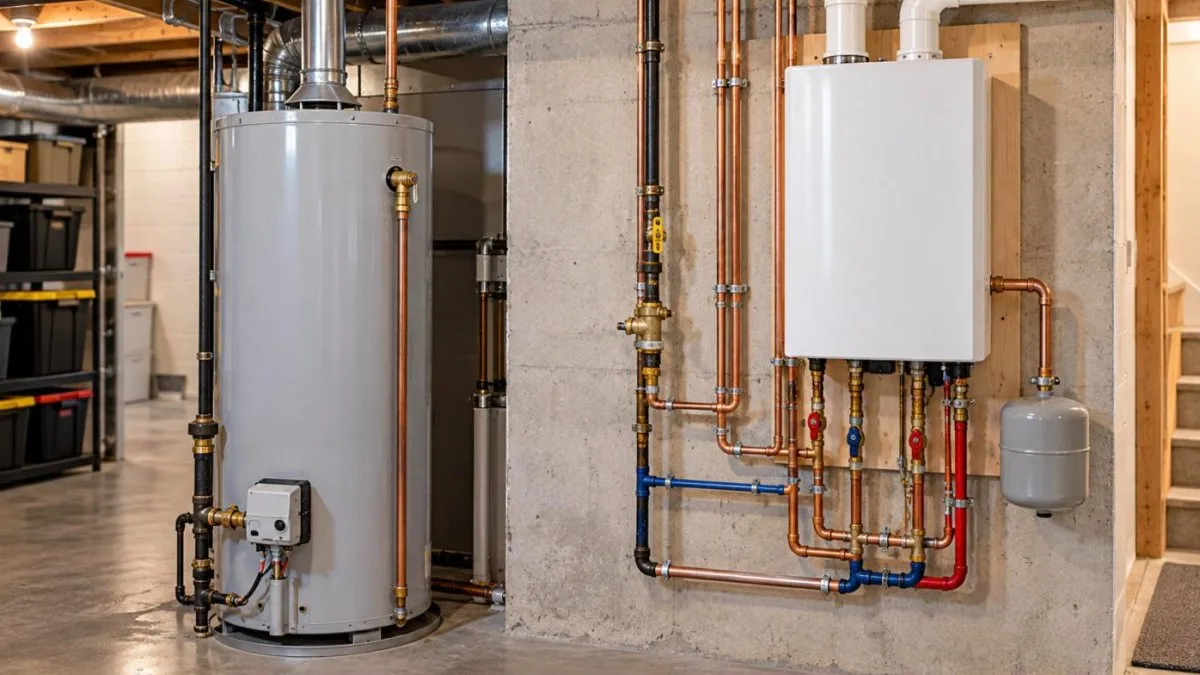
Water inside the cabinet or dripping from the bottom of the casing means shut off the gas and power, close the isolation valves and call a plumber. Don't open the sealed combustion chamber. Most tankless leak repairs fall in the $150 to $450 range. Annual descaling, which most manufacturers require and which protects the heat exchanger, is covered in our tankless vs tank water heater comparison.
Repair or Replace a Leaking Water Heater?
The location of the leak decides most of this, and the heater's age decides the rest.
- Leak from the tank body or bottom seam: replace. No exceptions, at any age.
- Leak from a fitting, connector, drain valve or T&P valve on a heater under about 8 years old: repair. The tank is sound, and the fix costs a fraction of a new heater.
- Same fitting leak on a tank of 10 to 12 years or more: think carefully. Tanks in our area typically last 8 to 12 years. A.O. Smith puts the range across all types at 8 to 20 years. A $300 repair on a 12-year-old tank often buys months, not years, and old drain and relief valves are fragile to work on. If the tank shows rust at the base, rumbles with sediment or has given rusty hot water, put the money toward a replacement.
- Repeated T&P discharge: fix the cause first. An expansion tank or a temperature correction fixes the problem regardless of the heater's age.
- Tankless with a cracked heat exchanger: check the warranty. Heat exchanger warranties on tankless units are often long, but usually cover the part only, and may require proof of descaling.
To find your heater's age, look at the serial number on the label. Most brands encode the year and month or week in the first few characters. Send us a photo and we can decode it. If your heater isn't leaking but has stopped heating, our guide to no hot water causes and fixes covers those repairs.
Replacing a water heater in New Jersey requires a permit. Under N.J.A.C. 5:23-2.17A, a like-for-like replacement is "minor work": the contractor notifies the construction office, can start right away and files the permit within five business days, which is how a leaking heater can legally be replaced the same or next day. Installing water heaters and gas piping is licensed master plumber work under N.J.A.C. 13:32-1.4.
What Our Plumbers See in Central NJ Basements
The same leaks come up week after week across Monmouth, Middlesex and Ocean counties.
Hard water and a spent anode
Many towns in our area, and most private wells, have hard enough water to leave a thick layer of sediment in the bottom of a tank. Sediment insulates the bottom from the water, so the steel under it runs hotter, and the glass lining cracks faster. Meanwhile the anode rod, which corrodes so the tank doesn't, gets used up. A.O. Smith says anode rods usually last three to five years. When we pull the anode on a leaking 10-year-old tank, it's often bare wire. A tank that has never had its anode checked is usually the one leaking from the bottom.
The plastic drain valve
Builder-grade heaters often come with a plastic drain valve. Homeowners who flush the tank (a good habit) sometimes find the valve won't reseat afterward, or the stem snaps. A brass replacement is a better long-term part.
The "slow leak" behind the stored boxes
A tank that has been seeping for weeks behind storage boxes or in a closet does more damage than one that fails loudly. We find rotted subflooring, moldy drywall and rusted water heater stands from leaks nobody saw. A leak sensor on the floor next to the heater, which costs less than a service call, would have caught every one of them.
Shore houses and closets
In raised homes in Ocean County and in condos and townhouses across the area, water heaters often sit in a closet on the main floor or above finished space. There, a leaking water heater isn't a basement puddle; it's a ceiling below. A drain pan piped to a drain, and an automatic shutoff valve, are worth far more in those locations than in an unfinished basement.
The relief valve that "keeps getting replaced"
When a customer tells us they've replaced the relief valve twice and it's still dripping, it's almost always thermal expansion. A meter or pressure-reducing valve change by the water utility can turn an open system into a closed one overnight, and the relief valve starts weeping within days.
Water Heater Leak Repair Cost in Central NJ (2026)
These are Guardian Air ranges for Monmouth, Middlesex and Ocean counties in 2026, parts and labor included. Our service call is $89 to $150 and is credited toward the repair. For other plumbing work, see our plumber cost guide.
| Repair | Typical cost | What drives the price |
|---|---|---|
| Service call / diagnostic | $89–$150 | Credited toward the repair |
| Tighten or replace a fitting, flex connector or nipple | $150–$350 | Corrosion at the tank threads, copper soldering |
| Drain valve replacement | $150–$300 | Draining the tank, brass vs plastic |
| T&P relief valve replacement | $175–$350 | Draining, discharge pipe corrections |
| Expansion tank installed | $250–$500 | Size, location on the cold supply |
| Anode rod replacement | $200–$400 | Ceiling height, seized rod, flexible rod needed |
| Heating element or gasket (electric) | $200–$400 | Upper or lower element, scale in the tank |
| Gas control valve | $350–$650 | Brand and model; worth it mainly on newer tanks |
| Tank flush / sediment removal | $150–$300 | How much sediment, drain valve condition |
| Drain pan with piped drain (retrofit) | $200–$500 | Distance to a drain; easiest during a replacement |
| Tankless leak repair (fitting, valve, condensate) | $150–$450 | Part and access |
| Leak detection (hidden leak, not the heater) | $150–$450 | Thermal imaging, pressure tests |
| Standard 40–50 gal tank replacement | $1,800–$3,500 | Gas $1,900–$3,500; electric $1,800–$3,000; venting and code items |
| Power-vent gas tank replacement | $3,000–$4,800 | PVC vent run, outlet |
| Conversion to gas tankless | $3,500–$6,500 | Gas line, venting, condensate drain |
| Water damage mitigation (restoration company) | $1,500–$10,000+ | How long it leaked and where; usually an insurance matter |
The cheapest leak is the one caught early. A drip from a fitting is a $150 to $350 repair. The same heater left to seep for a month can mean a new tank plus subfloor and drywall.
How to Prevent Water Heater Leaks
- Flush the tank once a year in hard-water areas, or have it done during a plumbing visit. It slows the corrosion that sediment causes. If the drain valve is plastic and old, have a plumber do the first flush.
- Have the anode rod checked every few years, starting around year three to five, and replaced when it's mostly gone. It's the cheapest way to add years to a tank.
- Keep the temperature at about 120°F. It's safer for scalding and easier on the tank and relief valve.
- Install an expansion tank if your home has a check valve, backflow preventer or pressure-reducing valve at the meter, and have its air charge checked when the heater is serviced.
- Put the heater in a drain pan piped to a drain if it sits on a finished floor, in a closet or above living space.
- Add a leak sensor on the floor beside the heater, or an automatic shutoff valve that closes the cold supply when it detects water.
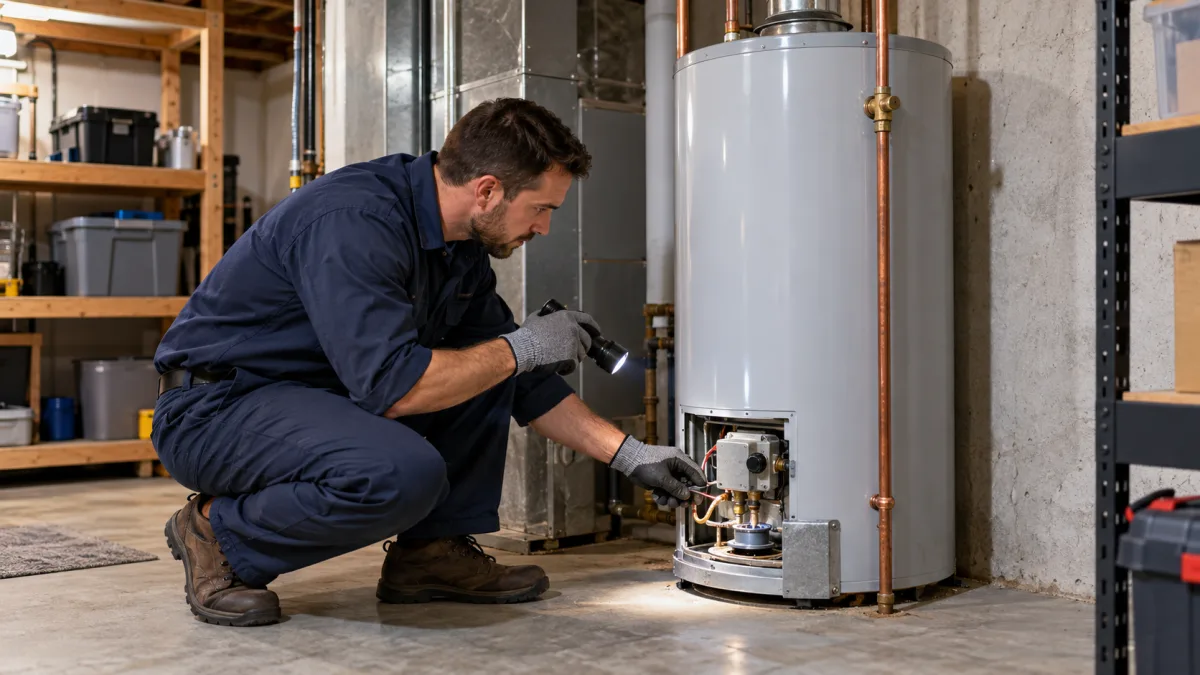
- Look at it once a month. Thirty seconds with a flashlight: dry floor, no rust at the base, no crust on the fittings, nothing coming from the discharge pipe.
- Keep the space around it clear. Storage against the tank hides leaks, and on gas heaters it can block combustion air.
- Protect it from freezing. Heaters in garages and unheated utility rooms, and tankless units on outside walls, can freeze and split. Our guide to preventing and thawing frozen pipes covers the cold-weather steps.
- Replace on your schedule, not the tank's. If your tank is past 10 to 12 years, planning a replacement before it leaks lets you choose the right model and avoid water damage.
When You Don't Need Us
We'd rather you not pay for a visit you don't need. You can usually handle these yourself:
- Condensation that appears after heavy hot water use or on humid days and dries up within an hour or two. Watch it for a few days; if the floor stays dry overnight, there's no leak.
- A drain valve that drips from its spout. Close it by hand and add a brass hose cap with a washer.
- A flex connector nut that's weeping. A gentle quarter turn with a wrench. If it doesn't stop, call us; don't keep cranking.
- A T&P valve that discharged once after you set the temperature very high. Turn the temperature down to about 120°F and see if it stops.
- Water that isn't from the heater at all. A sweating cold pipe, an AC condensate line or a washer hose. Check overhead and around the heater before you call.
Call a plumber for a leak from the tank itself, a corroded fitting at the tank, a relief valve that keeps discharging, water near the burner or wiring, any gas smell, any leak you can't trace, or any heater that sits over finished space.
About Guardian Air
Guardian Air is a licensed New Jersey HVAC and plumbing contractor serving Monmouth, Middlesex and Ocean counties. Our plumbers repair and replace leaking tank and tankless water heaters, install expansion tanks and drain pans, and track down leaks that turn out not to be the water heater at all, in homes from Freehold, Howell and Old Bridge to Edison, Brick and Toms River, with a flat-rate written quote before work starts. See our water heater repair and replacement, tankless water heater, emergency plumbing and leak detection pages, browse all plumbing services, learn more about our team, or call (848) 276-6300 (Mon–Fri 8–6, Sat 8–4) and book a service visit. Leaking water heaters get priority during those hours at our standard flat rate. If yours starts leaking overnight or on a Sunday, turn off the gas or power, close the cold-water valve and call us as soon as we open.
Sources
- A. O. Smith: Why Is My Water Heater Leaking? (leak locations, condensation, T&P valve, drain valve, expansion tank, tank and anode rod life)
- U.S. Consumer Product Safety Commission: Tap Water Scalds safety alert
- U.S. Consumer Product Safety Commission: Carbon Monoxide Fact Sheet
- International Code Council: CodeNotes: Water Heater Safety in the I-Codes (relief valve discharge piping)
- N.J.A.C. 5:23-2.17A: Minor work (permits for like-for-like replacement)
- N.J.A.C. 13:32-1.4: Scope of plumbing licensure
- N.J.A.C. 5:70-4.19: Carbon monoxide alarm requirements
- New Jersey Natural Gas: Emergency contacts