October 22, 2026
Frozen Pipes: How to Prevent, Thaw & Fix Them in NJ
Pipes usually start freezing near 20°F, and they burst from trapped pressure, not the ice. How to prevent frozen pipes in NJ homes, thaw them safely, handle a burst and what repairs cost in Monmouth, Middlesex and Ocean counties.
By Noor Kamal, Technology Manager · Published · Updated
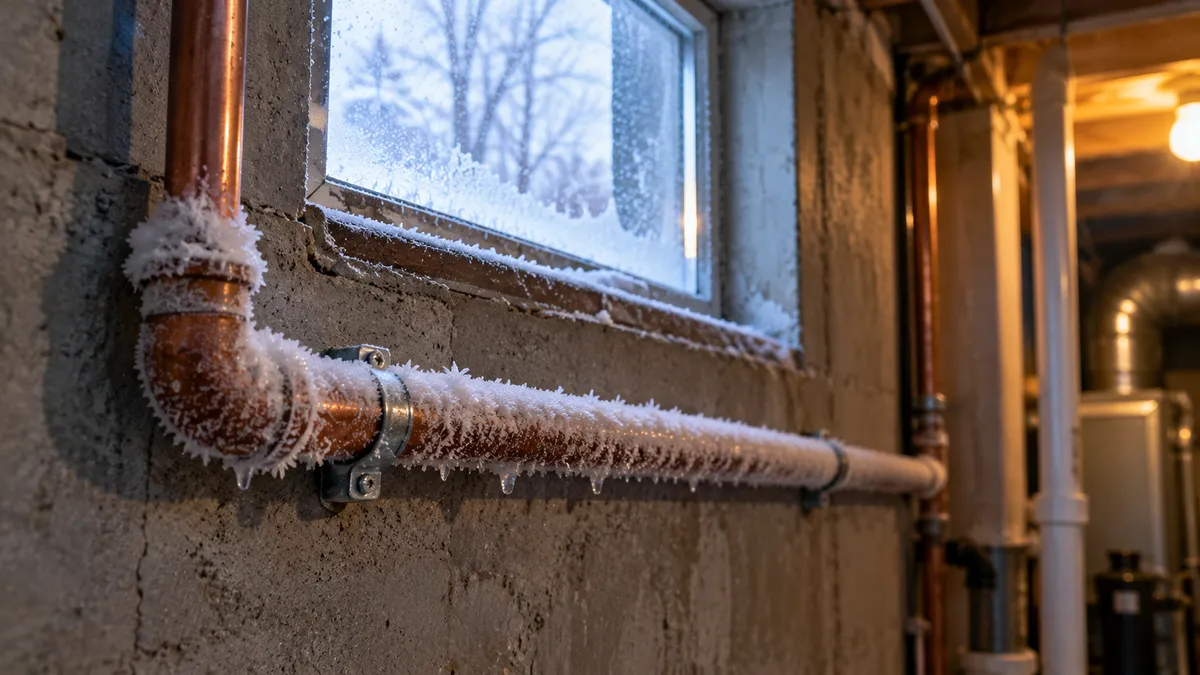
Frozen pipes happen when water in an unheated or poorly insulated line turns to ice, usually once outdoor temperatures fall to about 20°F or below. The ice itself rarely splits the pipe: pressure builds between the ice blockage and a closed faucet, and the pipe bursts there. To prevent frozen pipes, keep the heat at 55°F or higher, insulate exposed lines, open sink cabinets, let a faucet drip on the coldest nights and shut off outdoor spigots. If a pipe is already frozen, open the faucet and warm the pipe gently with a hair dryer, never a flame. If it has split, shut off the main water valve first.
Written by the Guardian Air plumbing team · Reviewed for accuracy October 2026
Every winter, the first real cold snap brings the same calls into our office: a kitchen faucet that gives a trickle and then nothing, a laundry room with no cold water, or the one nobody wants, water coming through a ceiling. Frozen pipes are among the most preventable plumbing emergencies we deal with in Monmouth, Middlesex and Ocean counties, and also one of the most expensive when prevention fails. This guide explains what temperature pipes freeze at, why they burst, which pipes in New Jersey homes are most at risk, how to keep pipes from freezing, how to thaw them safely, what to do in the first ten minutes after a burst, and what repairs cost in central NJ in 2026.
What Temperature Do Pipes Freeze?
Water freezes at 32°F, but a pipe inside a house does not freeze the moment it is 32°F outside. Walls, insulation, floor framing and heat leaking from the living space all buffer the pipe. That is why the number most often quoted for frozen pipes is lower.
The Insurance Institute for Business & Home Safety (IBHS) says that freezing of unprotected pipes generally begins when outdoor temperatures drop to about 20°F. The International Code Council has summarised that guidance in an article for building officials. The figure, called a "temperature alert threshold," comes from research by the Building Research Council at the University of Illinois. The researchers studied uninsulated pipes running through unheated attics and found that freezing began when it was about 20°F or colder outside.
Read that number carefully. It is a warning level, not a guarantee:
- Pipes can freeze above 20°F. The same research notes that freezing incidents can happen while the temperature stays above 20°F, especially with wind, a draft blowing straight onto a pipe, or several cold nights in a row.
- Duration matters as much as the low. One night at 19°F is less risky than three days that never get above 25°F. In a long cold spell, the cold creeps into crawl spaces, garages and wall cavities.
- Wind chill doesn't cool a pipe below the air temperature, but wind pushes cold air through gaps in siding, sill plates and foundation vents, so the air around the pipe gets much colder, much faster.
- An empty house is a special case. If the heat fails or is set too low, the indoor temperature drifts down for days and every pipe in the building is at risk.
Frozen pipes in NJ: how cold does it get here?
Central New Jersey sits right on that threshold. According to NOAA's 1991–2020 climate normals, the average January low is about 22°F in Toms River, 23°F in New Brunswick, 25°F in Long Branch and 21°F in Hightstown. Those are averages, which means a normal winter brings plenty of nights in the teens and a few arctic outbreaks that drop into single digits. Coastal towns run a few degrees milder than inland ones, but shore houses often have more exposed plumbing, so the risk evens out.
In practice, we start warning customers when the forecast calls for lows in the low 20s, and especially when it calls for several days in a row below freezing. That is when the phones ring.
Why Frozen Pipes Burst (It Isn't the Ice Itself)
Most people picture ice expanding and splitting the pipe from the inside, right where it froze. It usually doesn't work that way. IBHS explains that the outward push of ice against the pipe wall rarely breaks it. What happens is this:
- Water in the coldest part of the pipe freezes into a solid plug of ice.
- As more water freezes, the ice plug grows along the pipe.
- Downstream, between the ice and a closed faucet (or a second ice plug), there is a trapped pocket of water with nowhere to go.
- As the ice keeps growing into that trapped pocket, water pressure climbs sharply.
- The pipe fails at its weakest point inside that pocket, often where there is little or no ice at all.
Upstream of the ice, water can push back toward the street main, so pressure doesn't build there. This explains two things that confuse homeowners.
- The split often isn't where the pipe froze. We regularly find the frozen section in an outside wall and the burst a few feet away, sometimes inside a heated room.
- The leak shows up when it warms up. While the line is frozen, the ice plugs the break. Most burst pipes are discovered when the ice melts and the water flows again, often the next afternoon.
It also explains why an open, dripping faucet helps. A faucet that is even slightly open gives that trapped pocket somewhere to go, so the pressure can't build up the same way. Moving water is also slower to freeze.
The water that comes out once a pipe has split adds up quickly. University of Illinois Extension notes that an eighth-of-an-inch crack can release up to 250 gallons of water a day, and a fully split supply line at house pressure releases far more than that. State Farm reports that from 2024 through June 2025 it received more than 20,000 claims for frozen pipes, paying over $628 million, and the average claim payment was more than $30,000.
Which Pipes Freeze in New Jersey Homes?
The American Red Cross lists the pipes most likely to freeze as those exposed to severe cold (outdoor hose bibbs, pool supply lines, irrigation lines), those in unheated interior spaces (basements, crawl spaces, attics, garages, kitchen cabinets) and those along exterior walls with little insulation. Here is how that looks in the homes we work in.
Kitchen sinks on outside walls
The classic central NJ frozen pipe. The kitchen sink sits under a window on an outside wall, and the supply lines run up through the wall cavity or a poorly insulated base cabinet. Bump-out or cantilevered kitchens, common in post-war capes, ranches and split-levels across Middlesex and Monmouth counties, are the worst. The floor under the sink hangs out past the foundation with only a thin layer of insulation beneath it.
Crawl spaces and rim joists
Crawl spaces with open foundation vents, missing insulation or a dirt floor get close to outdoor temperature in a cold snap. In basements, the danger zone is the rim joist, the band of framing that sits on top of the foundation wall. Pipes that run along it, or through it to an outside spigot, sit inches from outdoor air, often with gaps around them where cold air pours in.
Exterior walls in older homes
Many older homes in Red Bank, Long Branch, New Brunswick, Perth Amboy and other early towns have supply pipes in exterior walls that were never insulated, or were insulated decades ago with material that has since slumped. Bathrooms over porches or added onto the back of a house are particularly exposed.
Garages and rooms above them
Lines that run through a garage ceiling to a bathroom or bonus room above, utility sinks in the garage, and water heaters or washers in unheated garages are all at risk. A garage door left open for an afternoon in January can freeze them.
Hose bibbs, irrigation and pool lines
Outdoor spigots (hose bibbs or sillcocks) are the most common single freeze point we see. Lawn irrigation backflow preventers that weren't drained in the fall are a close second. Both sit right where the pipe passes from the heated house into outdoor air.
Attic lines
Less common here than in slab-built southern homes, but we still see supply lines in attics: over finished garages, in some additions, and in homes where plumbing was rerouted during a renovation. These are the same conditions the University of Illinois research measured.
Shore homes and vacation houses in Ocean County
Second homes in Point Pleasant, Brick, Toms River, Barnegat and along the barrier island sit empty for weeks in winter. Many were raised after Superstorm Sandy, which often left supply lines running down through an open, unheated area beneath the house. Many have crawl spaces open to the wind. If the heat fails or the power goes out while nobody is there, there's no one to notice until a neighbour sees water coming out under the door.
How to Prevent Frozen Pipes: A Checklist for NJ Homes
Most of these steps cost little or nothing. Work through the list before the first hard freeze, usually by Thanksgiving here, and repeat the cold-snap items whenever the forecast calls for lows near 20°F.
- Insulate exposed pipes. Foam pipe sleeves for any supply line in a crawl space, garage, attic, unheated basement corner or along the rim joist. Match the sleeve to the pipe size, tape the seams, and don't leave gaps at elbows and valves. Insulation slows heat loss. As the International Plumbing Code commentary notes, insulation alone without a heat source can't stop a pipe from freezing in a long cold spell. That's why it works best combined with the steps below.
- Seal the air leaks that feed cold air to pipes. Caulk or foam gaps where pipes, cables and dryer vents pass through the rim joist and exterior walls. Close or block crawl space vents for winter if your house was built with operable vents. In our experience, a draft blowing on a pipe matters more than a few degrees of outdoor temperature.
- Use UL-listed heat cable where insulation isn't enough. For a pipe that freezes year after year, such as a line under a raised shore house or in a cold crawl space, install heat cable rated for pipes. The Insurance Information Institute advises buying UL-listed heating cables with built-in thermostats and following the manufacturer's instructions closely. Plug it into a GFCI-protected outlet, don't overlap cable unless the instructions specifically allow it, and replace old, cracked or brittle cable. Damaged heat cable is a fire risk.
- Keep the heat at 55°F or higher, day and night. IBHS, the Red Cross and State Farm all give 55°F as the minimum, even when nobody is home. During a severe cold snap, the Insurance Information Institute suggests keeping the house at 65°F, because walls with pipes in them are colder than the rooms around them. Skip deep overnight setbacks during arctic weather.
- Open cabinet doors under sinks on outside walls. This lets warm room air reach the pipes. Move cleaning products out of reach of children and pets while the doors are open.
- Let a faucet drip on the coldest nights. More on this below. In short, yes, on the right faucet and in the right conditions.
- Disconnect garden hoses. A hose left attached traps water in the spigot. That trapped water can freeze and split even a frost-free sillcock inside the wall.
- Shut off and drain outdoor faucets. If your spigots have an indoor shutoff valve, close it, then open the outdoor faucet to let the line drain. If the indoor valve has a small bleeder cap, open it to let the last bit of water out, then close it once it stops dripping. Blow out and drain irrigation systems and backflow preventers in the fall, following the installer's directions.
- Upgrade to frost-free sillcocks. A frost-free sillcock puts its shutoff valve several inches to more than a foot inside the wall, in heated space, so the part of the pipe that's outdoors drains every time you turn it off. It has to slope slightly downward toward the outside and the hose has to come off for winter, or it can still freeze.
- Add smart leak and temperature sensors. Inexpensive Wi-Fi sensors placed under sinks, near the water heater and in the crawl space can send an alert to your phone when the temperature drops toward freezing or when water appears. An automatic water shutoff valve on the main line can close itself when it detects a leak. That's the best insurance for a house that sits empty. Some insurers offer discounts for these devices, so it's worth asking yours.
- Winterize a vacant or seasonal home properly. For an absence of more than a week in freezing weather, IBHS suggests closing the main valve and draining faucets on the lowest floor. For a shore house closed for the season, a full winterization goes further: shut off the main, drain the supply lines and the water heater (with the power or gas off first), open the faucets, blow out the lines, and add non-toxic plumbing antifreeze to the sink and tub traps and toilets. If you keep the heat on instead, use a smart thermostat or temperature sensor that alerts you if it fails, and ask a neighbour to check the house.
- Know where your main shutoff is before you need it. Find it now, make sure it turns, and show everyone in the house. In central NJ basements, it is usually on the front foundation wall where the service line enters, near the water meter. In slab homes, look in a utility closet, near the water heater or in the garage.
Should I drip faucets to stop pipes freezing?
Yes, on the right faucets during real cold snaps. The Red Cross and State Farm both recommend it, and the Insurance Information Institute says to open the hot and cold faucets just enough to drip. Some practical points:
- Pick the faucets fed by the most exposed pipes. Usually the kitchen sink on an outside wall, or a bathroom over the garage or a porch. You don't need to drip every faucet in the house.
- A slow, steady drip or a pencil-thin trickle is enough. The main benefit is pressure relief: it gives the water trapped behind an ice plug somewhere to go.
- On a single-handle faucet, set it to the middle so both the hot and cold lines move.
- Make sure the drain is clear. A slow drain plus an overnight drip can mean an overflowing sink. If you have a drain problem, fix it first. Our guide to a clogged drain covers the common causes.
The water cost of one dripping faucet for a few nights is small compared with what a burst pipe costs.
How to Tell if Your Pipes Are Frozen
Check first thing on a frigid morning, before the house warms up and the ice starts to melt.
- A faucet gives only a trickle, or nothing, while other faucets in the house work normally. That means a frozen branch line, almost always on an outside wall or in a cold space.
- A toilet doesn't refill after flushing.
- Visible frost on an exposed pipe in the basement, crawl space or garage, or a pipe that's very cold to the touch compared with others nearby.
- A bulge or a hairline crack on an exposed pipe. Treat this as a burst waiting to happen (see below).
- No hot water from one fixture but cold works. The hot line to that fixture may be frozen. If there's no hot water anywhere in the house, it's more likely a water heater problem. Our guide to no hot water covers that.
- No water anywhere in the house. Either the main line is frozen where it enters the house, or there's a supply problem on the street. Ask a neighbour or check with your water utility before assuming it's your pipe.
To find the frozen spot, trace the line back from the faucet that isn't working toward the main. The frozen section is usually where the pipe passes the coldest point: an outside wall, a gap in the rim joist, under a bump-out or in the garage.
Pipes Frozen? What to Do and How to Thaw Them Safely
If you have caught frozen pipes before they burst, you can often thaw an accessible pipe yourself. Before you start, look closely along the pipe. If it is visibly split, bulging or leaking, or you can see water anywhere it shouldn't be, stop and shut off the main water valve first, then skip ahead to the burst pipe section below. Thawing a split pipe with the water on just turns a frozen pipe into a flood.
If the pipe looks intact:
- Open the faucet the pipe feeds, both hot and cold handles. This gives melting ice and water an exit and relieves pressure as the plug softens. Running water also helps melt the remaining ice.
- Start warming near the faucet and work back toward the frozen section. State Farm recommends starting as close to the faucet as possible and working toward the coldest part of the pipe. That way the melted water always has an open path out, instead of being trapped between two ice plugs.
- Use gentle heat. A hair dryer on its warm setting, an electric heating pad wrapped around the pipe, towels soaked in hot water, or a space heater placed safely nearby to warm the cabinet or room. For pipes under a sink, open the cabinet doors and warm the space.
- Keep electrical appliances away from water. Don't run a hair dryer or space heater while you are standing in water or when water is dripping near it. Plug into a GFCI-protected outlet where possible and never leave a space heater unattended or near curtains, cardboard, insulation or other flammable materials.
- Keep going until full pressure returns. A trickle means part of the pipe is still frozen. Keep applying heat until the flow is normal.
- Check every other faucet in the house. If one pipe froze, others on the same wall or in the same space may have too.
- Watch the thawed pipe for the next few hours. A crack the ice was hiding may only start leaking once the water is flowing at full pressure.
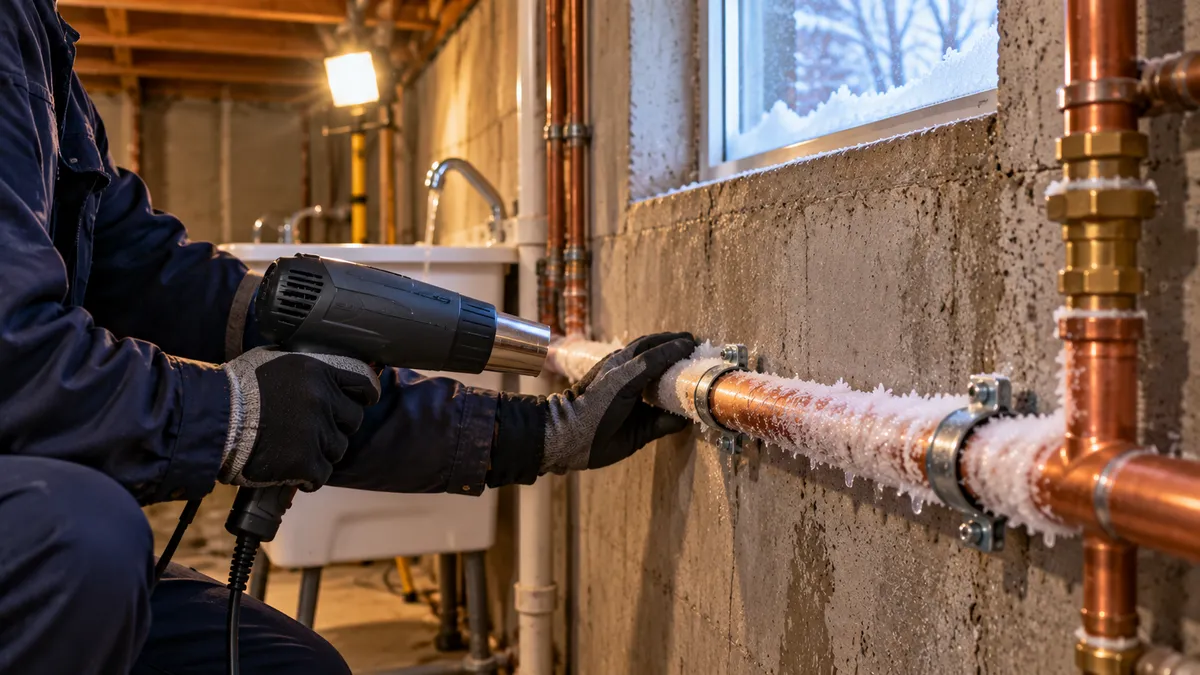
What never to do when thawing frozen pipes
- Never use an open flame. No propane or butane torches, no kerosene or propane heaters, no charcoal, no lighters. The Red Cross, State Farm and University of Illinois Extension are all clear on this. Torches start house fires: the flame reaches dust, wood framing and insulation behind the pipe that you can't see. Fuel-burning heaters indoors also produce carbon monoxide.
- Be careful with heat guns. A heat gun can scorch framing, ignite insulation and damage plastic pipe and fittings. Plumbers use them carefully with the heat kept moving. If you aren't sure, use a hair dryer.
- Don't thaw a pipe you can't see. If the frozen section is inside a closed wall, ceiling or floor, you can't check it for splits or keep heat away from framing. Warm the room instead (raise the thermostat, open cabinets, point a space heater at the wall from a safe distance) or call a plumber. We have tools such as infrared cameras to find the frozen section.
- Don't pour boiling water on pipes or use chemicals in the drain to "melt" a frozen supply line. Supply lines are a separate, sealed system from your drains.
- Don't close the faucet while you work. That recreates exactly the trapped-pressure condition that bursts pipes.
What to Do if a Frozen Pipe Bursts
Speed matters most here. A split supply line pours water into the house until someone shuts it off, and drywall, subfloors and insulation soak it up quickly. In this order:
- Shut off the main water valve. Turn it clockwise until it stops. Gate valves (round handle) can take many turns. Ball valves (lever handle) need a quarter turn, so the lever ends up crossways to the pipe. If the valve is stuck or broken, many homes also have a curb stop outside at the property line, which your water utility can shut.
- Open the faucets. Open a faucet on the lowest floor to drain the water left in the pipes, and a faucet on the top floor to let air in. State Farm also advises leaving faucets open after shutting the main.
- Make it safe electrically. If water is near outlets, appliances, ceiling light fixtures or the electrical panel, don't touch them. Turn off power to the affected area at the breaker only if you can reach the panel while standing on a dry floor. If you can't, keep everyone out of the wet area and call your electric utility.
- Turn off the water heater. With the water supply shut off, the tank can drain down. Set a gas water heater to "vacation" or "pilot", or switch off the breaker for an electric one, so the elements don't burn out heating an empty tank.
- Document everything. Take photos and video of the split pipe, the water, ceilings, floors and damaged belongings before you clean up. Keep the damaged section of pipe if a plumber removes it. Note the time and what the thermostat was set to.
- Start removing water. Mop, wet-vac, move belongings to a dry area and get air moving. Wet drywall, carpet pad and insulation usually need to come out. Call a water damage restoration company for anything beyond a small area, especially if water got into ceilings or walls, so it is dried with proper equipment before mould grows.
- Call your insurer to start a claim, then call a plumber to repair the pipe and check the rest of the system. A pipe that burst usually wasn't the only one that froze.
Our plumbers work Monday to Friday 8 AM to 6 PM and Saturday 8 AM to 4 PM. Burst pipes get priority during those hours at our standard flat rate, with no emergency markup. If a pipe fails overnight or on a Sunday, shut off the main valve, take the steps above, and call us as soon as we open. Water off and power safe buys you time. Our emergency plumbing page has more on what to do while you wait.
PEX vs Copper vs CPVC: How Each Pipe Handles Freezing
The pipe material changes how a freeze plays out, and how it fails.
| Pipe | How it behaves when frozen | Typical failure | Thawing notes |
|---|---|---|---|
| Copper | Rigid; can't stretch to take up the pressure | A split along the pipe or a blown-out solder joint, often away from the frozen spot | Conducts heat well, so a hair dryer works quickly. Most common supply pipe in post-war central NJ homes |
| PEX (cross-linked polyethylene) | Flexible; can swell somewhat as ice forms, so it resists bursting better than rigid pipe | Not freeze-proof. Failures tend to happen at fittings, manifolds and valves, and repeated freezes can weaken the pipe | Use gentle heat only; keep heat guns and flames away. Exposure to temperatures above its rating damages it |
| CPVC | Rigid and gets more brittle as it gets colder | Cracks, sometimes shattering, especially at glued fittings and on older pipe | Thaw gently, avoid bumping or flexing frozen CPVC, and inspect fittings once thawed |
| Galvanized steel | Rigid; often already corroded inside in older homes | Splits or failure at threaded joints; corrosion makes it more likely | A freeze on old galvanized is often a good time to talk about replacing it |
The big takeaway: PEX is more freeze-tolerant, not freeze-proof. We see homeowners skip insulation on PEX runs in crawl spaces because "PEX doesn't burst." It does, especially at the brass or plastic fittings, and those fittings are usually in the coldest, hardest-to-reach spots. Where plumbing is being replaced anyway, re-routing it into heated space is a better fix than relying on the pipe material.
What Our Plumbers Find on Frozen Pipe Calls
The same patterns come up every winter across Monmouth, Middlesex and Ocean counties. None of these are rare.
The hose that was left on the spigot
One of our most common spring calls is really a winter freeze. A frost-free sillcock was installed correctly, but a hose stayed attached all winter. Water stayed in the long valve body inside the wall, froze and split it. Nothing happens until the first warm day in March or April, when someone turns on the hose and water runs into the basement ceiling or the finished wall behind it. If your hose bibb dribbles from the wall side or the basement gets wet when you use it, that's the likely cause.
The kitchen bump-out
Supply lines in a cantilevered kitchen floor, or tight against an outside wall behind the sink base, freeze in the same houses year after year. The fix that lasts is usually not more heat tape. It's opening the floor or wall, sealing the air leaks, insulating on the cold side of the pipe and, where possible, moving the pipe toward the warm side of the wall.
Gaps in the rim joist
In basements, we often find the frozen section right where a pipe runs along or through the rim joist. Usually there's a gap around a cable, a dryer vent or an old oil-fill line letting outdoor air straight in. A can of foam and a few feet of pipe insulation would have prevented it.
Raised shore homes with exposed plumbing
On homes raised after Sandy, supply lines often run down through an open area under the house. We find heat cable that was installed and then unplugged, tripped GFCI outlets nobody checked, and insulation that has been knocked loose or damaged by animals. On a house that is empty for the winter, a simple temperature alert on your phone is worth much more than its cost.
A heating failure, not a plumbing failure
Many frozen pipe calls start with a heating problem. A furnace locked out overnight, a boiler that stopped circulating, a heat pump that couldn't keep up during an arctic outbreak, or a power outage that took the heat with it. If your house lost heat, the pipes are the next thing at risk. See our guides on what to do when your heat goes out and on a heat pump not heating.
The "fixed" pipe that freezes again
A burst pipe patched in the same spot, with the same exposure, usually freezes again the next cold winter. When we repair a freeze, we look at why it froze and tell you what would stop it happening again. Sometimes that's a $20 foam sleeve. Sometimes it's moving the line.
When Not to DIY
Thawing an exposed pipe with a hair dryer is a reasonable homeowner job. These situations aren't:
- The pipe is split, bulging or leaking. Shut off the water and call a plumber.
- You can't find or reach the frozen section, or it is inside a finished wall, ceiling or floor.
- The main line is frozen where it enters the house, or there's no water anywhere.
- Water is near electrical equipment, has come through a ceiling light, or has reached the electrical panel.
- The same pipe has frozen before. The cause needs fixing, not just the symptom.
- The pipe is CPVC or old galvanized, which can crack when handled while frozen.
- The house was empty and you don't know how long the heat was off. Several lines may be frozen or split, and you may need the water heater, boiler and fixtures checked before turning the water back on.
- You smell gas, or a fuel-burning appliance stopped working during the cold. Leave the house and call your gas utility from outside first.
Frozen Pipe Repair Cost in Central NJ (2026)
These ranges are Guardian Air estimates for Monmouth, Middlesex and Ocean counties in 2026. The plumbing price depends mainly on how easy the pipe is to reach, the pipe material, how many sections froze or split, and whether walls, ceilings or floors have to be opened. Our service call is credited toward the work. For other plumbing jobs, see our plumber cost guide.
| Job | Typical cost | What drives the price |
|---|---|---|
| Service call / diagnostic | $89–$150 | Credited toward the repair |
| Thawing a frozen pipe (no burst) | $150–$450 | How many lines froze and where; a pipe in a finished wall takes longer than one in an open basement |
| Burst pipe repair, exposed (basement, crawl space, under sink) | $250–$650 | Pipe material, number of splits, crawl space access |
| Burst pipe repair, inside a wall or ceiling | $500–$1,500 | Opening and closing the access hole; drywall finishing and paint usually extra |
| Burst pipe repair, difficult access (under a floor, multiple breaks, main line) | $1,000–$3,000+ | Excavation or flooring removal, several sections, rerouting the line into heated space |
| Leak detection (hidden leak after a thaw) | $150–$450 | Finding the leak with thermal imaging, acoustic tools and pressure tests |
| Frost-free sillcock installed | $250–$550 | Wall type, access from inside, any rotted framing or siding |
| Pipe insulation and air sealing (professional) | $200–$600 | Linear feet, crawl space access; DIY foam sleeves cost a few dollars per length |
| Heat cable on a problem pipe | $250–$700 | Length of run, whether a GFCI outlet needs adding |
| Water damage mitigation (restoration company) | $1,500–$10,000+ | How much area got wet, ceilings and walls involved, how long before drying started. Usually handled through insurance |
| Whole-home re-pipe | Free written estimate | House size, number of bathrooms, wall access; worth considering when old galvanized or failing copper keeps leaking |
Three factors explain most of the difference between a small bill and a big one:
- Access. The same split in an open basement ceiling and in a finished bathroom wall can differ by a thousand dollars, mostly in opening and closing.
- Time to shutoff. The plumbing repair costs about the same whether the main was shut off in five minutes or five hours. The water damage doesn't.
- Whether the cause gets fixed. Paying to reroute or properly protect a chronic freeze line once is cheaper than repairing it every other winter.
Water damage from a burst near a basement water heater can also shorten the heater's life, especially if it sat in water. If yours is getting old anyway, our water heater replacement cost guide shows what to expect.
Does Homeowners Insurance Cover Frozen Pipes?
Often, but not always. Insurance details vary by policy and company, so read your own policy and ask your agent. In general:
- Sudden bursts are usually covered. The National Association of Insurance Commissioners explains that homeowners policies cover damage from a "sudden and accidental" discharge from a plumbing system, and that policies often cover the resulting water damage if frozen pipes burst. The Insurance Information Institute says that standard homeowners policies cover most damage that results from a freeze.
- Reasonable care is usually a condition. Policies generally require you to keep the home at a minimum temperature, or to shut off the water supply if the home is vacant. If the insurer decides the plumbing was neglected, the burst may not be covered.
- Vacant and seasonal homes are the biggest risk. Many policies limit or exclude freeze damage while a home is vacant or unoccupied unless heat was maintained or the water was shut off and the system drained. If you own a shore house or a rental that sits empty in winter, check this wording specifically.
- The pipe repair itself is often treated differently from the water damage it caused. Many policies pay for the damaged floors, walls and belongings but not for fixing the pipe that failed.
- Slow leaks are usually excluded. Damage from a gradual, long-running leak is typically treated as a maintenance problem rather than a sudden event.
Practical steps that help a claim: keep your thermostat records or smart thermostat history, take photos before cleanup, keep the failed pipe section and the plumber's written description of the cause, and report the loss promptly. If you have trouble with a claim, the NAIC suggests contacting your state department of insurance. In New Jersey, that's the Department of Banking and Insurance.
About Guardian Air
Guardian Air is a licensed New Jersey HVAC and plumbing contractor serving Monmouth, Middlesex and Ocean counties. Our plumbers thaw frozen lines, repair burst pipes, install frost-free sillcocks and track down the hidden leaks a freeze leaves behind, in homes from Freehold and Long Branch to Edison, Toms River and Point Pleasant, with a flat-rate written quote before work starts. Because we also service furnaces, boilers and heat pumps, we can fix the heating failure that froze the pipes as well as the pipes. See our plumbing services, emergency plumbing and leak detection pages, learn more about our team, or call (848) 276-6300 (Mon–Fri 8–6, Sat 8–4) and book a service visit.
Sources
- American Red Cross: Preventing & Thawing Frozen Pipes
- Insurance Institute for Business & Home Safety (IBHS): Winter Weather Ready guide
- International Code Council: Build It to Code to Minimize Damage from Frozen Water Pipes (IBHS 20°F threshold, Building Research Council research and burst mechanism)
- University of Illinois Extension: Cold Weather, Frozen Pipes? Extension Gives You All You Need to Know
- Insurance Information Institute (Triple-I): The Homeowner's Severe Cold Weather Survival Guide and Protect Your Home from Winter Weather
- National Association of Insurance Commissioners: Will My Homeowners Insurance Policy Cover Water Damage From a Burst Pipe?
- State Farm: Ideas on How to Help Prevent Pipes From Freezing and Frozen Pipes? Not So Nice! (claims data, January 2026)
- NOAA National Centers for Environmental Information: U.S. Climate Normals, 1991–2020