September 29, 2026
AC Replacement Cost in NJ (2026): What a New Central Air Conditioner Really Costs
What a central air conditioner replacement really costs in New Jersey in 2026: prices by size and SEER2, what goes into a quote, the refrigerant change, AC + furnace bundles, and when to repair instead.
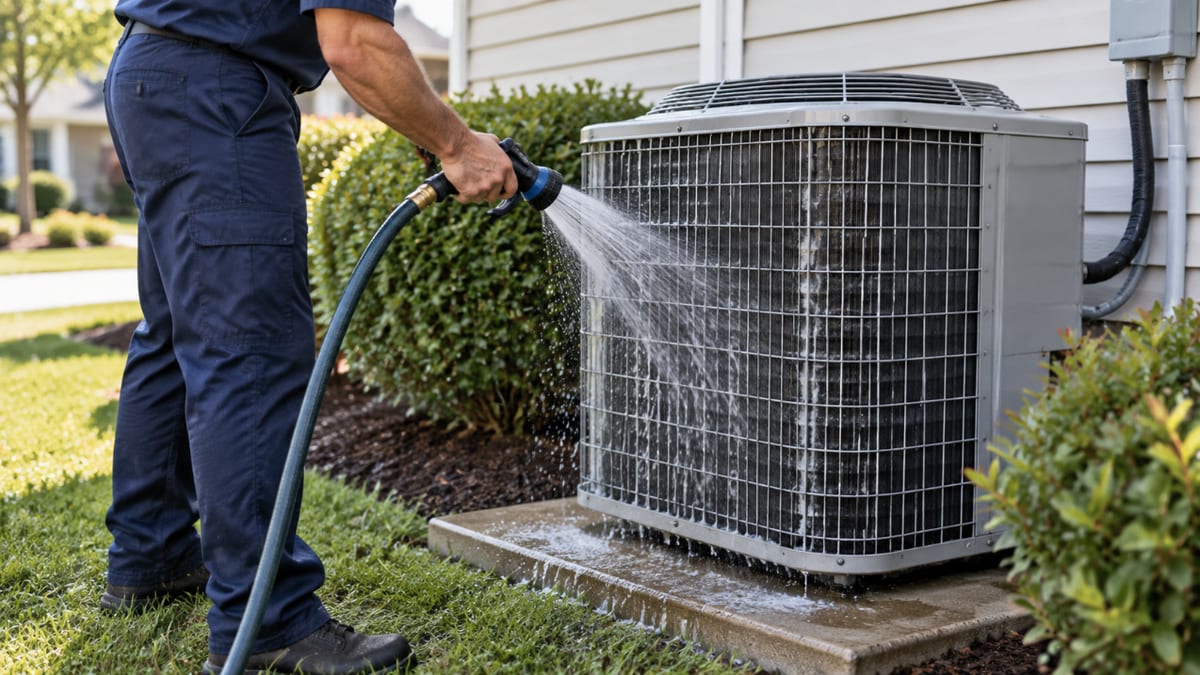
The typical AC replacement cost in central New Jersey in 2026 is about $6,500 to $14,000 installed for a central air conditioner with a matched indoor coil. Most 3-ton, standard-efficiency replacements land between $7,500 and $10,500. Variable-speed systems, attic air handlers and new line sets push the price up, and replacing the furnace at the same time usually means $12,000 to $22,000.
Those numbers are wide because "a new AC" can mean a like-for-like condenser and coil on a ranch house with a basement furnace, or a 5-ton variable-speed system with a new air handler in the attic of a two-story colonial. This guide breaks the price into the pieces we actually quote in homes across Monmouth, Middlesex and Ocean counties, explains the 2025 refrigerant change that raised prices, and gives you an honest way to decide between repairing and replacing.
If you are weighing a heat pump instead of a straight air conditioner, we covered that pricing separately in our heat pump cost guide. This article sticks to central air conditioning.
How Much Does It Cost to Replace an AC Unit in 2026?
The big national cost surveys are a useful starting point, as long as you know what each one measures.
| Source | What it measures | Range | Average |
|---|---|---|---|
| Fixr (2025) | Central AC installation, national | $5,800–$14,400 | $8,750 |
| Fixr | Replacement using existing ducts | $5,500–$10,000 | — |
| This Old House (2026 survey of 1,000 homeowners) | Central AC, installed | $6,345–$10,575 | $8,460 |
| HVACProjectCost (2026) | Central AC replacement | $3,500–$14,000 | ~$6,600 for 1,500–2,000 sq ft |
National averages blend low-cost labor markets with expensive ones, and they blend simple swaps with complicated ones. In central Jersey, three things push real prices toward the middle and top of those ranges: Northeast labor rates, the higher cost of the new A2L refrigerant equipment, and a housing stock full of attic air handlers and long line-set runs. Here is what we see on our own jobs in 2026, for a split-system air conditioner and matched coil on existing ductwork:
| System size | Typical home it fits* | Fixr national (installed) | Central NJ 2026 (our estimate) |
|---|---|---|---|
| 1.5 ton | Small ranch, condo, addition | $3,650–$6,250 | $5,800–$8,000 |
| 2 ton | Cape Cod, small split-level | $4,250–$7,500 | $6,300–$8,800 |
| 2.5 ton | Bi-level, mid-size ranch | $4,500–$8,000 | $6,800–$9,500 |
| 3 ton | Typical colonial or split-level | $5,000–$9,150 | $7,300–$10,500 |
| 3.5 ton | Larger colonial | $5,450–$9,700 | $7,800–$11,200 |
| 4 ton | Large two-story home | $6,950–$11,600 | $8,500–$12,500 |
| 5 ton | Large home, single system | $7,800–$14,000 | $9,500–$14,000 |
*Home size is only a rough guide. The right size comes from a load calculation, not square footage, and we have put 2-ton systems in 2,000-square-foot homes and 4-ton systems in 1,800-square-foot ones. More on that below.
Our ranges assume single-stage or two-stage equipment in the 14.3 to 17 SEER2 range, a new or properly flushed line set, a new pad, disconnect and whip, condensate work, the permit, and removal of the old equipment. Variable-speed equipment adds to the top of each row, as the efficiency table further down shows.
What Goes Into AC Replacement Cost: Line by Line
When two quotes for "a 3-ton AC" differ by $3,000, the difference is almost never the brand. It is in the lines below. A complete estimate should address every one of them, even if some come to zero on your job.
| Component | Typical 2026 central NJ range | Notes |
|---|---|---|
| Outdoor condensing unit | $2,200–$6,500 | Depends on tonnage, SEER2 tier and single-stage vs variable-speed |
| Indoor evaporator coil (cased, A2L) | $900–$2,200 | Must be the coil listed with the condenser in the AHRI matched rating |
| Air handler (attic or closet systems) | $1,800–$4,000 | Replaces the coil line when there is no furnace; common on second floors |
| Installation labor | $2,000–$4,500 | One day for a straight swap; longer for attic work or new line sets |
| Refrigerant line set | $150–$400 to flush and reuse; $400–$1,500 to replace | Depends on length, access and whether it is buried in finished walls |
| Pad or raised stand | $100–$500 | Raised stands for snow, flood zones and settled pads |
| Electrical disconnect and whip | $150–$450 | Replaced on almost every job; a new circuit is $400–$1,200 extra |
| Condensate drain, safety switch or pump | $75–$450 | Gravity drain where possible; pump where not |
| Secondary drain pan (attic) | $100–$300 | Required under attic air handlers; protects the ceiling below |
| Duct transitions and sealing | $300–$3,000 | New coils rarely match the old plenum exactly |
| Thermostat | $150–$600 | Needed for two-stage and variable-speed equipment |
| Permit and inspection | $100–$500 | Set by your town's construction office |
| Removal, refrigerant recovery and disposal | $100–$300 | Fixr lists removal at $150–$250 nationally |
Fixr reports that split-system installation labor alone typically runs $1,250 to $3,000 nationally, at hourly rates of $75 to $250. New Jersey sits toward the top of that band, which is the single biggest reason local prices run above national averages.
The outdoor unit and the matched indoor coil
A central air conditioner is two halves joined by copper pipe: the condenser outside and the evaporator coil inside, sitting on top of your furnace or inside an air handler. The efficiency rating you see advertised belongs to the combination, not the outdoor unit alone. Every legitimate pairing is certified in the AHRI directory, and that certificate is what manufacturers and utility rebate programs check.
This is why we almost never quote "just the outdoor unit." A new condenser on a 15-year-old coil will not deliver its rated SEER2, may void the manufacturer's warranty, and since 2025 usually isn't even possible because the refrigerants don't match. Ask every bidder for the AHRI reference number of the exact system they are quoting.
Line set: replace or flush?
The line set is the pair of copper pipes running between the indoor coil and the outdoor unit. Reusing it saves money, and when it is the right diameter, in good condition and accessible, flushing, pressure testing and reusing it is perfectly sound practice. We replace it when:
- It is the wrong size for the new unit, which is common when tonnage changes.
- It came from an old R-22 system and carries mineral oil and contamination that the new system's oil won't tolerate, and it can't be flushed clean.
- The insulation has rotted off the suction line, or it has been kinked, crushed or patched.
- A compressor burned out on the old system, leaving acid in the lines.
In many split-levels and colonials around Freehold, Old Bridge and Toms River, the line set runs up through a closet or finished wall to an attic air handler. Replacing that run means opening drywall or running a new path outside the house, which is why the same task can cost $400 in one home and $1,500 in another. Whatever the choice, a proper install ends with a nitrogen pressure test and a deep vacuum measured with a micron gauge before any refrigerant is released. Ask whether that is included.
Attic air handlers: common in New Jersey, and more expensive
If your house has a basement furnace, the AC coil sits on top of it and the job is mostly on one level. But a large share of the colonials and split-levels we work on have a second system, or their only cooling system, with an air handler in the attic. Those jobs cost more because:
- Equipment has to go up through a pull-down stair or a small hatch, sometimes in pieces.
- The work happens in an attic that can pass 120°F in July, which slows everything down.
- An attic unit needs a secondary drain pan with a float switch that shuts the system off before water reaches your ceiling.
- You are buying an air handler with its own blower, not just a coil, which adds $1,000 to $2,500 to the equipment line.
Attic ducts are also frequently the weak point in these systems. A new air handler on leaky, poorly insulated attic ductwork will disappoint no matter how high its rating.
Pad, disconnect, whip and condensate
These are small lines that separate a complete quote from a thin one. Old composite pads settle and tilt, which strains the compressor mounts and traps water; a new pad or raised stand is cheap insurance. The electrical disconnect and the flexible "whip" between it and the unit weather badly, especially near the shore, and we replace both on nearly every job. Indoors, the coil produces gallons of water on a humid day. It needs a trapped drain to a floor drain or a condensate pump, and a safety switch that shuts the system down if the drain backs up.
AC Replacement Cost by SEER2 Efficiency
SEER2 measures how much cooling you get per unit of electricity over a season; higher means lower summer bills. Since January 1, 2023, the federal minimum for a new split-system air conditioner in the northern states, which include New Jersey, is 13.4 SEER2 under 10 CFR 430.32. Southern states have higher minimums. Here is how the price steps up for a 3-ton system in our area:
| Efficiency tier | Typical equipment | 3-ton installed, central NJ 2026 |
|---|---|---|
| 13.4–14.3 SEER2 | Single-stage, builder grade | $7,000–$9,000 |
| 15.2–16 SEER2 | Single-stage or basic two-stage | $8,000–$10,500 |
| 17–18 SEER2 | Two-stage, better humidity control | $9,500–$12,500 |
| 19–22+ SEER2 | Variable-speed inverter | $11,500–$15,500 |
These are our estimates, built from Fixr's national per-tier equipment prices plus our local labor and scope. HVACProjectCost's 2026 data points the same way: it prices high-efficiency systems at about 1.15 times the standard tier and premium systems at about 1.30 times.
Which tier makes sense here? New Jersey summers are humid but short compared with the South, so the energy savings from the top tier pay back slowly. What a two-stage or variable-speed system buys you in a New Jersey home is mostly comfort: longer, quieter run cycles that pull more moisture out of the air, and more even temperatures between the first and second floors. For most homes we recommend the 15.2 to 17 SEER2 band, which is also where utility rebates begin. We point people to variable-speed when they have a hot upstairs, humidity complaints or plans to stay in the house for a long time.
AC Only, AC Plus Coil, or the Whole System?
"How much for a new AC?" really has four different answers, depending on how much of the system gets replaced.
| Scope | Central NJ 2026 (our estimate) | When it applies |
|---|---|---|
| Outdoor condenser only | $3,500–$6,000 | Rare now: only with remaining pre-2025 R-410A stock matched to a young R-410A coil |
| Condenser plus matched coil | $6,500–$12,000 | The standard AC replacement on a house with a furnace |
| Condenser plus air handler | $8,500–$15,000 | Attic or closet systems with no furnace |
| AC plus gas furnace (full system) | $12,000–$22,000 | When both are near the end of their lives |
For comparison, HVACProjectCost puts a combined AC and furnace replacement at $7,000 to $18,000 nationally in 2026, with mid-range jobs at $10,500 to $13,500. Our numbers sit higher because most central Jersey full-system jobs include a condensing furnace with PVC venting, and often a chimney liner for the water heater. Our furnace replacement cost guide breaks down that half of the bill.
When replacing the AC and furnace together makes sense
We recommend doing both at once when the furnace is 15 years old or more, when it is an 80% unit you were going to upgrade anyway, or when its blower can't move enough air for the new coil. HVACProjectCost estimates that most contractors charge $500 to $1,500 less for a combined job than for two separate visits, because the plenum, coil transition, electrical and permit work are done once.
There is also a refrigerant-era reason. New A2L coils include a leak sensor, and the system has to be able to start the furnace blower to clear refrigerant if that sensor trips. A furnace from 2012 has no way to receive that signal without an add-on control. If your furnace is young, that add-on works and you should keep the furnace. If it is old, the add-on is money spent on equipment you will replace in a few years anyway.
We don't recommend replacing a furnace that is under about ten years old just because the AC failed. The combined discount rarely beats the value of the years left in a healthy furnace.
The Refrigerant Change and What It Did to AC Prices
Under the EPA's Technology Transitions rule, new residential air conditioning and heat pump systems must use refrigerants with a global warming potential under 700, with an installation compliance date of January 1, 2025. R-410A, the refrigerant in almost every AC installed between about 2010 and 2024, doesn't meet that limit. Manufacturers moved to R-454B or R-32, both classified as A2L, or mildly flammable.
The EPA has since relaxed the installation deadline. Under a final rule effective July 27, 2026, R-410A units manufactured or imported before January 1, 2025 can still be installed until existing supplies run out. Meanwhile, production of R-410A refrigerant itself keeps stepping down.
For a homeowner in 2026, that means:
- Higher equipment prices. A2L systems launched at noticeably higher prices than the R-410A models they replaced, and they have not come back down. On our own quotes, the equipment line is where most of that increase shows up.
- Replacing both halves. An A2L condenser needs an A2L coil with a leak sensor. The old option of swapping only the outdoor unit is mostly gone.
- More expensive repairs on R-410A systems. As refrigerant supply shrinks, recharges and leak repairs on existing R-410A systems cost more. On an older system with a coil leak, that tips the math toward replacement sooner.
- Leftover R-410A stock. A few distributors still hold pre-2025 R-410A equipment. It can make sense for a like-for-like swap on a tight budget, but you are buying into a refrigerant that will only get more expensive to service. Ask any contractor which refrigerant the quoted equipment uses, and if it is R-410A, why.
If your existing system still runs on R-22, which was phased out of new production years ago, a significant leak almost always means replacement. The refrigerant is scarce and expensive, and nothing modern can be matched to the old coil.
What Size AC Do You Need? Why Tonnage by Square Foot Fails
The fastest way to size an air conditioner is "one ton per 500 square feet" or "same as the old one." Both are common, and both regularly produce the wrong answer. The industry standard is an ACCA Manual J load calculation: a room-by-room estimate of heat gain based on your insulation, window area and orientation, air leakage, occupants and local design conditions.
Oversizing is the typical mistake, and in humid New Jersey it is an expensive one. An oversized AC cools the air fast, satisfies the thermostat in a few minutes and shuts off before it has run long enough to pull moisture out. The house ends up cold and clammy, the system short-cycles, and you paid more for the larger unit. The Department of Energy's federal buying guidance is blunt about it: installation problems like oversizing, improper charging and leaky ducts "result in efficiency losses, occupant discomfort, and shortened equipment life."
We regularly find homes in Middletown and Edison that had a 4-ton system replaced with another 4-ton system for 30 years, when new windows and attic insulation brought the real load down to about 3 tons. Right-sizing saved those owners $1,000 or more on equipment and fixed a humidity problem at the same time. The ductwork matters too: a system can only deliver the capacity the ducts can carry, so a proper estimate looks at return size and static pressure as well as the load.
Repair or Replace? The $5,000 Rule and Its Limits
Air conditioners typically last 10 to 20 years according to Fixr, and 15 to 20 years when properly maintained according to This Old House. In our experience, units near salt air on the barrier islands and along the bays tend to sit at the lower end because of coil corrosion, while well-maintained inland systems often reach 15 years or more. ENERGY STAR suggests considering replacement once an air conditioner is more than 10 years old, noting that properly installed efficient equipment can save up to 20% on heating and cooling costs.
Age alone doesn't decide it, though. The trade's shortcut is the $5,000 rule: multiply the age of the unit in years by the repair quote. If the result is over $5,000, replacement usually makes more financial sense.
- A $350 capacitor on a 6-year-old AC: 6 × 350 = 2,100. Repair it.
- A $900 coil leak repair on an 11-year-old R-410A system: 11 × 900 = 9,900. Start pricing replacements.
- A $2,200 compressor on a 13-year-old unit: 13 × 2,200 = 28,600. Replace.
It is a useful gut check, but it has real blind spots:
- The threshold is dated. It was set when a new system cost far less than it does after the A2L change. Some contractors now use a higher number, which pushes the decision toward repair on mid-life units.
- It ignores warranty. A failed compressor on an 8-year-old unit scores well over 5,000, but if the parts warranty was registered, you may only be paying labor and refrigerant.
- It ignores refrigerant type. Any repair that involves opening the system on an R-22 unit, or a large recharge on R-410A, costs more every year.
- It ignores repair frequency. Three $400 repairs in two summers is a pattern, not three separate decisions.
- It ignores efficiency. Replacing a 10 SEER system from the early 2000s with a modern one cuts cooling costs substantially, which the formula doesn't count.
For typical New Jersey prices on the common repairs, from capacitors to compressors, see our AC repair cost guide.
When we tell people not to replace
We would rather lose a sale than sell a system someone doesn't need. Repair is usually the right call when:
- The unit is under about 10 years old and the failure is a capacitor, contactor, fan motor or a clogged drain.
- A compressor or coil failed within the registered parts warranty.
- The "problem" is actually a dirty coil, a clogged filter or a drain line. These are maintenance issues, not the end of the system. Our article on why annual AC maintenance pays for itself explains how much life a proper tune-up can add.
- Rooms are uneven because of ductwork, not because of the AC. A new condenser won't fix a crushed attic duct.
- You are selling within a year and the system still cools. A service record and a clean inspection may be worth more to a buyer than new equipment.
Central AC vs Heat Pump vs Ductless
Replacing an air conditioner is the natural moment to ask whether you should put in a heat pump instead. A heat pump cools exactly like an AC but can also heat, and paired with your existing gas furnace it becomes a dual-fuel system. It typically costs somewhat more than an AC of the same size and efficiency, and the pricing, rebates and trade-offs are in our heat pump cost guide.
If the house has no ducts, or the problem is one hot room over the garage, a ductless mini-split may be cheaper and more effective than extending a central system. For a straight central air replacement on existing ducts, see our AC installation service.
AC Replacement in New Jersey: Permits, Licensing and Rebates
Permits under the Uniform Construction Code
Replacing an air conditioner in New Jersey requires a permit from your municipality's construction office. Under N.J.A.C. 5:23-2.17A, replacing existing air conditioning units and condensing units with new appliances of like capacity counts as "minor work." The contractor notifies the construction office before starting, delivers the completed application within five business days, and the office inspects within three business days of the request. That is why a failed AC can be replaced the next day during a heat wave without skipping the permit. A job that adds a new circuit or changes capacity may need an electrical permit as well. Fees are set by each town.
Master HVACR licensing
New Jersey requires that HVACR work be performed under a licensed Master HVACR contractor. Under N.J.A.C. 13:32A-2.4, the licensed master must impress their seal on every HVACR permit application, and the rules at N.J.A.C. 13:32A-5.1 require the license number on the company's vehicles, invoices and advertising. If a quote doesn't show a Master HVACR license number, ask for it before you go any further.
Utility rebates
Rebates for plain central air conditioners are modest in New Jersey, and much larger for heat pumps. As of September 2026, JCP&L's HVAC rebate program, which covers most of Monmouth and Ocean counties, lists $100 for a central AC rated at least 15.2 SEER2 and 12 EER2, and $200 for at least 17 SEER2 and 12 EER2, with the rebate tied to the matched system. PSE&G customers in Middlesex should check the current terms of its HVAC Instant Rebates program with their contractor, since amounts change during the program cycle. The state's New Jersey Clean Energy Program also runs Comfort Partners, which offers free efficiency improvements to income-eligible households.
No federal tax credit in 2026
Many cost guides still promise a 30% federal credit of up to $600 for a high-efficiency air conditioner. That credit, Section 25C, was ended by the One Big Beautiful Bill Act, signed July 4, 2025. The IRS confirms that the credit is not allowed for any property placed in service after December 31, 2025. An AC installed in 2025 can still be claimed on a 2025 return. An AC installed in 2026 gets nothing federally, so if a quote still subtracts a tax credit, ask for it to be removed. Current Guardian Air promotions and financing are on our offers page.
What a Proper AC Installation Includes
Price only means something next to scope. On a complete replacement, you should expect:
- A load calculation, plus a look at the ducts, electrical and outdoor location, before a price is given.
- Refrigerant recovered from the old system by an EPA-certified technician, never vented.
- A condenser and coil (or air handler) that appear together on an AHRI certificate.
- A line set that is new or flushed, pressure tested with nitrogen and evacuated with a micron gauge.
- Brazed connections made with nitrogen flowing, to keep scale out of the new system.
- A new pad or stand, disconnect and whip, and a properly trapped condensate drain with a safety switch.
- The A2L leak sensor wired to the furnace or air handler so it can start the blower if needed.
- Charge set to the manufacturer's specification, with airflow and temperature split checked and recorded.
- The permit pulled, the inspection attended, and the old equipment removed.
- Warranty registration done for you. Most manufacturers extend parts coverage only if the equipment is registered within a set window after installation; Carrier, for example, lists 10-year parts coverage upon registration. Miss the window and you may get far less.
After installation, annual service keeps the system at its rated efficiency and is often a condition of the warranty. Our HVAC maintenance guide covers what that visit should include.
How to Compare AC Replacement Quotes
Get at least two written estimates and put them side by side. For each one, check:
- Exact model numbers for the condenser and coil or air handler, and the AHRI reference number.
- Tonnage and how it was chosen: a Manual J, or just the old unit's size.
- Refrigerant type, and whether the furnace can handle A2L leak-detection controls.
- Line set: new or reused, and if reused, how it will be flushed and tested.
- Electrical, pad and condensate work spelled out.
- Duct transitions and sealing included or excluded.
- Permit pulled by the contractor.
- Warranty: parts, compressor and labor terms, and who registers it.
- Rebates: which program, who files, and whether the price shown is before or after.
Red flags
- A price over the phone, or sizing based only on square footage.
- No load calculation and no look at the ductwork.
- A new condenser quoted against your existing coil, or a coil that doesn't appear with the condenser on an AHRI certificate.
- A "same size as before" answer on a house that has had new windows or insulation.
- No permit, or a discount offered to skip it.
- A 2026 quote that still deducts a federal tax credit.
- "Today only" pricing designed to stop you comparing.
- No Master HVACR license number on the proposal.
Our Take on AC Replacement Cost
For most central Jersey homes, a realistic 2026 budget is $7,500 to $10,500 for a well-installed 3-ton air conditioner with a matched coil, $8,500 to $15,000 if it is an attic air handler system, and $12,000 to $22,000 if the furnace goes at the same time. Spend your money first on correct sizing, a matched A2L system, a clean line set and a documented installation. Buy variable-speed if you want better humidity control and even temperatures upstairs, not because a salesperson promises it will pay for itself. If you can, replace in the spring or fall rather than in a July heat wave, so you have time to compare quotes. And if your system is under ten years old and a single part failed, repair it.