September 29, 2026
Water Heater Replacement Cost in NJ (2026): Tank, Tankless & Heat Pump Prices
What a new water heater really costs in central New Jersey in 2026: tank, power-vent, tankless and heat pump prices, the venting and code items that change a quote, running costs with the math shown, and current rebates.
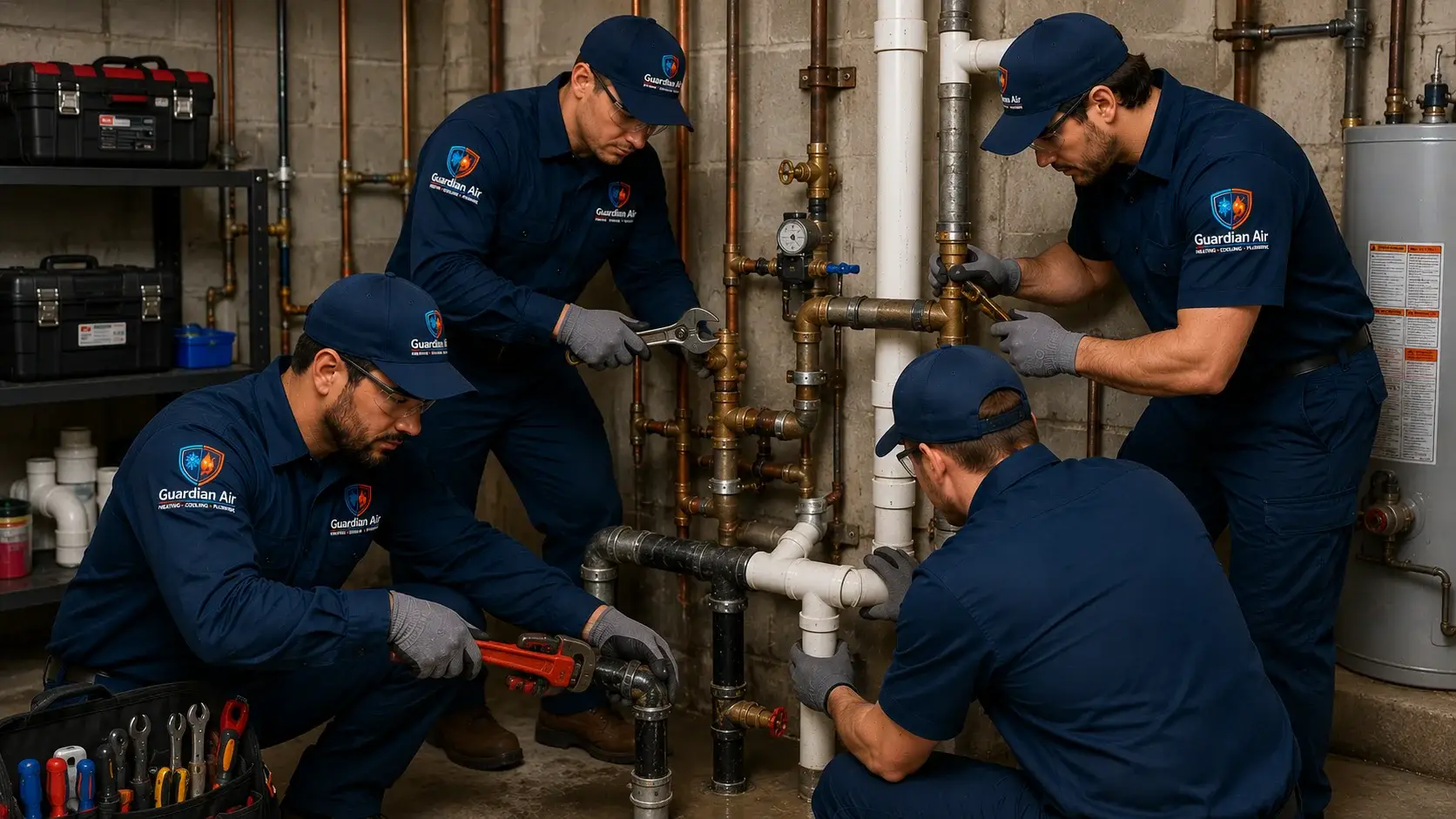
In 2026, water heater replacement cost in New Jersey typically runs about $1,800 to $3,500 installed for a standard 40- or 50-gallon gas or electric tank. A power-vent gas tank usually costs $3,000 to $4,800, and a gas tankless or heat pump water heater usually costs $3,000 to $6,500 before rebates.
The spread is wide because "a new water heater" can mean a two-hour swap of an identical tank, or new venting, a bigger gas line, a new circuit and a condensate drain. This guide breaks the price into the pieces a plumber actually quotes in the basements and utility closets we work in across Monmouth, Middlesex and Ocean counties, and explains when a like-for-like tank is the smartest buy.
Safety First: What to Do Before You Price Anything
Most people start shopping because the old heater has failed. Some failures are just inconvenient. Deal with the dangerous ones first.
If you smell gas
Natural gas carries an added odorant that smells like rotten eggs. If you smell it, leave the house immediately. Do not flip light switches, try to relight a pilot, use a phone indoors or start a car in an attached garage. From a safe distance outside, call 911 and your gas utility's 24-hour emergency line:
- New Jersey Natural Gas: 800-GAS-LEAK (800-427-5325). See NJNG's emergency contact page.
- PSE&G: 1-800-880-7734 (1-800-880-PSEG).
- Elizabethtown Gas: 1-800-492-4009 or 1-844-571-LEAK.
If a carbon monoxide alarm goes off
Get everyone out, pets included, and call 911 from outside. A gas water heater that back-drafts, usually because of a blocked or oversized flue, can spill exhaust into the basement. Carbon monoxide is colourless and odourless, and the U.S. Consumer Product Safety Commission lists its early symptoms as headache, fatigue, shortness of breath, nausea and dizziness, which are easy to mistake for flu.
In New Jersey a CO alarm is a legal requirement. Under the state fire code, N.J.A.C. 5:70-4.19, one- and two-family homes with a fuel-burning appliance or an attached garage must have a carbon monoxide alarm in the immediate vicinity of the sleeping areas. The CPSC also recommends one on every level of the home.
If the relief valve is discharging
Every tank has a temperature and pressure (T&P) relief valve with a pipe running toward the floor. Never cap, plug or remove that pipe. A valve that weeps now and then is often reacting to thermal expansion in a closed system (more on that below). One that repeatedly discharges hot water or steam can mean the tank is overheating. Turn the heater off (gas control to "off," or the breaker off for electric) and have it checked. Swapping the valve rarely fixes anything; it is usually reporting the real problem.
If the water is scalding
The CPSC's tap water scald alert urges everyone to set water heaters to 120°F. Most adults suffer third-degree burns after two seconds in 150°F water, six seconds at 140°F and thirty seconds at 130°F, and children and older adults are most at risk. We set new heaters at or near 120°F and check a tap with a thermometer. If you want hotter water stored in the tank, a thermostatic mixing valve keeps the taps safe.
If the tank is leaking
Water pooling under the tank, or rust streaks from the bottom seam, usually means the steel tank has rusted through. That can't be repaired. Close the cold-water valve feeding the top of the tank, turn the gas control off or switch off the breaker, and keep the floor drain clear. A small weep can become forty gallons on a finished basement floor with little warning. If you can't stop the water, call an emergency plumber.
How Much Does a New Water Heater Cost in 2026?
National surveys are a useful baseline. Fixr puts the average installation at about $1,400, with most gas tank jobs between $900 and $3,000. It lists tanks at $600–$2,500 installed, tankless at $1,000–$4,000, indirect-fired at $1,200–$4,500 and heat pump units at $1,200–$4,600. This Old House puts the average at about $1,950 within a $1,600–$5,400 range, with basic tanks at $1,200–$2,300, heat pump units at $2,500–$3,500 and tankless at $2,100–$4,000.
Those averages blend cheap labor markets with expensive ones, and simple swaps with conversions. In central New Jersey, labor rates, required permits, older chimneys and the code items inspectors expect push real prices toward the middle and upper end. Here is what we typically see on our own jobs in 2026:
| Water heater type | Typical 2026 installed price in central NJ | What usually drives the high end |
|---|---|---|
| Gas tank, atmospheric vent (40–50 gal) | $1,900–$3,500 | Flue or chimney liner work, expansion tank, tight access |
| Electric tank (40–50 gal) | $1,800–$3,000 | Wiring corrections, drain pan with piped drain |
| Gas tank, power-vent (50 gal) | $3,000–$4,800 | New PVC vent run, new outlet, long vent route |
| Gas tank, direct-vent (40–50 gal) | $2,800–$4,500 | Location must allow a through-wall vent |
| Gas tank, 75 gallon | $3,200–$5,500 | Larger vent and gas demand, stairs |
| Gas tankless, condensing | $3,500–$6,500 | Gas line upsizing, PVC venting, condensate drain |
| Electric tankless (whole house) | $2,000–$4,500+ | Large new circuits; possible service upgrade |
| Heat pump water heater (50–65 gal) | $3,200–$5,500 before rebates | New 240V circuit, condensate drain, ducting in tight rooms |
| Indirect-fired tank on an existing boiler | $2,500–$5,000 | Boiler piping and zone controls, tank size |
Replacing an old tankless unit with a new one, where the gas line and venting are already right, often comes in well below the conversion price.
Water Heater Replacement Cost by Type
Gas tanks: atmospheric, power-vent or direct-vent
The most common heater in central Jersey basements is a 40- or 50-gallon atmospheric gas tank. It relies on natural draft: hot exhaust rises through a draft hood into a masonry chimney or metal B-vent, with no fan and no plug. That is why it's cheap to buy and simple to swap. Fixr's gas water heater guide puts a tank-style gas replacement at $1,000–$2,700 nationally, averaging about $1,900.
A power-vent tank has a blower that pushes exhaust through PVC or CPVC pipe, usually out a sidewall. It needs a 120V outlet and costs more, but it frees the heater from the chimney. A direct-vent tank uses sealed combustion, drawing air from outside and exhausting through the same wall penetration, which suits closets and tight rooms. Fixr prices power venting at $300–$1,000 on top of an atmospheric install.
Electric tank
Electric tanks are the cheapest to install when the wiring is already there: no venting, no gas, no combustion air. What makes them expensive is running them, as the operating-cost table below shows.
Gas tankless
A tankless heater heats water as it flows through a heat exchanger instead of keeping a tank hot around the clock. Fixr's tankless guide puts whole-house units at $2,500–$4,500 nationally, averaging about $2,811, with gas line work adding roughly $500–$800. A tank-to-tankless conversion in an older New Jersey home usually costs more than that, because of three items that aren't on the unit's price tag:
- Gas supply. A typical 40- or 50-gallon tank burns roughly 35,000–40,000 BTU per hour; a whole-house tankless unit is commonly rated near 199,000. The half-inch branch that fed the old tank rarely carries that, so we often run a new 3/4-inch line (larger on long runs) sized for every gas appliance in the house, and confirm the meter can keep up.
- Venting. Condensing units vent through PVC to a wall or roof, never the old chimney.
- Condensate. Slightly acidic water that needs a drain, and often a neutralizer to protect cast-iron pipe.
See our tankless water heater installation page, and the honest tankless section below.
Electric tankless
Electric tankless needs no venting but a lot of power. In winter, water enters many New Jersey homes in the 40s or low 50s °F, so a hot shower needs roughly a 70°F rise. A 27-kilowatt unit delivers about 92,000 BTU per hour, which works out to about 2.6 gallons per minute at that rise (BTU/h ÷ (500 × temperature rise)): roughly one shower at a time. It also draws about 112 amps at 240 volts (27,000 ÷ 240), which in a 100- or 150-amp house often means a service upgrade. A 199,000 BTU gas unit at 95% efficiency delivers about 5.4 gallons per minute at the same rise. Electric tankless suits a single bathroom or an addition, not a whole older house.
Heat pump water heater
A heat pump water heater (HPWH, or hybrid) is a tank with a small heat pump on top that pulls heat from the surrounding air, using electric elements only as backup. The federal Energy Management Program's purchasing guidance estimates an ENERGY STAR model costs about $97 a year to run in its scenario, versus about $340 for a standard electric tank, or roughly $2,500 saved over a 13-year life at national prices.
Placement is the catch. ENERGY STAR says these units belong in spaces that stay between 40°F and 90°F year-round with about 1,000 cubic feet of air, and they cool the space they're in. A typical unfinished New Jersey basement works well, and the dehumidifying is welcome in August. A small closet needs louvered doors or ducting. Most full-size models also need a 240V circuit and a condensate drain. For space heating and cooling, see our separate heat pump cost guide.
Indirect-fired tank from a boiler
If your home heats with a boiler, an indirect tank uses boiler water circulating through a coil to heat your domestic water, with no separate burner or flue. A good indirect tank usually outlasts a standard gas tank. The price depends on the boiler's piping and controls, and it only makes sense when the boiler is reasonably efficient, since it now fires in July too.
Water Heater Replacement Cost by Size
Size matters less than type and venting, but bigger tanks cost more, weigh more on basement stairs, and may need a larger vent and gas supply. Fixr's national installed ranges:
| Tank size | Typical household | Installed cost (Fixr, national) |
|---|---|---|
| 30 gallons | 1–2 people | $550–$2,100 |
| 40 gallons | 1–4 people | $550–$2,300 |
| 50 gallons | 3–5 people | $700–$2,500 |
| 75 gallons | 4–6 people | $1,100–$3,400 |
| 80 gallons | 6+ people | $1,200–$3,600 |
Choose by first-hour rating, printed on the EnergyGuide label, rather than gallons alone. It tells you how much hot water the heater delivers in a busy hour. A 40-gallon gas tank with a strong burner can outperform a slow-recovering 50-gallon electric tank. Oversizing costs more and wastes energy keeping extra water hot. Tankless units are sized by gallons per minute at your winter temperature rise instead.
What Goes Into a Water Heater Replacement Quote
A complete estimate lists every line below, even those that come to zero. When two quotes for "the same 50-gallon heater" differ by $1,200, the difference is almost always here, not in the tank.
| Item | When you need it | Typical cost | Source |
|---|---|---|---|
| Labor | Always | $300–$1,500 (18–50% of total) | Fixr |
| Removal and disposal | Always (often bundled) | $75–$500 | Fixr |
| Permit | Always in NJ; fee set by your town | $25–$1,500 nationally; basic permits at the low end | Fixr |
| Venting | Power-vent, direct-vent, tankless or failed flue | $300–$1,100 | Fixr / This Old House |
| Gas line work | Tankless conversion or relocation | $500–$800 typical; more for long runs | Fixr |
| Water line changes | New location or connection height | $200–$600 | This Old House |
| Expansion tank | Closed system (check valve or PRV) | Usually a few hundred dollars | Our field experience |
| Drain pan with piped drain | Heater in or above finished space | Small add-on; more for long drain runs | Our field experience |
| Chimney liner | Orphaned atmospheric heater | Often $900–$2,500 | Our furnace cost guide |
| Electrical | Power-vent, HPWH or electric tankless | From an outlet to a panel upgrade | Varies by house |
If you're pricing a repair rather than a replacement, our plumber cost guide covers typical rates.
What Drives the Price Up in New Jersey Homes
The orphaned water heater
This is the item most often left off cheap quotes. In many Monmouth and Ocean county homes built from the 1960s to the 1990s, the furnace and water heater share one masonry chimney. When the furnace is replaced with a condensing unit, it moves to PVC through the wall and leaves the water heater venting alone into a flue sized for two. That "orphaned" heater can't warm the big flue enough to draft reliably, so exhaust cools, condenses, spills back into the basement and damages the masonry.
The fix is a correctly sized stainless liner, or a power-vent or direct-vent heater that skips the chimney entirely. If your furnace was upgraded and nobody addressed the water heater, ask about it. Our furnace replacement cost guide covers the same problem from the furnace side.
Expansion tanks and closed systems
Water expands when heated. In older homes that expansion pushed back into the street main. Many New Jersey homes now have a pressure-reducing valve, check valve or backflow preventer at the meter, which closes the system, so every heating cycle raises the pressure until the relief valve weeps. A small expansion tank on the cold supply absorbs it. If you have one of those valves and no expansion tank, expect it on the quote.
Drain pans, not earthquake straps
National cost pages often list seismic strapping. It's a code item in earthquake-prone areas like California, not a standard line item for typical New Jersey homes. What matters here is water damage. When a heater sits in a finished basement, closet or attic, we install a drain pan piped to a floor drain, sump or other safe outlet; a pan with no drain only buys minutes. A leak detector with automatic shutoff is cheap insurance.
Hard water, scale and anode rods
Water quality varies across our area. Some towns and private wells have hard water that scales tank bottoms and tankless heat exchangers; other supplies are softer but more corrosive. Your supplier's annual Consumer Confidence Report lists hardness. Scale causes the rumbling in older tanks and cuts efficiency. The sacrificial anode rod corrodes so the tank doesn't, and checking it every few years is the cheapest way to extend a tank's life. Tankless units need annual descaling, usually as a warranty condition.
Permits and licensing
Replacing a water heater in New Jersey requires a permit. Under N.J.A.C. 5:23-2.17A, replacing an existing heater with one of like capacity is "minor work": the contractor notifies your construction office before starting, files the application within five business days, and the office inspects within three business days of the request. That's how a failed heater can legally be replaced the same or next day.
Under N.J.A.C. 13:32-1.4, installing water heaters and gas piping falls within a licensed master plumber's scope. A homeowner working on their own single-family home is exempt from the license, not from the permit. New Jersey's plumbing subcode is the National Standard Plumbing Code, and the state's amendments define "hot water" as 120°F to 140°F. NJNG also requires proof of permit for its rebates.
Repair or Replace Your Water Heater?
Start with the age. The serial number on the label encodes the build date, usually in the first few characters; most brands use a year-and-month or year-and-week format, and Bradford White uses a letter code. A photo of the label is enough for us to decode it.
| Problem | Usually | Why |
|---|---|---|
| Tank leaking from the body or bottom seam | Replace | The tank has rusted through |
| Leak at a fitting, valve or connector | Repair | The tank is fine |
| Gas pilot won't stay lit (standing-pilot units) | Repair | Often the thermocouple |
| Electric: lukewarm or runs out fast | Repair | Often an element or thermostat |
| Rumbling or popping | Flush; replace if old | Sediment buildup |
| Rusty hot water only | Check anode; replace if old | Depleted anode or failing lining |
| Failed gas control on a 10+ year-old tank | Usually replace | Repair cost approaches a new tank's |
Tank heaters typically last 8 to 12 years, tankless units 20 or more with descaling, and federal guidance uses a 13-year life for heat pump water heaters. A repair on a 4-year-old tank is almost always worth it; a major repair on a 12-year-old tank usually isn't. Our water heater repair and replacement page covers the common symptoms.
Operating Costs: What Each Type Costs to Run in New Jersey
Here is a like-for-like comparison using New Jersey prices and the same hot water load for every heater. Assumptions:
- Load: 55 gallons a day heated from 58°F to 125°F, the federal "medium draw" test pattern: 55 × 8.34 lb × 67°F × 365 ≈ 11.2 million BTU a year.
- Electricity: 23.98¢ per kWh, New Jersey's 2026 residential average through July, from the EIA Electric Power Monthly.
- Natural gas: about $16.04 per thousand cubic feet, the average of New Jersey's monthly residential prices from July 2025 to June 2026 (EIA), or about $1.55 per therm.
- Efficiency: representative UEF ratings. Yours is on the EnergyGuide label.
| Water heater | UEF used | Energy per year | Approx. cost per year |
|---|---|---|---|
| Electric tank | 0.92 | ~3,570 kWh | ~$857 |
| Gas tank, atmospheric | 0.62 | ~181 therms | ~$280 |
| Gas tank, power-vent | 0.68 | ~165 therms | ~$255 |
| Heat pump water heater | 3.0 | ~1,100 kWh | ~$263 |
| Gas tankless, condensing | 0.95 | ~118 therms | ~$183 |
The method: heat delivered ÷ UEF = energy bought, times price. For the electric tank, 11.2 million BTU ÷ 0.92 ≈ 3,570 kWh, times $0.2398 ≈ $857.
- Electric tank to heat pump saves roughly $600 a year, the biggest gain on the table. With a rebate, the price difference can pay back within a few years.
- Atmospheric gas tank to gas tankless saves roughly $100 a year here. If the conversion costs $2,500 more than a new tank, payback is long.
- Gas tank versus heat pump is close at current prices, so venting and space usually decide it.
These are estimates. Actual bills depend on your household's use, rate structure and fixed charges, and a heat pump water heater pulls some heat from the basement in winter.
Is a Tankless Water Heater Worth It? An Honest Answer
Sometimes. The Department of Energy built its 2024 standards around heat pump technology for electric tanks, not tankless, and our numbers show why a gas tankless conversion often takes years to pay back. We regularly steer people away from tankless when:
- One or two people live in the house and a 40- or 50-gallon tank already keeps up.
- The gas line would need a long new run across a finished basement.
- Nobody will descale it every year.
- The plan is to sell within a few years.
Tankless earns its price when you genuinely run out of hot water, need the floor space, or have the heater in a finished area where a tank failure would be costly; tankless units usually stop heating rather than flooding the floor. It's also cheaper when the gas line and venting are already in place from an earlier tankless.
When a Like-for-Like Tank Swap Is the Smart Choice
For many homes the best value is the boring one: the same type and size, in the same spot, with code items updated. It's the right call when the old tank lasted a normal life and you never ran short, the venting is sound (no orphaned chimney, or already lined), you need hot water back today, or your budget is better spent on the furnace, insulation or a failing sewer line. A well-installed tank that lasts twelve years beats a tankless unit that never pays back.
Rebates, Tax Credits and the 2029 Federal Rule
The federal 25C tax credit is gone. The Energy Efficient Home Improvement Credit used to cover part of the cost of qualifying heat pump and high-efficiency gas water heaters. The One Big Beautiful Bill Act, signed July 4, 2025, ended it. The IRS confirms that the credit is not allowed for any property placed in service after December 31, 2025. A water heater installed in 2025 can still be claimed on a 2025 return; a 2026 installation gets nothing federally.
Utility rebates are the main incentive now:
- NJNG SAVEGREEN: The water heating program offers up to $750 for the highest-efficiency gas units, plus 0% on-bill financing. Equipment must be purchased and installed by June 30, 2027, applications are due within 120 days with a paid receipt and proof of permit, and new construction doesn't qualify. Past program flyers excluded atmospheric tanks, so check the current eligibility list before choosing a model.
- JCP&L: Its appliance rebate program lists $750 for an ENERGY STAR certified heat pump water heater.
- PSE&G: Also offers water heating rebates, including for heat pump water heaters. Amounts and efficiency floors change, so check current terms before you buy.
Rebates depend on funding; confirm the figure before you sign. Current promotions are on our offers page.
The 2029 standard. In 2024 DOE finalized efficiency standards for consumer water heaters that take effect in 2029 (manufacturer A. O. Smith lists May 6, 2029). They will push the most common sizes of electric storage heaters to heat pump technology and modestly raise the bar for gas tanks. A separate rule for gas tankless heaters was nullified by Congress in 2025. The storage rule remains on the books as of this writing. It governs what manufacturers build, not what's already in your basement.
How to Compare Water Heater Quotes
- Exact model number, so you can check the UEF and first-hour rating.
- Venting: atmospheric, power-vent, direct-vent or condensing, and where it terminates.
- Chimney plan: whether the flue suits the new heater, and what happens if it's orphaned.
- Gas line size and route for tankless, and who checked the meter.
- Code items: expansion tank, T&P discharge pipe, drain pan, sediment trap, shutoff valves.
- Electrical for power-vent, HPWH or electric tankless.
- Permit included and pulled by the contractor.
- Haul-away of the old heater.
- Warranty: tank or heat exchanger, parts and labor years listed separately.
- Rebate paperwork, and whether the price is before or after rebates.
Red Flags in a Water Heater Bid
- A phone price for a tankless conversion before anyone has looked at the gas line.
- No permit, or a discount for skipping it.
- A new atmospheric tank into a chimney the furnace no longer uses, with no mention of a liner.
- A plugged or missing T&P discharge pipe.
- A promised federal tax credit on a 2026 installation.
- "Tanks are being banned, go tankless now." They aren't.
Our Take
For most central New Jersey homes with a sound chimney and a household that never runs short, a well-installed gas tank is still the best value. If you have an electric tank and basement space, a heat pump water heater is usually the strongest upgrade, especially with a $750 utility rebate. Gas tankless is a comfort and space choice first and an energy-saving choice second. And whenever a furnace or boiler is replaced, check the water heater's venting at the same time.
Get a Free Water Heater Replacement Estimate
If your water heater is leaking, aging or not keeping up, we'll look at the venting, gas or electrical supply and code items, and give you a written, itemized price for the options that actually fit your home, including the honest "just replace the tank" option. See our water heater services, check current offers, or request your free estimate.