June 20, 2026
5 Signs Your Furnace Needs Repair (And When to Replace Instead)
Banging noises, rising gas bills, cold rooms, short cycling and a yellow burner flame — what each one actually means mechanically, which are safety issues, and how to tell whether repair or replacement is the better use of your money.
By Noor Kamal, Technology Manager · Published · Updated
Every furnace gives you warning before it quits. Almost none of them quit without one.
That is the single most useful thing we can tell a New Jersey homeowner about heating repair, and it is the reason this guide exists. In our experience across Monmouth, Middlesex and Ocean counties, the overwhelming majority of no-heat calls we run in January trace back to a symptom the homeowner had already noticed — often weeks earlier — and understandably set aside. A noise. A room that never quite warms up. A gas bill that climbed for no obvious reason.
The difference between a $200 repair in November and a failed heat exchanger in January is usually nothing more than whether somebody acted on that signal. This guide covers the five signals that matter most, what is actually happening mechanically behind each one, which ones are genuine safety issues, and — the part most articles skip — how to tell whether the right answer is a repair at all.
Why New Jersey Furnaces Fail When They Do
Heating equipment in this part of the state lives a particular kind of life, and it shapes how failures show up.
Our winters are not the harshest in the country, but they are erratic. A furnace in central New Jersey might idle through a mild stretch in the forties, then be asked to run nearly continuously when a nor'easter drops temperatures into the teens overnight. Equipment does not fail during the mild stretch. It fails on the first hard demand after one — which is why the phones ring all at once on the first genuinely cold night of the season, and why getting a technician quickly is hardest at exactly the moment you need one most.
Housing stock matters too. Much of Monmouth and Ocean County's inventory went up in development waves — the 1960s and 70s, then again through the 1980s and 1990s. Furnaces last roughly 15 to 20 years with decent maintenance. That means entire neighbourhoods tend to reach end-of-life together, and it is why a street in Marlboro or Old Bridge can see half a dozen replacements in a single season.
Proximity to the water adds a third factor. Homes in Point Pleasant, Long Branch and the bayfront sections of Middletown deal with salt air, which is hard on metal. Flue components, burner assemblies and electrical contacts corrode faster near the coast than they do fifteen miles inland.
Sign 1: Unusual Noises
A healthy furnace makes a consistent, boring set of sounds — a click, the whoosh of ignition, then steady airflow. Anything that stands out from that pattern is information, and the specific sound narrows the diagnosis considerably.
Banging or booming at start-up
This is the noise to take seriously. A delayed-ignition boom happens when gas accumulates in the combustion chamber before the igniter lights it, so instead of a controlled flame you get a small explosion. The usual causes are dirty burners, a weak igniter, or a gas pressure problem.
Beyond the alarming noise, repeated delayed ignition stresses the heat exchanger — the metal wall separating combustion gases from the air you breathe. Crack that, and you have a carbon monoxide path into the home. A boom at start-up is worth a service call this week, not next month.
Scraping or grinding
Metal on metal, almost always in the blower assembly. Either the blower wheel has shifted and is contacting the housing, or the motor bearings have worn out. Scraping is cheap to fix early and expensive to ignore: a blower wheel that destroys its housing turns a bearing job into an assembly replacement.
Squealing or high-pitched whining
On older belt-driven units, a slipping or cracked belt. On modern direct-drive systems, more often failing motor bearings or a capacitor beginning to fail. Not an emergency, but a clear signal of a part heading toward failure.
Rattling
Often benign — a loose panel screw or a duct vibrating against a joist. Worth checking the obvious things yourself. If the rattle is coming from inside the cabinet rather than the ductwork, have it looked at.
Clicking that never becomes ignition
You hear the igniter attempting repeatedly, but no flame follows, and eventually the unit locks out. This is typically a failed hot-surface igniter, a dirty flame sensor, or a pressure-switch fault. The flame sensor in particular is one of the most common and least expensive repairs in the trade — a thin metal rod that develops a film over a season or two and stops detecting flame. Cleaning it is often a matter of minutes.
Sign 2: Rising Heating Bills Without a Change in Habits
This one is easy to rationalise away, because energy prices move and no two winters are alike. The way to read it properly is to compare against the same month in prior years rather than against last month, and to account for how cold the month actually was.
A furnace loses efficiency gradually, not suddenly. Dirty burners, a clogged filter restricting airflow, a blower moving less air than designed, ductwork leaking heated air into an unconditioned attic or crawlspace — each shaves a little off, and together they can add up to a system consuming noticeably more fuel to deliver the same comfort.
It is worth understanding what your furnace's efficiency rating means here. AFUE — Annual Fuel Utilisation Efficiency — describes what fraction of fuel becomes usable heat. Older units run 70 to 80 percent. Current high-efficiency condensing furnaces reach 90 to 98 percent. A furnace rated at 80 percent when new does not stay there if it is never serviced.
Before calling anyone, change the filter and give it two weeks. A restricted filter is the single most common cause of a furnace working harder than it should, and it is the one thing on this entire list you can fix yourself for a few dollars.
Sign 3: Uneven Heating and Cold Rooms
Uneven heat is the symptom homeowners most often assume is normal for their house. Sometimes it genuinely is — a room over a garage or an addition on a long duct run will always be harder to condition. But persistent cold rooms that used to be comfortable indicate something changed. If the vents are pushing out air that never warms up anywhere in the house, that is a different fault — see our guide to a furnace blowing cold air.
The usual suspects, roughly in order of how often we find them:
- Duct leakage. Joints separate over time, particularly in attics and crawlspaces. Heated air escaping into an unconditioned space is heat you paid for and will never feel.
- Closed or obstructed registers. Furniture moved over a vent, or dampers closed years ago and forgotten.
- A weakening blower motor. Less airflow means the rooms furthest from the unit get progressively less.
- Undersized or poorly designed ductwork. Common where a finished basement or addition was tied into an existing system without recalculating capacity.
- A failing thermostat, or one placed somewhere unrepresentative — an interior hallway, or a wall in direct afternoon sun.
One note worth stating plainly, because it is widely believed and wrong: closing vents in unused rooms does not save money. It raises static pressure in the duct system, which makes the blower work harder and can shorten its life. Modern residential systems are not designed to be balanced that way.
Sign 4: Short Cycling
Short cycling means the furnace starts, runs briefly, shuts off, and repeats — often several times an hour without ever satisfying the thermostat. It is worth learning to recognise, because it is both a symptom and a cause of damage. Each start-up is the hardest moment in a heating cycle, and a system doing it four times an hour is ageing far faster than one running longer, steadier cycles.
Common causes:
- Restricted airflow — usually a clogged filter — causing the high-limit switch to trip on overheat. The furnace shuts down to protect itself, cools, restarts, overheats again.
- A dirty flame sensor losing the flame signal shortly after ignition.
- A failing high-limit switch tripping when it should not.
- Thermostat placement or wiring faults.
- An oversized furnace. A unit with far more capacity than the house needs satisfies the thermostat too quickly and never settles into a steady cycle. This is a design problem, not a repair problem — and it is one reason proper load calculation at replacement matters more than picking the biggest available unit.
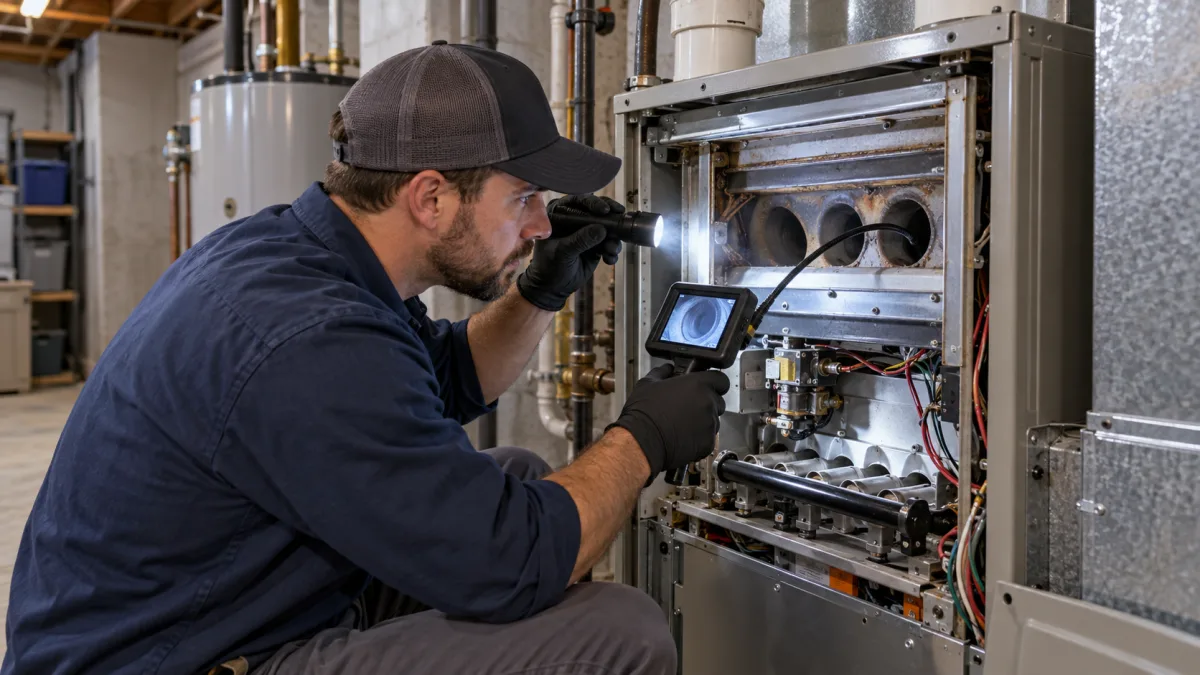
Check the filter first. If a fresh filter does not resolve it within a day, have the system looked at — the overheating that drives most short cycling is genuinely hard on the heat exchanger. Our full guide to furnace short cycling causes and fixes walks through the diagnosis step by step.
Sign 5: A Yellow Burner Flame or Any Carbon Monoxide Indicator
This is the one section of this article that is about safety rather than economics, and it is the reason we put flame colour on the list despite it being the sign homeowners are least likely to check.
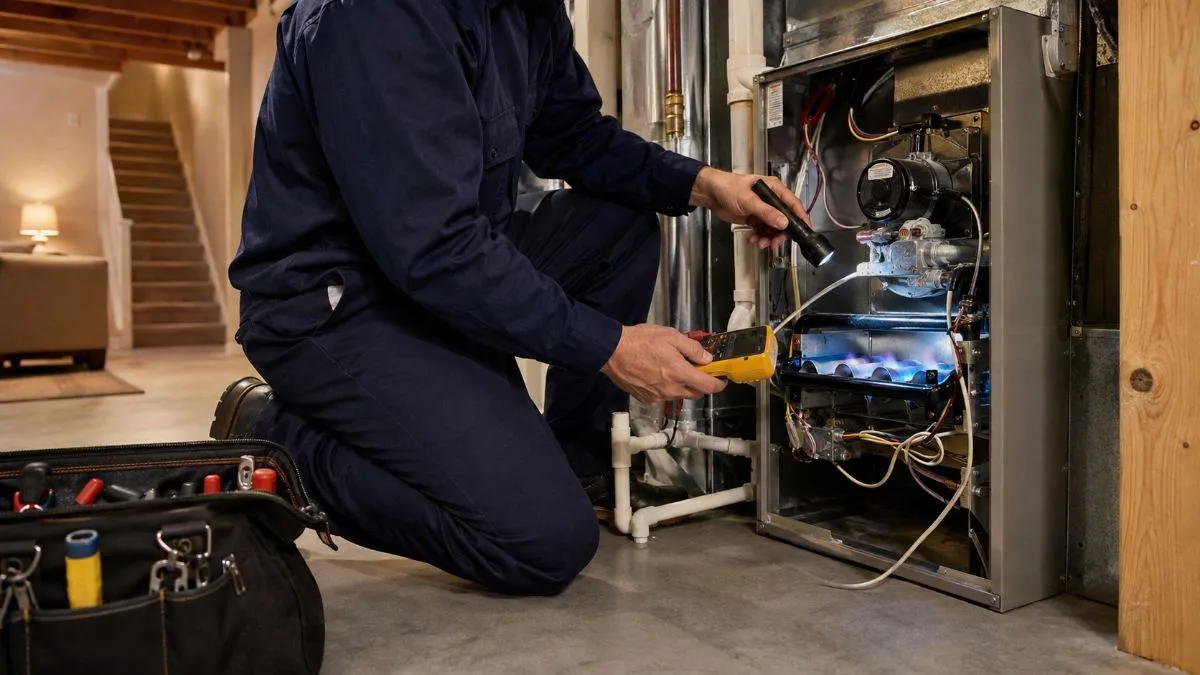
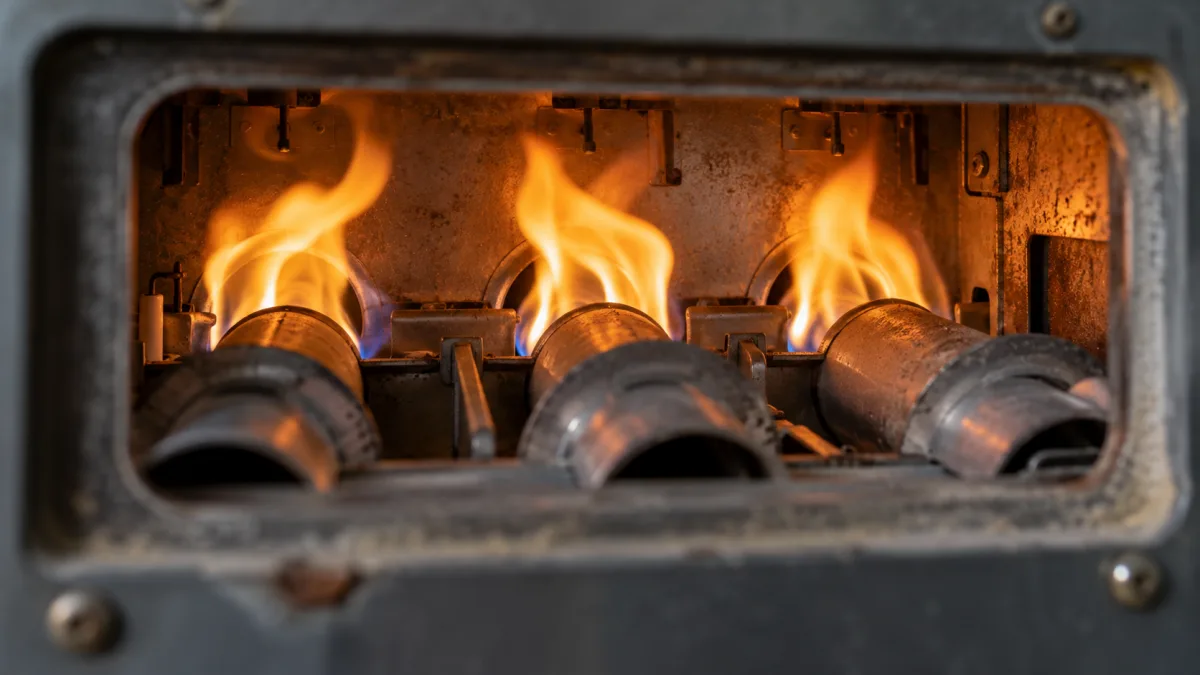
Natural gas burning correctly produces a crisp blue flame. A yellow, orange or lazily flickering flame indicates incomplete combustion — and incomplete combustion produces carbon monoxide. Carbon monoxide is colourless, odourless, and the early symptoms of exposure (headache, dizziness, nausea, fatigue) are easy to mistake for a winter virus.
Other indicators worth knowing:
- Soot or dark streaking around the furnace cabinet or vent pipe
- Persistent condensation on windows near the unit that was not there before
- A sharp or acrid smell when the system runs
- Household members whose symptoms improve when they leave the house
If you suspect carbon monoxide: get everyone outside, do not stop to investigate, and call 911 or your gas utility from outside the home. Diagnosis comes after everyone is out.
Every home with fuel-burning appliances should have working CO alarms on each level, replaced per the manufacturer's stated lifespan — most units expire after five to seven years regardless of battery condition. This is inexpensive and it is not optional.
Repair or Replace? An Honest Framework
Not every symptom above means repair is the right call, and we would rather tell you that plainly than sell you a repair that postpones an inevitable replacement by one season.
A rule of thumb the trade has used for years, and which holds up reasonably well: multiply the repair quote by the age of the furnace in years. If the result exceeds roughly $5,000, replacement usually wins on economics. A $400 repair on a six-year-old furnace scores 2,400 — fix it. The same $400 repair on a seventeen-year-old furnace scores 6,800 — put the money toward a new system instead.
It is a heuristic, not gospel. Judgement still applies:
| Situation | Usually |
|---|---|
| Under 10 years, minor component failure | Repair |
| Under 10 years, major component failure, still in warranty | Repair — check warranty first |
| 10–15 years, repeated repairs in one or two seasons | Get both quotes |
| Over 15 years, major repair quoted | Usually replace |
| Cracked heat exchanger, any age past warranty | Replace |
| Still running R-22-era paired equipment | Plan replacement |
Two further considerations. First, check the warranty before authorising anything — many manufacturers cover parts for ten years, but frequently on condition that annual professional maintenance was performed and documented. Second, a genuine efficiency jump changes the maths: moving from an ageing 70 percent unit to a 95 percent system is a material reduction in fuel consumed for the same heat, every winter for the next fifteen-odd years. Our furnace replacement cost guide for New Jersey breaks down what that new system typically costs.
If you're seeing replacement signs rather than repair signs — an ageing furnace, repeat breakdowns, a cracked heat exchanger — read Signs You Need a New Furnace for the nine signs it is time to replace and how to tell whether your furnace is going out.
What You Can Check Before Calling Anyone
None of this requires tools or any risk, and it occasionally solves the problem outright:
- The thermostat. Set to HEAT, set above room temperature, and — if battery powered — fitted with fresh batteries.
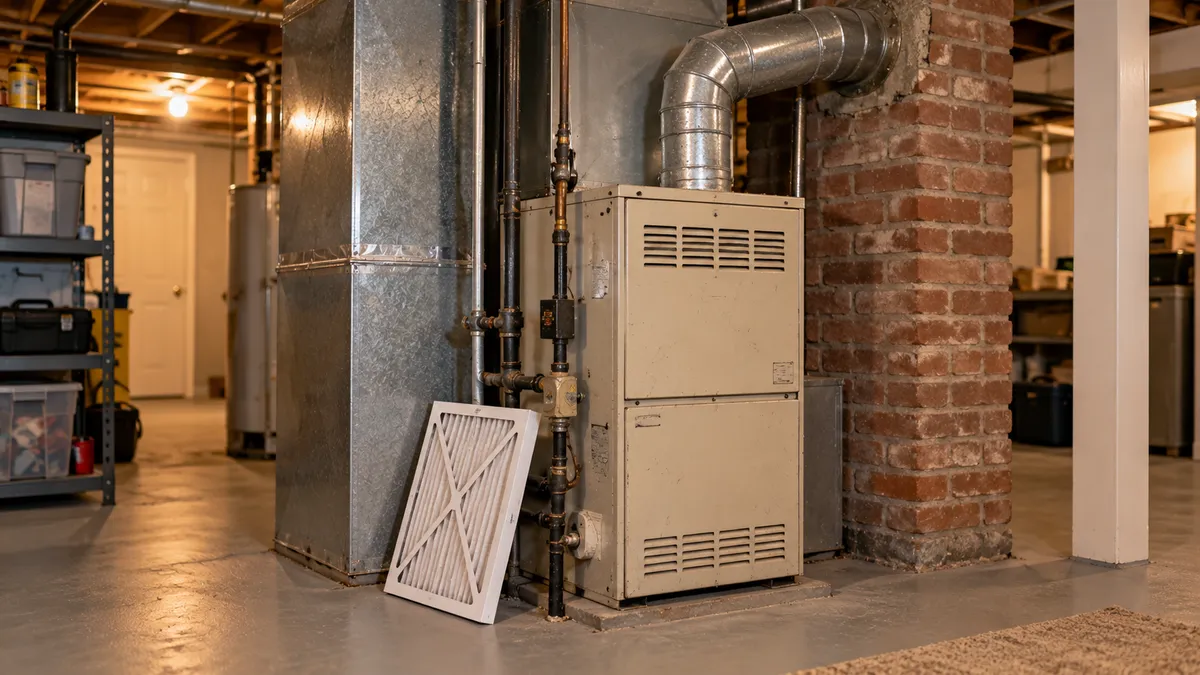
- The filter. Hold it up to a light. If light does not pass through, replace it. Most homes need this every 90 days; every 60 with pets.
- The furnace switch. It looks like an ordinary light switch near the unit and gets flipped by accident more often than anyone expects.
- The breaker. Check the panel for a tripped heating circuit.
- The gas valve. Confirm it is open, and that other gas appliances are working.
- Registers and returns. Open and unobstructed throughout the house.
- The condensate drain, on high-efficiency units. A blocked drain trips a safety switch and prevents operation, and it is the usual reason a furnace leaks water onto the floor.
Beyond that list, stop. Gas, high-voltage electrical and combustion venting are not DIY territory, and in New Jersey this work is licensed for good reason.
The Case for Annual Maintenance
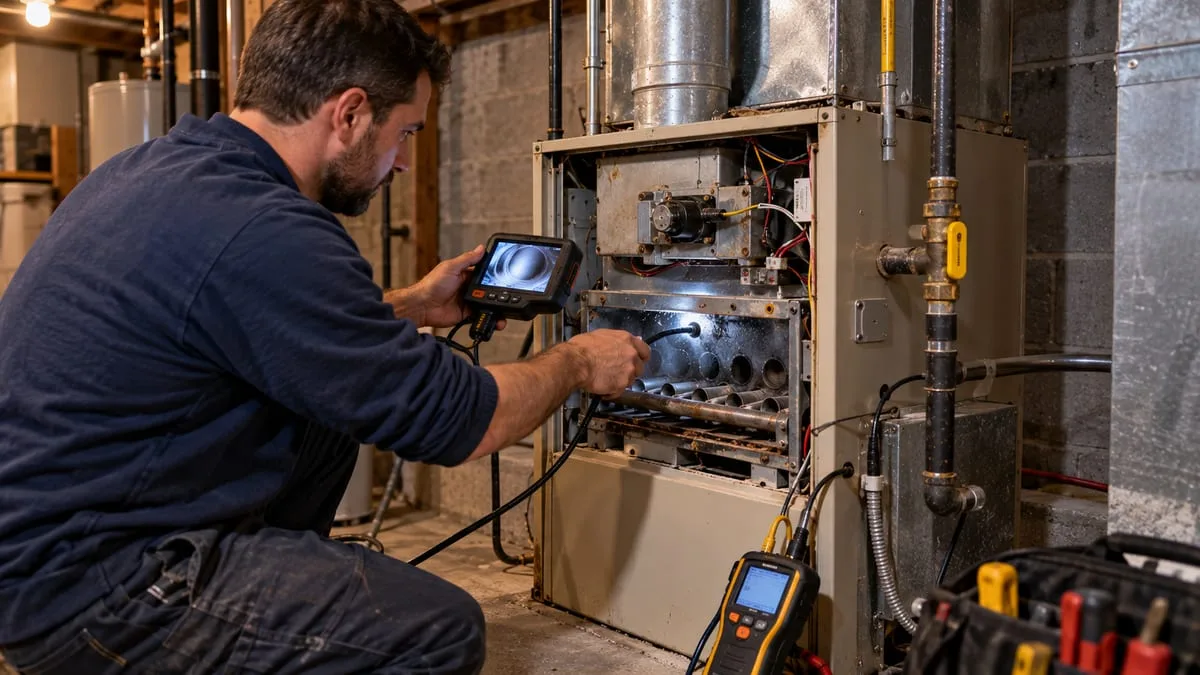
Nearly every failure described above is detectable before it becomes a failure. A proper maintenance visit includes inspecting the heat exchanger, cleaning burners and the flame sensor, testing safety controls and the limit switch, checking gas pressure and temperature rise, verifying draft and venting, examining electrical connections, and measuring blower performance.
Schedule it in early autumn, before the first cold snap. That is when availability is best and when a problem discovered is a scheduled repair rather than an emergency — and, not incidentally, when it satisfies the documentation most manufacturer warranties require. Our furnace maintenance checklist lists every item a proper tune-up should cover.
When to Call Right Away
Most of the signs above allow you to schedule at your convenience. These do not:
- Any smell of gas — leave first, call the utility from outside
- A yellow or flickering burner flame, or soot around the unit
- A CO alarm sounding
- Banging or booming at ignition
- No heat at all in freezing conditions, particularly with infants, elderly residents or anyone medically vulnerable in the home
- Visible scorching, melted wiring, or a burning smell
Electric Furnaces Are Diagnosed Differently
Most of this guide assumes a gas furnace, because that is what the majority of central New Jersey homes run. If yours is electric, several of the signs above do not apply and others mean something different.
An electric furnace has no burners, no flame and no combustion, so flame colour and carbon monoxide are not concerns. What it has instead is a bank of resistance heating elements, each controlled by a sequencer that brings them online in stages. Electric furnace repair therefore centres on a different set of parts: heating elements that burn out, sequencers that fail to stage properly, contactors that pit and stick, and the high-limit switches that protect the whole assembly.
The symptom pattern shifts accordingly. Rather than ignition noise, you tend to see gradually declining output as individual elements fail — the system still produces heat, just less of it, and your electric bill climbs as the remaining elements run longer to compensate. A house that heats acceptably in mild weather but cannot keep up in a cold snap is the classic presentation of an element that has already failed.
Breaker trips deserve particular attention on electric systems. These units draw substantial current, and a breaker that trips repeatedly is signalling a genuine fault — a shorted element or a failing contactor — not an inconvenience to be reset. Repeatedly resetting it is a fire risk.
Getting It Looked At
Guardian Air is a family-owned, licensed and insured heating contractor working throughout Monmouth, Middlesex and Ocean counties — Freehold, Howell, Aberdeen, Middletown, Red Bank, Long Branch, Old Bridge, Edison, Woodbridge, Toms River, Brick, Jackson, Lakewood and the surrounding towns.
Every visit starts with an actual diagnosis and a flat-rate price you approve before any work begins. If a repair makes sense, we will tell you. If your furnace is past the point where repair is a good use of your money, we will tell you that too, and quote both options so you can decide with the numbers in front of you.
Call (848) 276-6300 to book a heating inspection, or request an estimate online. You can also read more about furnace maintenance, furnace replacement, or typical furnace repair costs in New Jersey.