October 14, 2026
Boiler Replacement Cost in NJ (2026): What You'll Pay
Boiler replacement cost in central New Jersey for 2026: $7,000–$14,000 for gas hot water, $8,500–$14,000 for a combi, $9,000–$16,000+ for steam. Where the money actually goes, why steam costs more, and how to compare quotes properly.
By Guardian Air · Published · Updated
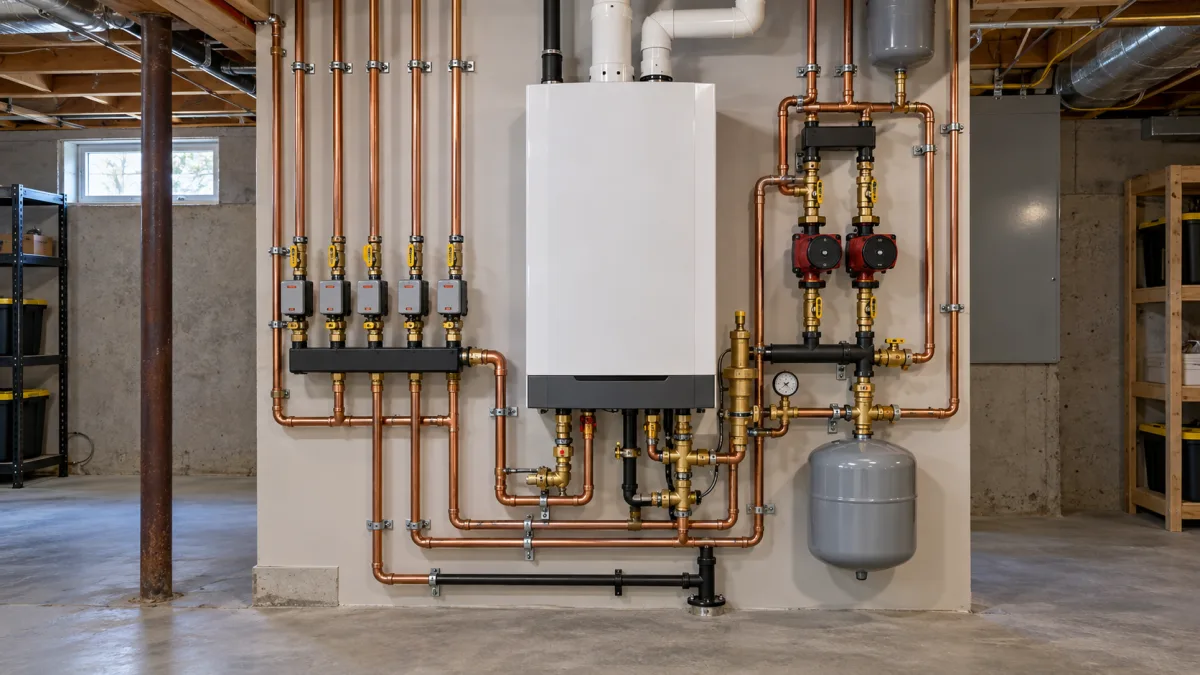
Boiler replacement in central New Jersey typically costs $7,000 to $14,000 installed for a gas hot-water boiler in 2026 — about $7,000 to $10,000 for a standard-efficiency unit and $9,000 to $14,000 for a high-efficiency condensing model. A combi boiler that also makes your domestic hot water runs $8,500 to $14,000, and a steam boiler $9,000 to $16,000 or more because of its weight and the exacting near-boiler piping it demands. Roughly a third of the price is the boiler itself; the rest is piping, venting, controls, permits and labour. Which is why two honest quotes on the same house can differ by thousands.
Written by the Guardian Air HVAC & plumbing team · Reviewed for accuracy October 2026
A lot of central New Jersey runs on hot water and steam. Red Bank Victorians, pre-war colonials around Freehold and Long Branch, older housing stock across Perth Amboy and New Brunswick — these homes were built around radiators, and when a 30-year-old boiler finally gives up the owner usually has no frame of reference for what a replacement should cost. This guide gives you our real numbers, explains what sits behind them, and is honest about the two or three places where a cheap quote is cheap for a reason.
How Much Does a New Boiler Cost in 2026?
| Boiler type | Installed cost, central NJ | Typical AFUE |
|---|---|---|
| Gas hot-water, standard efficiency | $7,000–$10,000 | 84–87% |
| Gas hot-water, condensing (high efficiency) | $9,000–$14,000 | 90–95%+ |
| Combi boiler (heat + domestic hot water) | $8,500–$14,000 | 90–95%+ |
| Steam boiler | $9,000–$16,000+ | 82–84% |
| Oil-fired boiler | $9,000–$15,000 | 86–90% |
| Electric boiler | $4,500–$8,500 | ~100% at the unit |
For comparison, a gas furnace in the same market runs $3,800 to $10,000 installed. Boilers cost more for structural reasons, not because contractors mark them up harder: there is far more pipe, far more fitting, considerably more weight, and no duct system to reuse. Our boiler vs furnace comparison goes through the full trade-off if you are weighing a switch.
An electric boiler looks cheap on that table and almost never is in practice. At New Jersey electricity rates it costs substantially more to run than gas, and it often needs a service upgrade. We install them where there is genuinely no gas service and no room for anything else.
Where the Money Actually Goes
This is the part that explains quote variation. On a typical $11,000 condensing boiler job:
- The boiler, 30–40%. The appliance itself.
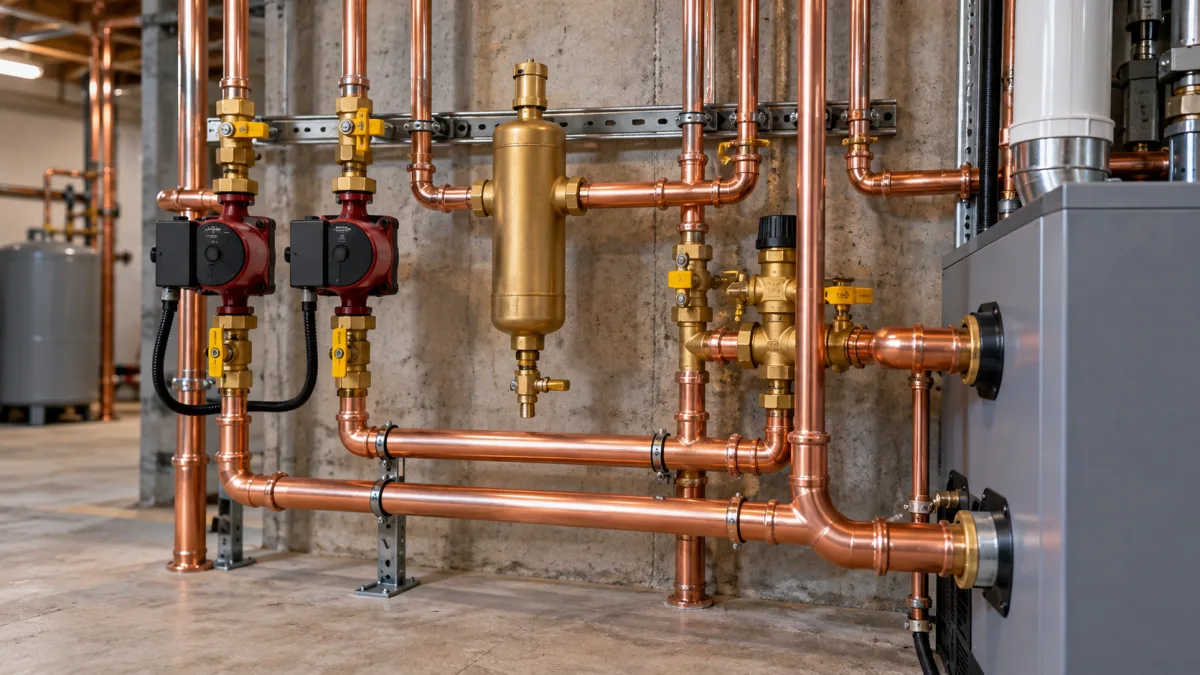
- Near-boiler piping, 20–25%. The manifold of pipe, fittings, circulators and valves that connects the boiler to your existing system. On a condensing boiler this includes primary/secondary piping or a low-loss header so the boiler sees the flow rate it needs. This is skilled work, done on site, and it is where good installers separate themselves.
- Venting, 10–15%. A condensing boiler cannot share an old masonry chimney — the flue gas is cool and acidic and will destroy it. It needs sealed stainless or PVC venting run to a sidewall or through the chimney as a liner.
- Controls and accessories, 10%. Outdoor reset control, zone valves or circulators, thermostats, low-water cutoff, expansion tank, air separator.
- Condensate handling, 2–5%. A condensing boiler produces several gallons of acidic condensate a day. It needs a drain and, in most installations, a neutraliser cartridge.
- Removal, permits, inspection, labour, the balance. Old cast-iron sections are heavy and sometimes have to be broken down in place to get out of a basement.
What Pushes the Price Up
Steam
Steam boilers sit at the top of the range for three reasons. They are heavy. The near-boiler piping must follow the manufacturer's drawing almost exactly — header height, riser sizes, equalizer — or the boiler will carry water over into the mains and never run quietly or efficiently. And the system needs proper skimming after installation to remove oil from the new piping. Steam work is unforgiving of shortcuts, and a cheap steam quote is usually a quote from someone who intends to take them.
Going from standard to condensing
The equipment premium is real, but the install cost is where it shows: new venting, a condensate drain and neutraliser, and often a rethink of the piping so return water comes back cool enough for the boiler to actually condense. A condensing boiler fed 180°F return water never reaches its rated efficiency — you paid for 95% AFUE and installed an 87% system. This is the most common way a high-efficiency boiler disappoints its owner.
Adding domestic hot water
A combi boiler, or a conventional boiler with an indirect-fired tank, lets one appliance heat the house and the showers. It often replaces both a boiler and a water heater, which is why $8,500 to $14,000 can represent good value against buying the two separately. Combis suit smaller homes with modest simultaneous demand; an indirect tank handles a busy family better.
Asbestos and old insulation
Pre-1980 boilers and pipes in this area sometimes carry asbestos insulation. It has to be abated by a licensed contractor before removal. That is a separate line item, legally and practically, and anyone who proposes to just rip it out is putting your household at risk.
Zoning and system repairs
If we are in there anyway, failing circulators, seized zone valves, a waterlogged expansion tank or radiators that have never balanced are often worth correcting. They add cost and they are the difference between a new boiler and a system that actually works.
Efficiency: What the Ratings Mean for Your Bill
Boiler efficiency is AFUE — the share of fuel energy that becomes useful heat over a season. Federal minimums under 10 CFR 430.32 are 84% for gas hot-water boilers and 82% for steam. Condensing models reach 90–95% and above by extracting heat from the flue gas until water vapour condenses out of it.
At New Jersey's 2026 residential gas price of roughly $1.55 per therm, the arithmetic on a home burning around 1,000 therms a season looks like this:
| AFUE | Fuel for the same delivered heat | Annual gas cost |
|---|---|---|
| 80% (an old boiler, derated) | 1,000 therms | ~$1,550 |
| 85% (new standard efficiency) | 941 therms | ~$1,459 |
| 95% (condensing, properly piped) | 842 therms | ~$1,305 |
So the honest answer on condensing: roughly $150 to $250 a season against a new standard-efficiency boiler, for a $2,000 to $4,000 premium. On a 20-year boiler life that pays back, but not dramatically, and only if the piping lets it condense. Where condensing clearly wins is a home with low-temperature emitters — radiant floor, or generously sized baseboard — because the return water is naturally cool. Where it struggles is a steam system (condensing is not applicable) or a cast-iron radiator system running high water temperatures.
Outdoor reset control is the cheapest efficiency upgrade in the whole job. It varies water temperature with outdoor conditions instead of firing to 180°F on a 45°F day, and it improves comfort as well as fuel use. Ask whether it is included.
Repair or Replace Your Boiler?
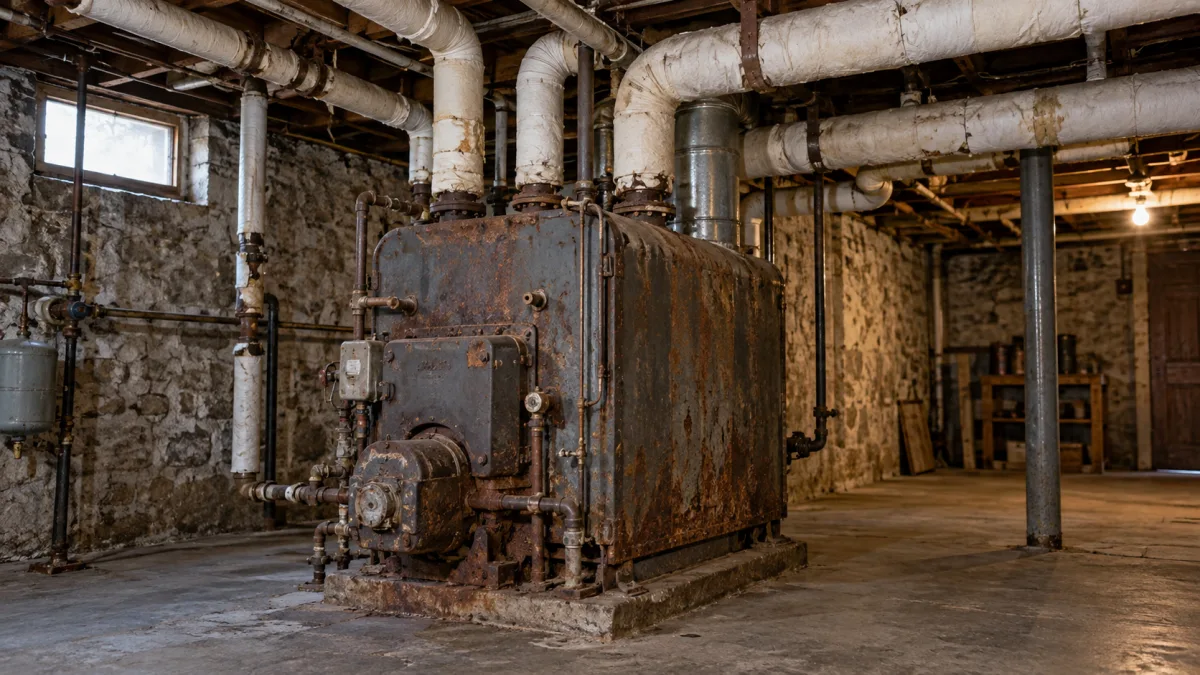
Boilers are long-lived. Cast-iron sections can run 25 to 30 years or more, and most faults — circulators, valves, controls, ignition — are economic repairs on a sound boiler. Our boiler repair prices typically run $200 to $700 for common component failures, with a diagnostic fee of $89 to $150 credited toward the work.
Replace when:
- The heat exchanger or a section is cracked or leaking. This is the one that decides it. A leaking block is not repairable.
- It is over 20 to 25 years old and needs significant work.
- It is badly oversized. Many older boilers were sized for a draughtier version of the house. An oversized boiler short-cycles, which wastes fuel and wears components.
- You are converting from oil to gas, where the equipment change pays for itself on fuel.
The same rule of thumb we apply across our heating guides works here: multiply the repair quote by the boiler's age in years, and if the result tops $5,000, replacement usually wins. Cast iron earns some latitude — a 25-year-old cast-iron boiler with a $400 circulator fault is still worth fixing.
Rebates and Incentives
The federal 25C tax credit expired for systems installed after 31 December 2025, so New Jersey utility programmes are now the main source of help. New Jersey Natural Gas runs SAVEGREEN rebates and 0% on-bill financing on qualifying high-efficiency equipment, and PSE&G and JCP&L have their own programmes. Condensing boilers at or above the ENERGY STAR threshold are generally the ones that qualify; standard-efficiency replacements usually are not.
Worth knowing: the most generous incentives in New Jersey now sit with heat pumps, not boilers. If you are facing a full boiler replacement anyway, it is worth at least pricing a heat pump — ducted, or ductless alongside a retained boiler — and NJNG's SAVEGREEN hybrid heat programme specifically pays for pairing a heat pump with a gas boiler or furnace. We keep current terms in our NJ HVAC rebates and incentives guide.
How to Compare Boiler Quotes
A quote you can actually evaluate names:
- The boiler make, model and input rating, plus the AFUE. "High-efficiency gas boiler" is not a specification.
- A heat loss calculation. Sizing should come from a room-by-room heat loss on your house, not from the rating of the boiler being removed. Replacing like-for-like perpetuates the previous installer's guess.
- The venting method and where it terminates.
- Near-boiler piping and what is being reused. For steam, confirm the piping follows the manufacturer's drawing.
- Controls included — outdoor reset, zone valves or circulators, thermostats, low-water cutoff.
- Condensate drain and neutraliser on a condensing boiler.
- Permits and municipal inspection. Required here, and they protect you.
- Warranty terms on heat exchanger, parts and labour — and who honours the labour.
- Asbestos handling, if applicable.
Red flags
- No heat loss calculation, and a size that just matches the old boiler.
- A condensing boiler quoted with no mention of new venting or condensate handling.
- A steam quote that does not reference the manufacturer's piping requirements or skimming.
- A price that drops by thousands when you hesitate.
- No permit in the quote.
- Pressure to sign the same day.
Get a Written Boiler Replacement Quote
Guardian Air installs and services hot-water, steam and condensing boilers across Monmouth, Middlesex and Ocean counties — Red Bank, Freehold, Middletown, Long Branch, Perth Amboy, New Brunswick, Toms River, Brick and the surrounding towns. Every replacement starts with a heat loss calculation and a written, flat-rate quote, and we handle permits and inspection. Call (848) 276-6300 or request a free estimate. See also boiler repair, our full heating services, and current offers.