October 16, 2026
Sewer Line Repair Cost in NJ: Trenchless vs Digging
Sewer line repair cost in central New Jersey: $1,000–$3,000 for a spot repair, $5,000–$15,000+ to replace a lateral. How CIPP lining and pipe bursting compare with digging, why Orangeburg pipe cannot be lined, and who pays for the lateral in NJ.
By Guardian Air · Published
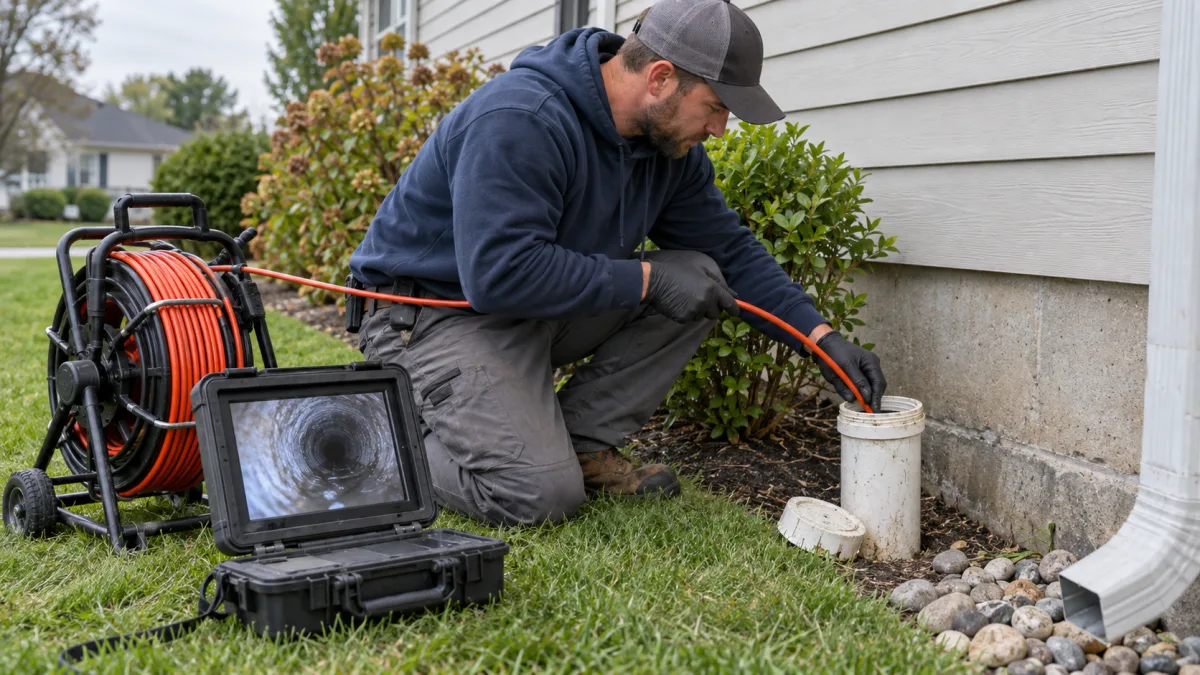
Sewer line repair in central New Jersey runs $1,000 to $3,000 for a spot repair on a single failed section, and $5,000 to $15,000 or more to replace a full residential lateral. Trenchless methods — CIPP lining or pipe bursting — usually land in the $80 to $150 per foot range here, so a typical 50 to 80 foot lateral comes in between roughly $5,000 and $12,000, and often beats open-cut once you count restoring a driveway, patio or mature landscaping. Before anything else, pay $150 to $350 for a camera inspection: it tells you which repair you actually need, and in most New Jersey towns the lateral is the homeowner's responsibility all the way to the public main — sometimes including the section under the street.
Written by the Guardian Air HVAC & plumbing team · Reviewed for accuracy October 2026
This is the plumbing bill nobody budgets for. A sewer lateral is invisible, needs nothing for decades, and then fails in a way that puts sewage in a basement on a Sunday. Roughly half of New Jersey's housing predates 1972, which means an enormous number of homes in Monmouth, Middlesex and Ocean counties are still served by clay tile, cast iron or Orangeburg — the three materials most likely to be at the end of their lives right now. Here is what repair genuinely costs, how the methods differ, and how to avoid paying for the wrong one.
Signs Your Sewer Line Is the Problem
A branch clog affects one fixture. A failing main line announces itself across the whole house:
- Several fixtures backing up together — toilets and showers, typically the lowest ones first.
- Water rising at a basement floor drain when you run the washing machine or a bath. This is the clearest signal there is.
- Toilets gurgling when another fixture drains, as air is forced back through the trap.
- Repeated main line clogs. Once is an event; three times in two years is a defect.
- Sewage smell indoors, or outdoors along the run of the line.
- Unexplained lush green patches or soft ground in a line across the lawn — the pipe is feeding and saturating the soil.
- New foundation or slab cracks, or a sinkhole-like depression over the line, where a leak has been washing soil away.
- Rodents or drain flies appearing indoors; a broken lateral is an entry point.
Step One Is Always a Camera
Do not authorise a sewer repair that has not been seen. A camera inspection costs $150 to $350 — often credited against the repair — and it is the difference between a targeted fix and an expensive guess. It tells you:
- What the pipe is made of, which largely determines your options. Cast iron, clay tile, Orangeburg, PVC and ABS all fail differently and not all of them can be lined.
- What is wrong — root intrusion, a crack, an offset joint, a belly holding water, scale, or a full collapse.
- Where it is, by distance from the cleanout and by depth, located from the surface with a sonde. Depth drives excavation cost more than almost anything else.
- How much of the line is bad. This is the question that decides spot repair versus full replacement, and it is the one contractors most often get wrong by assumption.
If you are buying an older home anywhere in our service area, a pre-purchase sewer camera is among the best inspection money you can spend. A standard home inspection does not include it, and the lateral becomes your liability on closing day.
Sewer Line Repair Costs in Central New Jersey
| Work | Typical cost, 2026 | When it applies |
|---|---|---|
| Service call / diagnostic | $89–$150 | Credited toward the work |
| Main line snaking through a cleanout | $250–$500 | Restores flow; does not fix a defect |
| Camera inspection with locating | $150–$350 | Always, before any repair |
| Root cutting and hydro jetting | $400–$800 | Root mats, grease, scale; sound pipe only |
| Spot repair / single section | $1,000–$3,000 | One localised defect, reasonable depth |
| Cleanout installation | $800–$2,500 | If the house has no accessible cleanout |
| CIPP lining (trenchless) | ~$80–$150 per foot | Pipe intact enough to host a liner |
| Pipe bursting (trenchless) | ~$100–$170 per foot | Full replacement without a trench |
| Full lateral replacement | $5,000–$15,000+ | Collapsed, bellied or Orangeburg lines |
A typical central New Jersey residential lateral runs 50 to 80 feet from the foundation to the main. At the per-foot rates above, that puts a trenchless job between roughly $5,000 and $12,000 — which is why trenchless and open-cut quotes often land closer together than homeowners expect.
Trenchless vs Digging: Which Is Actually Cheaper?
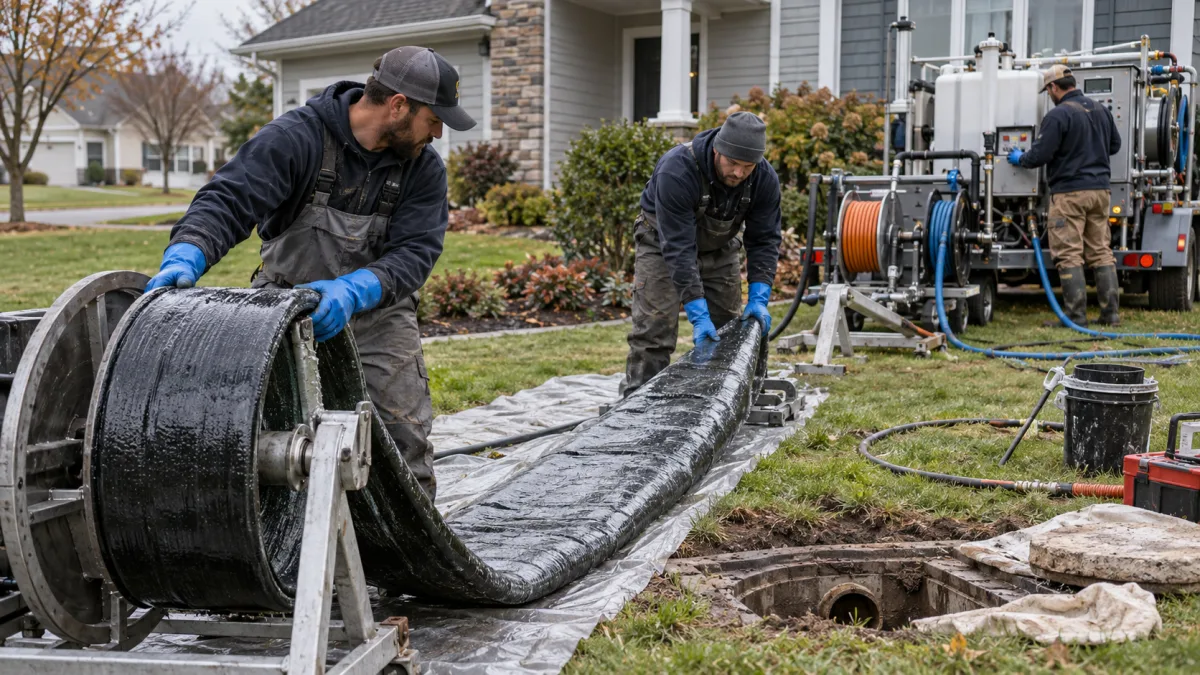
Trenchless is not automatically cheaper per foot. It is frequently cheaper in total, because the expensive part of open-cut sewer work is usually not the pipe.
CIPP lining (cured-in-place pipe)
A resin-saturated felt liner is pulled or inverted into the existing pipe and cured in place, forming a new jointless pipe inside the old one. Access is through the cleanout and often one small pit.
- Good for: cracks, root intrusion at joints, corrosion, and generally sound pipe that has deteriorated rather than failed.
- Not suitable for: a collapsed line, a severe belly (lining a sag preserves the sag), or badly deformed Orangeburg.
- Trade-off: slightly reduces internal diameter, though the smooth bore usually improves flow anyway.
Pipe bursting
A bursting head is pulled through the old pipe, fracturing it outward while simultaneously drawing new HDPE pipe into the void. Two access pits, no continuous trench.
- Good for: full replacement where the existing line is too far gone to line, and where you want a new full-diameter pipe.
- Not suitable for: lines with tight bends, or where the pipe runs very close to other utilities.
Open-cut (traditional dig and replace)
A trench is excavated along the line and the pipe is replaced conventionally.
- Good for: collapsed sections, correcting a belly by re-establishing proper fall, shallow runs under open lawn, and situations where the line's route or depth makes trenchless impractical.
- The real cost driver: restoration. Shoring for safe trench depth, backfill and compaction, and then putting back whatever was on top.
The thing that decides it
Look at what sits above your sewer line. If it runs under open lawn at modest depth, open-cut is often the economical answer and lets us correct grade properly. If it runs under a concrete driveway, a paver patio, a deck, a finished basement slab or mature trees you would rather keep, trenchless usually wins outright — not on the pipe price but on everything you do not have to tear up and rebuild. Replacing a driveway apron alone can run into thousands.
What Else Adds to the Bill
- Depth. Cost rises sharply with depth. Trenches beyond five feet need shoring for worker safety, and the excavation volume grows fast.
- The street. If the failed section is under a public road, you are looking at a road-opening permit, traffic control, and a municipal specification for restoring the pavement. This is where sewer jobs get genuinely expensive — and in most New Jersey municipalities that portion is still the homeowner's responsibility.
- Permits and inspection. Required, and they protect you. A sewer replacement is inspected before backfill.
- Utility mark-out. New Jersey One Call must be notified before excavation. It is free and it is not optional.
- No cleanout. Many older homes never had one. Adding one costs $800 to $2,500 and makes every future service call cheaper and less invasive.
- Landscaping and hardscape restoration. Get this in writing. "Backfilled and graded" is not the same as "lawn restored."
- Interior work. If the failure is under a basement slab, concrete cutting and patching is a separate trade.
Who Pays? New Jersey Specifics
In most New Jersey municipalities the homeowner owns and maintains the sewer lateral — the pipe from the house to the connection at the public main — and in many towns that responsibility extends to the whole lateral, including the length beneath the public street. The town maintains the main itself. Where exactly the line sits varies, so confirm with your municipal utility or engineering department before you accept anyone's assumption about it.
Two practical consequences:
- A failing lateral is almost always your bill, including root intrusion from a street tree you did not plant.
- Standard homeowner policies generally exclude gradual deterioration, which is precisely what clay joint failure and Orangeburg fatigue are. Sudden accidental damage may be covered. Many insurers sell a service line endorsement for buried utility lines for a modest annual premium — worth asking about, and far more worth having before you need it.
Orangeburg: The New Jersey Problem Pipe
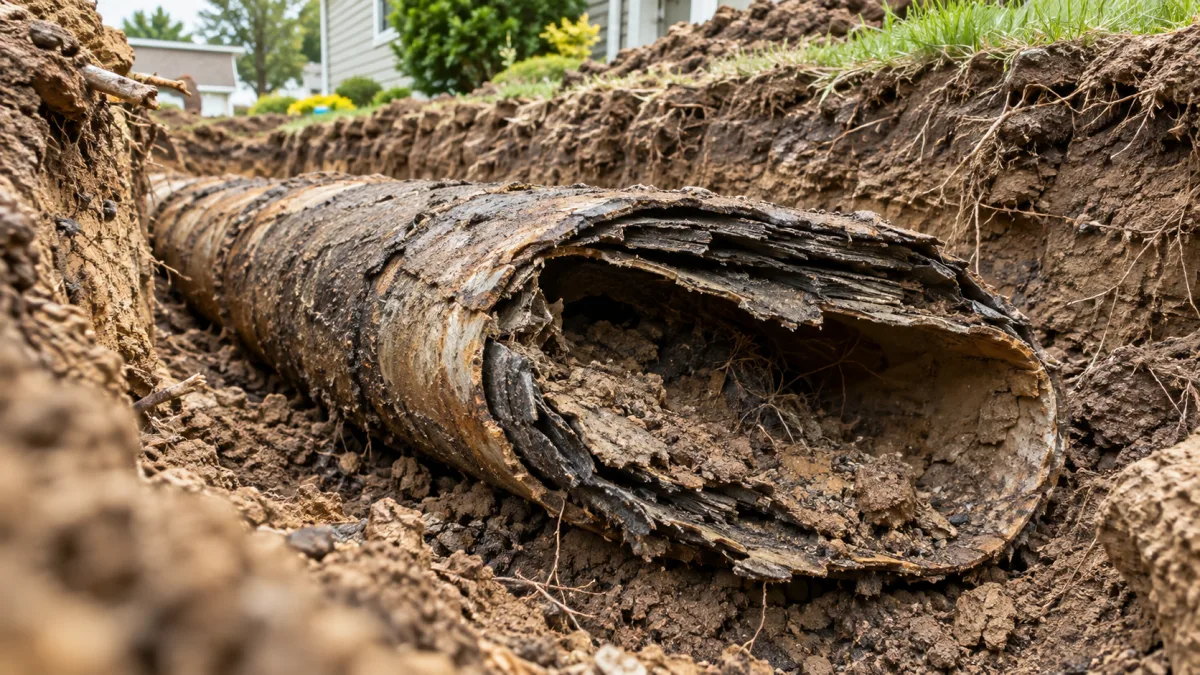
If your home was built between roughly 1945 and 1972, there is a real chance the lateral is Orangeburg — a pipe made of wood fibre bound with coal tar pitch, used widely for private laterals because it was cheap and light. Its service life is about 30 to 50 years. All of it in our area is now beyond that.
Orangeburg does not crack cleanly; it deforms. It goes oval under soil load, delaminates in layers, and blisters inward, which is why root intrusion and blockages become chronic before the pipe finally collapses. Two things follow: it generally cannot be lined reliably, so replacement is the honest recommendation, and because it was only ever used for private laterals, a failing Orangeburg line is essentially always the homeowner's to fix.
If a camera shows Orangeburg, treat repeated snaking as buying time rather than solving anything, and start planning the replacement.
How to Compare Sewer Quotes
- Insist on camera footage. Of your line, with the distance counter visible. Ask for a copy.
- Get the defect located by distance and depth, in writing.
- Ask why the proposed method, and not the others. A contractor who only offers one technique will recommend that technique.
- Ask how much of the line is being addressed. Spot repair on a line that is failing in three places is money wasted.
- Get restoration specified. Exactly what is put back, and to what standard.
- Confirm permits and inspection are included.
- Check the warranty, and that it covers the liner or pipe and the workmanship.
- Get a post-work camera run as proof of what you paid for.
Red flags
- A replacement quote with no camera inspection.
- Footage that is clearly not your pipe — no distance counter, or a video that appears in the sales pitch for every customer.
- Full replacement recommended for a single localised defect.
- Lining proposed for a collapsed line or deformed Orangeburg.
- Hydro jetting pushed on pipe nobody has inspected. Jetting fragile clay or Orangeburg can finish it off.
- Pressure to sign while there is sewage on the floor. Clear the blockage first, then decide on the repair with a clear head.
Get Your Sewer Line Inspected First
Guardian Air runs camera inspections, root cutting, hydro jetting, spot repairs and full lateral replacements across Monmouth, Middlesex and Ocean counties — Freehold, Red Bank, Middletown, Long Branch, Howell, Toms River, Brick, Lakewood, Edison, Woodbridge, Perth Amboy, New Brunswick and the surrounding towns. We will show you the footage, locate the defect by distance and depth, and quote the repair that matches what is actually wrong. Call (848) 276-6300 or book an inspection. See also sewer repair, camera inspection, hydro jetting and our clogged drain guide.