October 13, 2026
No Hot Water? Causes, Safe Checks & Repair Costs
No hot water, or hot water that runs out fast? The gas and electric diagnostic paths our plumbers use — pilot, thermocouple and gas valve, or breaker, reset button and elements — which checks are safe to do yourself, and 2026 central NJ repair prices.
By Guardian Air · Published · Updated
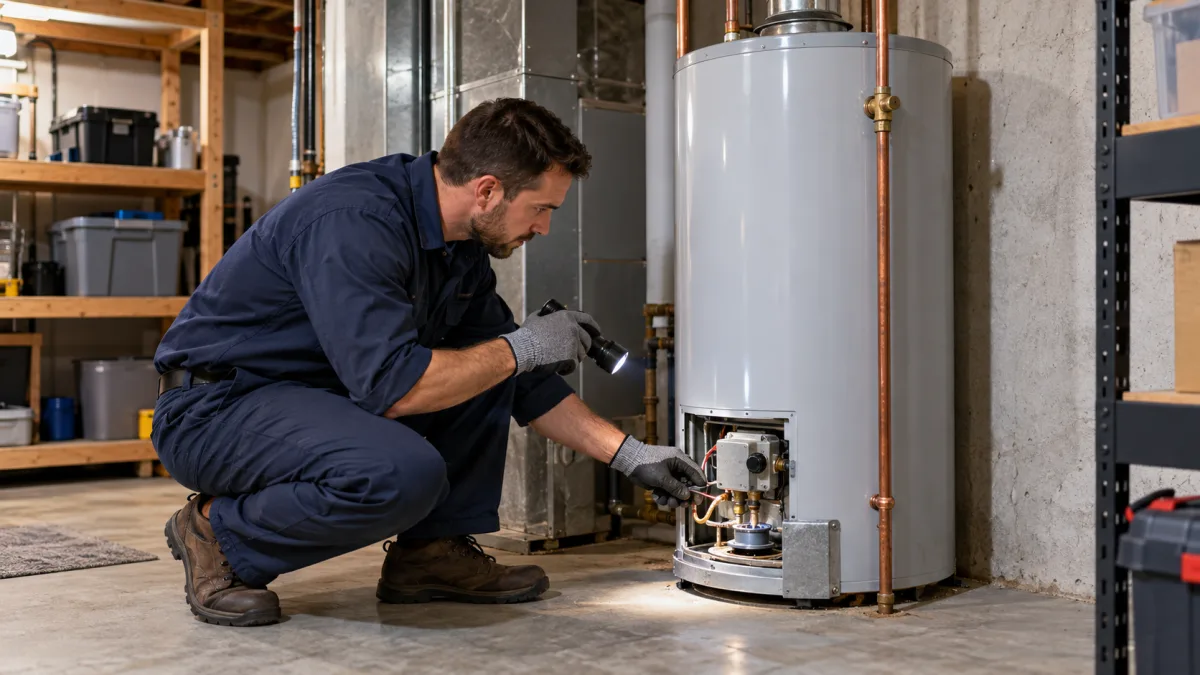
No hot water usually comes down to a handful of causes. On a gas water heater: a pilot that will not stay lit, a failed thermocouple, a dirty burner or a failed gas control valve. On an electric one: a tripped breaker, a tripped high-limit reset button, or a burnt-out heating element. If you have some hot water but it runs out fast, suspect a failed lower element, sediment in the tank, or a tank that is simply too small for how the house now lives. Most repairs run $200 to $650 in central New Jersey. If the tank itself is leaking or rusty water is coming out of the hot tap, it is replacement, not repair — and a standard 40- or 50-gallon tank runs $1,800 to $3,500 installed.
Written by the Guardian Air HVAC & plumbing team · Reviewed for accuracy October 2026
Cold showers get people calling faster than almost anything else we do. The good news is that a water heater is a simple machine with a short list of failure points, and two or three of them are things you can safely check yourself in a few minutes. The important news is that one symptom — water on the floor — means stop troubleshooting and shut it off. Here is how to tell the difference.
Safety First: Three Things to Check Before Anything Else
- Is there water on the floor or around the base? A leaking tank cannot be repaired. Shut off the cold supply at the valve on top of the heater, kill the power or gas, and call a plumber. A tank that is weeping at the seam can fail completely, and 50 gallons on a finished basement floor is a different kind of problem.
- Do you smell gas? Leave the house, do not touch switches, and call New Jersey Natural Gas or your utility's emergency line from outside. Not us first — them.
- Is the temperature and pressure relief valve discharging? The T&P valve is the brass fitting with a lever near the top, piped toward the floor. If it is dribbling or releasing, the tank is over-temperature or over-pressure. Never cap, plug or strap that valve shut. It is the one component standing between a water heater and a genuine explosion.
If none of those apply, carry on.
Gas Water Heater: No Hot Water
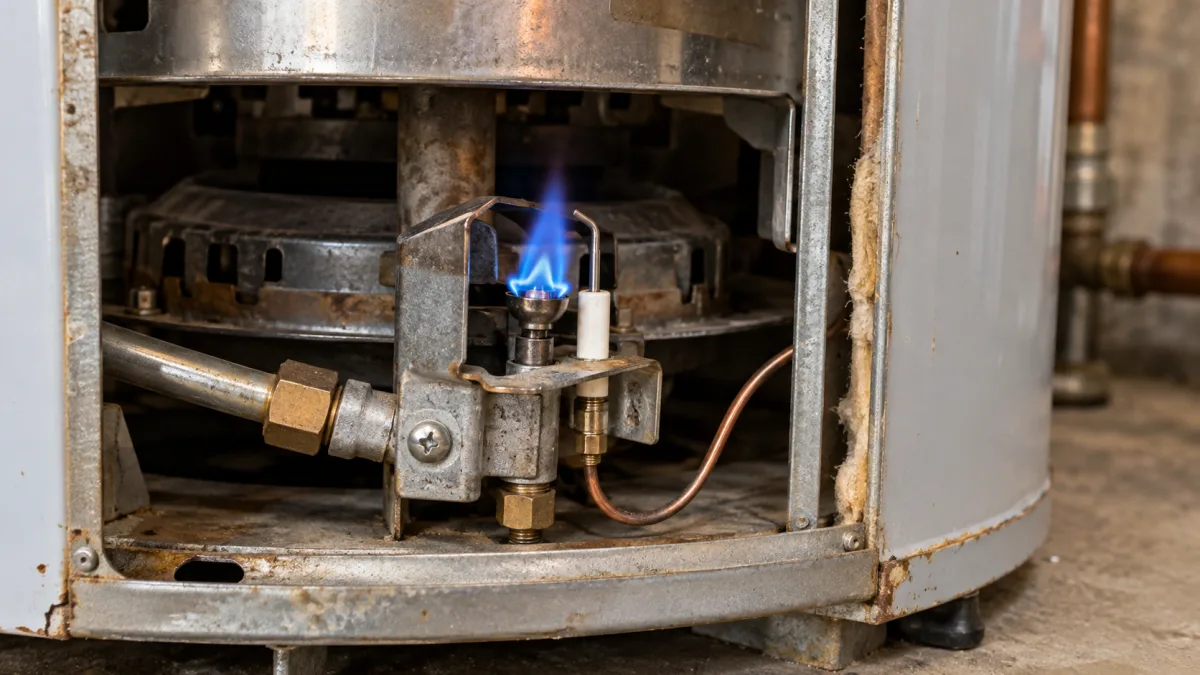
On a gas tank, heat comes from a burner under the tank, lit by a pilot or an electronic igniter, controlled by a gas valve with a thermostat probe in the water. The diagnostic path runs pilot → thermocouple → gas valve.
The pilot light is out
Look through the small sight glass at the base. No flame means no heat. Modern heaters have a sealed combustion chamber and a push-button piezo igniter with printed relighting instructions on the label — follow them exactly, including the waiting period that lets residual gas clear. If it lights and stays lit, you are done; something interrupted it, perhaps a draft or a brief gas supply interruption.
The pilot lights but will not stay lit
This is the classic thermocouple failure. The thermocouple is a thin metal probe sitting in the pilot flame; the heat generates a tiny voltage that tells the gas valve "the pilot is burning, it is safe to open." When it degrades, the valve stops believing it and shuts the gas off a few seconds after you release the button. It is an inexpensive part and a routine repair — typically $150 to $300 installed here.
Two other things cause the same symptom and are worth ruling out: a dirty or partly blocked pilot orifice, and a blocked flue or tripped thermal switch. That second one matters. Many heaters have a one-time thermal cut-off that trips when the combustion chamber overheats because lint, dust or a blocked vent has starved it of air. That is a combustion safety fault, and it needs a technician rather than repeated relighting attempts.
The pilot is lit and the burner still will not fire
Now you are looking at the gas control valve or its thermostat. Valves fail, and most are not field-repairable — the assembly gets replaced, generally $350 to $650 installed. Before condemning it, a technician will check the gas supply pressure and the thermostat setting, because a valve turned down to "vacation" produces a convincing impression of a dead water heater.
Electric Water Heater: No Hot Water
An electric tank has two heating elements — upper and lower — each with its own thermostat, plus a high-limit cut-out.
Check the breaker, then the reset button
A water heater runs on a dedicated 240V double-pole breaker. If it has tripped, reset it once. If it trips again, stop: that is a shorted element or wiring fault, not a nuisance trip.
If the breaker is fine, there is a second thing to check that catches most people out. Pop the upper access panel, fold back the insulation, and you will find a small red reset button (the ECO, or high-limit cut-out). If it has popped, press it. Then pay attention to why it popped — usually a failed upper thermostat or an element shorting. A reset button that trips repeatedly is reporting a fault, and the high-limit exists to stop scalding-hot water reaching your taps.
Burnt-out heating elements
Elements fail, especially where water is hard or the tank has never been flushed. The pattern tells you which one:
- No hot water at all → usually the upper element or its thermostat.
- A little hot water that runs out very fast → usually the lower element. The upper third of the tank heats, the rest stays cold.
Element replacement runs about $200 to $400 installed. If both elements have failed on an older tank, or the tank is heavily scaled, replacement is often the better money.
Some Hot Water, But Never Enough
This is a different problem from no hot water, and it is often not a fault at all.
| Symptom | Likely cause | Fix |
|---|---|---|
| Runs out much faster than it used to | Failed lower element, or sediment occupying tank volume | Element replacement; flush the tank |
| Never was enough since you moved in | Tank undersized for the household | Larger tank, or tankless |
| Lukewarm everywhere | Thermostat set low, or a crossover through a mixing valve or a failed single-handle faucet cartridge | Check the setting; isolate the faulty fixture |
| Rumbling or popping while heating | Sediment layer boiling under the burner | Flush; expect reduced life |
| Rotten-egg smell in the hot water only | Spent anode rod reacting with bacteria | Replace the anode rod |
| Rusty or brown hot water | Tank liner corroding from inside | Replace the heater |
Set the thermostat to 120°F. That is hot enough for household use, limits scald risk, and slows scale formation. Going much above it mostly buys you higher bills.
What Water Heater Repair Costs
Central New Jersey, 2026, parts and labour included. Our diagnostic fee is $89 to $150 and is credited toward the repair.
| Repair | Typical cost |
|---|---|
| Thermocouple (gas) | $150–$300 |
| Heating element (electric) | $200–$400 |
| Thermostat (electric) | $200–$350 |
| Gas control valve | $350–$650 |
| Igniter / pilot assembly | $250–$500 |
| Anode rod | $200–$400 |
| T&P relief valve | $175–$350 |
| Expansion tank | $250–$500 |
| Tank flush / sediment removal | $150–$300 |
| Dip tube | $200–$400 |
Repair or Replace?
Water heaters are one of the few appliances where the decision is usually clear-cut.
Replace, no further discussion, if:
- The tank is leaking from the body or the seam. A corroded liner cannot be fixed.
- Hot water runs rusty or brown while cold water is clear.
- It is past 12 years old and needs a significant part.
Repair is usually right if:
- The heater is under 8 to 10 years old and the failure is a single component — thermocouple, element, thermostat, valve.
- Everything else about it is sound and it has been flushed reasonably regularly.
A conventional tank lasts roughly 8 to 12 years in our area; tankless units 20 or more with annual descaling. If you are replacing, our water heater replacement cost guide puts a standard 40- or 50-gallon gas or electric tank at $1,800 to $3,500 installed in central New Jersey, and our tankless vs tank comparison prices a tankless conversion at $3,500 to $6,500 and works through whether it earns the difference.
One thing worth knowing if you are deciding: DOE efficiency standards for consumer water heaters take effect in 2029 and will push the most common electric storage sizes toward heat pump technology. That does not affect a tank you buy today, but it does mean the heat pump water heater option is where the utility rebate money is heading.
Why New Jersey Tanks Fail Early
Three local factors show up repeatedly in our service calls:
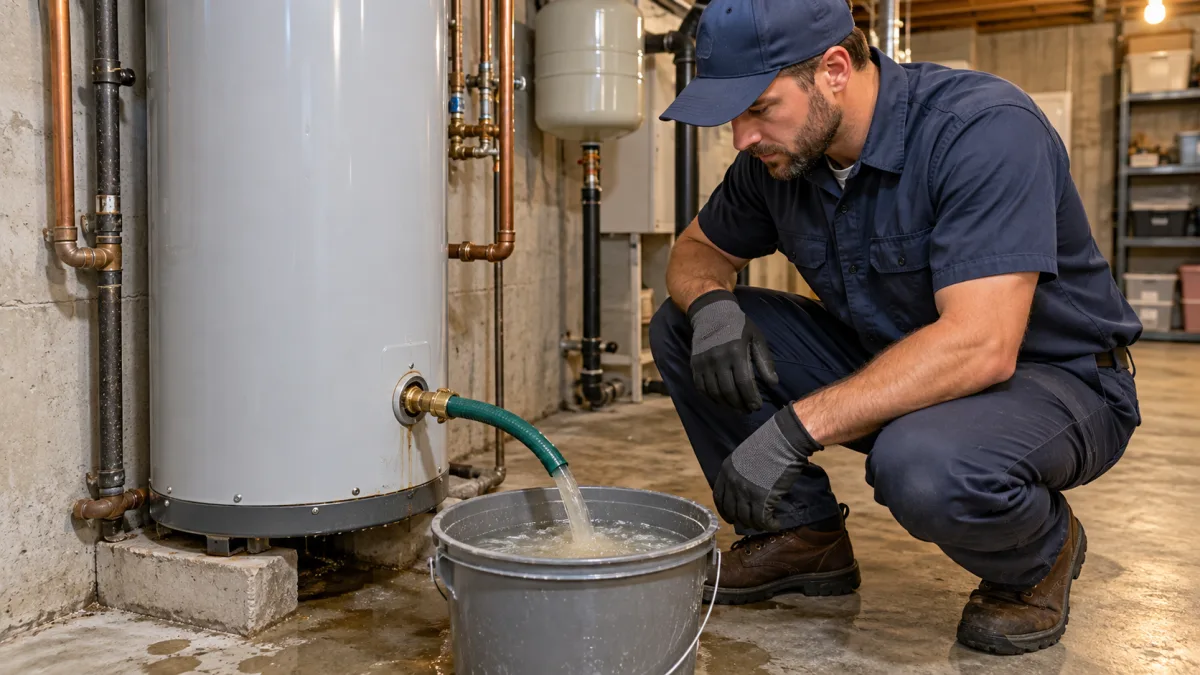
- Sediment. Mineral content varies across Monmouth, Middlesex and Ocean counties, and in harder-water pockets a tank that is never flushed can build an inch or more of scale across the bottom. On a gas heater that layer sits between the burner and the water, so the steel overheats and fails early; on an electric one it buries the lower element.
- No expansion tank. Many homes on municipal water have a pressure-reducing valve or check valve that makes the plumbing a closed system. Without a thermal expansion tank, every heating cycle spikes pressure, which stresses the tank and makes the T&P valve weep.
- Spent anode rods. The sacrificial anode is what corrodes instead of your tank. It is consumable, almost nobody replaces it, and once it is gone the tank starts rusting from the inside. Replacing one at year five or six is one of the cheapest ways to extend a heater's life.
Flush the tank annually, check the anode every few years, and confirm you have a working expansion tank. That is most of it.
Get Your Hot Water Back
Guardian Air repairs and replaces gas, electric and tankless water heaters across Monmouth, Middlesex and Ocean counties — Freehold, Red Bank, Middletown, Toms River, Brick, Lakewood, Edison, Old Bridge, Perth Amboy and the towns around them. Licensed, flat-rate priced, and straight with you about whether a repair makes sense on a tank of that age. Call (848) 276-6300 or book online. See also our water heater service, tankless water heaters and emergency plumbing.