October 11, 2026
AC Not Cooling? 9 Causes, Safe Checks & What It Costs
Air conditioner running but not cooling? Start with the five checks worth doing yourself, then the nine real causes — frozen coil, dirty condenser, failed capacitor, tripped float switch, refrigerant leak — and 2026 central NJ repair costs.
By Guardian Air · Published · Updated
If your AC is not cooling, work through five things before calling anyone: the thermostat is set to COOL and below room temperature, the air filter is clean, the breaker (and the outdoor disconnect) has not tripped, the outdoor condenser is clear of grass and shrubs, and the supply registers are open. Beyond that, the usual culprits are a frozen evaporator coil, a dirty condenser coil, a failed run capacitor, a tripped condensate float switch or low refrigerant from a leak. A healthy system drops the air about 18–22°F between return and supply; much less than that means something is wrong. Repairs on a central AC in central New Jersey typically run $150 to $800, with refrigerant leaks and compressors costing more.
Written by the Guardian Air HVAC & plumbing team · Reviewed for accuracy October 2026
On the first genuinely hot week of the year our phones do not stop. The call is almost always the same: the air conditioner is running, air is coming out of the vents, but the house will not cool down. That specific combination — running but not cooling — narrows the problem considerably, and about a third of the time the homeowner can fix it in ten minutes without paying for a visit. This guide walks the same sequence our technicians use, tells you which checks are safe to do yourself, and explains what we look at when the easy answers run out.
First, Is It Actually Not Cooling?
Air conditioners do not blow cold air the way a refrigerator does. A correctly working residential system removes about 18 to 22°F from the air passing through it. Measure it: tape an ordinary cooking thermometer in a supply register near the air handler, then read a return grille. If the supply air is roughly 20°F cooler than the return, the equipment is doing its job and the problem is somewhere else — insulation, duct losses, a hot attic, undersized equipment, or simply a 95°F day with afternoon sun on the glass.
Two more things that are normal and alarm people every summer:
- The system runs for long stretches in a heat wave. Equipment is sized for a design temperature, not the worst day of the decade. On a 95°F afternoon a correctly sized system may run almost continuously and still hold only 75–78°F indoors. That is the system working, not failing.
- It cannot keep up with a deep setback. Coming home to an 84°F house and setting the thermostat to 70°F does not make it cool faster. Pulling a house down takes hours, and on a humid day much of the early capacity goes into removing moisture rather than lowering temperature.
Five Safe Checks Before You Call
None of these require tools or opening sealed equipment. Do them in order.
- Thermostat. Mode on COOL (not FAN or AUTO-heat), setpoint at least a few degrees below the current room reading, and fan on AUTO. If it is a smart thermostat, check it has not reverted to a schedule or an away/eco setting. Replace the batteries if it takes them — a thermostat with dying batteries can run the blower and never call for cooling.
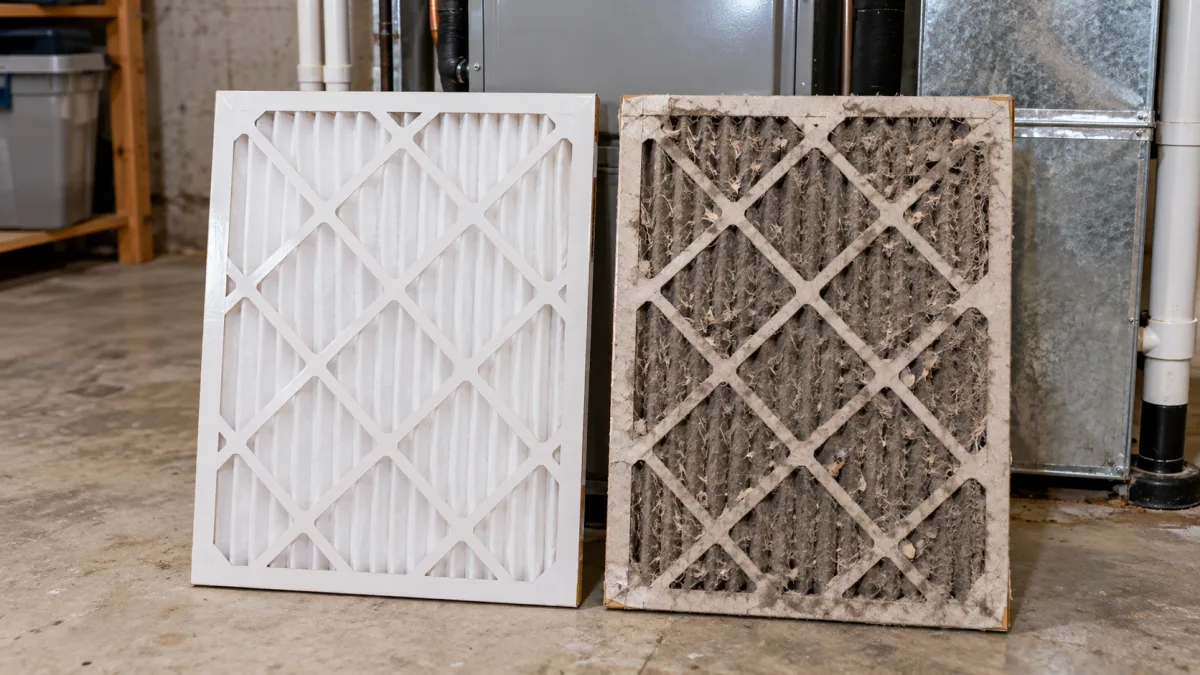
- Air filter. Pull it out and hold it to a light. If you cannot see light through it, it is choking the system, and a choked system is the single most common cause of an AC not cooling. Replace it. Note the direction arrow points toward the blower.
- Breakers and the outdoor disconnect. A central AC has two circuits: the indoor air handler and the outdoor condenser. If the blower runs but the outdoor unit is silent and still, check the condenser breaker in the panel and the pull-out disconnect box on the wall beside the outdoor unit. Reset a tripped breaker once. If it trips again, stop — a breaker that keeps tripping is reporting a real electrical fault, not nuisance.
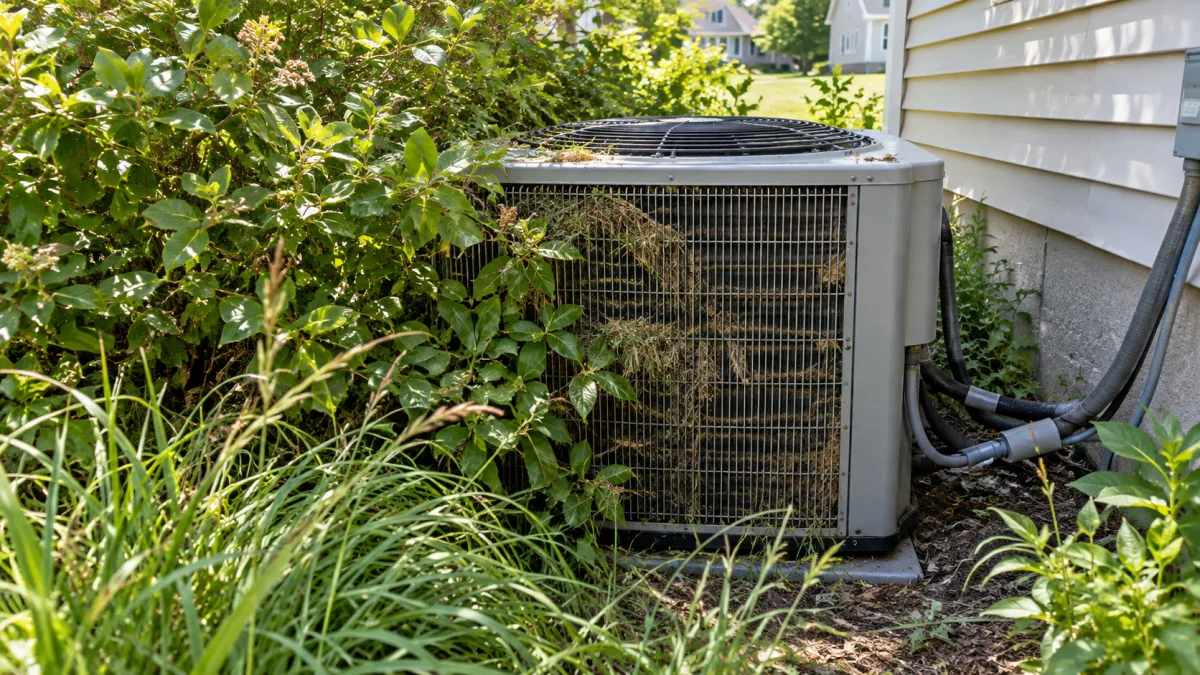
- The outdoor unit. It rejects your home's heat into the air, and it cannot do that buried in grass clippings, cottonwood fluff, pollen or shrubbery. You want at least two feet of clear space on all sides and nothing on top. With the disconnect pulled, you can rinse the coil gently from the inside out with a garden hose — low pressure, never a pressure washer, which folds the fins flat.
- Registers and returns. Open every supply register, including in unused rooms, and make sure furniture or rugs are not covering returns. Closing registers to "push air elsewhere" raises static pressure and reduces total airflow, which can freeze the coil.
Why Is My AC Not Cooling? The Nine Real Causes
1. A frozen evaporator coil
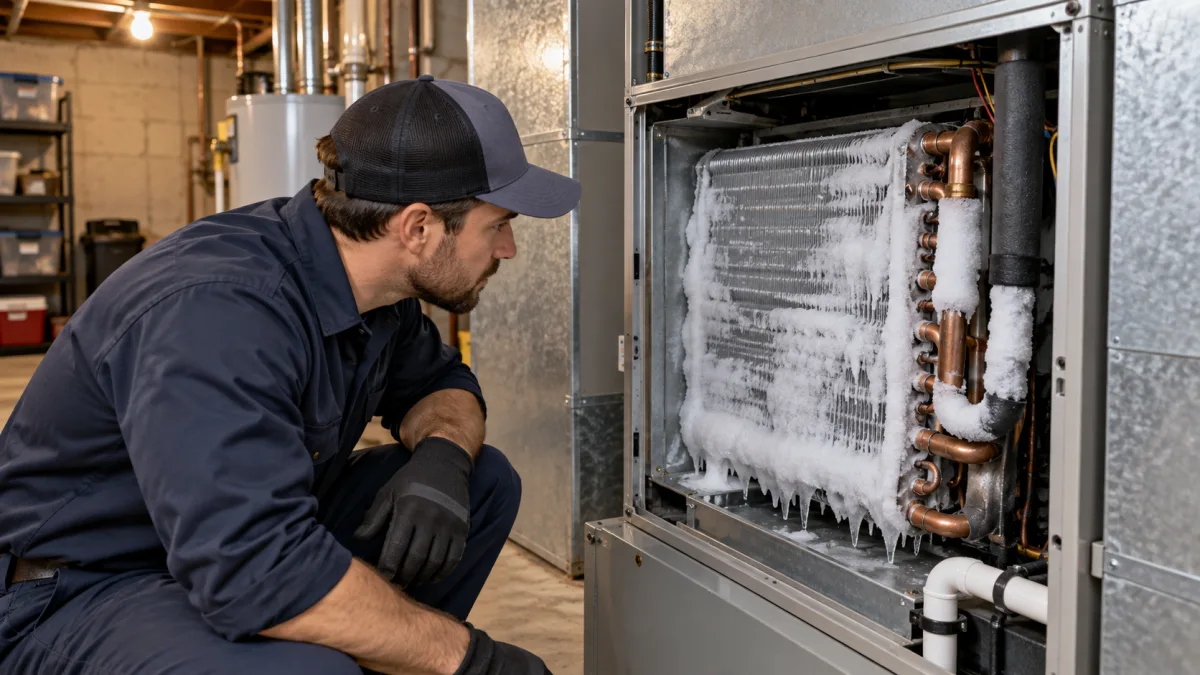
This is the classic. Reduced airflow or low refrigerant makes the indoor coil run below freezing, so condensation turns to ice on contact. Ice insulates the coil, airflow drops further, and the system spirals: the blower runs, the compressor runs, and progressively warmer air comes out of the vents. Tell-tale signs are frost or ice on the copper lines near the air handler, water pooling by the indoor unit, or a block of ice visible on the coil.
What to do: turn the system OFF at the thermostat and set the fan to ON. Room-temperature air blown across the coil melts the ice fastest — it can take anywhere from four to twenty-four hours. Put towels down; a season's worth of ice is a lot of water. Replace the filter while you wait. Once it is fully thawed, run cooling again. If it freezes a second time, the cause is still there and it needs diagnosis: a dirty coil, a failing blower, crushed or undersized ductwork, or a refrigerant leak.
2. A dirty condenser coil
The outdoor coil is a heat exchanger, and a coat of dirt, pollen or lawn debris acts like a blanket. The system keeps absorbing heat indoors and cannot dump it outdoors, so head pressure climbs, capacity falls and the house stays warm. In our area this shows up badly in early summer after cottonwood and grass season, and chronically along the shore in Long Branch and Point Pleasant, where salt air corrodes aluminium fins and the coil loses heat transfer even when it looks clean.
3. A failed run capacitor
A capacitor stores the jolt that gets the compressor and condenser fan motor turning. When it weakens, the most common symptom is an outdoor unit that hums but does not start, or a fan that will spin if you nudge it but not on its own. It is a cheap part and one of the most frequent single-part repairs we do on a no-cooling call. It is also not a homeowner job: a capacitor holds a dangerous charge even with the power off and has to be discharged before handling.
4. A burnt contactor
The contactor is the relay that switches high voltage to the outdoor unit. Its contacts pit and burn over years of switching, and eventually they either fail to close (nothing outdoors runs) or weld shut (the compressor never cycles off). A technician can see pitting immediately with the panel off.
5. A tripped condensate float switch
Cooling pulls gallons of water out of New Jersey's summer air, and that condensate drains away through a small PVC line that loves to clog with biological slime. A float switch is designed to shut the system down before the pan overflows into your ceiling. So a system that stops cooling and will not restart, with no obvious fault, is very often a full drain pan doing exactly what it was designed to do. Clearing the line and the trap fixes it; a wet-vac at the outdoor termination often does the job.
6. Low refrigerant from a leak
Refrigerant is not consumed. A system does not "use it up" and does not need topping off as routine maintenance — if it is low, it leaked, and the leak is the repair. Symptoms are weak cooling that gets worse over weeks, ice on the suction line, a hissing or bubbling sound, and longer and longer run times. A technician should find and fix the leak, then weigh in a correct charge, not just add gas and leave.
This matters more than it used to. Under the federal AIM Act phasedown, R-410A production allowances have been cut sharply and distributor prices for R-410A have roughly doubled in a couple of years, with a further step-down scheduled for 2029. New equipment has moved to lower-GWP refrigerants such as R-454B and R-32 since January 2025. R-410A is still perfectly legal to buy for servicing existing systems, but a leaking older system is getting more expensive to keep alive every season — which changes the repair-versus-replace maths. We cover the numbers in our AC repair cost guide.
7. A failing blower motor or wheel
If airflow at the registers is feeble everywhere, the blower may be struggling, or the blower wheel may be caked with dust, which destroys its ability to move air. ECM blower modules also fail, often intermittently and often in hot weather.
8. Duct problems
Disconnected, crushed or badly leaking ducts in an attic or crawlspace can dump a large share of your cooled air where nobody lives, while pulling 130°F attic air into the return. Nothing is broken in the equipment; the delivery system is the fault. This is common in homes where an addition was tied into an original duct system that was never resized.
9. Equipment at the end of its life
A worn compressor loses pumping efficiency gradually. The system still runs, still blows air that feels slightly cool, and simply cannot hold temperature on a hot day. Combined with age, repeated repairs and R-410A pricing, this is usually the point where we talk honestly about replacement rather than another part. Our AC replacement cost guide puts a central air conditioner at roughly $6,500 to $14,000 installed in central New Jersey.
Heat Pump Owners: One Extra Cause
If your system heats as well as cools from the outdoor unit, you have a heat pump, and cooling can also fail because the reversing valve is stuck in heating mode or the defrost board is misbehaving. The symptom is distinctive: the outdoor unit runs, the house gets warmer, and the outdoor coil feels hot in cooling. That is a technician repair. Our companion article on a heat pump not heating covers the same system from the winter side.
What It Costs to Fix
Central New Jersey, 2026, parts and labour included. These are Guardian Air estimates and match our full AC repair cost breakdown.
| Repair | Typical cost |
|---|---|
| Diagnostic / service call | $89–$150, credited toward the repair |
| Run capacitor | $150–$400 |
| Contactor or relay | $200–$450 |
| Condensate drain clearing | $150–$350 |
| Condenser fan motor | $450–$900 |
| Refrigerant leak: find, repair, recharge | $400–$1,500+ |
| Evaporator coil replacement | $1,500–$3,000 |
| Compressor (out of warranty) | $1,800–$2,800 |
When to Stop and Call a Technician
- The breaker trips again after one reset.
- You smell burning, or see scorched wiring or a swollen capacitor.
- The coil refreezes after a full thaw and a new filter.
- There is ice on the refrigerant lines at the outdoor unit.
- Water is dripping from the air handler or staining a ceiling below it.
- The outdoor unit hums, clicks and does not start.
- Cooling has been fading over several weeks — that pattern points to a leak.
And one safety note that is not about comfort: if anyone in the home is elderly, very young or medically vulnerable, do not spend two days troubleshooting in a July heat wave. Call for emergency HVAC service and get the house cooled.
How to Stop It Happening Again
Nearly every no-cooling call we run in July traces back to something a spring visit would have caught. Change filters on a schedule you actually keep — every one to three months for a 1-inch filter. Keep two feet clear around the condenser and rinse it once a season. Pour a cup of white vinegar down the condensate line cleanout in spring to keep slime from forming. And book an AC tune-up before the first hot week, when we can measure the temperature split, check the charge, clean the coil, test the capacitor against its rating and clear the drain — we lay out the economics of that in why annual AC maintenance pays for itself.
Get Your AC Cooling Again
Guardian Air runs cooling calls across Monmouth, Middlesex and Ocean counties — Freehold, Red Bank, Middletown, Toms River, Brick, Edison, Old Bridge and the surrounding towns. We diagnose with instruments rather than guesses, quote flat-rate before we start, and tell you plainly when a repair is not worth your money. Call (848) 276-6300 or request service online, and see our full cooling services if you want to know what else we handle.