October 12, 2026
AC Repair Cost in NJ (2026): Prices by Part & Problem
What AC repair really costs in central New Jersey in 2026, part by part — capacitors, contactors, motors, coils and compressors — plus why the R-410A phasedown has changed the repair-or-replace decision on older systems.
By Guardian Air · Published · Updated
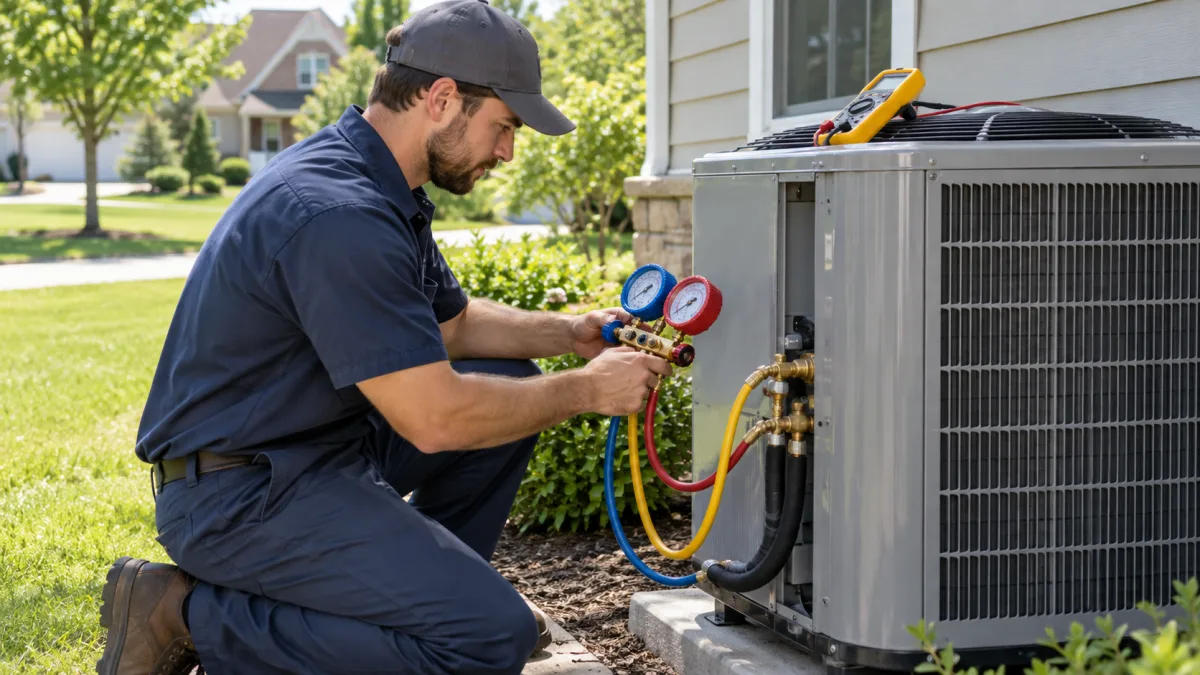
AC repair in central New Jersey typically costs $150 to $800 in 2026, including parts and labour. A run capacitor is $150 to $400, a contactor $200 to $450, a condenser fan motor $450 to $900, and a refrigerant leak found, repaired and recharged $400 to $1,500 or more. An out-of-warranty compressor at $1,800 to $2,800 is usually the point to price a replacement instead. Expect a diagnostic fee of $89 to $150, credited toward the repair. The one thing that has genuinely changed: R-410A refrigerant has roughly doubled in price under the federal AIM Act phasedown, so leak repairs on older systems now carry real replacement maths behind them.
Written by the Guardian Air HVAC & plumbing team · Reviewed for accuracy October 2026
Nobody asks what AC repair costs on a pleasant day in April. They ask on the hottest afternoon of the year, with a technician on the way and no sense of whether $400 is a fair number or a fleecing. So here are our actual central New Jersey prices, what each repair involves, why two quotes for "the same job" can differ legitimately, and the specific circumstances where we would tell you to stop repairing and start pricing a new system.
How Much Does AC Repair Cost in 2026?
Most repairs land between $150 and $800. The spread is wide because "AC repair" covers everything from a twenty-minute capacitor swap to a half-day coil replacement.
| Repair | Typical cost, central NJ | What it involves |
|---|---|---|
| Diagnostic / service call | $89–$150 | Full-system diagnosis; credited toward the repair |
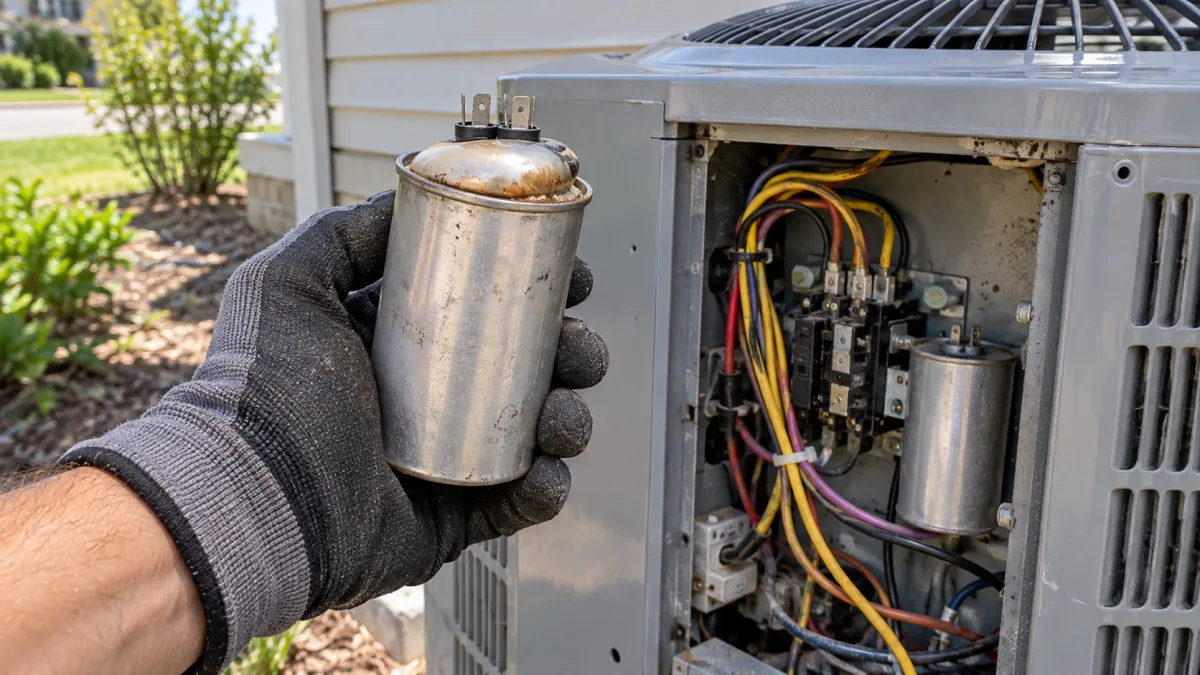
| Run or start capacitor | $150–$400 | Common single-part failure; under an hour |
| Contactor / relay | $200–$450 | Switches high voltage to the outdoor unit |
| Condensate drain clearing | $150–$350 | Clears the line and trap, resets the float switch |
| Thermostat replacement | $200–$650 | Higher for smart or multi-stage controls |
| Condenser fan motor | $450–$900 | Motor, blade and capacitor as a set |
| Blower motor (PSC) | $500–$1,100 | Indoor air handler motor |
| Blower motor (ECM module) | $700–$1,500 | Variable-speed module and programming |
| Refrigerant leak: find, repair, recharge | $400–$1,500+ | Depends entirely on leak location |
| TXV / metering device | $550–$1,200 | Requires recovery and recharge |
| Evaporator coil | $1,500–$3,000 | Half-day job; recovery, braze, evacuate, recharge |
| Control board | $450–$1,100 | Varies sharply by manufacturer |
| Compressor (under warranty) | $600–$1,200 | Labour and refrigerant; part supplied |
| Compressor (out of warranty) | $1,800–$2,800 | Usually the replacement conversation |
Those are flat-rate prices quoted before work starts. We do not bill by the hour on repairs, because a homeowner should not absorb the cost of a difficult access or a slow diagnosis.
Why Refrigerant Changes the Maths in 2026
This is the part most cost guides skip, and it is the single biggest shift in AC repair economics in a decade.
The federal AIM Act is phasing down production of high-global-warming-potential refrigerants. Production allowances have sat at 60% of baseline since 2024, with the next step down to 30% scheduled for 2029. Since 1 January 2025, new residential air conditioners and heat pumps cannot be manufactured with refrigerants above a GWP of 700 — which rules out R-410A at roughly 2,088 — so new equipment ships with R-454B (GWP around 466) or R-32 (around 675).
What that means for your repair:
- R-410A is still legal to buy and use for servicing existing systems. Nobody is forcing you to replace a working air conditioner.
- But it has roughly doubled at the distributor level in a couple of years, from around $6–$10 per pound to roughly $12–$18 per pound by early 2026. Installed, homeowners are seeing $40 to $90 per pound.
- A typical residential system holds 6 to 12 pounds. A full recharge after a significant leak is therefore a real number — several hundred dollars in gas alone, before the leak repair.
- It gets worse, not better. The 2029 step-down tightens supply again. Every future leak on an R-410A system costs more than the last.
And if your system is old enough to use R-22, the calculation is already decided. R-22 production ended in 2020, and what remains is reclaimed stock at punishing prices. We do not recommend significant repairs on R-22 equipment; the money goes further toward a new system.
What Drives Your Quote Up or Down
Where the fault is, not just what the part costs
A capacitor sits behind an access panel on the outdoor unit. An evaporator coil sits inside the air handler, which may be in a cramped attic in a Toms River ranch or a tight closet in an Edison split-level. The part may be $400; the access is what makes it a half-day.
Whether refrigerant has to come out and go back in
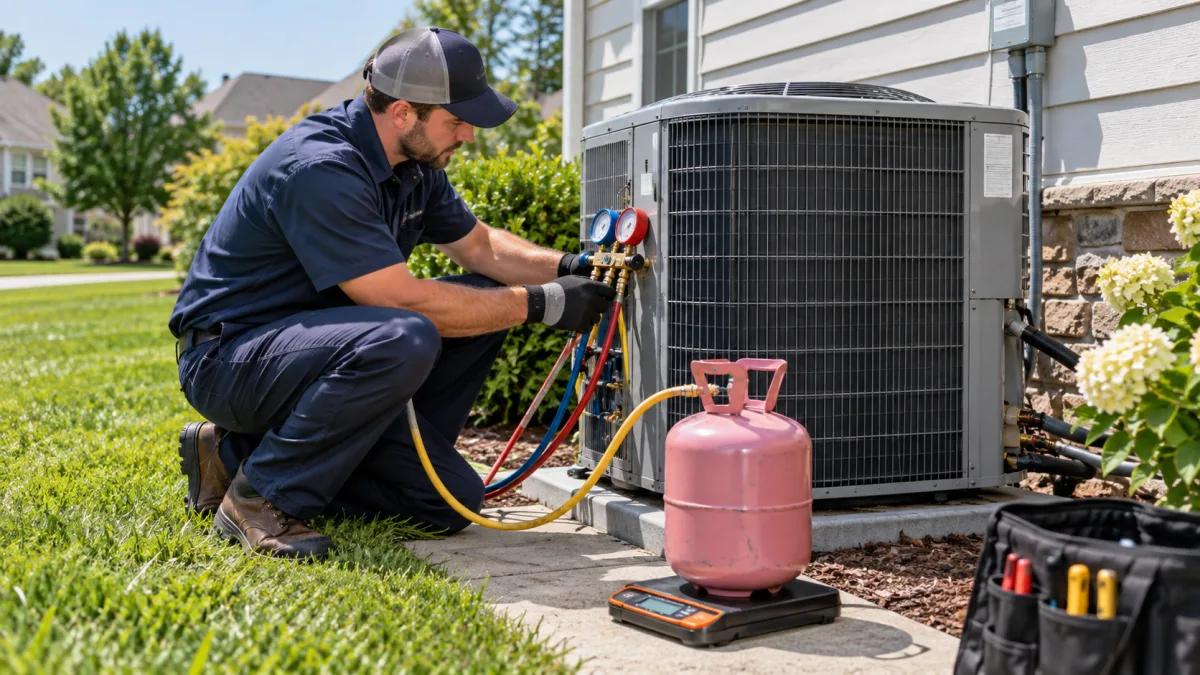
Any repair that opens the sealed system — coil, TXV, compressor, line set — requires recovering the existing charge, brazing, pulling a deep vacuum, and weighing in a fresh charge. That is the difference between a $200 repair and a $1,200 one.
Warranty status
Most manufacturers give 10 years on parts if the system was registered at installation, and 5 if it was not. A compressor under warranty costs you labour and refrigerant; the same compressor out of warranty costs two to three times more. Find your model and serial number before you call — it is on the data plate of the outdoor unit — and we can check coverage.
Emergency and after-hours timing
A Sunday-evening call in a heat wave costs more than a Tuesday morning. We are straightforward about that rather than hiding it in the parts price.
Age and condition of everything else
Replacing a coil on a fifteen-year-old condenser sometimes means the new coil is mismatched to old equipment and the system never performs properly. A good technician tells you that before taking your money, not after.
Repair or Replace? The Honest Test
We use the same rule of thumb across our heating and cooling guides because it keeps emotion out of an expensive decision:
Multiply the repair quote by the age of the system in years. If the result tops $5,000, replacement usually wins.
A $300 capacitor on a 6-year-old system scores 1,800 — fix it without hesitating. A $1,400 coil on a 14-year-old system scores 19,600 — you are repairing a system that owes you nothing. Then layer on four more questions:
- What refrigerant is in it? R-22 points firmly to replacement. R-410A with a leak points that way too.
- Is this the second or third repair? One repair on a sound system is maintenance. A pattern is a failing system.
- Is the compressor involved? Out-of-warranty compressor work is typically a third of the cost of a whole new system that comes with a fresh warranty and much better efficiency.
- Does the house actually cool properly when it works? If it never kept up, replacement is a chance to fix sizing and ductwork rather than restore mediocrity.
For replacement numbers, our AC replacement cost guide puts a central air conditioner at roughly $6,500 to $14,000 installed in central New Jersey, and a ductless mini split at $3,500 to $7,500 for a single zone. If you are replacing anyway, it is worth pricing a heat pump, which gives you cooling and heating from one system and is where the utility rebates now sit.
Rebates: What Is Left in 2026
There is no rebate for a repair. But if the conversation turns to replacement, the federal 25C tax credit expired for systems installed after 31 December 2025, which makes New Jersey utility programmes the main incentive now. PSE&G, JCP&L and New Jersey Natural Gas run rebates and 0% financing on qualifying high-efficiency equipment, with heat pumps treated most generously. We keep the current details in our NJ HVAC rebates and incentives guide.
How to Read an AC Repair Quote
Four things a fair quote has:
- A named fault, not a symptom. "Failed run capacitor, measured 12.4 µF against 45 µF rated" is a diagnosis. "Needs a tune-up" is not.
- A flat price before work starts. You should know the number before anyone picks up a tool.
- The repair-versus-replace comparison in writing when the repair is substantial.
- A leak search, not just a recharge, if refrigerant is low. Adding gas without finding the leak means you are buying the same refrigerant again next summer at a higher price.
Red flags
- A refrigerant "top-off" offered as routine maintenance. Refrigerant is not consumed; if it is low, it leaked.
- A replacement quote with no load calculation and no look at your ductwork.
- Pressure to decide today, or a price that drops sharply when you hesitate.
- A diagnosis given from the driveway, before anyone opened a panel or took a reading.
- Refusal to put the diagnosis in writing.
Keeping Repair Bills Down
The cheapest repair is the one you never need. Change the filter every one to three months. Keep two feet clear around the outdoor unit and rinse the coil once a season. Flush the condensate line with white vinegar in spring. And have the system measured annually — a technician testing a capacitor against its rated microfarads will often catch it before it strands you in July, which is both cheaper and considerably more comfortable. We make the case in why annual AC maintenance pays for itself, and you can book an AC tune-up directly.
If the system is not cooling right now, our AC not cooling troubleshooting guide walks the five checks worth doing before you pay for a visit.
Get a Flat-Rate AC Repair Quote
Guardian Air repairs central air conditioners, heat pumps and ductless systems across Monmouth, Middlesex and Ocean counties — Freehold, Red Bank, Middletown, Howell, Toms River, Brick, Edison, Old Bridge and neighbouring towns. You get a measured diagnosis, a flat price before we start, and a straight answer about whether the repair is worth your money. Call (848) 276-6300 or book online, and browse our cooling services for the full list.