October 17, 2026
Is Air Duct Cleaning Worth It? An Honest Answer
We offer duct cleaning and we talk people out of it. What the EPA actually says, the three conditions where cleaning is truly warranted, what a proper NADCA job costs and involves, why the $79 coupon exists, and where that money does more for your air.
By Guardian Air · Published
For most homes, routine air duct cleaning is not worth it. The US EPA is unusually blunt about this: duct cleaning "has never been shown to actually prevent health problems," and the agency does not recommend it routinely — only as needed. There are three conditions where it genuinely is warranted: substantial visible mould growth inside the ducts or on system components, an infestation of rodents or insects, and ducts so clogged with dust and debris that particles are actually being released into rooms from the registers. If one of those applies, a proper NADCA-standard cleaning runs about $450 to $1,000 for an average home. If none applies, your money does more for your air quality spent on better filtration, sealing duct leaks and humidity control.
Written by the Guardian Air HVAC & plumbing team · Reviewed for accuracy October 2026
We offer duct cleaning. We also talk a fair number of people out of it, which is an odd thing for a contractor to publish — so let us explain the reasoning, because the gap between what duct cleaning is marketed as and what the evidence supports is wider than almost anything else in this trade.
What the EPA Actually Says
The EPA's guidance document Should You Have the Air Ducts in Your Home Cleaned? is the closest thing to a neutral authority on this, and it is worth quoting rather than paraphrasing:
"Knowledge about air duct cleaning is in its early stages, so a blanket recommendation cannot be offered as to whether you should have your air ducts in your home cleaned." And: "Duct cleaning has never been shown to actually prevent health problems."
The EPA does not say duct cleaning is harmful — it notes that provided the cleaning is done properly, no evidence suggests it would be detrimental. What it says is that there is no evidence routine cleaning delivers a health benefit, so it should be done as needed, not on a schedule.
That is the opposite of how the service is usually sold. If a company tells you ducts should be cleaned every two or three years as preventive maintenance, they are not describing a position any health authority holds.
The Three Times It Is Genuinely Worth It
The EPA identifies three specific conditions. These are also, in our experience, exactly the cases where customers notice a real difference afterwards.
1. Substantial visible mould growth inside the ducts or on system components
Not a musty smell, and not a lab report from the company selling the cleaning — visible growth on the inside of hard-surface duct or on components like the evaporator coil, blower or drain pan. Two cautions here. Insulated flexible duct and duct liner that has actually grown mould generally has to be replaced rather than cleaned, because porous material cannot be reliably decontaminated. And a lot of what gets pointed out as mould is dust or sealant residue. If it matters, get it identified independently — we offer mould testing as a separate service precisely so the diagnosis is not coming from whoever profits from the remedy.
2. Vermin infestation
Rodents or insects nesting in ductwork. This one is unambiguous. Droppings and nesting material are a genuine contamination issue, and you are also going to need the entry point found and closed, or it recurs.
3. Ducts so clogged that debris is being released into the house
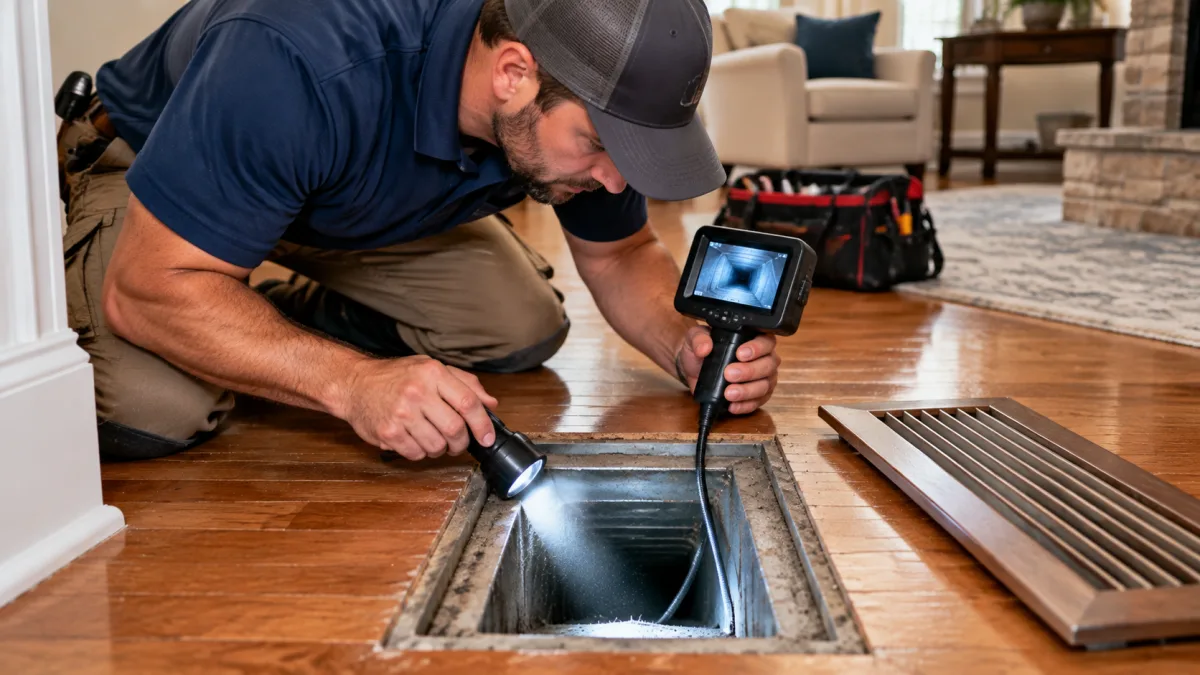
The test is not "is there dust in my ducts" — there is dust in every duct in every house. The test is whether particles are visibly coming out of the supply registers, or whether the ducts are so loaded that airflow is affected. Hold a tissue near a register with the fan running; pull a register cover and look in with a torch. Heavy, matted accumulation is a different thing from a film of settled dust.
The caveat that matters more than the list
The EPA adds something that most marketing leaves out: if any of those conditions exists, it usually indicates an underlying cause, and the cause must be corrected first or the problem will recur. Mould in ducts means moisture is getting in — a leaking drain pan, condensation on uninsulated duct in a humid crawlspace, a roof or plumbing leak. Cleaning without fixing that buys you a few months. Vermin means an opening. Heavy debris usually means an unfiltered return, a filter that has been bypassed, or construction dust nobody cleaned up.
Common Reasons People Clean Ducts — And Whether They Hold Up
| Reason given | Does it hold up? |
|---|---|
| "It will fix our allergies" | Not supported. Most household allergen exposure comes from carpets, bedding, upholstery and pets, which continuously reintroduce particles. Better filtration and source control do more. |
| "It will lower our energy bills" | Rarely. Unless debris is genuinely restricting airflow, there is no measurable saving. Sealing duct leaks does cut bills — that is a different job. |
| "There is dust on the registers" | Usually not a reason. That dust is from the room, settling on the grille. Normal. |
| "We just had construction or a renovation" | Often yes. Drywall dust and sawdust are fine, abundant, and genuinely get into returns. One of the better reasons. |
| "We just moved in" | Sometimes. Reasonable if the previous owners smoked or had pets, or if the system looks neglected. Not automatic. |
| "There is a musty smell from the vents" | Investigate, don't assume. Usually a wet evaporator coil or a blocked condensate drain, not the ducts. Cleaning ducts will not fix either. |
| "We had water damage or a flood" | Yes. Wet duct and wet insulation need assessment, and often replacement. |
| "Rodents got in" | Yes. One of the EPA's three conditions. |
| "It is recommended every 3 years" | No. No health authority recommends routine cleaning on a schedule. |
What Duct Cleaning Costs — and What the $79 Coupon Buys
NADCA, the industry's certifying body, puts a properly performed residential duct cleaning at roughly $450 to $1,000 for an average-sized home, with price driven by the size of the system, number of systems, the type of ductwork and how contaminated it actually is. Most homeowners land in the $400 to $600 range for a straightforward single-system house.
Which brings us to the advertisements for whole-house duct cleaning at $79 or $99. Those prices do not cover the labour that a real cleaning requires, and they are not meant to. They buy a visit. The business model is the upsell that follows — "sanitiser" treatments, antimicrobial fogging, duct sealing, or a mould finding that arrives with a replacement quote attached.
What a proper job actually involves
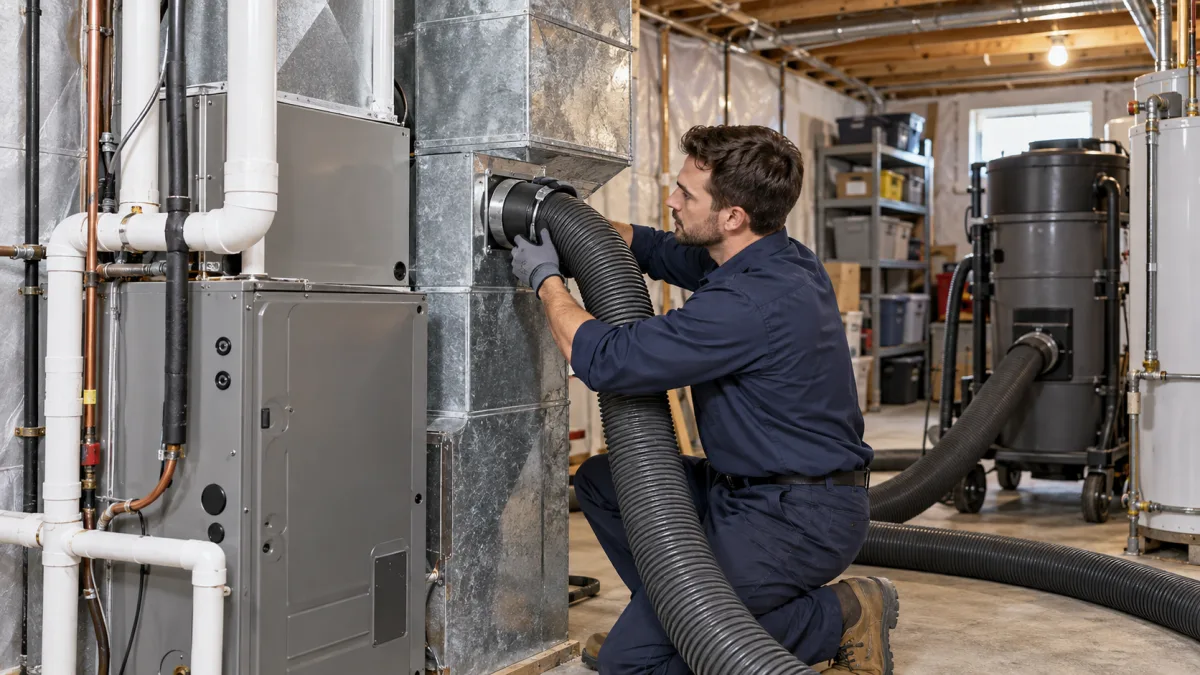
A NADCA-standard cleaning uses the source removal method, and it looks like this:
- The entire system is addressed — supply and return ducts, registers and grilles, the plenums, the blower and blower housing, the evaporator coil and the drain pan. Not just the register openings.
- The system is put under negative pressure with a vacuum connected near the air handler and exhausted outside or through HEPA filtration, so dislodged debris is captured rather than redistributed.
- Access ports are cut where needed and properly sealed afterwards.
- Agitation devices — brushes, air whips, skipper balls — dislodge adhered debris toward the vacuum.
- It takes three to five hours for a typical home, often with two technicians.
- You get before-and-after photographs of your ducts.
If a crew is in and out in forty-five minutes having stuck a shop vac hose into each register, that is a "blow and go." It can genuinely make things worse by loosening debris and leaving it in the system.
On chemical sanitisers and sealants
Be sceptical. The EPA's position is that any product applied inside ductwork must be EPA-registered for that specific use, and it cautions against the routine application of sealants and biocides in residential duct systems — the research base is thin and misapplication carries its own risks. In clean, dry metal duct there is nothing for a biocide to accomplish. We do not fog ducts as an add-on, and a company that leads with "sanitising" rather than source removal is selling the wrong thing.
If Not Duct Cleaning, Then What?
This is the useful part. If you have an indoor air quality complaint — dust, allergies, stuffiness, uneven comfort — here is where the same money does more, roughly in order of return:
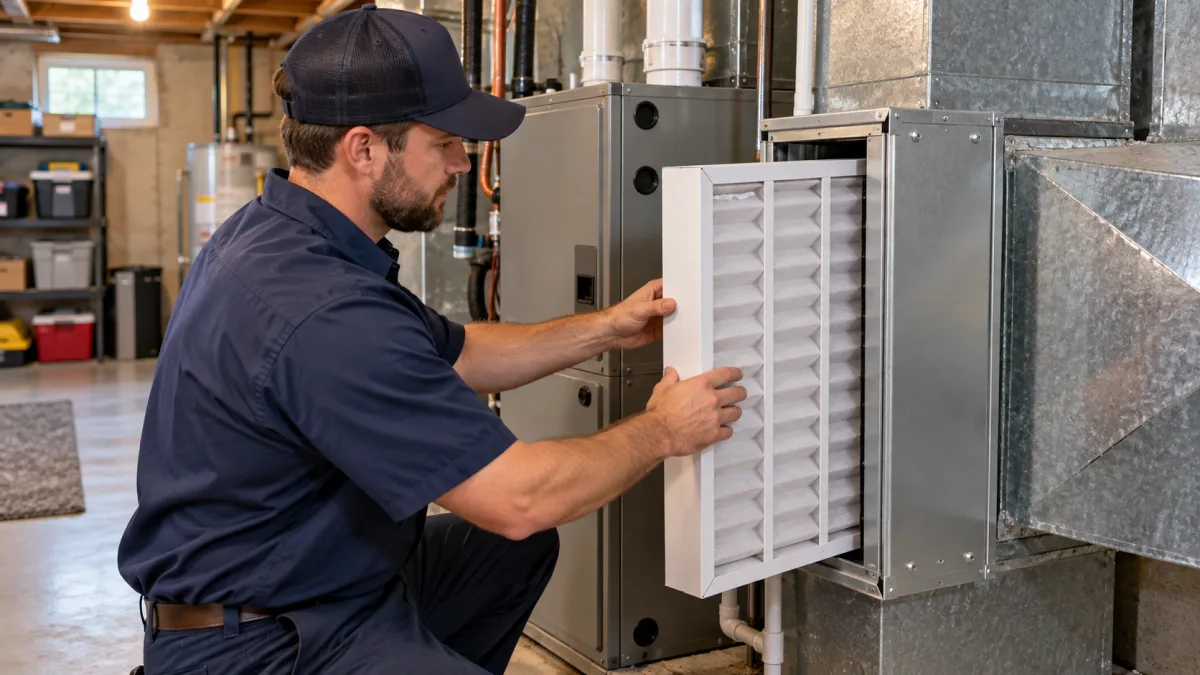
- Better filtration, within what your system can handle. Moving from a cheap fibreglass filter to a pleated MERV 11–13 captures dramatically more fine particulate. The caveat is real: a restrictive filter in a system not designed for it raises static pressure and reduces airflow, which hurts performance and can freeze a coil. A 4-inch media cabinet gives you high filtration with low resistance and is one of the best upgrades available.
- Seal duct leaks. Leaky ducts in an attic or crawlspace pull in dusty, unconditioned air on the return side and dump conditioned air where nobody lives. This is the fix people think they are buying when they buy duct cleaning, and unlike cleaning it has a measurable effect on bills and comfort.
- Control humidity. New Jersey summers are humid and winters are dry. Keeping indoor relative humidity between about 30 and 50% suppresses dust mites and mould and makes the air feel better at the same thermostat setting. Our humidifier and dehumidifier service covers whole-home options.
- Fix the moisture source. A blocked condensate drain, a wet drain pan or uninsulated duct sweating in a crawlspace causes the musty smell people blame on dirty ducts.
- Source control. Doormats, regular vacuuming with a sealed HEPA machine, washing bedding warm, and kitchen and bathroom extract fans that actually vent outside.
- Clean the dryer vent. Often confused with duct cleaning and far more worth doing — a lint-packed dryer vent is a genuine fire risk and a real efficiency loss. Different duct, different job, clear benefit.
- Consider targeted air cleaning if someone in the house has significant allergies or asthma. We cover options on our air purifier page, and our guide to improving indoor air quality at home goes deeper on all of this.
Red Flags in Duct Cleaning Sales
- $79 or $99 whole-house pricing. It is a lead, not a service.
- Photographs of filthy ducts that are not yours. Ask for photos taken in your home, with your register visible.
- A mould diagnosis from the company selling the cleaning, with no independent testing.
- "The EPA recommends cleaning every X years." It does not. This claim alone should end the conversation.
- Pressure to add sanitising, fogging or sealant on the day.
- A price that rises substantially once they are in the house.
- No NADCA certification and no description of the method they will use.
- No mention of the coil, blower or drain pan. Those are where the measurable dirt that affects performance actually accumulates.
Our Honest Position
We clean ducts when one of the EPA's three conditions applies, after construction or water damage, or when a customer who understands the evidence still wants it done — which is a legitimate choice, and no, it will not hurt anything if it is done properly. What we will not do is sell it as routine maintenance or as an allergy cure.
If you are unsure, have someone look at the system rather than guessing. A technician can pull a register, open the air handler, show you the coil and blower, measure static pressure across your filter, and tell you whether you are looking at a cleaning job, a filtration upgrade, a duct sealing job or a wet coil. Our service call is $89 to $150 and is credited toward whatever the work turns out to be — including nothing, if the answer is that your ducts are fine.
Get an Honest Assessment First
Guardian Air provides duct cleaning, dryer vent cleaning, mould testing, filtration upgrades and humidity control across Monmouth, Middlesex and Ocean counties — Freehold, Red Bank, Middletown, Howell, Toms River, Brick, Edison, Old Bridge and the towns around them. We will look at your actual system and tell you which of those you need, including when the answer is none of them. Call (848) 276-6300 or book an assessment. See also duct cleaning, indoor air quality services and our air quality services guide.