October 11, 2026
Boiler vs Furnace: Cost, Efficiency & Which Is Better in NJ
Boiler vs furnace, explained by NJ technicians: how hot-water heat and forced air differ, 2026 installed prices in central New Jersey, monthly running costs at NJ gas rates, comfort, lifespan, how to tell which you have, and when switching makes sense.
By Noor Kamal, Technology Manager · Published · Updated
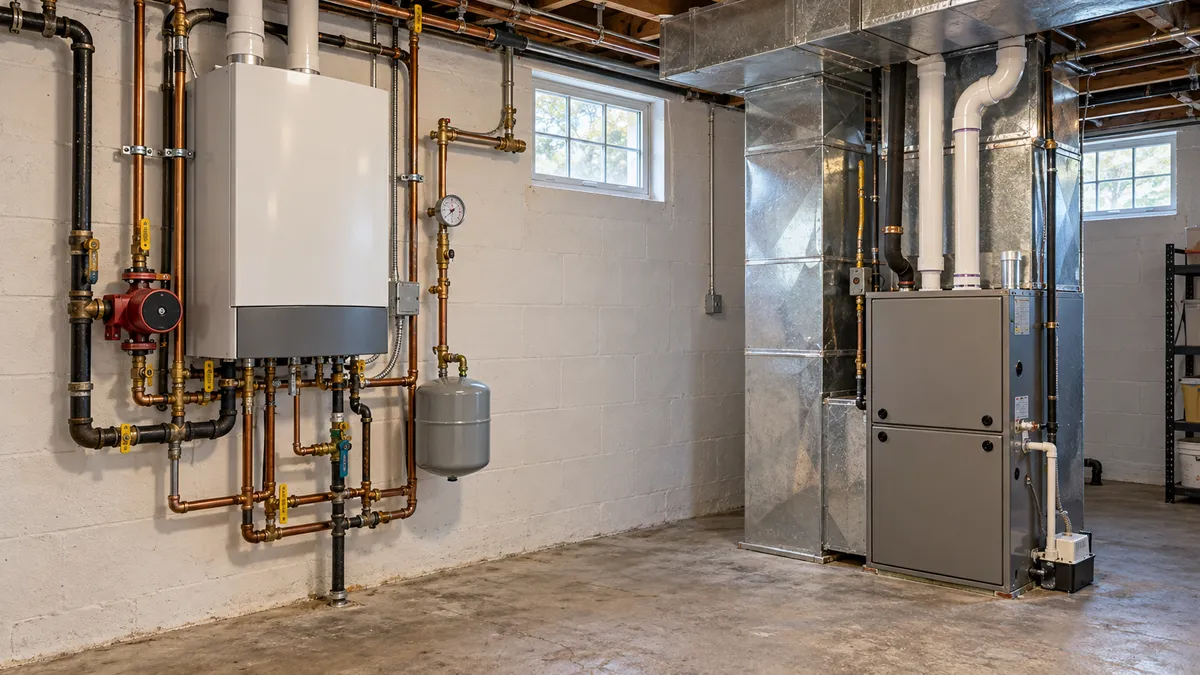
Boiler vs furnace, in one paragraph: a furnace heats air and blows it through ducts; a boiler heats water and pumps it through radiators, baseboard or radiant floor tubing. In central New Jersey a gas furnace typically costs $3,800 to $10,000 installed, while a gas hot-water boiler replacement typically runs $7,000 to $14,000. Condensing models of either cost about the same to run. A boiler gives quieter, more even heat and can last 25 years or more; a furnace heats faster, filters the air and shares ducts with central air. In most homes, keep the system the house was built around and upgrade it.
Written by the Guardian Air HVAC & plumbing team · Reviewed for accuracy October 2026
We hear this question constantly, usually from someone who just bought an older home with radiators or whose 30-year-old boiler finally failed. This guide covers the difference between a boiler and a furnace, what each costs to install and run in New Jersey, how to tell which one you have, and when switching makes sense.
What Is the Difference Between a Boiler and a Furnace?
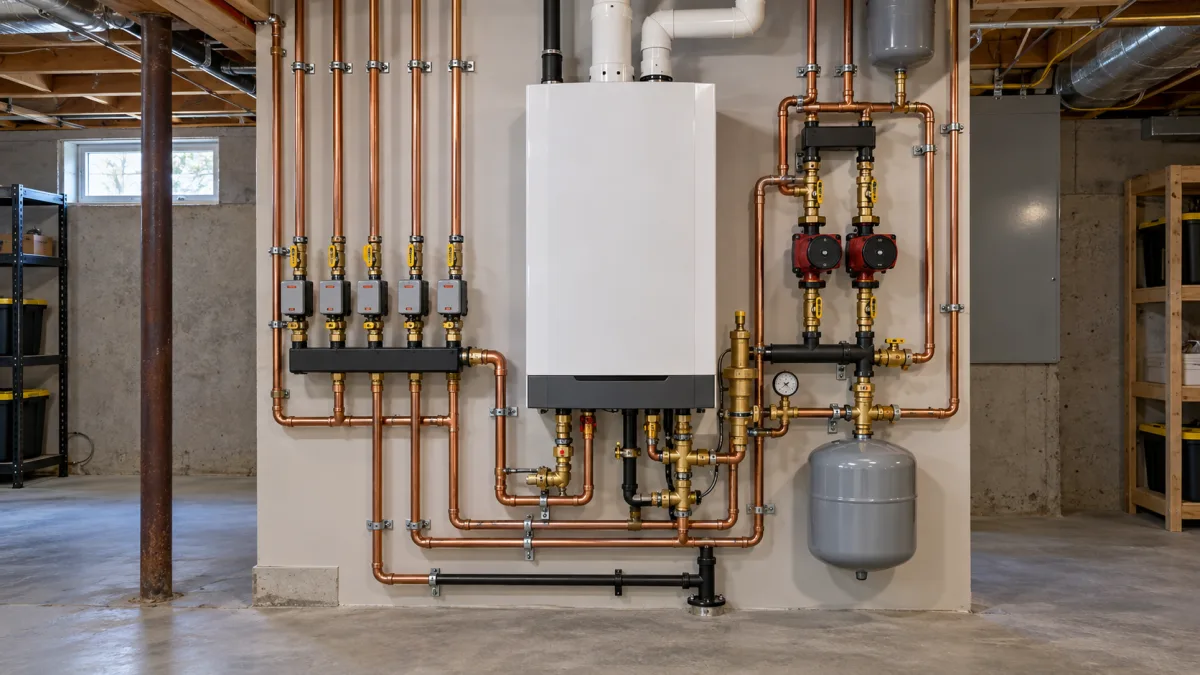
The difference between a boiler and a furnace is what carries the heat. Both burn fuel (or use electricity) to make heat. A furnace passes that heat to air across a heat exchanger, and a blower pushes the warm air through supply ducts to registers in each room, then pulls it back through return ducts. That is forced-air heat. A boiler passes the heat to water. In a hot-water (hydronic) system, a circulator pump moves water at roughly 120°F to 180°F through cast-iron radiators, finned baseboard or floor tubing and back. In a steam system, the boiler actually boils the water; steam rises to the radiators, condenses and drains back.
So, is a boiler a furnace? No, though plenty of people call whatever heats the house "the furnace." The boiler versus furnace question really comes down to boiler heat vs forced air, and the parts, skills and prices are different.
How a gas boiler vs gas furnace compares, side by side
| Gas furnace (forced air) | Gas boiler (hot water) | |
|---|---|---|
| Heats | Air, delivered through ducts | Water, delivered through pipes |
| Typical installed price, central NJ (2026 estimate) | $3,800–$10,000 | $7,000–$14,000 (steam higher) |
| Efficiency range (AFUE) | 80% standard; 95–98% condensing | 82–87% standard; 90–95%+ condensing |
| Federal minimum AFUE (gas) | 80% (non-weatherized) | 84% hot water; 82% steam |
| Typical lifespan | 15–20 years | 15–20 years condensing; 25–30+ cast iron |
| Comfort | Fast warm-up; can feel drafty and dry | Even, quiet radiant heat; slower to recover |
| Air filtration | Yes, at the return | None |
| Central air | Shares the same ducts and blower | Needs a separate system (often ductless) |
| Can also make hot water | No | Yes, with an indirect tank or a combi boiler |
Do I Have a Boiler or a Furnace?
If you are not sure, the house tells you.
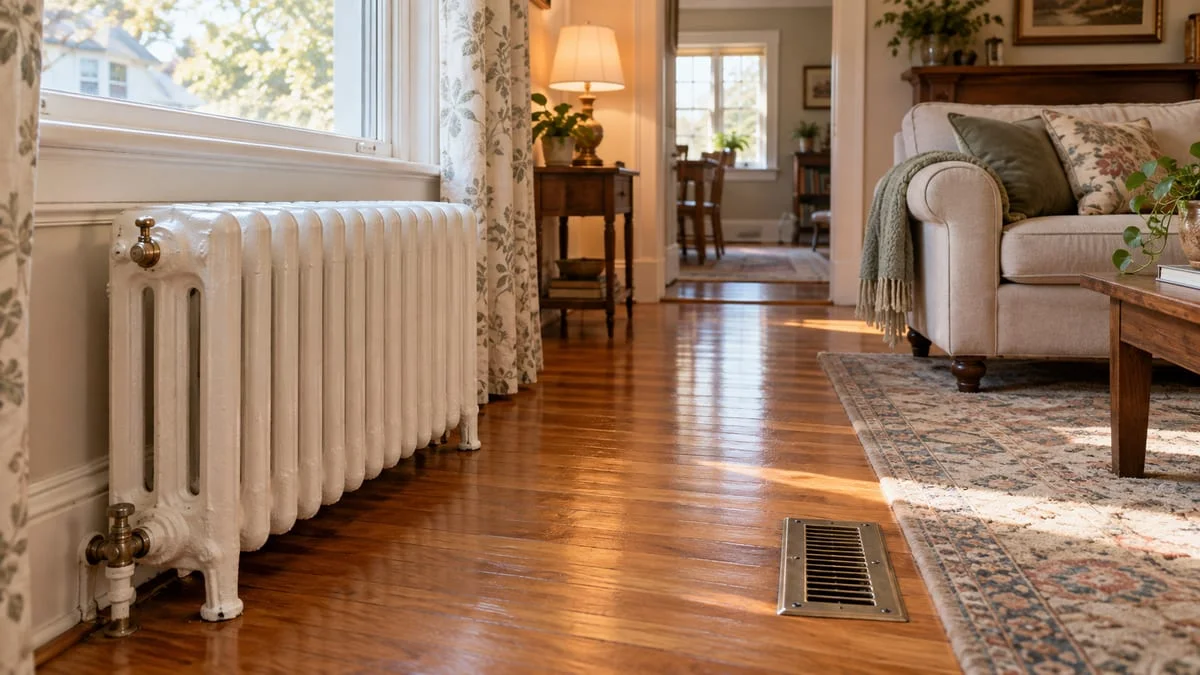
- Radiators or baseboard = boiler. Cast-iron radiators or metal baseboard covers along exterior walls mean hot water or steam. Warm floors with no visible heaters usually mean radiant tubing.
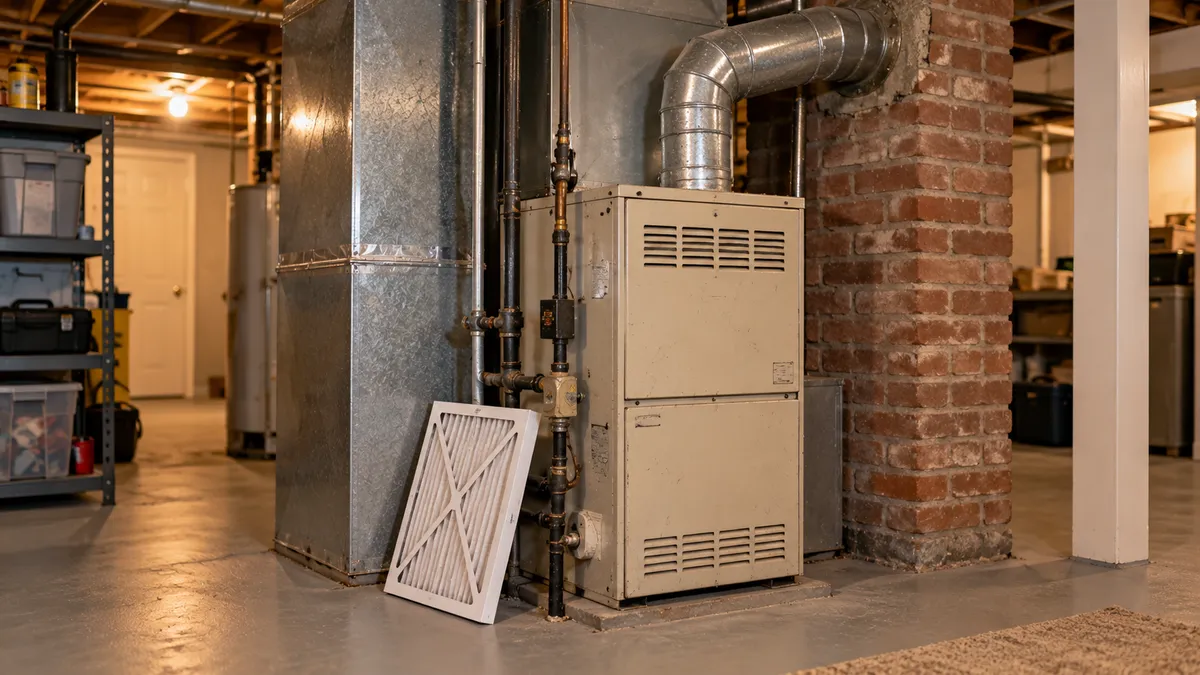
- Floor, wall or ceiling registers = furnace. Grilles that blow warm air, plus larger return grilles, mean ducts and a furnace or heat pump air handler.
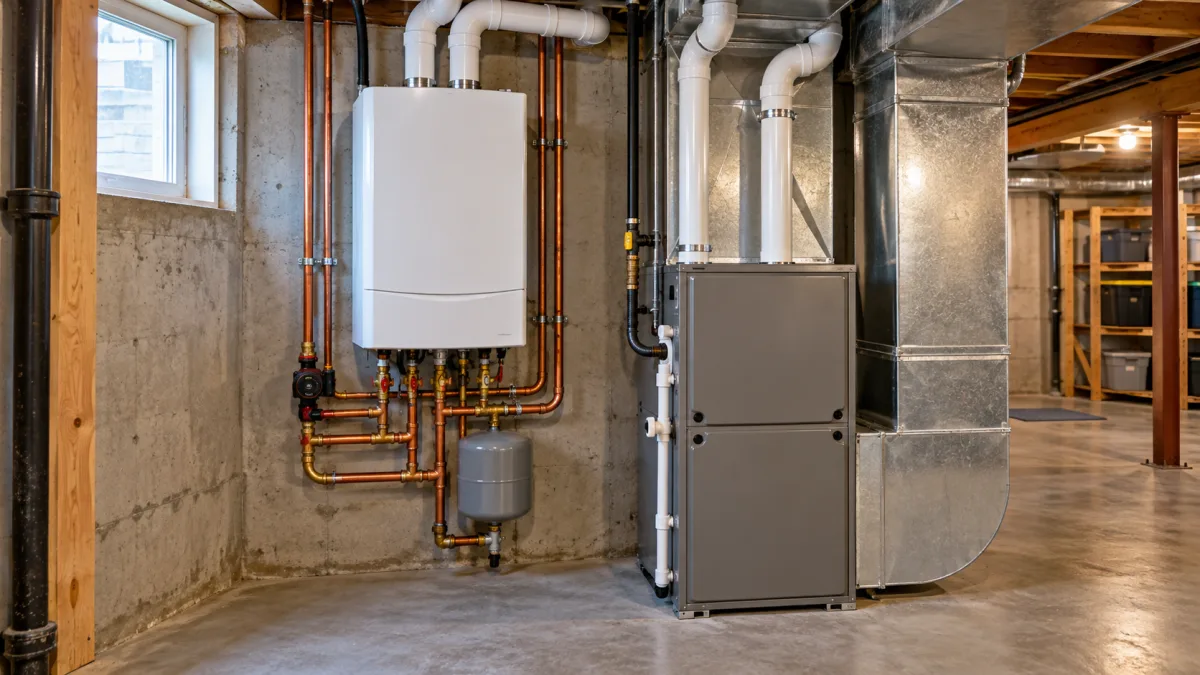
- Pipes vs sheet metal. A boiler has copper or black iron pipes coming off it. A furnace has large rectangular sheet-metal ducts.
- A pressure/temperature gauge. Hot-water boilers have a combination gauge, usually around 12 to 15 psi cold. Steam boilers have a glass sight tube and a gauge reading only a few psi.
- An expansion tank. A small tank hanging off the piping, or an older steel tank strapped to the joists, is a hydronic giveaway.
- A filter slot. Furnaces have a filter in a slot or cabinet where the return duct meets the unit. Boilers have none.
The flue won't settle it: standard-efficiency models of both vent into a chimney, and condensing models of both vent through PVC out a side wall. If you have ducts but also see a boiler, you may have hydro-air, where a boiler feeds a hot-water coil inside an air handler.
Boiler vs Furnace Cost: Installed Prices in Central NJ
Our furnace replacement cost guide puts a gas furnace at about $3,800 to $10,000 installed in 2026, with 80% units at the low end and condensing or modulating furnaces in the upper half. Boilers cost more, mainly for labor and near-boiler piping. Our typical 2026 central NJ estimates:
- Gas hot-water boiler replacement, standard efficiency (cast iron): about $7,000 to $10,000.
- Condensing (modulating-condensing) gas boiler: about $9,000 to $14,000.
- Combi boiler (heat plus on-demand domestic hot water): about $8,500 to $14,000, often replacing both a boiler and a water heater.
- Steam boiler replacement: commonly $9,000 to $16,000 or more, because of weight and exacting near-boiler piping.
- Oil-to-gas boiler conversion: gas service, venting or a liner, and oil tank removal can add several thousand dollars.
These are estimates, not quotes. What moves a boiler price most is the chimney's condition, whether existing zone valves and circulators are worth keeping, whether piping must be reworked so a condensing boiler sees cool enough return water, and whether an indirect water heater is part of the job. Our quotes itemize those lines, and our boiler replacement cost guide breaks each one down in detail.
Boiler vs Furnace Monthly Cost: Which Is Cheaper to Run?
On fuel, a gas boiler vs gas furnace of similar efficiency costs about the same to run; a therm makes the same heat either way. Here is an illustrative 60 MMBtu season (the example load from our heat pump vs furnace guide), priced at about $1.55 per therm based on EIA's New Jersey residential gas prices from July 2025 to June 2026:
| System | AFUE used | Gas per season | Approx. gas cost per season | Avg. per heating month (Nov–Mar) |
|---|---|---|---|---|
| Gas furnace, standard | 80% | ~750 therms | ~$1,163 | ~$233 |
| Gas boiler, standard cast iron | 84% | ~714 therms | ~$1,107 | ~$221 |
| Gas boiler, condensing (as installed) | 92% | ~652 therms | ~$1,011 | ~$202 |
| Gas furnace, condensing | 96% | ~625 therms | ~$969 | ~$194 |
The table leaves out two things. First, electricity: a furnace blower uses several times the power of a boiler's circulator, very roughly $50 to $100 more a season at New Jersey's 2026 price of about 23.98¢ per kWh (EIA Electric Power Monthly), which offsets the furnace's slight fuel edge. Second, a condensing boiler only condenses, and only reaches its rating, when water returns below roughly 130°F. Generously sized cast-iron radiators with an outdoor reset control allow that much of the season; small baseboard loops often don't. We use 92% for that reason.
What We See in Central New Jersey Homes
In homes we service in Monmouth County, especially older parts of Red Bank, Long Branch and Freehold, hot-water boilers with cast-iron radiators are common, some houses still run on steam, and many were converted from oil to gas. Middlesex County's postwar ranches and capes often have baseboard hot water. Newer subdivisions in all three counties are almost all forced-air gas furnaces with central air.
What we check before recommending a boiler
We do a room-by-room heat loss calculation instead of copying the old boiler's input rating; old cast-iron boilers are very often oversized. We measure the radiation in each room to see what water temperature the house really needs, check whether the chimney needs a liner, and decide whether the piping suits a condensing boiler. On steam, we check the near-boiler piping and main vents, because a new steam boiler on bad piping bangs just like the old one.
What we check before recommending a furnace
With a furnace, the ductwork decides more than the furnace does. We check static pressure, return size and duct leakage, whether a condensing unit can vent and drain where it sits, and whether the water heater will be orphaned in the chimney. Our signs you need a new furnace guide covers when replacement makes sense at all.
Comfort: Radiant Heat vs Forced Air
Boiler heat warms surfaces and objects, so rooms often feel comfortable at a lower setting, with no blowing air, no duct noise and no dust moved around. It doesn't dry the air the way forced air can. The downside is slow response: a cast-iron system can take an hour or more to recover from a deep setback, and radiators take wall space.
Forced air reacts fast, filters the air, can run a whole-house humidifier and shares its ducts with central air. The downsides are temperature swings, drafts, blower noise and dry winter air without humidification.
Lifespan, Maintenance and Safety
Cast-iron boilers commonly last 25 to 30 years or more. Condensing boilers, with lighter heat exchangers and more electronics, typically last 15 to 20 years, like a furnace; our guide to how long furnaces last explains what shortens or stretches that range.
Boiler maintenance: an annual service to clean the burner and heat exchanger, test combustion, check system pressure, the expansion tank's air charge and the relief valve, and clean a condensing boiler's condensate trap. Bleed radiators when they gurgle or heat only at the bottom. Steam boilers need the low-water cutoff flushed and tested on the manufacturer's schedule; a dry-fired steam boiler can be ruined.
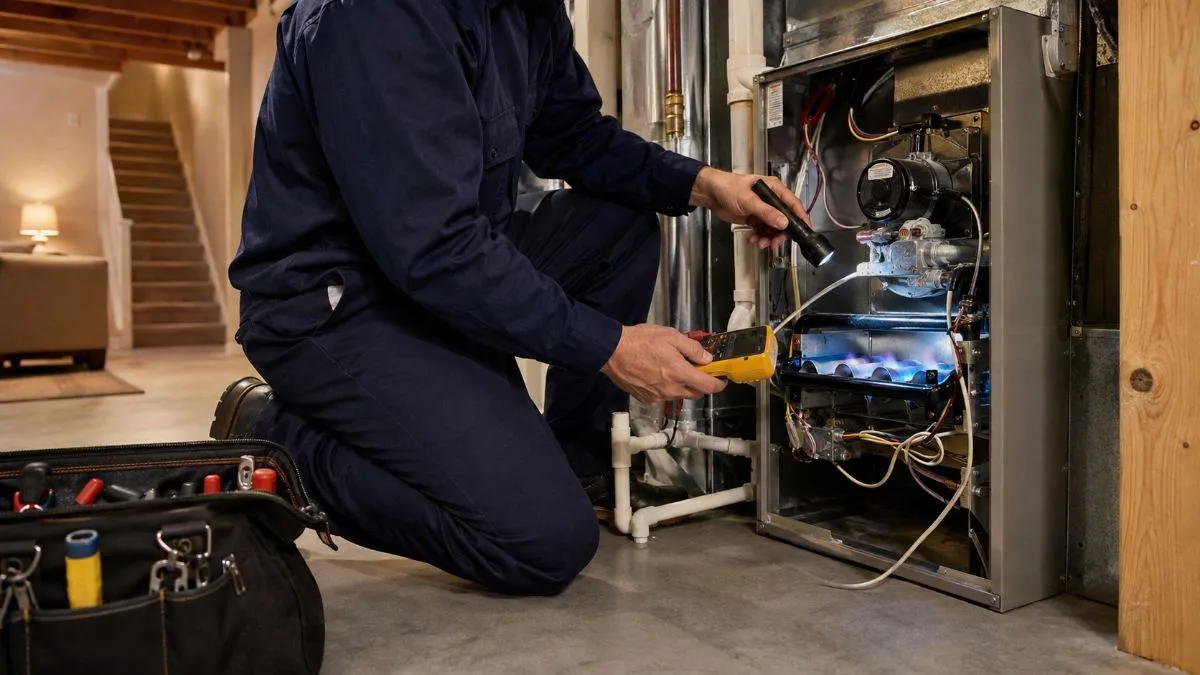
Furnace maintenance: check the filter every one to three months and have an annual tune-up covering the flame sensor, ignitor, heat exchanger, blower and condensate drain. Our furnace maintenance checklist for NJ walks through it.
Safety: both burn fuel and both can produce carbon monoxide if venting or combustion goes wrong. A cracked furnace heat exchanger, one of the signs your furnace needs repair, can put combustion gases into the airstream; a boiler's usually fails by leaking water, but a blocked chimney is just as dangerous with either. Have combustion tested every year, and remember that under N.J.A.C. 5:70-4.19 New Jersey homes with a fuel-burning appliance need a CO alarm near the sleeping areas.
Boiler vs Water Heater: What Is the Difference?
Both heat water, which is the confusion. A water heater heats potable water to about 120°F for your taps. A heating boiler heats water in a closed loop through your radiators that never comes out of a faucet. The two can be connected: an indirect water heater is a storage tank heated by a coil fed from the boiler, and a combi boiler heats both the space-heating loop and your domestic hot water on demand in one wall-hung unit. Combi boilers suit homes with one or two bathrooms; larger households usually do better with an indirect tank. For standalone water heaters, see our tankless vs tank guide.
Converting a Boiler to a Furnace (or the Reverse)
The furnace is the cheap part of converting from a boiler. The expensive part is ductwork: supplies to every room, returns, and routes through finished walls and ceilings never framed for it. In an existing two-story home that commonly adds many thousands of dollars plus drywall repair, and some layouts have nowhere for a proper return. It makes sense mainly during a gut renovation or when ducts are already going into an attic for central air. Going from furnace to boiler is rarer and also expensive; a radiant floor in one bathroom or basement is the practical version.
Cooling in a boiler home. Central air needs ducts, so most boiler homes get cooling from ductless mini splits instead. Our ductless mini split installation cost guide puts a single zone at about $3,500 to $7,500 and multi-zone systems at $9,000 to $22,000 in central NJ. Mini splits are heat pumps, so they can also carry shoulder-season heating.
Heat Pumps: The Third Option
If you are replacing either system, consider an air-source heat pump: ducted to replace or pair with a furnace, or ductless alongside a boiler. Our heat pump vs furnace comparison runs the operating-cost numbers at New Jersey prices, and our heat pump cost guide covers installed prices. NJNG's SAVEGREEN hybrid heat program specifically pays for pairing a heat pump with a gas furnace or boiler.
Limitations of This Comparison
Prices are typical 2026 ranges from our central New Jersey work, not quotes; boiler prices vary more because piping and venting vary. The running-cost table uses one illustrative load, a statewide average gas price and rated efficiencies, and ignores fixed delivery charges. Lifespans are typical, not guaranteed. Rebates change: SAVEGREEN equipment rebates require qualifying equipment replacing a non-condensing furnace or boiler, installation by June 30, 2027, and proof of permit, when we checked in October 2026. The federal 25C tax credit does not apply to 2026 installations; the IRS confirms it ended for property placed in service after December 31, 2025. Our NJ HVAC rebates guide has the current programs.
Boiler vs Furnace Decision Checklist
- What does the house have now? Like for like is almost always cheapest.
- Do you want central air? With ducts, a furnace pairs naturally; without, price ductless before new ductwork.
- Comfort or speed? Even, quiet heat favors a boiler; fast recovery and filtration favor forced air.
- Is your water heater also due? A combi boiler or indirect tank may solve both at once.
- Can the system vent and drain a condensing unit? That decides whether the efficiency upgrade is practical.
About Guardian Air
Guardian Air is a licensed New Jersey HVAC and plumbing contractor serving Monmouth, Middlesex and Ocean counties. We repair and replace hot-water and steam boilers, gas furnaces and heat pumps in homes from Freehold and Red Bank to Old Bridge and Toms River. Every estimate is written and itemized. See our boiler repair and service and furnace replacement pages, learn more about our team, or call (848) 276-6300 (Mon–Fri 8–6, Sat 8–4) and request your free estimate.
Sources
- U.S. Department of Energy, Energy Saver: Furnaces and Boilers
- Federal energy conservation standards, 10 CFR 430.32: minimum AFUE for residential furnaces and boilers
- ENERGY STAR: Boilers and Furnace Key Product Criteria
- AHRI: Directory of Certified Product Performance
- U.S. Energy Information Administration: New Jersey Residential Natural Gas Price and Average Price of Electricity by State
- NJNG SAVEGREEN: HVAC and Water Heating Rebates and Hybrid Heat
- N.J.A.C. 5:70-4.19: Carbon monoxide alarm requirements; CPSC: Carbon Monoxide Fact Sheet
- IRS: FAQs on the modification of Section 25C