October 23, 2026
Whole House Humidifier: Types, Settings & Cost in NJ (2026)
How a whole house humidifier works, which type fits your furnace or heat pump, what humidity to set in a New Jersey winter, what installation involves, and 2026 central NJ costs, plus when not to install one.
By Noor Kamal, Technology Manager · Published · Updated
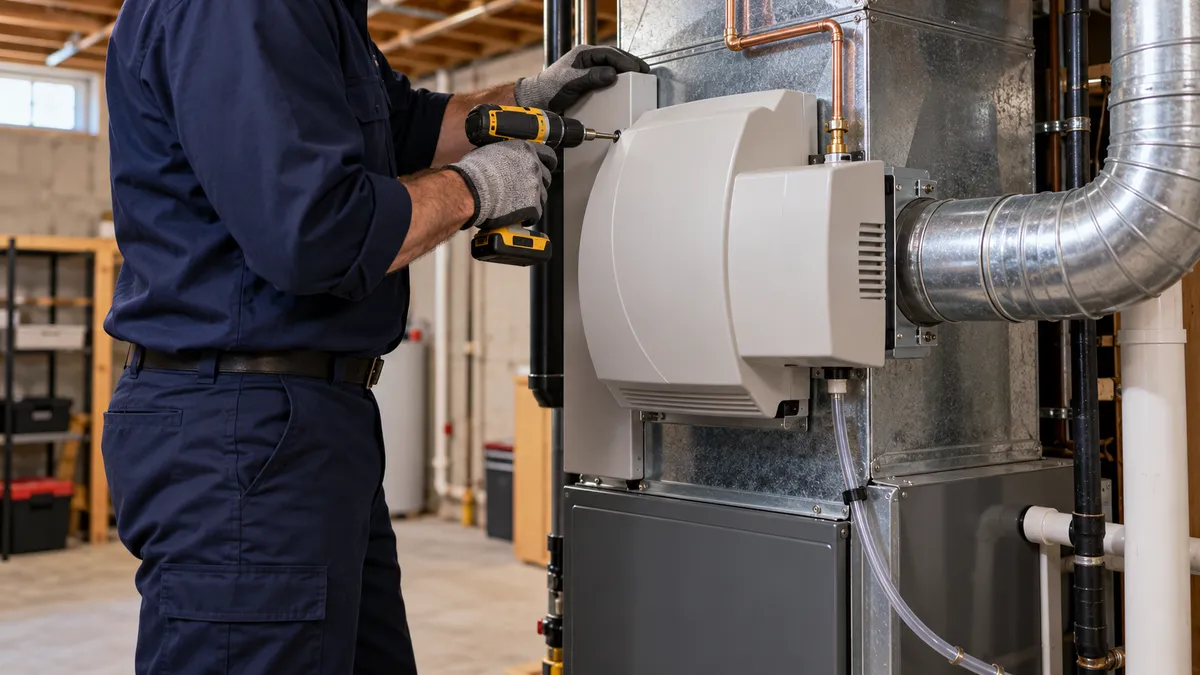
A whole house humidifier mounts on your furnace ductwork and adds moisture to the heated air, so every room stays around 30 to 45 percent relative humidity in winter instead of dropping into the teens or 20s. Bypass models cost about $500–$900 installed in central New Jersey, fan-powered $700–$1,200 and steam $1,500–$3,000. Set it by outdoor temperature, not by feel, and skip it if your house already has a moisture problem.
Written by the Guardian Air HVAC team · Reviewed for accuracy October 2026
Every January we hear the same complaints from homes across Monmouth, Middlesex and Ocean counties: static shocks, cracked hands, nosebleeds and gaps opening between hardwood boards. Usually the heating system is fine. The problem is the air it is heating. This guide explains how a whole house humidifier works, the three main types and which one suits which home, what humidity you should actually aim for on a cold night, what installation involves, what it costs in 2026, and when we tell homeowners not to install one at all.
If you are still deciding whether dry air is your biggest indoor air issue, start with our broader guide on how to improve indoor air quality at home, which covers filtration, ventilation and humidity together.
Why New Jersey Homes Get So Dry in Winter
Relative humidity is the amount of water vapor in the air compared with the most it could hold at that temperature. Warm air can hold far more moisture than cold air. So when cold outdoor air leaks into your house and the furnace heats it to 70°F, the moisture it carried in stays the same, but its capacity to hold moisture jumps. The relative humidity collapses.
Aprilaire's humidifier reference guide gives a worked example: outdoor air at 70% relative humidity and +10°F, heated to 70°F indoors, drops to about 6% relative humidity. That is drier than most deserts. Real homes rarely sit that low, because people, cooking, showers and plants add moisture back (Aprilaire estimates a family of four adds about two gallons a day through everyday activity), but in a drafty house on a windy January night, indoor readings in the teens and low 20s are common.
Central Jersey winters aren't Minnesota winters, but January and February bring runs of nights in the teens and 20s, and wind drives more cold, dry air through every gap. The same house can feel fine in December and parched in late January.
Signs your NJ home is too dry
- Static shocks from doorknobs, light switches, the car door and each other, especially on carpet.
- Dry, itchy skin, chapped lips and cracked knuckles that improve when you travel somewhere humid.
- Dry or bloody noses, scratchy throats and irritated eyes first thing in the morning, when the bedroom has been heated all night.
- Gaps between hardwood floorboards that open in winter and close in summer, and cabinet doors or trim joints that shift.
- Musical instruments going out of tune, especially pianos and acoustic guitars, which are sensitive to drying.
- The house feels cold at 70°F. Dry air pulls moisture off your skin faster, which cools you by evaporation, so people turn the thermostat up.
- A cheap hygrometer reads below 30%. This is the only sign that actually measures the problem. A $15 digital hygrometer in a living room and a bedroom tells you more than any symptom.
Dry noses and itchy skin have other causes too, so measure for a week or two before buying any humidifier.
How a Whole House Humidifier Works
A whole house humidifier, also called a whole home humidifier or furnace humidifier, is a small cabinet attached to the supply or return ductwork of a forced-air furnace or air handler. It is connected to three things:
- A water line, usually a small copper or approved plastic tube from a nearby cold or hot water pipe, controlled by a solenoid valve that opens only when the humidifier runs.
- A drain (on most models) that carries away the water that doesn't evaporate, along with the minerals it has collected.
- A control: a humidistat on the wall or duct, a digital control with an outdoor temperature sensor, or a smart thermostat that manages humidity.
When the control calls for humidity and the blower runs, water flows in and the ducts carry moisture to every room the furnace heats: one plumbed-in appliance, no tanks to fill. Rooms the ducts don't reach, such as an attic on a separate mini-split, won't benefit much.
Whole House Humidifier Types: Bypass, Fan-Powered and Steam
There are two ways to put water into air: evaporate it, or boil it. Evaporative humidifiers come in two styles, bypass and fan-powered. Steam humidifiers are their own category.
Bypass humidifiers
A bypass humidifier is the most common evaporative whole house humidifier in New Jersey homes. It mounts on one plenum and connects to the other with a round "bypass" duct, typically 6 inches, with a damper. Because the supply side of the duct system is at higher pressure than the return, some heated air is pushed through the humidifier's water panel (a pad of expanded aluminum or similar media with water trickling down it) and back into the return. The air picks up moisture and the furnace blower spreads it around the house. There is no motor in the humidifier itself.
Aprilaire's popular large bypass model is rated at 17 gallons per day at a 120°F plenum temperature, with a water feed of 3 gallons per hour while it runs. Most of that feed rinses down the drain, which is how the panel stays clean of mineral buildup. Newer models reduce that waste: the AprilAire 620 uses a recirculation valve that the manufacturer says cuts wastewater by 55%. Drainless bypass models also exist; they use far less water but are more sensitive to mineral content.
Older drum-style humidifiers, a foam drum turning through a standing pan of water, still turn up in our area. We don't install them; standing water in a warm duct is what you don't want.
Fan-powered humidifiers
A fan-powered humidifier works the same way but has its own fan, so it mounts on the supply plenum with no bypass duct. It is the answer when a bypass duct won't fit, and it delivers somewhat more output. Aprilaire rates its fan-powered model at 18 gallons per day, with a higher water feed of 6 gallons per hour, and it needs a 120-volt outlet for the fan.
Steam humidifiers
A steam humidifier boils water in a canister or tank with electric heating elements and injects the steam into the ductwork through a dispersion tube. It doesn't depend on warm air to evaporate water, so it works the same whether the furnace burner is on or not. That makes steam the better choice for heat pumps, homes that need a lot of moisture, and homes where humidity is critical, such as a room full of instruments or antique furniture. Aprilaire's steam model ranges from 11.5 gallons per day at 120 volts up to 34.6 gallons per day at 240 volts, drawing 11.5 to 16 amps. That electrical draw is the catch: most installs need a dedicated circuit, and the electricity to boil water is a real running cost.
Whole house humidifier types compared
| Bypass (evaporative) | Fan-powered (evaporative) | Steam | |
|---|---|---|---|
| How it adds moisture | Furnace air pushed through a wet panel via bypass duct | Built-in fan pulls furnace air through a wet panel | Electric elements boil water; steam injected into duct |
| Typical output | About 12–18 gallons/day at rated conditions | About 18 gallons/day | About 11–35 gallons/day depending on voltage and model |
| Power | 24-volt solenoid only | 120-volt outlet for the fan | Often a dedicated 120- or 240-volt circuit |
| Water to drain | Moderate to high; lower on recirculating and drainless models | Higher | Low; periodic flushes to clear minerals |
| Works with a heat pump | Reduced output; hot water feed helps | Reduced output; hot water feed helps | Yes, full output |
| Yearly upkeep | New water panel each season, clean scale | New water panel each season, clean scale | Canister or element cleaning/replacement, more with hard water |
| Best fit | Most gas furnace homes up to about 3,000–4,000 sq ft | Gas furnace homes without room for a bypass duct | Heat pumps, large or leaky homes, precise control |
So what is the best humidifier for a whole house? For a typical central Jersey colonial or split-level with a gas furnace, a good bypass unit with automatic outdoor-temperature control is the best value. Choose fan-powered if a bypass duct won't fit. Choose steam if you heat with a heat pump, need a lot of moisture, or want tight control. Brand matters less than correct sizing, a proper control and good installation.
What Humidity Should Your Whole House Humidifier Be Set To in Winter?
This is the single most important part of owning a whole house humidifier, and the part most often gotten wrong.
The general target
The EPA advises keeping indoor humidity below 60 percent, ideally between 30 and 50 percent, and its humidifier guidance says not to humidify above 50 percent, because excess moisture encourages biological growth. Some manufacturer marketing quotes a higher band; Aprilaire's site, for example, cites ASHRAE for 40–60%, while adding that outdoor temperature and the house itself limit what is attainable. In a New Jersey winter, the house sets the ceiling, not the brochure.
Why the setting has to drop as it gets colder: window condensation
Your windows are the coldest surfaces in the house. When indoor air touches glass colder than its dew point, water condenses. At 70°F, the dew point is about 50°F at 50% relative humidity, 45°F at 40%, 41°F at 35%, 37°F at 30% and 32°F at 25%, where condensation turns to frost.
On a 10°F night, the inside face of an older double-pane window, especially along the bottom edge and at the frame, can easily fall into the 30s or low 40s. Hold 45% indoors and that glass will run with water. Hold 30% and it usually stays dry. The same physics applies inside exterior walls and attics, where you can't see the condensation, which is why condensation on windows is a warning, not just a nuisance. Aprilaire's guide makes that point directly: window fogging usually means humidity is too high, and the same condensation could be taking place inside walls.
Outdoor temperature vs. indoor humidity setting
Manufacturers publish sliding scales for exactly this reason. Aprilaire's reference table:
| Outdoor temperature | Recommended indoor relative humidity |
|---|---|
| +40°F | 45% |
| +30°F | 40% |
| +20°F | 35% |
| +10°F | 30% |
| 0°F | 25% |
| −10°F | 20% |
| −20°F | 15% |
Honeywell's humidifier instructions follow the same logic: as the outside temperature drops, the recommended setting is lowered to account for dew point, and if condensation persists for more than a few hours, turn the humidifier down to its lowest setting and ventilate.
For most central Jersey homes, that works out to roughly 35–40% on a typical winter day in the 20s and 30s, and around 30% during a cold snap. Treat the table as a starting point: new, well-insulated windows can often hold a few points more, older single-pane or aluminum windows a few less.
Let the control do it
Nobody re-sets a dial every time the forecast changes, so we recommend an automatic control with an outdoor sensor, or a thermostat with a window-protection feature. Honeywell's T10 Pro, for example, lets the installer set Window Protection on a 1–10 scale, and requires an outdoor sensor or internet weather data to do it. Many current humidifiers, including the AprilAire 620A, ship with a digital control that adjusts by outdoor temperature in automatic mode.
Whole House vs. Portable Humidifier
Portables suit a single bedroom, a renter or a house with baseboard or radiator heat and no ducts. For a forced-air home that is dry throughout, whole house usually wins.
| Whole house humidifier | Portable humidifier | |
|---|---|---|
| Coverage | Every room the ducts serve | One room, sometimes two |
| Water supply | Plumbed in; no refilling | Tank refilled daily |
| Cleaning | Once or twice a season | EPA advises cleaning every third day and refilling daily |
| Mineral "white dust" | Not an issue with evaporative units; minerals stay in the panel or go down the drain | Ultrasonic and mist units can release minerals as white dust unless you use low-mineral water |
| Up-front cost | About $500–$3,000 installed | About $40–$300 each |
If you are hauling distilled water jugs for three portables every week of winter, as the EPA's low-mineral advice implies, a whole house humidifier pays for itself in convenience quickly.
Whole House Humidifiers With Heat Pumps and Dual-Fuel Systems
More of our customers are heating with air-source heat pumps, often with a gas furnace as backup in a dual-fuel setup. That changes the humidifier decision.
An evaporative humidifier relies on warm air to evaporate water. A gas furnace delivers supply air around 120°F; a heat pump runs much cooler, which Aprilaire's guide puts around 90 degrees. Cooler air evaporates less water. Aprilaire states that its drainless bypass model delivers roughly 60% of its rated capacity on a heat pump, and recommends piping evaporative humidifiers to hot water on all heat pump installations to make up some of the difference.
Our rule of thumb:
- Gas furnace only: bypass or fan-powered is fine for most homes.
- Dual-fuel (heat pump plus furnace): evaporative can work, but output drops on the mild days when the heat pump carries the load. Hot water supply helps. In a larger or leakier house, steam is worth pricing.
- All-electric heat pump: steam is usually the right answer if you want real moisture. Factor its electricity use into the running costs we cover in our heat pump vs. furnace cost to run in NJ comparison.
If the humidifier is set to run independently of a heat call, it has to bring the blower on, which adds fan run time; that should be a deliberate setup choice, not a default.
Whole House Humidifier Installation: What a Proper Job Includes
Installing a furnace humidifier takes a few hours, but a rushed job leaves you with a leak, a clogged drain or a humidifier that never turns on.
Location on the ductwork
The manufacturer's instructions specify where the unit can go. Aprilaire's installation instructions say not to mount it on the furnace cabinet itself, not on a plenum face where the blanked-off ends of the AC coil block airflow, and not on a supply plenum where static pressure exceeds 0.4 inches of water column, a limit that zoned systems can exceed. We check static pressure on systems where we suspect the ducts are tight. In attic and crawlspace installations, freezing is a concern, and a steam unit installed in conditioned space is often the safer choice.
The water line: saddle valve vs. a proper valve
Many humidifiers still come with a self-piercing saddle valve, which clamps onto a copper pipe and punches a small hole in it. Aprilaire's own instructions allow it and note that it is meant to be fully open or fully closed, not used to regulate flow. They are quick, but in our experience they are also the most common source of slow leaks we find on older humidifier installs, and they don't belong on plastic pipe. We tie in with a proper tee fitting and a quarter-turn shutoff valve, then run the supply line to the humidifier's solenoid. Hot water (Aprilaire specifies 140°F maximum) increases evaporative output and is the better choice on heat pumps; cold water is fine on most gas furnaces. Water pressure above 125 psi needs a pressure-reducing valve.
New Jersey's plumbing subcode is the National Standard Plumbing Code, 2021 edition, adopted under N.J.A.C. 5:23-3.15, and like any connection to the potable water system, a humidifier feed has to be protected against backflow. Depending on the town and the scope of work, a permit may also be required; check with your local construction office or ask your contractor how they handle it.
The drain
Evaporative humidifiers with drains need a 1/2-inch drain hose with a constant downward slope to a floor drain, laundry tub or condensate pump. No sags, no kinks, and no running it uphill. Where there's no drain nearby, we often share the furnace's condensate pump if it has capacity, or add one. A humidifier drain backing up is one of the causes we cover in our furnace leaking water guide.
Wiring and controls
Bypass units run on 24 volts from the furnace or a separate transformer, fan-powered units need a 120-volt outlet, and steam units usually need a dedicated circuit. The control has to know when the blower is running, and an outdoor sensor belongs on a shaded wall away from dryer vents and sun.
Whole House Humidifier Maintenance
A neglected humidifier does nothing at best and grows slime at worst. The EPA says to follow the manufacturer's directions for central, furnace-mounted humidifiers. In practice that means:
- Replace the water panel every heating season. Aprilaire calls for most of its water panels to be changed once per heating season, and some higher-use panels twice. Honeywell says yearly, adding that the actual frequency depends on water quality. A panel caked hard with white scale no longer absorbs water.
- Clean the scale from the distribution tray, the tiny feed orifice and the drain spout, and confirm the drain runs freely. A vinegar soak loosens most deposits.
- Steam units: clean or replace the canister or elements on the manufacturer's schedule. Many models track run time and flush automatically, but harder water means more frequent service. If you have a water softener, tell your installer; some steam canisters are designed for specific water conductivity.
- Close the bypass damper in summer. On a bypass unit, the damper should be open in winter and closed in summer, so cooled air doesn't flow through the humidifier and back to the return. Shut the water off for the season too, or turn the control off.
Water quality varies a lot across our service area, by water utility, by source (surface water or wells) and by whether the house is on a private well. Your utility's annual water quality report lists hardness. Harder water means more scale on panels and more frequent steam canister service. We fold humidifier service into fall heating maintenance; our guide to HVAC maintenance cost and what it includes explains how that visit is priced.
What Our Technicians Find on Humidifier Calls
We service a lot of whole house humidifiers that other people installed, and the same few problems come up every winter.
Humidifiers that haven't run in years
This is the most common thing we see. The water panel is a solid block of scale, the feed orifice is plugged, or the valve was shut years ago and never reopened. The house is at 22% and the humidifier hasn't put out a drop in seasons.
Bypass dampers left in the wrong position
Closed all winter, the humidifier barely works. Open all summer, cooled air short-circuits back to the return. We check the damper at every seasonal visit.
Dials set to "high" and left there
A humidistat turned all the way up in November is still all the way up in a January cold snap. We've seen sweating windows, peeling paint on window sills, and dark spots in closet corners on outside walls, all in homes where the fix was simply a lower setting or an automatic outdoor-reset control. That is why we recommend the automatic control on almost every installation.
Saddle valves dripping onto the furnace
An old saddle valve weeping onto ductwork or a furnace cabinet can go unnoticed for years. We find rust streaks and corroded parts below it. Replacing it with a tee and a real valve is a small job.
Humidifiers on the wrong system
An evaporative unit on cold water, on an all-electric heat pump, in a large house, can't keep up. The equipment is fine; it just doesn't suit the heat source.
Dirty, slimy units
Occasionally we open a cabinet that has sat wet behind a clogged drain, coated in slime. That is when a humidifier genuinely becomes an air quality problem; cleaning, a new panel and a clear drain resolve it. If a musty smell has spread to the ducts, it's worth reading our honest take on whether air duct cleaning is worth it before paying for one.
Short cycling and blower settings that undercut the humidifier
An evaporative humidifier only works while air moves across it, so a furnace running two-minute cycles gives it little time. Fix that first; our guide to furnace short cycling covers the causes.
Risks, Limitations and When Not to Install a Whole House Humidifier
A whole house humidifier is a good tool for a dry house. It is the wrong tool for several others. We regularly talk homeowners out of one.
Over-humidification and hidden condensation
The main risk isn't the humidifier itself; it's too much moisture. Running a whole house humidifier at 45–50% through a New Jersey cold snap pushes moisture into exterior walls and attics, where it can condense on the cold sheathing out of sight. The visible signs, when they appear, are sweating windows, mold on window sills and in closets on outside walls, frost on the underside of the roof deck, and peeling paint. The EPA warns that excess moisture encourages biological growth in the home. Lennox makes a related point: humidifiers don't create mold spores, which are already in household air, but above roughly 60 percent humidity, conditions favor mold.
Don't install one if:
- Your windows already sweat in winter without one. You need ventilation or air sealing, not more water.
- You have a tight, newer home. Tight houses keep the moisture people produce, and many sit at 30–40% all winter on their own. Measure first.
- There is an existing mold or moisture problem: a damp basement, a musty crawlspace, past roof leaks, visible growth. Fix the moisture source first; our mold testing page explains how we approach that.
- Your attic has frost or stained sheathing in winter. That points to warm, moist air leaking into the attic; adding humidity makes it worse.
- You don't have forced-air heat. With a boiler, the options are a ductless steam system or good portables.
- Nobody will maintain it. A humidifier that never gets a new panel and never has its drain checked is worse than none.
Running costs that aren't obvious
- Evaporative units use furnace heat. Evaporating water takes energy, roughly 8,700 BTU per gallon, and that comes from the heat your furnace produces. A humidifier evaporating several gallons a day adds a modest amount to your gas use. The flip side is that properly humidified air feels warmer, which some people find lets them keep the thermostat a degree lower.
- Steam units use electricity. Working from Aprilaire's published amperage and output, a steam humidifier uses roughly 2.7 to 2.9 kWh for each gallon it boils. A house averaging 5 gallons a day uses roughly 14 kWh a day, on the order of 2,000 kWh over a five-month season. Check your electric rate to put a dollar figure on it.
- Evaporative units with drains use water. A standard bypass unit feeds about 3 gallons per hour while running, most of it to the drain. Recirculating and drainless models reduce this considerably.
How Much Is a Whole House Humidifier? 2026 Central NJ Costs
These are Guardian Air estimates for Monmouth, Middlesex and Ocean counties in 2026. They're in line with Carrier's national 2026 whole house humidifier cost guide, which puts bypass units at $400–$800 installed and steam at $1,200–$2,500, with central Jersey labor and permitting nudging the top of each range up.
| Item | Equipment only | Installed | Notes |
|---|---|---|---|
| Bypass humidifier | $150–$400 | $500–$900 | Most gas furnace homes; automatic outdoor control at the upper end |
| Fan-powered humidifier | $250–$500 | $700–$1,200 | When there's no room for a bypass duct; needs a 120V outlet |
| Steam humidifier | $600–$1,400 | $1,500–$3,000 | Heat pumps, large homes; dedicated circuit often extra |
| Dedicated electrical circuit (steam) | — | $250–$700 | Depends on panel space and distance |
| Condensate pump for the drain | — | $150–$450 | Only when no floor drain or existing pump is usable |
| Replacing a saddle valve with a tee and shutoff | — | $100–$250 | Often done during a service visit |
| Diagnostic / service call | — | $89–$150 | For a humidifier that isn't working |
| Annual maintenance: evaporative | $20–$45 panel | $60–$150 as part of a heating tune-up | New panel, clean tray and orifice, check drain |
| Annual maintenance: steam | $80–$200 canister | $150–$350 | More often with hard water |
What drives the price
The biggest factors are the type (steam costs the most to buy, wire and run), the control (an automatic outdoor-sensing control costs more than a manual dial, but it is what keeps your windows dry), how far the unit is from a water line, a drain and electrical panel space, and the duct layout: tight closets and attic or crawlspace furnaces take longer. Adding a humidifier at the same time as a new furnace saves a separate visit.
About Guardian Air
Guardian Air is a licensed New Jersey HVAC and plumbing contractor serving Monmouth, Middlesex and Ocean counties. Our technicians install and service bypass, fan-powered and steam whole house humidifiers from every major brand, plumb them to a proper shutoff rather than a saddle valve, and set them up with controls that follow the weather, in homes from Freehold and Edison to Toms River. If a humidifier isn't the right fix for your house, we'll tell you. See our indoor air quality services, whole-home humidifiers and dehumidifiers and heating services, or call (848) 276-6300 (Mon–Fri 8–6, Sat 8–4) and book a visit.
Sources
- U.S. EPA: A Brief Guide to Mold, Moisture and Your Home and Use and Care of Home Humidifiers
- Aprilaire (Research Products Corporation): Humidifier Reference Guide; Humidifier Capacities and Specifications; Model 700 Installation Instructions
- AprilAire: 620A Whole-House Large Bypass Humidifier, Water Panel 10 and Ideal Humidity Levels
- Honeywell: HE120 Bypass Drum Humidifier Owner's Guide; Honeywell Home / Resideo: T10 Pro Indoor Air Quality Control
- Lennox: Humidifiers and Mold
- Carrier: Whole House Humidifier Costs in 2026
- N.J.A.C. 5:23-3.15: Plumbing subcode (National Standard Plumbing Code 2021)