October 18, 2026
Furnace Leaking Water? Causes, Fixes & Repair Costs
Furnace leaking water or dripping onto the basement floor? Learn why high-efficiency furnaces and AC coils make water, the safe checks you can do yourself, when to shut the furnace off, what our NJ technicians find, and 2026 central NJ repair costs.
By Guardian Air · Published
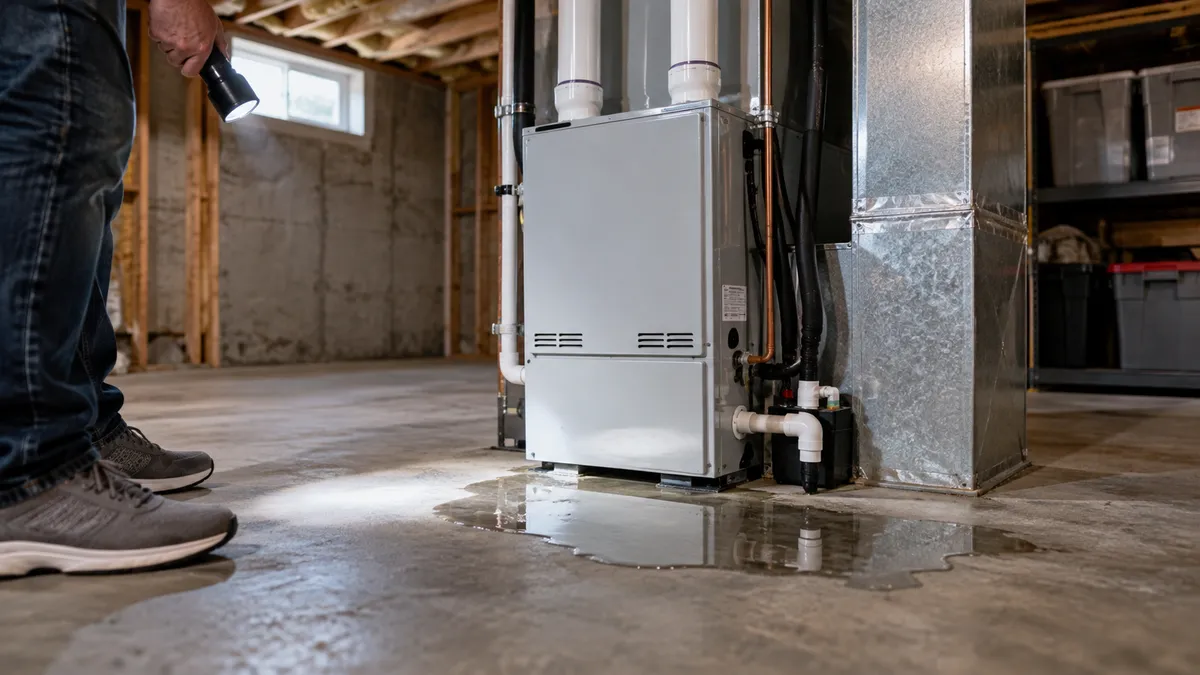
A furnace leaking water is almost always a drainage problem. High-efficiency gas furnaces make water whenever they heat, and the AC coil on top makes water all summer. When the condensate drain line, trap, pump or pan clogs, cracks or freezes, the furnace starts dripping water onto the floor. Most fixes are simple, but rule out vent and heat exchanger problems first.
Written by the Guardian Air HVAC team · Reviewed for accuracy October 2026
A puddle next to the furnace is one of the most common calls we take in Monmouth, Middlesex and Ocean counties, and it comes in two waves: the first cold week of fall, when condensing furnaces start running hard, and the first humid week of summer, when the air conditioner starts pulling water out of the air. This guide explains where the water comes from, what you can safely check yourself, what our technicians find on service calls, and what repairs cost in central New Jersey in 2026.
Can a Furnace Leak Water? Why It Happens at All
Yes, a furnace can leak water, and in a modern home it usually has water running through it on purpose. There are three normal sources of water in or around a gas furnace, and knowing which one you have narrows the cause fast.
1. Condensate from a high-efficiency furnace (heating season)
A high-efficiency furnace pulls so much heat out of its exhaust that the water vapor in the flue gas condenses into liquid, the same way a cold glass sweats on a humid day. The U.S. Department of Energy's federal furnace purchasing guidance notes that every ENERGY STAR furnace is a condensing furnace, and in northern states like New Jersey the ENERGY STAR level is 95% AFUE. That water collects in a plastic trap on the side of the furnace and drains to a floor drain, a laundry sink standpipe or a small condensate pump. As Carrier puts it, it is normal for a high-efficiency furnace to drain water as long as the drain system is working.
2. Condensate from the AC coil on top of the furnace (cooling season)
In most central New Jersey basements, the central air evaporator coil sits in a metal box directly on top of the furnace. In summer that coil wrings moisture out of the house air, and the water drips into a pan and out a drain line. If that drain clogs, the pan overflows and water runs down the outside of the furnace cabinet. That is why so many people search "furnace leaking water when AC is on." The furnace isn't the problem; the coil above it is.
3. A humidifier or nearby plumbing
A bypass or steam humidifier mounted on the ductwork has its own water supply line and drain. Basements also hold the water heater, the main water line, a laundry tub and sometimes a sump pit. Water that appears "under the furnace" often traveled from one of these along the floor. We cover how to tell them apart below.
How to tell if you have a high-efficiency furnace
Look at the vent pipes. A condensing furnace vents through white PVC plastic pipe, often two pipes (one for intake air, one for exhaust), usually exiting a side wall or the roof. A standard 80% furnace vents through a metal pipe into a chimney and has no condensate trap. If yours is a gas furnace with a metal flue and it is leaking water in winter, the water is probably coming from somewhere else: the AC coil drain, a humidifier, or condensation in the chimney flue, which needs a technician to inspect.
Why Is My Furnace Leaking Water? Symptom, Cause and Fix Table
Start by noting when the leak happens (heat on, AC on, or all the time) and where the water appears. That pattern points to the cause.
| What you see | Likely cause | What you can safely check | When to call |
|---|---|---|---|
| Puddle beside the furnace in winter, heat on | Clogged condensate trap or drain line | Drain hose kinked, sagging or out of the floor drain | If the trap itself is full of sludge or cracked |
| Furnace leaking water from bottom, near the trap | Cracked trap, loose hose clamp or fitting | Look for drips at hose connections with a flashlight | If the trap or an internal hose is leaking |
| Water on the floor next to a small pump box | Failed condensate pump or tripped float | Pump plugged in, outlet tubing not kinked | If the pump hums but doesn't empty, or doesn't run |
| Furnace runs a minute, shuts off, repeats; water near the trap | Water backed up to the pressure switch | Drain path, error code on the board | Yes, needs testing |
| Water dripping from the PVC exhaust pipe joint | Vent pipe sagging or sloped wrong, loose joint | Look for low spots or separated joints | Yes, vent work affects combustion safety |
| Water leaking from furnace in winter after a cold snap | Frozen condensate line outdoors or in a garage, crawlspace or attic | Where the drain line ends; is it outside? | If the line is frozen or the furnace has locked out |
| Furnace leaking water when AC is on | Clogged AC drain line or overflowing coil pan | Drain line outlet, filter, float switch | If the pan is rusted through or the coil is iced |
| Water from the overflow pipe, or dripping from an outdoor pipe above a window | Primary AC drain clogged, secondary drain working | Nothing to fix yourself beyond the main drain | Soon: the overflow is the warning |
| AC stopped cooling, water around the base after it shuts off | Frozen evaporator coil melting | Filter, closed registers; run fan only to thaw | Yes, low refrigerant or airflow fault |
| Water from ductwork above the furnace in winter | Humidifier valve, clogged pad or drain | Humidifier drain tube, water supply valve | If the solenoid valve is stuck open |
| Water inside the burner area, rust on burners | Secondary heat exchanger leak, vent condensation running back | Nothing; don't open sealed panels | Yes, shut it off and call |
| Puddle that grows whether the furnace runs or not | Water heater, plumbing, or groundwater | Dry the floor and trace the water | A plumber or our leak detection team |
Furnace Leaking Water When Heat Is On: The Common Causes
Clogged condensate trap
Condensate from a gas furnace is slightly acidic and picks up rust, dust and biological slime over time. That sludge settles in the trap, which is a U-shaped bend that holds water to keep exhaust gases from escaping down the drain. When it clogs, water backs up inside the furnace and either spills out the trap seams or backs into the inducer housing. Lennox's consumer guide to a furnace leaking water lists clogged drain hoses, drain lines and traps as the leading cause, and Lennox's furnace installation manual calls for the drain and trap to be cleaned and the trap re-primed with water during annual maintenance.
Furnace drain pipe leaking or clogged
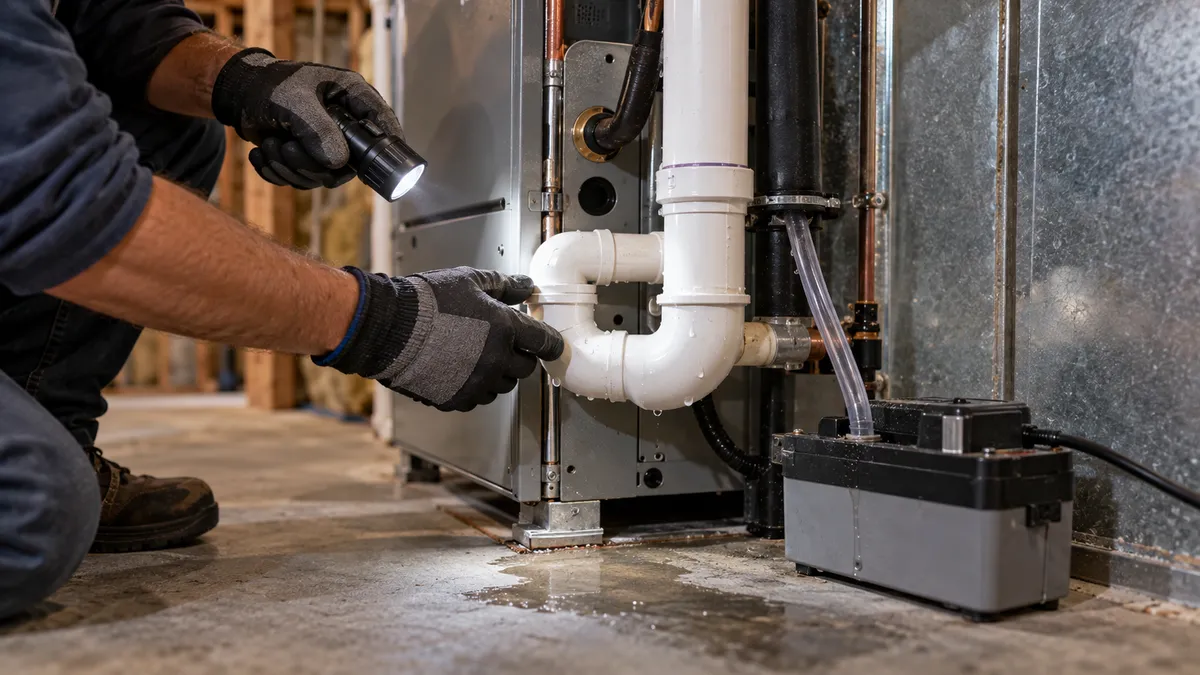
Past the trap, the drain usually runs through clear vinyl tubing or small PVC pipe to a floor drain or pump. We see three problems over and over: tubing that sags and holds a belly of sludge, tubing that has slipped out of the floor drain and dumps on the slab, and a drain line that slopes uphill somewhere along its run. Lennox's ML193DFE installation instructions state plainly that the condensate line must slope downward away from the trap to the drain, and that if the drain is higher than the trap, a condensate pump must be used.
Failed condensate pump
Many finished basements have no floor drain near the furnace, so a small pump collects the water and pushes it up and over to a sink or outside. When the pump motor fails, the check valve sticks, or the outlet tube clogs, the reservoir overflows. Lennox says a condensate pump typically lasts three to five years, which matches what we see in the field. Many pumps have a built-in safety switch that should shut the furnace or AC off before overflow; if yours was never wired, the first sign of failure is a wet floor.
Exhaust vent condensation running back
The white PVC exhaust pipe carries warm, wet flue gas, and some of it condenses inside the pipe before it gets outside. That's why manufacturers require the pipe to slope back toward the furnace so the water drains to the trap. Lennox requires a minimum drop of 1/4 inch per foot of horizontal run toward the unit, and the DOE Building America measure guideline for high-efficiency gas furnaces gives the same 1/4 inch per foot figure. A vent that sags between hangers, or one that pitches the wrong way, collects water and drips from a joint. A furnace pipe dripping water at a joint is also a possible exhaust leak, so it is a technician call, not a caulk job.
Frozen condensate line
A drain line that runs outside, through an unheated garage, a crawlspace or an attic can freeze solid on a cold January night. The water backs up, the furnace's pressure switch senses it, and the furnace shuts down, often with water dripping from the cabinet as well. Lennox's manual says the condensate drain should be routed within conditioned space to avoid freezing, and allows a heat cable kit on the trap and line where that isn't possible. The DOE guideline goes further for cold climates: drain flue gas condensate into the home's sanitary drain system, never outdoors.
Secondary heat exchanger leak
The secondary heat exchanger is the part of a condensing furnace where the water actually forms. If it corrodes through, condensate can drip into the burner compartment or onto the blower, and you may see rust on the burners or water inside the furnace rather than at the trap. Both Lennox and Carrier list a failed heat exchanger as a cause of leaks, and Carrier notes that a cracked heat exchanger can lead to carbon monoxide leaks. This is uncommon, but it is the one cause where the furnace should stay off until it is inspected.
Humidifier leak
A whole-home humidifier only runs in heating season, so a humidifier problem looks exactly like a winter furnace leak. A stuck solenoid valve, a mineral-clogged evaporator pad or a clogged drain tube sends water down the duct and onto the furnace. If the water appears near the ductwork above the furnace, look there first.
Furnace Leaking Water When AC Is On
When the leak shows up in June, not January, focus on the evaporator coil sitting on the furnace. That coil can produce a lot of water on a muggy Jersey Shore afternoon, and everything depends on one drain line staying open.
Furnace dripping water when the AC runs: clogged condensate line
Algae, mold and dust grow in the warm, wet drain pan and line every summer. Eventually the line plugs, the pan fills, and water spills out of the coil box and down the furnace cabinet. In our experience, this is the cause most of the time when water shows up under the furnace in summer.
Overflow pipe and float switches
New Jersey's residential code is the 2021 International Residential Code as adopted in the NJ UCC One- and Two-Family Dwelling Subcode. Section M1411.3.1 requires a secondary drain or overflow protection on cooling coils where an overflow would damage the building. That can be a separate overflow line that discharges somewhere you'll notice, or a water-level switch that shuts the system off before the pan overflows. So if you see water coming from an overflow pipe, often an outdoor pipe that drips above a window, it means the primary drain is blocked and the backup is doing its job. Furnace leaking water from overflow pipe is a warning, not a separate problem. If a float switch has shut the AC off and it won't restart, the same blocked primary drain is usually why.
Rusted or cracked drain pan
In our experience, older coils, especially metal pans 15 or more years old, rust through. Water then leaks out the bottom of the coil box no matter how clear the drain line is. Some pans can be replaced; on others the pan is built into the coil, and the fix is a new coil.
Frozen evaporator coil
A clogged filter, closed registers or low refrigerant can let the coil drop below freezing and grow a layer of ice. When the system shuts off, the ice melts faster than the pan and drain can handle, and water pours down over the furnace. If your AC stopped cooling and there's a puddle, switch the thermostat to OFF, run the fan only to speed the thaw, change the filter and call. Low refrigerant means a leak, and that needs an EPA-certified technician.
Combined furnace and AC drains
In many homes the AC coil drain and the furnace condensate drain are tied together into one line. That's allowed, but Lennox's installation manual says the AC drain outlet must be vented so the furnace pressure switch works properly. When combined drains are piped without that vent, or one clogged line serves both, you can get leaks in both seasons and nuisance furnace shutdowns in winter.
Is It Really the Furnace? Water Heater and Plumbing Look-Alikes
In a typical New Jersey basement the furnace and water heater sit a few feet apart, so water often travels along the slab and pools somewhere misleading. Before blaming the furnace, run this quick test.
- Dry the floor completely with towels, then lay a few paper towels around the furnace base, the water heater and the condensate pump.
- Check again after a heating or cooling cycle. The first wet paper towel is close to the source.
- Look at the water heater relief valve pipe and the base of the tank. Rust and water at the bottom of a tank usually mean the tank is failing. Our water heater replacement cost guide covers what comes next.
- Check the floor drain itself. A floor drain backing up during heavy rain looks like a leak. That's a drain problem, not an HVAC problem; call a plumber rather than an HVAC technician.
- Note whether it grows with the furnace off. If the puddle keeps growing with the system shut down for an hour, the water is coming from plumbing or groundwater, not the furnace.
What to Do When Your Furnace Is Leaking Water: Homeowner-Safe Steps
These steps don't require opening sealed furnace panels, touching wiring or cutting pipe. Lennox's consumer guidance is to turn the furnace and its power off first; that's where we start too.
- Turn the system off. Set the thermostat to OFF, then turn off the furnace service switch, which usually looks like a light switch on or near the furnace. Water and 120-volt furnace wiring don't mix.
- Protect the area. Mop up, move boxes and anything stored near the furnace, and put towels or a shallow pan down. Photograph where the water is.
- Replace the air filter if it's dirty. A clogged filter is a top cause of a frozen AC coil, and it costs a few dollars to rule out.
- Follow the drain line with a flashlight. From the furnace trap (usually on the side of the cabinet) to where it ends. Look for a kinked hose, a hose pulled out of the floor drain, a sag holding sludge, or a disconnected fitting. Pushing a slipped hose back into the drain is a fair fix.
- Check the condensate pump. Make sure it's plugged in and the outlet tube isn't kinked. Pour a little water into the reservoir; it should switch on and empty. If it hums without pumping, or doesn't run at all, it needs replacing.
- Look at the AC drain line outlet. In summer, find where the coil drain ends. If no water is coming out while the AC runs, the line is probably clogged.
- Flush an accessible AC drain. Lennox suggests flushing a clogged condensate line with equal parts white vinegar and hot water. We only recommend doing that yourself through a capped clean-out tee on the AC coil drain. Don't pour anything into the furnace trap itself.
- Check for a frozen line in winter. If your furnace drain runs outside or through a garage and the weather has been below freezing, a frozen line is likely. Don't use a torch or heat gun on PVC. Call us; the trap may need clearing and the line rerouted.
- Write down any error code. Most furnaces have a blinking LED visible through a small window in the lower door. Note or photograph the pattern before you reset anything. A pressure switch code alongside water often means the trap backed up.
- Restart once. If you found and fixed a simple drain issue, turn power back on, set the thermostat to call for heat or cooling and watch the drain for 15 minutes. If water appears again, shut it off and call.
Safety First: When to Shut the Furnace Off and Leave It Off
Most leaks are just water. A few are signs of a combustion or electrical problem, and those change the plan.
- Carbon monoxide alarm sounding. Don't hunt for the source. The CPSC carbon monoxide fact sheet says to get outside to fresh air immediately, call 911 and stay out until responders say it's safe. Flu-like symptoms without a fever, especially if several people in the house feel them, are also a reason to leave.
- Water inside the burner compartment, rust on the burners, or soot. These can point to a heat exchanger or venting failure. Keep the furnace off until it's inspected.
- Water dripping from the exhaust vent joints. A separated or cracked vent can leak flue gas into the basement. Turn the furnace off and call.
- Water on or near wiring, the control board or an outlet. Turn off the service switch or breaker without standing in water. If you can't reach it from dry floor, call an electrician or us before touching anything.
- Gas smell. Leave the house and call your gas utility from outside. This is not a water problem at all.
CPSC recommends battery-operated or battery-backup CO alarms on every level of the home and outside sleeping areas, and having heating systems checked by a professional every year. If you have a condensing furnace and no CO alarm in the basement hallway or near bedrooms, fix that this week.
What Our Technicians Find on Service Calls
After years of water-under-the-furnace calls across central New Jersey, a few patterns stand out. These come from our own jobs, not a national survey.
The first cold week is trap week
A condensing furnace sits idle all summer. The water in the trap evaporates, the sludge left behind dries and hardens, and when the heat comes on in October or November, water backs up within the first few cycles. The fix is usually removing, cleaning and re-priming the trap, which Lennox's manual specifies with about 10 fluid ounces of water. This is one reason we clean and prime the trap on every furnace tune-up, and why the trap is on our NJ furnace maintenance checklist.
Shore humidity is hard on AC drains
Homes near the coast in towns like Brick and Toms River see long, humid summers, and the AC coil makes water almost constantly. Drain lines in those homes grow algae faster, and we find more overflowing pans and tripped float switches there than inland. A summer AC tune-up that flushes the drain and treats the pan heads off most of it. Inland or at the shore, the most common "my furnace is leaking water" call we get in July is really a clogged evaporator coil drain above the furnace.
Exterior drains freeze
We regularly see condensing furnaces whose drain line was run out through the rim joist to the yard, often during an older 80%-to-condensing conversion. It works for years, then a week in the teens freezes the end of the line, the furnace locks out on the pressure switch, and water spills from the trap. The lasting fix is rerouting to an indoor drain or a pump, which matches the DOE guidance to keep flue condensate inside in cold climates.
Finished basements and pumps
In finished basements in towns like Freehold and Edison, the furnace often sits in a closet with no floor drain, so a condensate pump is the only way out. Pumps that are five or more years old, pumps with no overflow switch wired to the furnace, and outlet tubing run uphill into a ceiling are behind a lot of carpet damage. Section M1411.4 of the code requires pumps in uninhabitable spaces like attics and crawlspaces to shut the equipment down if the pump fails; we recommend wiring the safety switch in every location.
Sagging vent pipe and leaky joints
Long PVC vent runs across a basement ceiling sometimes sag between hangers, often after other trades have worked nearby. We re-hang and re-pitch the pipe and check the joint for a flue gas leak at the same visit.
Limitations: When Not to DIY
We're glad to see homeowners check drains and pumps. Some jobs, though, are worth leaving alone.
- Don't open the burner compartment or remove the inducer. Internal hoses connect to safety pressure switches, and reassembling them wrong can let the furnace run with a blocked vent or flood the inducer.
- Don't cut or re-glue vent pipe. Vent material, length, slope and joints are specified by the manufacturer. A bad joint can leak exhaust.
- Don't bypass a float switch or pressure switch. Jumping a switch to get the heat back on is how a small water problem becomes a flooded basement or a combustion hazard. The switch is reporting a real fault.
- Don't add refrigerant. A frozen coil with low refrigerant needs leak repair by a certified technician; store-bought cans aren't legal for most systems and don't fix the leak.
- Don't run a leaking furnace "just until the weekend" if water is reaching the control board, blower motor or burners. Water damage to the board or blower costs more than the original repair.
- This guide can't diagnose your furnace. Trap designs, drain routing and error codes vary by brand and model. When in doubt, check your owner's manual or call.
Furnace Water Leak Repair Costs in Central NJ (2026 Estimates)
These ranges come from our own jobs in Monmouth, Middlesex and Ocean counties and match the figures in our other cost guides. Your price depends on the diagnosis, access, and parts for your model.
| Repair | Typical cost | Notes |
|---|---|---|
| Diagnostic / service call | $89–$150 | Simple fixes like reseating a drain hose are often handled on this visit |
| Condensate trap clean and re-prime | $89–$200 | Included in a furnace tune-up |
| Condensate drain line clearing or repair | $75–$450 | Higher end for rerouting or replacing a long run |
| Gravity drain reroute to an indoor floor drain | $75–$250 | Fixes frozen exterior drains when a drain is close |
| Condensate pump replacement | $150–$450 | Includes wiring the overflow safety switch |
| Heat cable on trap and drain line | $150–$400 | Only where the line can't be moved into heated space |
| Vent pipe re-pitch or joint repair | $150–$600 | More if sections must be replaced |
| Secondary drain pan or float switch | $100–$300 | Code-required overflow protection |
| Humidifier valve or pad repair | $150–$350 | A new whole-home humidifier runs $400–$1,000 installed |
| Evaporator coil replacement | $1,500–$3,000+ | Coil $900–$2,200 plus refrigerant recovery, brazing and charge |
| Secondary heat exchanger replacement | $1,500–$3,000+ | Often covered by parts warranty; on older units compare with replacement |
| New gas furnace | $3,800–$10,000 | See our furnace replacement cost guide |
In our experience, most furnace water leaks land in the first five rows. For bigger repairs, use the trade's rule of thumb from our HVAC repair guide: multiply the repair cost by the furnace's age in years, and if the result is over about $5,000, get a replacement quote too. Our post on the signs you need a new furnace covers the rest of that decision.
How to Prevent a Furnace From Leaking Water
- Annual furnace maintenance in early fall. Clean and prime the trap, check the drain and pump, and inspect the vent. CPSC also recommends a yearly professional check of heating systems for CO safety.
- A spring or early-summer AC tune-up. Flush the coil drain and check the pan and float switch before the humid season.
- Change filters on schedule. A clean filter keeps the AC coil from freezing.
- Replace aging condensate pumps before they fail, and make sure the overflow switch is wired.
- Keep drain lines indoors. If your furnace drain runs outside, ask about rerouting before winter.
- Service the humidifier each fall. Replace the pad and check the drain tube when you turn it on for the season.
Water that recurs after a fix, or a furnace that also cycles on and off or blows cool air, is a sign of a larger problem. Our guides to a furnace blowing cold air and the signs your furnace needs repair walk through those symptoms. If the leak is large, the heat is out in freezing weather, or anyone in the home is vulnerable, see our emergency HVAC service guide.
About Guardian Air
Guardian Air is a licensed New Jersey HVAC and plumbing contractor serving Monmouth, Middlesex and Ocean counties. Our technicians repair condensing furnaces, AC coils, condensate pumps and humidifiers from every major brand in homes from Freehold and Edison to Toms River and Brick, and our plumbers handle the water heater and leak detection side when the water isn't coming from the furnace at all. You get a diagnosis and a written quote before any work starts. Learn more about our team, see our heating services and service areas, or call (848) 276-6300 (Mon–Fri 8–6, Sat 8–4) and book a service visit.
Sources
- Lennox: Furnace Leaking Water: Causes & Solutions
- Lennox: ML193DFE Gas Furnace Installation Instructions (507865-02)
- Carrier: Furnace Leaking Water
- U.S. Department of Energy, Building America: Measure Guideline: High Efficiency Natural Gas Furnaces
- U.S. Department of Energy, FEMP: Purchasing Energy-Efficient Residential Furnaces
- UpCodes: New Jersey UCC One- & Two-Family Dwelling Subcode 2021, Chapter 14 (M1411 Condensate Disposal)
- U.S. Consumer Product Safety Commission: Carbon Monoxide Fact Sheet