October 30, 2026
Furnace Not Turning On? Causes, Checks & Fixes (NJ 2026)
Most furnaces that won't start have a simple cause: thermostat, power, filter or a tripped safety. The checks to do yourself, in the order a technician works, what failed parts cost to fix in NJ, and when to call.
By Noor Kamal, Technology Manager · Published
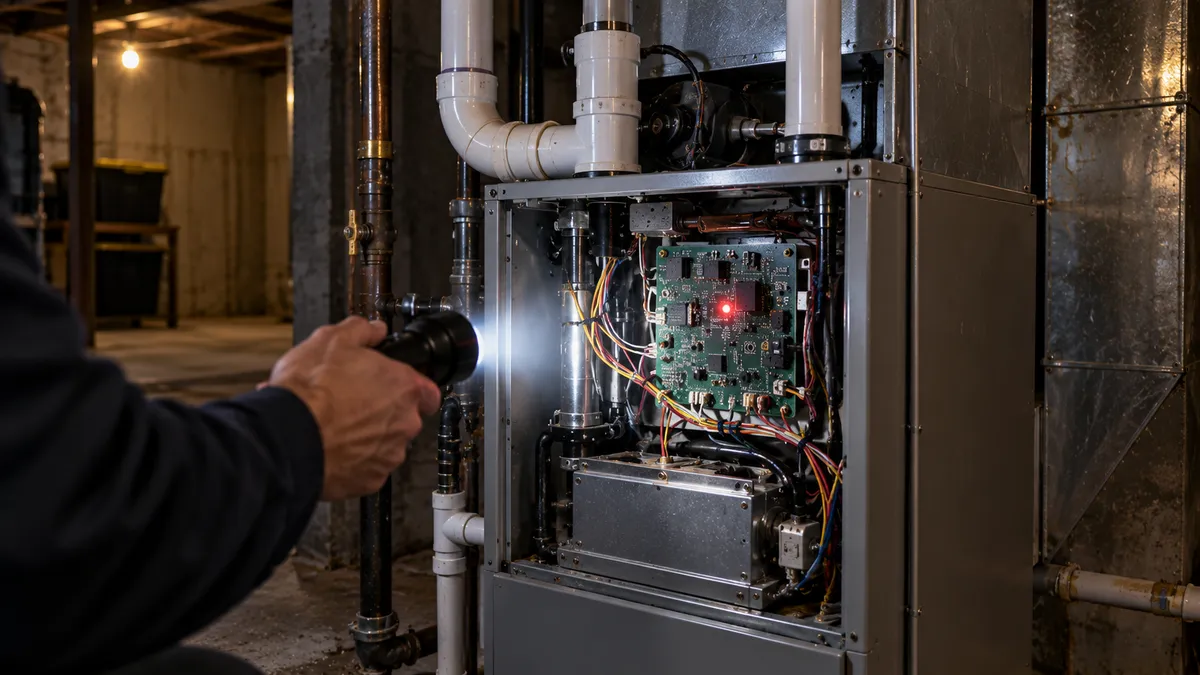
A furnace not turning on is usually caused by something simple: a thermostat set wrong or with dead batteries, a tripped breaker or furnace service switch, a clogged filter that tripped a safety limit, a loose blower door, a closed gas valve or a clogged condensate drain. Check those first, in that order, and note any blinking code on the control board. If the furnace still won't start or won't ignite, a part has usually failed, most often the ignitor, flame sensor, pressure switch or control board, and a technician should test it rather than guess.
Written by the Guardian Air HVAC team · Reviewed for accuracy October 2026
The first cold morning of the season, our phones fill up with the same sentence: "The heat won't come on." Some of those calls end in thirty seconds, when the thermostat turns out to be still in cooling mode. Others end with a failed ignitor or a cooked control board. This guide follows the order our technicians work on a no-heat call in Monmouth, Middlesex and Ocean counties, explains what each internal part does when it fails, and gives 2026 central NJ repair costs.
Safety First: When Not to Troubleshoot
- You smell gas. Natural gas smells like rotten eggs. Leave the house now. Don't flip switches, reset the furnace or use your phone inside. From outside, call 911 and your gas utility: New Jersey Natural Gas at 800-GAS-LEAK (800-427-5325), which serves most of Monmouth and Ocean counties; PSE&G at 1-800-880-7734; or Elizabethtown Gas at 1-800-492-4009. In Middlesex County, PSE&G and Elizabethtown Gas serve different streets, so check your bill.
- A carbon monoxide alarm sounds. Get everyone out and call 911 from outside. The CPSC lists early CO symptoms as headache, fatigue, shortness of breath, nausea and dizziness, easy to mistake for flu.
- You see soot, scorch marks or melted wiring, or a breaker trips again right after you reset it.
Two rules apply to everything below. Don't keep resetting a furnace that keeps locking out: a safety switch that trips again is reporting a real fault. And never bypass a safety switch with tape or a jumper wire.
Why Is My Furnace Not Turning On? Listen to What It Does
A modern gas furnace starts in a set order: the thermostat calls for heat, the inducer fan starts and a pressure switch proves the vent is clear, the hot surface ignitor glows, the gas valve opens, the flame sensor proves the burners lit, and the main blower starts. Where that sequence stops tells you where the problem is. Raise the thermostat a few degrees, stand by the furnace and listen for two or three minutes.
| What you hear and see | Where the sequence stopped | Look at |
|---|---|---|
| Nothing at all, no lights on the board | No power | Breaker, service switch, door switch, board fuse |
| Nothing, but the board LED is on | No call for heat reaching the furnace | Thermostat settings, batteries, wiring |
| Inducer runs, then stops, nothing lights | Pressure switch never closed | Vent pipes, condensate trap, pressure switch, inducer |
| Inducer runs, no orange glow, then lockout | Ignition | Hot surface ignitor or its wiring |
| Ignitor glows, no flame | Gas not flowing | Gas shutoff, gas valve, gas supply |
| Burners light for a few seconds, then go out | Flame not proven | Flame sensor (see our short cycling guide) |
| Burners run, but the blower never starts | Blower circuit | Blower motor, capacitor, control board |
If the blower runs and blows cool air but the burners never light, see our guide to a furnace blowing cold air.
Furnace Not Turning On? Check These 8 Things First
None of these steps needs tools or opening a sealed compartment. Work through them in order.
1. Thermostat mode, setpoint and batteries
Confirm the thermostat is set to HEAT, not COOL or OFF, and that the setpoint is above room temperature. Carrier suggests at least 3 to 5 degrees above the current reading. Check for a "hold" or vacation setting. If the display is blank or dim, replace the batteries; many thermostats stop sending a heat call before the screen goes dark. Then give the furnace a few minutes to respond.
2. Furnace not turning on with thermostat calling for heat
If the thermostat says "heat on" and the furnace does nothing, the signal isn't getting through. We often find a smart thermostat installed without a common (C) wire, a wire knocked loose at the wall plate during painting, or a thermostat cable pinched in the basement. Our guide to a thermostat not working covers blank screens, wiring and replacement cost.
3. Breaker and furnace service switch
Every furnace has a service switch that looks like a light switch, usually on the furnace, a nearby joist or at the top of the basement stairs. It gets flipped off by mistake all the time. Make sure it's on, then check the panel for a tripped breaker and push it fully off, then on. Trane's advice matches ours: if it trips again, stop and call, because that means a short. Carrier suggests a single reset by turning the power off for 30 seconds and back on.
4. The air filter
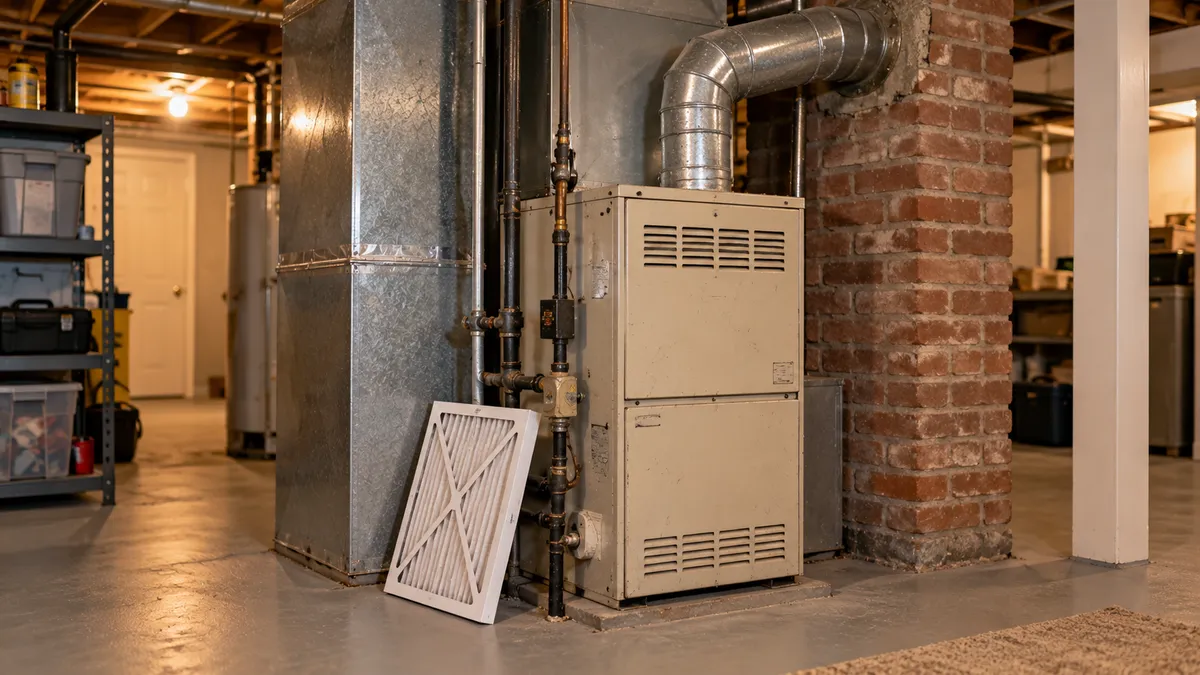
A clogged filter starves the furnace of air, the heat exchanger overheats and the high-limit switch shuts the burners down. Repeated limit trips can lock the furnace out so it stops responding to the thermostat. If you can't see light through the filter, replace it. Trane recommends a new filter every 30 to 90 days.
5. The blower door and its safety switch
Behind the lower front panel is a push-button switch that cuts power whenever the panel is off. If the panel went back crooked after a filter change, the furnace is dead, often with no lights on the board. Seat the panel flush. Never tape the button down: an open blower compartment can pull exhaust gases into the house.
6. The gas valve and fuel supply
The shutoff on the gas pipe into the furnace should have its handle parallel to the pipe (open). If no gas appliance in the house works, the problem is the supply, and your utility is the call. On propane or oil, check the tank gauge; an empty tank is a common "furnace won't ignite" cause in rural Monmouth and Ocean County homes.
7. Condensate trap, pump and PVC vents on high-efficiency furnaces
A furnace venting through two white plastic pipes is a condensing furnace that drains water through a trap, often to a small pump. When the drain clogs or the pump fails, a safety switch stops the furnace. Look for water around the furnace or a pump that hums without emptying. Then check outside where the PVC pipes leave the house: snow or leaves blocking them keep the pressure switch from closing.
8. The blinking LED code
Most furnaces have a status light on the control board, visible through a small window in the lower panel. Trane explains that a slow green blink generally means no call for heat, while red blink patterns signal specific faults. The legend is on a label inside the furnace door. Write the pattern down before you reset anything, because a reset clears it.
A word about reset buttons
Some furnaces have a red manual reset button on a rollout switch near the burners. Carrier says to press it once and call a dealer if it trips again immediately. We'd add that a tripped rollout switch means flame went where it shouldn't, sometimes from a blocked flue or a cracked heat exchanger, so it deserves a technician either way. On oil furnaces, the burner reset gets one press only; extra presses can flood the combustion chamber with oil and cause a puff-back. Many gas furnaces also lock out after several failed ignitions and wait before retrying, an hour on one Allied Air (Lennox family) board. A furnace that "fixes itself" later hasn't fixed anything.
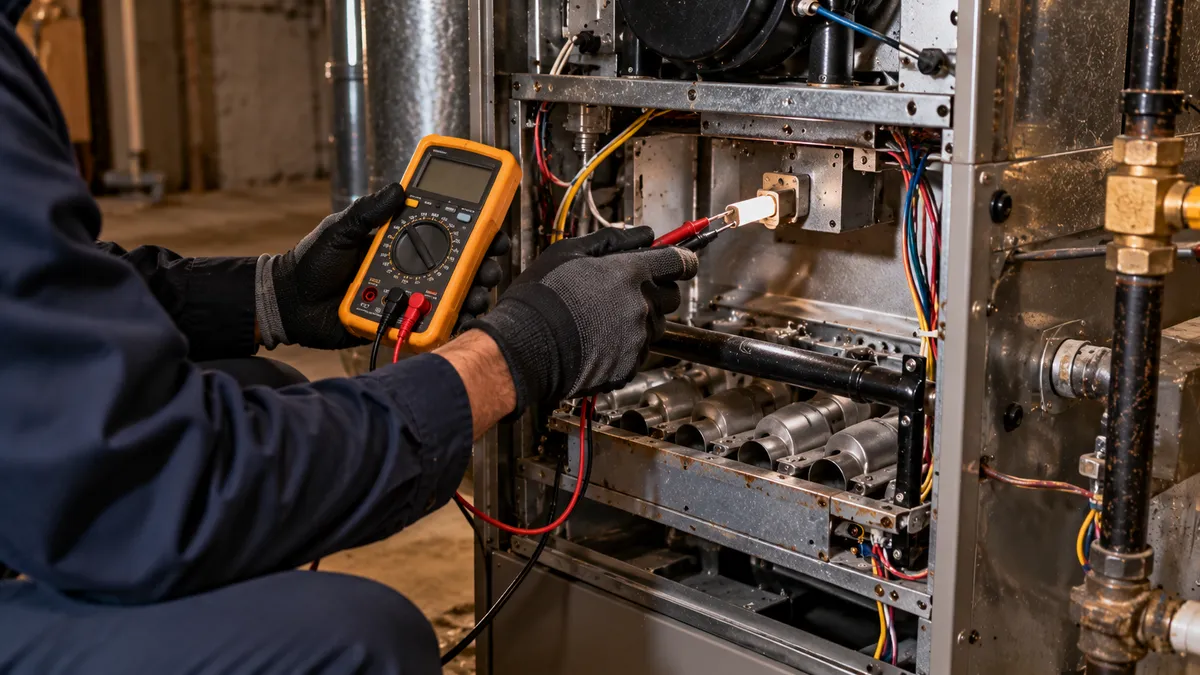
Gas Furnace Not Turning On: What's Failed Inside
If the checks above don't bring the heat back, the cause is almost always inside the furnace. These are technician repairs, but knowing what each part does helps you judge the diagnosis and the quote.
Hot surface ignitor (furnace won't ignite)
Most gas furnaces built since the 1990s light the burners with a ceramic hot surface ignitor that glows bright orange before the gas valve opens. Ignitors are brittle and wear a little with every cycle. The classic sign: the inducer runs, there's no glow through the sight glass, and the furnace tries a few times then locks out. We confirm with a resistance test and handle the new one by its base only, since skin oils and bumps shorten its life. Furnace ignitor replacement cost in central NJ runs $150 to $400 in 2026, depending on brand and ignitor type.
Flame sensor (lights, then shuts off)
The flame sensor is a thin metal rod in the burner flame. The control board sends a tiny current through the flame to prove the gas lit; if it can't see that current, it shuts the gas off within seconds. Over time the rod picks up a coating that weakens the signal, so the furnace lights, goes out, and eventually locks out. Flame sensor cleaning usually fixes it for $89 to $200, often on the diagnostic visit, and we measure the flame signal afterward. A pitted rod or cracked insulator means replacement, at $150 to $350.
Pressure switch and inducer motor
The inducer pulls exhaust through the heat exchanger and out the vent, and the pressure switch confirms enough draft before ignition is allowed. If the inducer runs and nothing else happens, the switch hasn't closed: a blocked vent, water in the hose or trap, a failed switch or a weak inducer. A pressure switch or hose runs $150 to $400; an inducer motor $400 to $900. We check the vent and trap first, because a switch correctly reporting a blocked vent isn't broken.
High-limit and rollout switches
The high-limit switch shuts the burners down if the furnace overheats, usually from restricted airflow; the rollout switch trips if flame escapes the combustion chamber. Both report problems rather than cause them, so we find the restriction or venting fault before replacing either, at $150 to $400.
Control board
The control board runs the whole start-up sequence, so a failure can leave the furnace dead or stop it at any step. Boards fail from power surges, heat, age and water dripping from a leaking condensate trap. Many carry a small fuse that blows when a thermostat wire shorts, and it will blow again until the short is found. Board replacement runs $350 to $900, most between $400 and $750, as our furnace repair cost guide shows.
Gas valve
If the ignitor glows and the board powers the gas valve but no gas flows, the valve may have failed. We confirm with a meter and a manometer, because low incoming gas pressure looks the same. Gas valves are replaced, not repaired, at $300 to $600.
Blower motor and capacitor
If the burners light but the blower never starts, the furnace overheats in a minute or two and the limit shuts it down. The cause may be a failed capacitor ($150 to $400), a seized motor or a failed ECM motor module. Furnace blower motor replacement cost runs $450 to $1,500, with standard PSC motors at the low end and variable-speed ECM motors at the high end. Smaller blower repairs often come in at $300 to $700.
Furnace pilot light out on older furnaces
Furnaces from before the mid-1990s often have a standing pilot, with a thermocouple in its flame holding the gas valve open. If the furnace pilot light is out, follow the relighting steps on the furnace label exactly. If it lights but goes out when you release the knob, the thermocouple is the likely cause, at $150 to $300. If you smell gas, stop and leave.
Electric Furnace Not Turning On
An electric furnace has no burners or gas valve, so the ignition causes above don't apply. Start with the thermostat, filter and door checks, then power: electric furnaces often run on two or more large breakers in the main panel, sometimes with extra breakers or fuses on the furnace itself. Inside, the usual failures are burned-out heating elements, sequencers that stage the elements on, a failed transformer or a tripped limit. Element and sequencer repairs typically run $200 to $600. A breaker that keeps tripping on an electric furnace is a fire warning; leave it off and call. If you have a heat pump with electric backup, start with our guide to a heat pump not heating.
Heater Won't Turn On After a Power Outage
After storms that knock out JCP&L or PSE&G service, the fix is usually simple: the thermostat lost its settings, or a breaker tripped when power returned. If the board shows no light at all afterward, a surge may have damaged the board, transformer or fuse. While the heat is down in freezing weather, protect your plumbing with our frozen pipes guide.
Furnace Not Turning On: Symptom, Cause, Fix and Cost
Guardian Air estimates for Monmouth, Middlesex and Ocean counties in 2026, parts and labor included. Our $89 to $150 diagnostic is credited toward the repair, and you get a flat-rate written quote before work starts.
| Symptom | Likely cause | DIY or pro | Typical cost |
|---|---|---|---|
| Thermostat blank or not calling for heat | Batteries, settings, wiring, failed thermostat | DIY first; pro for wiring | $0; thermostat replacement $150–$600 |
| No lights, nothing runs | Breaker, service switch, door switch | DIY; pro if the breaker trips again | $0; door switch $150–$300 |
| Dead after a thermostat wire shorted | Blown board fuse | Pro (find the short) | Usually within the $89–$150 diagnostic |
| Runs briefly, then locks out; dirty filter | High-limit trip | DIY filter change | Cost of a filter |
| Water near furnace, won't fire | Clogged condensate trap or failed pump | DIY check; pro to clear or replace | $75–$450 |
| Inducer runs, nothing lights | Blocked vent, pressure switch, inducer | DIY: clear vents; then pro | Switch $150–$400; inducer $400–$900 |
| No orange glow, lockout | Failed hot surface ignitor | Pro | $150–$400 |
| Lights, then goes out in seconds | Dirty flame sensor | Pro | Cleaning $89–$200; replacement $150–$350 |
| Ignitor glows, no flame | Gas valve or gas supply | DIY: check shutoff; then pro | Gas valve $300–$600 |
| Dead or stops at random steps | Control board | Pro | $350–$900 |
| Burners light, blower never starts | Capacitor or blower motor | Pro | Capacitor $150–$400; motor $450–$1,500 |
| Pilot out on an older furnace | Pilot or thermocouple | DIY relight per label; pro if it won't stay lit | Thermocouple $150–$300 |
| Rollout tripped, soot, or CO alarm | Venting or heat exchanger problem | Shut down; pro immediately | Diagnosis first; may mean replacement |
What Our Technicians Find on No-Heat Calls
- The first cold snap brings ignitors and flame sensors. Parts that were weak last March fail on the first real call for heat. A fall tune-up catches most of them.
- The crooked door. Plenty of "dead furnace" calls end when we reseat the blower panel after a filter change.
- The rollout switch someone kept resetting. When we find one, we inspect the flue and heat exchanger closely. Sometimes it's a cracked heat exchanger, which changes the whole conversation.
When to Repair vs. Replace a Furnace That Won't Turn On
Most no-heat repairs are worth doing. The answer changes as the furnace ages and the repair grows. Most furnaces last 15 to 20 years, gas furnaces about 18 on average and electric ones about 15, as our guide to how long furnaces last explains. Our rule of thumb: multiply the repair quote by the furnace's age in years. If the result tops about $5,000, get a replacement quote too. A $300 ignitor on a 9-year-old furnace scores 2,700: fix it. A $900 board on an 18-year-old furnace scores 16,200: put the money toward a new system. Replacement also wins when the heat exchanger is cracked, parts are obsolete, or repairs keep stacking up; our list of signs your furnace needs repair covers the warning signs. A new gas furnace in central NJ typically costs $3,800 to $10,000 installed, as our furnace replacement cost guide details.
How to Keep Your Furnace From Failing to Start
Most parts that leave a furnace dead on a cold morning wear out gradually, and a meter shows it before they fail. The U.S. Department of Energy recommends having furnaces checked in the fall and says regular maintenance can cut heating and cooling costs by 10% or more, and the CPSC urges an annual professional inspection of fuel-burning heating systems. Keep PVC vents clear and test your CO alarms; New Jersey's N.J.A.C. 5:70-4.19 requires one near sleeping areas in homes with a fuel-burning appliance. Use our furnace maintenance checklist or book a furnace tune-up before the first cold snap.
About Guardian Air
Guardian Air is a licensed New Jersey HVAC and plumbing contractor serving Monmouth, Middlesex and Ocean counties. Our technicians diagnose and repair gas, oil and electric furnaces from every major brand, in homes from Freehold, Marlboro and Howell to Edison, Old Bridge and Toms River, with a diagnosis and flat-rate written quote before any work starts. See our heating services, furnace tune-up and furnace replacement pages and our furnace repair cost guide, learn more about our team, or call (848) 276-6300 (Mon–Fri 8–6, Sat 8–4) and book a service visit.
Sources
- Carrier: Your Guide To A Furnace Not Turning On
- Trane: Furnace Not Turning On and Furnace Light Blinking: What's It Mean?
- New Jersey Natural Gas: Emergency Contacts
- Elizabethtown Gas: Committed to Safety
- U.S. Consumer Product Safety Commission: Carbon Monoxide Fact Sheet
- N.J.A.C. 5:70-4.19: Carbon monoxide alarm requirements
- U.S. Department of Energy: Energy Saver Guide: Tips on Saving Money and Energy in Your Home