October 31, 2026
Thermostat Not Working? Fixes, Signs It's Bad & Replacement Cost
A blank screen or a thermostat that won't start the heat or AC is usually batteries, power or a safety switch, not the thermostat. How to troubleshoot, tell if it is bad, and what replacement costs in NJ.
By Noor Kamal, Technology Manager · Published
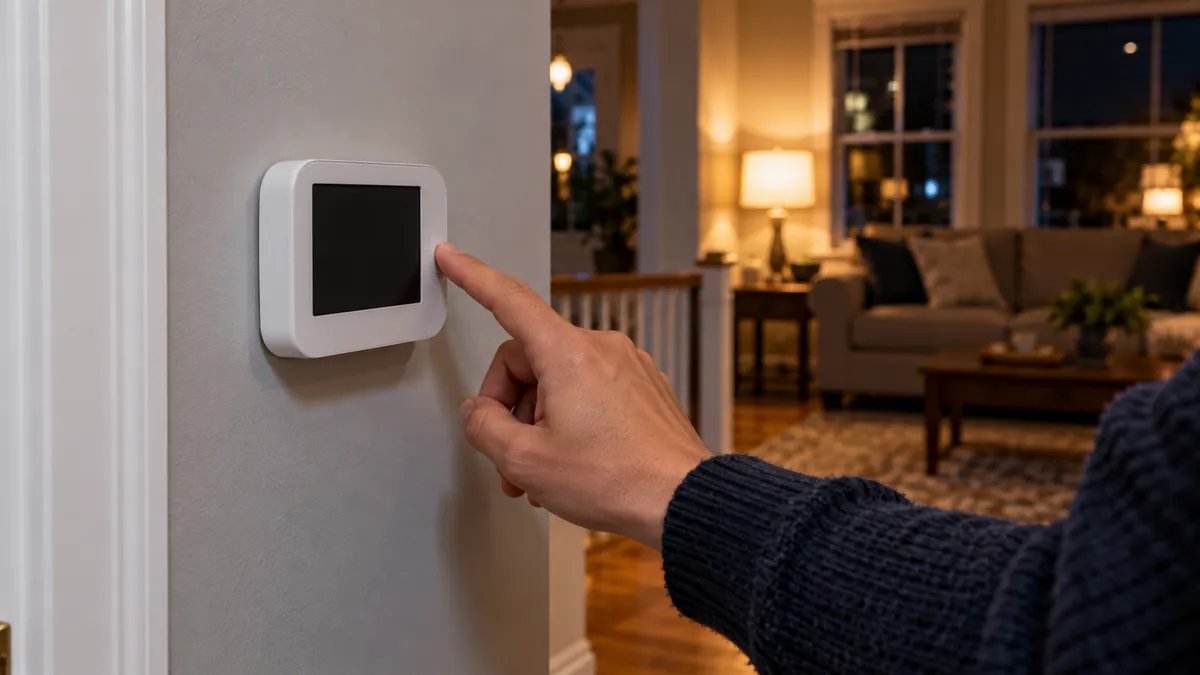
A thermostat not working is usually a settings, power or safety-switch problem, not a broken thermostat. Check that it is in HEAT or COOL with the setpoint a few degrees past room temperature, replace the batteries, reset the HVAC breaker and furnace service switch, make sure the furnace door is closed, and look for a tripped condensate float switch. A blank screen on a hardwired model often means a blown 3-amp fuse on the furnace control board. If the thermostat calls for heat or cooling and nothing runs, the fault is usually in the equipment.
Written by the Guardian Air HVAC team · Reviewed for accuracy October 2026
"My thermostat isn't working" is one of our most common calls, and it spikes on the first hot week of June and the first cold night of October. The thermostat gets blamed because it's the part you can see, but on most of these calls it isn't the failed part. This guide covers the checks in the order we do them, what common display messages mean, how to tell if the thermostat is bad, and what thermostat replacement and smart thermostat installation cost in Monmouth, Middlesex and Ocean counties in 2026.
Why Is My Thermostat Not Working?
A thermostat is a switch. On most central systems, a transformer in the furnace or air handler sends 24 volts up the R wire. To call for heat, the thermostat connects R to W; for cooling, R to Y and G. The equipment does the rest. So a thermostat that seems dead or ignored is usually one of four things:
- Set wrong: wrong mode, a schedule or away setting overriding you, or a setpoint that doesn't actually ask for heat or cooling.
- No power: batteries, breaker, service switch, furnace door, float switch, a blown fuse or a failed transformer.
- Can't talk to the equipment: a loose or broken wire, or a smart thermostat configured for the wrong system.
- Equipment fault: the thermostat calls correctly, but the furnace, boiler, heat pump or AC doesn't respond.
Thermostat Not Working? Check These Things in Order
Each step is safe for a homeowner and rules out a common cause before you pay for a visit.
- Mode, setpoint and schedule. HEAT or COOL, not OFF or FAN. Set it at least three degrees past the room reading so it's clearly calling. Look for a schedule, "eco," "away" or vacation setting overriding you, or a temporary hold that expired. On a heat pump, make sure it isn't left on emergency heat.
- Batteries. Many thermostats use AA or AAA batteries, even some wired ones. Weak batteries cause a dim or blank screen, lost settings, or a thermostat that shows "heat on" but never closes the circuit. Replace them even if the screen still lights.
- Breaker and furnace service switch. Reset a tripped furnace, air handler or AC breaker by switching it fully off, then on. Then check the service switch at the furnace, which looks like a light switch and often gets turned off by someone looking for the basement light. If a breaker trips again, leave it off and call.
- The furnace door. A door safety switch cuts power when the blower door is off. A door put back crooked after a filter change leaves the switch open and the whole system, thermostat included, dead. Reseat it so it sits flat.
- The condensate float switch. The most common cause of a dead thermostat we see in AC season. When the drain line from the AC coil or high-efficiency furnace clogs, a float switch opens and cuts the 24-volt power to protect your ceiling. Look for water in the pan under the indoor coil or standing in a small switch on the drain line. Our AC not cooling guide covers clearing the drain.
- Sensor and placement. The thermostat reads only the air around it. Sun, a lamp or TV, a supply register or a nearby kitchen makes it read warm, so heat shuts off early or cooling never stops. Hold a separate thermometer beside it for ten minutes and compare.
- Loose wires. With power off at the breaker, take the thermostat off its base. Every wire should be tight in its terminal, with clean copper, no corrosion and no stray strands touching a neighbor.
- The 3-amp fuse on the furnace board. A blank hardwired thermostat with the breaker and switches on often means the low-voltage fuse on the control board blew. That means something shorted, usually a nicked thermostat wire or a damaged wire at the outdoor AC unit. A new fuse without finding the short just blows again, so this is where we'd suggest calling a technician.
Also call if a breaker keeps tripping, you smell burning, the system runs with the thermostat off, or the equipment doesn't respond after the compressor delay. If you smell gas, leave and call your gas utility and 911 from outside.
What Your Thermostat Display Is Telling You
Many "thermostat not working" calls are really "my thermostat shows something I don't recognize." Messages vary by brand and model, so check your manual, but these are common.
Blank screen
No display means no power. On battery models, start with the batteries. On hardwired and smart thermostats, the 24-volt supply is missing: breaker, service switch, door switch, float switch, fuse or transformer, roughly in that order. Smart thermostats without a C wire can also go blank when their internal battery runs down.
"Wait" or a flashing "cool on" / "heat on"
This is behind many "Honeywell thermostat not working" searches, and it's usually normal. Honeywell Home's support page explains that "wait," "waiting for equipment" or a flashing "cool on" is a compressor protection delay of up to five minutes, which stops the compressor restarting too soon after it shuts off or the power blinks. Carrier describes it as typically lasting 3–5 minutes and a concern only if it persists beyond five minutes or the system never starts. Most smart thermostats have a similar delay.
"In Recovery" or "Active Recovery"
Also normal. Thermostats with a feature like Honeywell's Adaptive Intelligent Recovery learn how long your system takes to reach the next scheduled temperature and start early. Heat at 5:15 for a 6:00 schedule is why.
"AUX," "Em Heat" and power alerts
On a heat pump, "AUX" means backup heat is helping, which is normal on cold nights; "Em Heat" means only backup heat is running, which is expensive if left on. Our heat pump not heating guide explains both. On smart thermostats, repeated low-battery or "no power" alerts usually point to the C-wire problem covered below.
AC Thermostat Not Working vs. Heat Not Turning On
In summer, look first at the float switch, the breaker and outdoor disconnect, and a fuse blown by a damaged wire near the outdoor unit. If the thermostat says "cool on," the indoor blower runs and the air is warm, the thermostat is doing its job; the outdoor unit, often a capacitor or contactor, is the problem. See AC not cooling.
In fall, we find thermostats left in COOL or OFF, dead batteries, service switches turned off over the summer and furnace doors not seated. If the thermostat shows "heat on" and the inducer starts but no flame follows, or the burners light and go out, the furnace needs attention; see our guide to a furnace not turning on. If heat runs only a few minutes at a time, see furnace short cycling, where thermostat placement and cycle-rate settings are common culprits.
Thermostat Symptoms, Likely Causes and Costs
Guardian Air estimates for central New Jersey in 2026, matching our other repair guides. The diagnostic visit is usually credited toward the repair.
| Symptom | Likely cause | DIY or pro | Typical cost |
|---|---|---|---|
| Blank screen, battery model | Dead batteries | DIY | A few dollars |
| Blank screen, hardwired | Breaker, service switch, door or float switch | DIY checks first | $0, or $89–$150 diagnostic |
| Blank in summer, water in drain pan | Clogged condensate line | DIY for a simple line; pro if it recurs | $75–$450 |
| Fuse on furnace board blown | Shorted thermostat or outdoor wire | Pro | $89–$250 |
| No 24 volts at the board | Failed transformer | Pro | $150–$350 |
| "Wait" or flashing "cool on" a few minutes | Normal compressor delay | No action | $0 |
| Flashing over 10 minutes, nothing runs | Outdoor unit, wiring or safety switch | Pro | $89–$150, then repair |
| Wrong temperature reading | Placement, dust, failing sensor | DIY test; pro to relocate | $200–$500 to relocate |
| Heat pump blows cold after new thermostat | Wrong system type or O/B setting | Pro | Usually fixed on the diagnostic visit |
| Smart thermostat drops Wi-Fi or cycles randomly | No C wire, power stealing | Pro | $0–$400 depending on fix |
| Thermostat calls, equipment doesn't run | Igniter, flame sensor, capacitor, board | Pro | Varies; control board $350–$900 |
| Thermostat confirmed bad | Failed thermostat | Pro, or DIY on simple systems | $150–$600 replaced |
How Do I Know If My Thermostat Is Bad?
Signs the thermostat itself is failing:
- It reads more than two or three degrees off a reliable thermometer held beside it, away from heat sources and drafts.
- The screen is dim, flickers or ignores buttons with fresh batteries and good power.
- It keeps losing its settings or schedule.
- It shows "heat on" or "cool on" and nothing happens, but the system runs when a technician bypasses it.
- The system runs nonstop with the thermostat off, which can mean a stuck relay or a shorted wire.
The R-to-W jumper test, and why to leave it to a pro
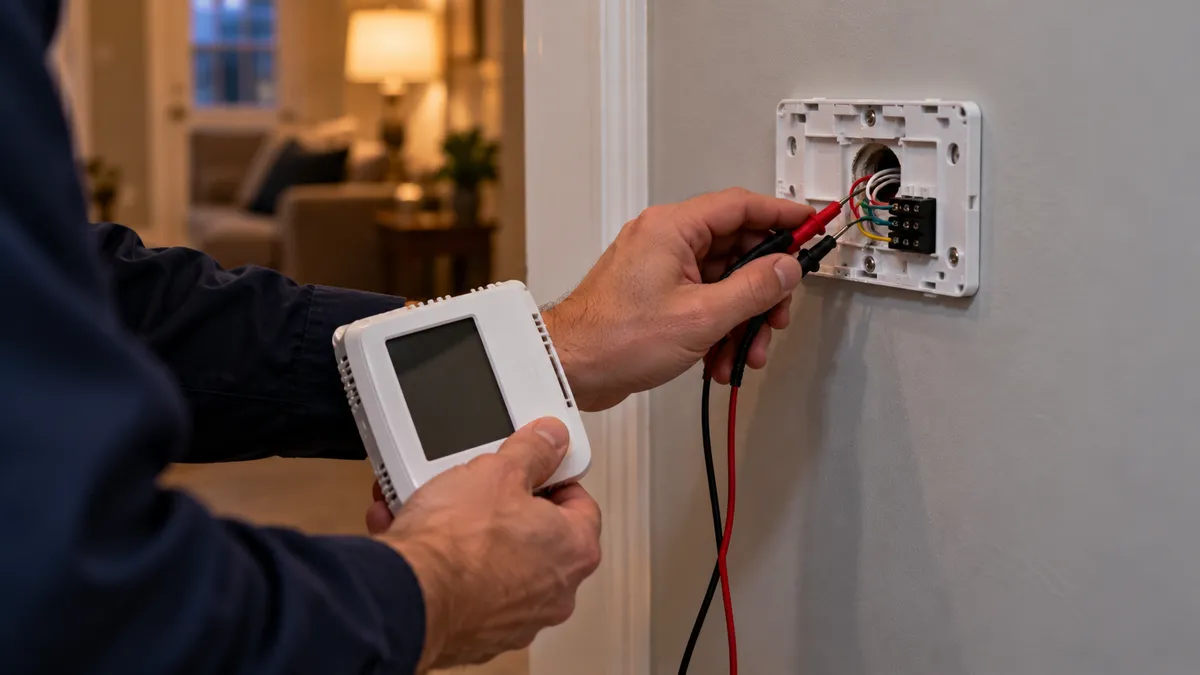
The definitive test takes the thermostat out of the equation. With the thermostat off its base, a technician briefly connects R to W, which is exactly what the thermostat does when it calls for heat. If the furnace starts, the furnace and wiring are fine and the thermostat is bad. If not, the fault is in the wiring or equipment. Joining R, Y and G tests cooling the same way.
We explain it so you know what the technician is doing, not as a DIY project. Done wrong, it can blow the board fuse or transformer, short a wire against the wrong terminal, or start a compressor without its protective delay. Heat pumps, zoned boilers and communicating systems need a different test. A technician also confirms 24 volts with a meter first.
What Our Technicians Find on Thermostat Calls
These patterns come from our own service calls across Monmouth, Middlesex and Ocean counties.
The float switch, every June
When the first heat wave hits, many "dead thermostat" calls end at a clogged condensate line, often an attic air handler or a basement furnace with the AC coil on top. A spring maintenance visit mostly prevents it.
The DIY smart thermostat that almost works
It works for a week, then drops offline, reboots or short cycles the furnace. Usually there was no C wire. Sometimes the old Rh–Rc jumper wasn't carried over, or on a heat pump the O/B setting is reversed, so it cools when asked to heat.
The nicked wire behind the outdoor unit
A 3-amp fuse that keeps blowing nearly always traces to a damaged low-voltage wire along the foundation to the AC unit, hit by a string trimmer or chewed by animals. The thermostat gets blamed; the wire gets replaced.
The thermostat in the wrong place
In many split-levels and colonials, the thermostat sits beside the return, above a register or in afternoon sun. No new thermostat fixes that. Relocating it, or adding a remote sensor, does.
Thermostat Replacement Cost in Central NJ (2026)
Guardian Air estimates for Monmouth, Middlesex and Ocean counties, thermostat and installation included. Our diagnostic visit is $89–$150, credited toward the work. Fixr's national thermostat installation cost guide puts the average replacement at about $200 and smart thermostats at $185 to $600, in line with what we see.
| Job | Typical cost installed | Notes |
|---|---|---|
| Basic non-programmable or programmable | $150–$300 | Swap on existing wires; fine for most single-stage furnaces and boilers |
| Smart Wi-Fi thermostat (ENERGY STAR certified) | $250–$600 | Includes setup for your system type, app and schedule |
| Communicating or manufacturer-specific | $400–$900+ | Required by some variable-speed systems; must match the equipment brand |
| C wire using an existing spare wire | Usually included | Connecting an unused conductor at both ends |
| C wire via a power adapter kit | $75–$150 | Only on compatible systems |
| New thermostat cable run | $150–$400 | Depends on basement or attic access |
| Thermostat relocation | $200–$500 | New cable and patching; painting extra |
| Line-voltage thermostat (electric baseboard) | $150–$350 each | Different product, 120/240-volt wiring |
The thermostat is rarely what drives the price. Wiring is: whether a C wire has to be added, how many stages and accessories it controls, and whether the equipment needs a matching communicating control. Our guide to HVAC service costs explains what a diagnostic visit includes.
Smart Thermostat Installation: C-Wire and Compatibility
Smart thermostat installation usually takes 30 to 90 minutes, and most problems we fix afterward are compatibility problems, not defective thermostats.
The C wire and power stealing
A smart thermostat needs constant power for its screen and Wi-Fi, which the C (common) wire provides. Google's Nest help center notes a C wire "doesn't control heating or cooling functions"; it only supplies power. Without one, many thermostats "steal" a trickle through the heating or cooling wires. Sometimes that works. When it doesn't, Google lists the symptoms: short battery life, a blank display, Wi-Fi dropouts, short cycling, and heating or cooling that won't turn off. Heat-only, cool-only, zoned and heat pump systems are the likeliest to need a C wire. The fixes:
- Use a spare wire already in the wall, connected to C at both ends.
- Use the manufacturer's adapter, such as ecobee's Power Extender Kit or Google's Nest Power Connector. These have limits: ecobee's kit is for 24-volt systems, needs a Y wire, and isn't meant for millivolt, high-voltage or communicating systems. Google warns some third-party adapters can damage a Nest thermostat.
- Run new thermostat cable, the cleanest fix and the right one when adding stages or accessories.
Always turn off power at the breaker before touching thermostat or furnace wiring.
Compatibility pitfalls
- Heat pumps need the thermostat set up as a heat pump with the right O or B setting and auxiliary heat configured; dual-fuel systems need a sensible switchover temperature. See our heat pump service page.
- Boilers in older homes often use two wires and zone valves or relays with no C wire, and power-stealing thermostats can make zone valves chatter. We usually add a cable or a transformer at the zone panel. Our boiler repair team handles these.
- Millivolt systems (gas fireplaces, wall furnaces) run on a thermopile, not 24 volts. Most smart thermostats aren't compatible.
- Electric baseboard uses 120 or 240 volts. A standard smart thermostat on line voltage is a fire and shock hazard.
- Communicating systems use a proprietary control. A generic smart thermostat may run them only in a basic mode, losing staging, dehumidification and diagnostics.
ENERGY STAR advises making sure a smart thermostat is compatible with your system and notes that higher-efficiency equipment may call for the manufacturer's own controller. Photograph your wiring before using a brand's compatibility checker.
Do Smart Thermostats Save Money?
If they're set up and used, yes. ENERGY STAR estimates that households with certified smart thermostats save about 8% on heating and cooling, or about $50 a year, and up to $100 for homes with high bills. The Department of Energy says you can save as much as 10% a year on heating and cooling by turning the thermostat back 7 to 10°F for 8 hours a day, with bigger savings in milder climates. A programmable thermostat can do that too; a smart one makes it easier to stick with.
One caveat: a deep setback on a heat pump can bring on expensive backup heat during morning recovery, wiping out the savings. Keep heat pump setbacks small. In severe cold, keep the house at a safe minimum; our frozen pipes guide explains why.
NJ smart thermostat rebates
As of October 2026, PSE&G's smart thermostat page lists a post-purchase rebate of up to $100 on qualifying ENERGY STAR certified smart thermostats. New Jersey Natural Gas's SAVEGREEN application limits smart thermostat rebates to two per account and shows the current amount in its rebate chart. JCP&L's appliance rebate page didn't list one when we checked. Confirm amounts, models and deadlines before you buy. Our NJ HVAC rebates guide covers equipment programs, including NJNG's hybrid heat rebate, which requires a compatible integrated thermostat.
When Not to Upgrade Your Thermostat
- You don't use schedules. If you keep one temperature all day, a smart thermostat saves little. A cheap programmable model, actually programmed, gets most of the setback savings.
- The real problem is the equipment. A new thermostat won't fix a furnace that locks out or an oversized system that short cycles.
- You have a communicating, millivolt or line-voltage system and the model you want isn't designed for it.
- The system is due for replacement. Buy the thermostat with the new equipment so it's matched and rebate-eligible.
- Uneven rooms are the complaint. That's usually ductwork or zoning, though a remote sensor can help.
About Guardian Air
Guardian Air is a licensed New Jersey HVAC and plumbing contractor serving Monmouth, Middlesex and Ocean counties. Our technicians diagnose thermostat problems, repair the furnaces, boilers, heat pumps and air conditioners behind them, and install smart thermostats with the wiring done right, in homes from Freehold and Marlboro to Edison, Howell, Manalapan and Toms River, with a flat-rate written quote before any work starts. See our heating services and cooling services pages, learn more about our team, or call (848) 276-6300 (Mon–Fri 8–6, Sat 8–4) and book a service visit.
Sources
- ENERGY STAR: Smart Thermostats and Smart Thermostats: savings
- U.S. Department of Energy, Energy Saver: Thermostats
- Honeywell Home: Why is my thermostat display showing "wait," "waiting for equipment," or flashing "cool on"? and Adaptive Intelligent Recovery Feature
- Carrier: "Cool On" Flashing on Thermostat: What It Means and How to Fix It
- Google Nest Help: Learn about the common or C wire
- PSE&G: Smart Thermostats rebate
- New Jersey Natural Gas SAVEGREEN: HVAC and Water Heating Rebate Application
- JCP&L / Energy Save NJ: Appliance Rebates
- Fixr: How Much Does It Cost to Install a Thermostat?